NOW JAZZ NOW - 100 Essential Free Jazz & Improvisation Recordings
1960-80 (Ecstatic Peace Library, 2025)
WARNING:
This book is addictive and may lead to compulsive and repeated use of
your PayPal, Discogs and Bandcamp accounts. We recommend deactivating
them immediately for at least a month after reading.
First things first: this is not a book about free jazz, this is THE book
about free jazz. We haven't seen Johannes Rod's work yet, and we're sure
it's excellent, but as far as we know, Now Jazz Now MUST be on your book
shelves between the Penguin and As Serious as Your Life, period.
In short,
strengths and weaknesses.
PROS:
1) The Layout. a) Thick, heavy-coated paper;
b) Cover and inside jacket photos (Don Cherry, Pharoah Sanders and Sonny
Sharrock, Marshall Allen, Carla Bley, Frank Wright, and Noah Howard) are
among the most incredible you've ever seen. c) Each album's description
includes a cover photo of the first vinyl pressing (you 3, bloody damn
discaholics...). d) A preface by Neneh Cherry and a final poem by Joe McPhee
are worth the ticket alone;
2) The Authors. One thing's for sure: with a
forward line like that, even Torino Football Club would be playing in the
Champions League. Byron Coley confirms himself as that seeker of the Musical
Klondike who sifts the stream in search of golden flakes and nuggets. And he
finds them (thank you, Mr. Coley, for the "guided tour" in the '90s through
Memphis' darkest alleys following Gibson Bros. et al.). Thurston Moore
(Thurston Moore!) with humility and modesty approaches the records and the
musicians he loves and shares his feelings with us. Mats Gustafsson…well,
what can we say, Mats writes as he plays: visceral, passionate,
incandescent, engaging, you read it and in an instant (autobiographical
reference) you find “Nana,” “We Now Create,” and “King Alcohol” keeping
company with your records;
3) The Discoveries. A cornucopia of inspirations,
ideas and emotions through a sonic journey. From the Ensemble Muntu to the
Edward Vesala Trio, from Abdul Al-Annan to Mario Schiano, from the Black
Unity Trio to Lokomotiv Konkret, you'll never cease to be amazed;
4) The
Confirmations. The aim of the book isn't a competition between the authors
to find the strangest album on earth, so we find records that any average
avid listener would listen to: Mitchell, Rollins, Coltrane, Braxton, Howard,
Parker, Giuffre, etc., but described in such a contextualized and exciting
way that when you put them back on the turntable for the hundredth time, it
will almost seem like you've never heard them before.
5) The Global Unity.
From the United States to Japan, from Finland to England, from France to
Italy, from Germany to Sweden, there are no walls, barriers, tariffs or
visas. The only form of suprematism is the universal one of the music that
will move you so much that you'll forget the usual
"why-is-there-this-and-not-that" game.
CONS. One major, heartbreaking flaw:
given Mats and Thurston's direct involvement in the music scene from the
'80s and '90s onward, it will be nearly impossible for a volume 2 to ever
see the light. This book is the epitome of BUY OR DIE stuff.
SUN RA: DO THE IMPOSSIBLE (Christine Turner, 2024)
For the twelfth edition, the Seeyousound International Music Film Festival
in Torino fulfills its usual goal of catering to diverse tastes without ever
compromising on quality. Our palate found what it was looking for in the
Italian premiere of the biographical documentary on Sun Ra by American
director Christine Turner (The Barber of Little Rock, J'Nai Bridges
Unamplified, A Knee on the Neck, Token of a Great Day, Homegoings, Betye
Saar: Taking Care of Business, Paint & Pitchfork). The Music Purist
Guards in the theater were arising the questions: can 85 minutes tell the
story of the life and works of a genius of the caliber of Sun Ra, one of the
greatest visionaries of the 20th century? A specious question, obviously
not. Would we be more satisfied watching every evening at the Fondation
Maeght on rotation? A rhetorical question, obviously yes. As we listened to
such learned questions, we wondered how many Ra records these "professors"
actually had but ok, let's forget it...
The film is an excellent work that,
on the one hand, serves as an excellent introduction for those unfamiliar
(or not too familiar) with Sun Ra, and on the other, will certainly satisfy
the readers of our community. The archive footages are breathtaking: from
his native Birmingham to his trip to Egypt among the pyramids, it cannot
fail to impress even the most completest of collectors, and the live scenes
featuring keyboards from Saturn, magic spheres, tiaras, and mystical
headdresses leave the viewer speechless. The external contributions are a
notable added value, including Arkestra members like Marshall Allen, Cheryl
Banks-Smith, Ahmed Abdullah, musicians DJ Spooky and King Britt, and
commentators Harmony Holiday and Louis Chude-Sokei. In short, a
kaleidoscopic journey into the surreal world of a larger-than-life character
like nobody else, by definition impossible to be summed up in this or in any
other film but that does not diminish the crystalline beauty of “Do the
Impossible”.
When I started listening to and collecting jazz, I tended to stay away from
groups without a drummer. I rather naively thought that drums were necessary
to give the music enough dynamics. I didn’t understand the exciting ways
that other instruments can bring their own sense of movement to the music. I
think the first time I understood this was with the Paul Bley-Evan
Parker-Barre Phillips group and their two great albums
Time Will Tell
and Sankt Gerold. I discovered Jimmy Giuffre and his trio albums
soon after that, and have been a fan of chamber jazz ever since. In
particular, I became aware of how powerful an instrument a harp could be in
improvised music when I saw Anthony Braxton’s ZIM Ensemble perform with 2
harps. (I also couldn’t help thinking what a nightmare it must be to travel
around with 2 harps.)
On Unified Field, we have cello, harp and piano and played by
Frances-Marie Uitti, Milana Zarić and Elisabeth Harnik.
Frances-Marie Uitti is a cellist and composer, and is well-known for her use
of extended techniques. Stephen Brookes wrote in the Washington Post that
"The spectacularly gifted cellist Frances-Marie Uitti has made a career out
of demolishing musical boundaries.” That sounds like someone I want to
listen to (as I think would readers of this blog). She has previously
appeared on FJB in Agustí Fernández’s Celebration Ensemble. There’s some
footage on YouTube of her playing with a two bow technique so that she
sounds like an entire ensemble.
I became even more excited to hear Unified Field as I read more
about Milana Zarić. She is a harpist who has worked extensively in both the
contemporary classical and improvised music fields, in groups both small and
large, as well as solo. She is principal harpist at the Belgrade
Philharmonic Orchestra and member of the groups Trio Timbre (flute, viola
and harp) and Ensemble Echoes (plucked string instruments and percussion).
She has performed pieces by Berio, Cage, Schafer, Stockhausen, as well as a
number of Serbian composers. She’s also worked with many artists familiar to
readers of this blog, including Biliana Vouchkova, Agustí Fernández , Butch
Morris, Rhodri Davies and Peter Evans.
Harnik should be familiar to readers of this blog as she has been reviewed
here multiple times, including a 5-star review for her tremendous solo album
Ways Of My Hands: Music For Piano. Listening to it now, I hear the wide
variety of her influences and her ability to synthesize wonderful new music
out of those influences.
On to the album. As Frances-Marie writes, she and her partners were
exploring “the intersection between plucked, bowed and hammered strings”.
The music is an intense but beautiful exploration at that. The first song,
Cryptic Symmetries, begins with a burst of sound from cello, which is
answered by a simple phrase from harp. The piano begins playing a single
note repeatedly and the piece sounds briefly like something from Morton
Feldman. But the musicians are restless and constantly looking for new music
to make on their own instruments and how best to react to their companions.
At times, they’re playing percussively, but then can switch in a moment to
sound quiet and contemplative and then bring forth a raging storm.
I’ve listened to this album many times and I find new and beautiful sounds
every time I do. This will be one of the albums of the year for me.
The blues. The fingers are getting stiff simply by writing down the word. No
way to describe it or to waste time and space talking about it: the blues
just IS. A sentence carved in our soul, that smell of blues like nothing
comparable, comes from the legendary Mezz Mezzrow, with his final will:”Just take my body and shove it in
one of them blast furnaces and when I’m melted down good, scrape out the
dust and mix it up with some shellac and press it into a record with a King
Jazz label on and then take it up to Harlem and give it to some raggedy kid
on The Corner who hasn’t got the price of admission to see the stage show at
the Apollo or a deuce of blips to buy himself a glass of foam, until he gets
tired of it, and then let him throw it away and that’s that. Just do that
and you know I’ll be happy.” Mezzrow, besides a chill down the spine,
provides the programmatic title of the record and subject matter of this
review. Italian musician Alberto Popolla, a clarinetist, arranger and
composer, has explored the different sounds and the infinite
resources of timbre of his clarinets, crossing experimentation and
improvisation, writing and conductions, Balkan music and klezmer. He has
promoted several Italian and European ensembles and collaborated with
musicians from all around the globe such as, among others, John Tchichai,
Don Byron, Steve Beresford, Lol Coxhill, Simon Allen, Chris Cutler, London
Improvisers Orchestra, Mamadou Diabate, Elliot Sharp, Mike Cooper, Lisa
Mezzacappa.
In recent years, with the group Roots Magic, Popolla has dedicated
himself passionately to the arrangement and composition, taking inspiration
from the great blues heritage and the fascinating sounds of the Canterbury
prog music scene. His mission statement is to juxtapose tradition and
innovation, blurring the boundaries through an ongoing tension between
composed form and free approach: “The development isn't always linear and
progressive but circular and spiral. The closed template is a step forward,
it could be a comfort spot to some extent but this doesn’t mean that things
are easier”, he clarifies. In this free-solo attempt on the blues wall,
Alberto’s purpose is to draw a direct line, in the full respect of the
Afrocentric elements of that rural sound, taking into account that, up to
the ‘50s and ‘60s, jazz dealt with an unreal, never seen, postcard-like
Africa, even when the artistic outcome was outstanding, like the legendary
“jungle sound" of Duke Ellington, whose Africanism was merely aesthetic
actually. Only from the late ‘60s, the most committed Black jazz musicians
tried a daring “back to Africa”, discovering that a three centuries cultural
divide was almost impossible to be bridged. Along with the clarinet, the
foot tapping and the beating on an array of objects, here we find a
heartfelt, spiritual, intimate, aware, homage to a music that for Popolla is
definitely not only a genre but a true language. The choice of the covers
deployed a Masterclass of Heroes: Mezz Mezzrow (Really the Blues); John
Carter (Karen on Monday); Randy Weston (Anu Anu); Jelly Roll Morton (Winin’
Boy Blues); Blind Willie Johnson (Dark was the night, cold was the ground);
Eric Dolphy (Serene); Jimmy Giuffre (Cry want, Pickin’em up and layin’em
down); Louis Armstrong (Lonesome Blues); Milt Jackson (Bag’s Groove). A
self-penned song (Golden Tooth Blues), plus the contribution of his partners
in crime Gianfranco Tedeschi (Pop’s Blues) and Errico De Fabritiis (Blues
for Amin B.) crown it all.
As per the sandpaper nuances that often come out
of his clarinet, it’s really interesting to listen to what Popolla has to
say about: “The clarinet in jazz is still affected by the imprint of the
great band leaders like Goodman, Shaw and Herman. Its sonorities and
aesthetic are often associated with swing, virtuoso, smooth and gentle
sounds, casting a shadow over the crucial role the clarinet had at the
beginning of jazz and blues history when it was played in an edgy, dark and
scratchy way. An epitome of this is The Sunday Afternoon JazzBlues
Society by John Carter, one of the very few to play clarinet outside the
box”. Really the blues is a sparkle pebble amidst the roaring waters we are
used to move into and such a “modicum of blues” (to quote Ivo Perelman)
could really be the perfect spot to find some solace and remember where
everything comes from.
Federico Ughi feat, Leo Genovese and Brandon Lopez - Infinite cosmos
calling you you (577 Records, 2024)
52 years, from Rome, NYC based since 2000 after some years spent roaming
from London to Tangeri, Ughi engaged in a longtime and fruitful partnership with Pennsylvanian flutist Daniel Carter with whom he founded 577 Records.
This record, the first under his own name in 5 years, sees Federico teaming
up with the monster keyboardist Leo Genovese from Brooklyn and fellow New Yorker, upright bassist Brandon Lopez, to deliver some of the most intriguing
and challenging music we had the chance to listen to throughout the year.
Notes by the record company highlight the “connection between artists, music
and audience” where the musicians represent “conduits for the delivery of
cosmic sound, the music world, the cosmic dimension of sound and light”.
Easy to quote Sun Ra among the influences and not only because the last
song of the album took its title from the name of the mythological artist,
but if this can’t be denied, it’s definitely less mundane trying to label
and pigeonhole such doom, dissonant and dystopian sounds who often driving Scandinavian or Japanese free projects to take shape in our mind. Anyway,
the perfect soundtrack for this crooked and vile time.
Roberto Ottaviano, Danilo Gallo, Ferdinando Faraò - Lacy in the sky
with diamonds
The subject matter of the cover versions and the tribute albums is so fascinating, intricate and complex to deserve a Blog’s masterclass, here we simply tell about a champion and two standout musicians who decided to pay homage to the late great Steve Lacy on the occasion of the twentieth anniversary of his death. We’re talking about Roberto Ottaviano (soprano sax) the champion of the Trio, trained by Luigi Nono, Evan Parker and Jimmy Giuffre, professor at several music academies across the globe, collaborator of Chet Baker, Enrico Rava, Han Bennink, Mal Waldron and Keith Tippet; Danilo Gallo (double bass, banjo, guitar), eclectic musician with a broad sonic perimeter encompassing jazz, avant, ethnic music, he played all over the world, teaming up with the likes of Uri Caine, Marc Ribot, Francesco Bearzatti, Gianluigi Trovesi, Anthony Coleman; Ferdinando Faraò (drums, percussion) who, after a period of time spent in the ensemble of Tiziana Ghiglioni, Claudio Fasoli e Tango Seis, had the chance to play, during their italian tours, along with Lee Konitz, Mal Waldron, Steve Grossman, Franco D’Andrea and Paul Jeffrey. The structure of the record sees seven Lacy’s songs performed by the group (Esteem, Deadline, Napping, And the sky weeps, Owl, Bound, Prospectus), “chosen by chance according to our tastes”, says Ottaviano and four originals (Bone/These foolish things, No one flew over the cuckoo’s nest, Diamond flocks accident, Hard landing), “impromptu songs generated by climate in the recording studio”. The polar star of the project is set on the map, directly quoting Lacy’s words: “Risk is at the heart of jazz, every note we play is a risk”, meaning that we won't find here a slavish and calligraphic rendition of Lacy, but rather a free expression that in his music finds the ignition to blast and then disperse in a thousand streams.
Massimo De Mattia Suonomadre - Domicide
Self-taught flutist from Pordenone (the rich and hyper contradictory
north-east of Italy), with past collaborations with Gianluca Trovesi, Ares
Tavolazzi, Tom Kirk, Herb Robertson, among others, De Mattia wrote Domicide as the third chapter of his own project Suonomadre. When the
former “Riot” and “Ethnoshock!” have been recorded live with an electric
band, this time the record saw the light in a recording studio with the
musicians strictly using acoustic instruments. Accompanied by the faithful
pards Zlatko Caucic (voice, drums, percussion), Giorgio Pagoric (piano) and
Luigi Vitale (drums, marimba, percussion), Massimo doesn’t step back of an
inch from the deep nature of his music, defined “rebel music, overtly and
unconditionally”. The political tension coming from social and
environmental worries is the propellant with the acoustic set-up as well,
being text and subtext at same time. Musically speaking, the leader put the
tracks on the ground through hyper free, oblique and extreme sounds; the
drumming, enriched with objects frantically beaten, is constantly forced
to pander to the rolling of the wagon, accompanied by the atonal
Tayloresque piano and by the colorful percussion, a polyrhythmic added
value for a beautifully working final outcome.
The opening moments of guitarist Max Koch's 2023 debut Ten Bulls is
pure listening pleasure. There is a slight insistence to Stephan Deller's
acoustic bass and Bill Elgart lithe drumming. For just a moment, I get the
feeling the same feeling that comes every time I listen to the opening moments
of
Gateway's first album, essentially, a gut feeling that this is going to be good.
And it has been. Ten Bulls has been near the top of my playlist since
it first landed in my hands late last year. Too long really without mention if
it, if I do say so myself. Between then and now, I caught Koch in concert at
the end of the year, and have had the chance to hear him in some different
contexts other than this great collection of slightly askew self-penned tunes
that invoke ghosts of jazz past and eagerly re-invent them.
After the first glistening moments of the opener, 'Sidetrack,' Max Arsava's
piano playing opens up the sonic curtains, letting in some light and color. It
stays cool, building slightly, carefully, arpeggiated lines from the keyboard
adding relief - then comes Max Hirth's tenor sax and Koch with a tandem line,
it is a quick detail, but one which opens the playing space even more. The
legato melodic lines mix with harmonic guitar swirls, the mood has become more
'spiritual' like and Hirth begins spinning an arcing solo riddled with
yearning. The intensity has coalesced and the space is aglow. It's more than
half-way into the track that Koch comes to the fore. He plays a single note
lines with an abrupt attack, using an approach to guitar that is both melodic
and textural. The song soon spins into a chaotic whirl before returning back
to a fractalized piano solo. As the group convenes for the outro, it suddenly
becomes apparent that some of the inspiration for the piece likely derives
from Ornette Coleman's 'Lonely Woman.'
The follow-up, 'Sneezes in a Row', begins with a pointillist melody that Koch
delivers with his clean toned electric guitar. His approach straddles a line
between melodic and entropic, the syncopated lines almost crumbling into
atonality, but never quite. Never dominating, it fits the music perfectly,
providing accompaniment or playing solo. The following 'Fifteen Minutes of
Fame' begins with Elgart's unaccompanied drums. The elder statesman in the
group - these other guys are young - brings a reservedness to the percussion
that allows the music to unfold unhurriedly. This is the most experimental of
the music, free but controlled, concentrating say the exuberance of Hirth's
circular breathing solo.
The final two tracks do not lose any of the momentum of the recording. The
title track has a see-sawing melody that has a bit of Prime-Time feel to it.
The 'harmolodic' aspect can be felt in the shifting time of the piano and
drums, which then gives way to 'time' - the bass begins walking and the sax
and piano solos that follow are somewhat grounded in tradition before letting
it go towards the end. The final track is in fact by Ornette, a rendition of
the track 'W.R.U.' off of Ornette! from 1962. A quick side-by-side
reveals a reverent reading of the initial head, although the trumpet/sax duo
of the original is actually a bit smoothed by the guitar/sax/piano approach
here. It unfolds with one eye towards the source, and the other firmly fixed
on the future. A fitting end to say the least.
Folk jazz has a long tradition in the US, going back to, for example, Jimmy
Giuffre with 'The Train and the River' in 1957 or Bill Smith's
Folk Jazz
recording in '59. These are just two examples of where folk themes were
incorporated and absorbed into of-the-time jazz. In the late 1970s,
Eugene Chadbourne
took a de/re-constructionist approach to country music, which kind of links
the following leap in time and space that we are about to make. On
Restless Response, American folk music has seemingly captured the
interest of three innovative, young musicians out of Cologne, Germany. They,
however, have no interest in smoothing over and synthesizing the tonalities of
folk with jazz, or even directly deconstructing it and reassembling it anew,
rather they are amplify its dissonances and bring experimental techniques to
this timeless music. It isn't really clear that the word jazz as a style
applies here, but let us keep going anyway.
On first listen, one may wonder how these thee would have gotten here
musically. Maybe through the likes of John Fahey? Surely at some point curious
guitarists like Max Koch or Steve Landgraf would explore the "American primitivist" guitarist, which could lead to other sources and in this time where
everything available, all the time, it's easy to follow these connections.
Luckily, they along with vocalist, violinist and electronicist Sophia
Lefeber, did. Together, the three explore with a certain glee these old
songs and sounds, finding inspiration within their jagged and dusty
corners.
'Cuyahoga Sanctuary' begins with tactile chaos - rubbing of violin strings,
hard plucking on a banjo, it is a harsh and dissonant way to kick off an
album. About half way though the four and a half minute piece the mood
changes - a slow melody picks up, seemingly wrung out of the violin as a
banjo plays clunky chords. There is a certain charm to the shamble of
sounds, this is pretty much as good as avant-garde Appalachian folk gets.
Then comes the 'Old Woman and Pig' - an old folk song full of grief and loss
- sung by convincingly by Lefeber and eventually leading to a
claw-hammer banjo and fiddle freak out. The follow up is Roscoe Holcombs'
'Rock Island Prison,' which continues the exploration of folk tune forms but
is now infused with distorted electric guitar done. 'Cowboy Love Song' is a
cute number that is given a pretty straight forward treatment, save for a
little phlegm, and a wonderfully obtuse set of solos. There is plenty more
to hear, in fact things get pretty weird with the slurry tune 'Intoxicated
Rat' and a bit morbid with a version of the 'The Great Titanic' from 1915, sporting the lyrics:
Oh it was sad when that great ship went down.
Their were husbands and their wives,
Little children lost their lives.
It was sad when that great ship went down.
It's not all fun and games though, for example, the trio's version of the
Appalachian tune "O Death', which had a rediscovery in the soundtrack for Coen
Brother's "Oh Brother, Where Art Thou?" is given a very sincere reading here,
the appreciation ringing out clearly.
In 1961 Candid released the Steve Lacy album, The Straight Horn Of Steve
Lacy, where the legendary soprano sax player led a quartet with baritone sax
player Charles Davis, Double Bass player John Ore and drummer Roy Haynes,
playing compositions by Cecil Taylor, Thelonious Monk and Charlie Parker,
with a liner notes by Martin Williams and Nat Hentoff.
The Straight Horn of Rudi Mahall, obviously, nods to Lacy’s classic album
and its iconic artwork. German clarinetist Mahall (of Globe Unity Orchestra,
Berlin Contemporary Jazz Orchestra and Die Enttäuschung fame) focuses on a
different straight horn, the B-flat clarinet (with a motto by Benny Goodman:
“It’s an awful lot of work playing the clarinet. You have to practice!”), is
joined by the Paris-Berlin Oùat piano trio - pianist Simon Sieger
(alternating on the trombone, also in the current line-up of the Art
Ensemble of Chicago), double bass player Joel Grip and drummer Michael
Griener (who was responsible for the recording and the insightful liner
notes), which focuses on swinging bebop verities, and already evoked the
sound of brilliant eccentrics like Elmo Hope, Herbie Nichols, and Thelonious
Monk on three previous albums. Now this quartet offers its own
interpretations of popular jazz standards from Sidney Bechet and Duke
Ellington to Jimmy Giuffre and Eric Dolphy.
Mahall has a sound of its own on the clarinet (and the bass clarinet), and
maintains a disciplined daily practice routine focused on the jazz standards
but claims that “Everyone hates the clarinet. It was then, and still is
today, a pretty much out-of-favor instrument in jazz music. You can't get
anywhere with the clarinet”. Like Mahall, Oùat is well-versed in the legacy
of jazz and is a perfect partner to this wise, often provocative moving
musical journey into iconic pieces that shape jazz as we know it today and
the role of the straight clarinet in these pieces.
Side A of The Straight Horn of Rudi Mahall begins with one of the first
iconic bebop pieces, Dizzy Gillespie’s “Bebop” from 1944, interpreted in a
similar powerful, fast and almost chaotic manner like its original version.
Tadd Dameron's playful and driving “Good Bait” highlights Mahall's beautiful
solos that according to Griener, keep “the tactic of compressing and
stretching the time against the rhythm section, resulting in rhythmic
overlaps that could possibly be explained by Einstein's theory of
relativity”. The following “Sechseinhalb Brüder” melts Giuffre’s 1947 “Four
Brothers”, a tribute to the saxophone section of Woody Herman's second big
band based on the chords of the Harry Warren composition “Jeepers Creepers”,
Mahall’s “Vier Halbe” (four halves in German, from Die Enttäuschung album by
the same name, Intakt, 2012) and Gerry Mulligan's 1949 “Five Brothers”, and
turns this imaginary sum of six and a half brothers = “Sechseinhalb Brüder”
into a wild ride. The interpretation of Ellington’s “The Mystery Song” from
1961 nods to Lacy’s version of the song (from Evidence, with Don Cherry, New
Jazz, 1962), with more room for improvisation over the 16-bar form. This
side ends with a composition of another pioneer of the straight horn
(clarinet and soprano sax) Bechet’s iconic “Petit Fleur” from 1952, after
moving to France, and having a French pianist in the quartet seemed perfect.
Mahall explores the full expressive potential of the clarinet, from the most
traditional jazz to the free jazz.
Side B begins with “Unbewusst im Puff” (Unconscious in the brothel), merges
cleverly Tadd Dameron’s “Hot House” (slang for brothel) and Lee Konitz’
“Subconscious-Lee”, both are abstractions of Cole Porter’s "What is this
thing called love", to show that "hectic" bebop and "cerebral" cool jazz
have a lot more in common than jazz critics would have you believe. Pee Wee
Russell’s signature piece “Pee Wee's Blues” allows the double bass and
clarinet to introduce it in free pitches before singing the familiar theme.
Mahall’s bass clarinet playing has earned him many comparisons to Dolphy,
and in 1992 he and Griener played in a project of pianist Rolf Sudmann, and
later he recorded with pianist Aki Takase Duet for Eric Dolphy (Enja, 1997),
which opened with “17 West” (a former Manhattan address of Dolphy) with
Mahall performing it on the bass clarinet. Now with a “normal” clarinet,
this piece receives a free, urgent version, with Sieger's piano solo is
reminiscent of early Cecil Taylor. This beautiful album concludes with “
In-stable Mates, an adaption of Benny Golson's “Stablemates”, a little less
stable version of Golson’s piece with its unusual structure”, that
highlights the strong individual voices of this great quartet.
Almost 50 years after he started recording and releasing music, John Zorn
has hit an incredible creative peak with his book of 300 Bagatelles. While
Zorn's Masada books have had, arguably, the most immediate and wide-ranging
impact, these newer compositions build on all of the methods Zorn has used
and developed over 50 years. The fourth edition of Bagatelles collects
volumes 13–16 and revolves around the theme of horns. Bagatelles, in
classical Western practice, tend to be composed for soloists or small
groups, and this edition takes beautiful advantage of the range of the
bagatelle style. The results from each volume are, in a word, masterful.
First, comes the incredible Volume 13, which features the Speed-Irabagon
Quartet, with Chris Speed and Jon Irabagon on tenor saxes, Christian
McBride on bass, Ches Smith on drums, and Zorn guesting on alto sax. The
quartet rips right into their set with a potent, buzzing energy. As far as
this edition goes, it’s the perfect opener. With Speed, Irabagon, McBride,
and Smith, it’s a lot like climbing into the proverbial rollercoaster:
buckle up and let the ride take you. A lot of Zorn’s music—think Dreamers,
Incerto, piano trio—is jazz with the inside turned out, and outside turned
in, which is exactly what Speed, Irabagon, McBride, and Smith have done
consistently throughout their careers. The music zips along under the guise
of a traditional quartet, but throughout, the horns bend and wind their way
through McBride and Smith’s fierce rhythms.
Volume 14 has Peter Evans solo on trumpet and piccolo trumpet. What,
honestly, can one add to the corpus of writing about Evans’s trumpet
playing? What he’s done for trumpet is right up there with Toshinori Kondo,
Birgit Ulher, and Axel Dörner. Alongside peers like Lina Allemano, Nate
Wooley, and Steph Richards, the trumpet’s been reimagined a dozen times
over. Key to this album, however, is how the marriage of Evans and Zorn’s
musical imaginations has produced a magical performance. On many of his
compositions, Zorn pushes instruments beyond commonly accepted
quote-unquote barriers, similar to what Evans has done physically and
musically. Together, they are a powerhouse,
Volume 15, Ben Goldberg leads a quartet with Jorge Roeder and Thomas Morgan
on bass, and Craig Taborn on piano. Goldberg references the Jimmy Giuffre 3
in his liner notes, and that’s the group that instantly came to mind
skimming the lineup. Adding a second bass player might seem to playfully
hint at Cecil Taylor’s early Blue Note albums, but that’s not quite what
Goldberg is up to here. This may be the most successful small-group
Bagatelles set to date, given how brilliantly Roeder and Morgan blend
together. Goldberg has a sly wit to his music that he brings to the
arrangements of Zorn’s music. Neither one of them (or Taborn, for that
matter) gets quite enough credit for the humor and lightness they
effortlessly bring to their music. This quartet is a sheer joy to listen
to, and I’m more disappointed than ever that I haven’t seen them perform
the music live.
On Volume 16, Sam Eastmond breaks the Bagatelles mold wide open, convening a
12-piece ensemble, the first group of British musicians to be invited to
record a set of Bagatelles. The lineup is pulled from Spike Orchestra
regulars, including Chris Williams on alto sax, Asha Parkinson and Emma
Rawicz on tenor sax, Mike Foster on baritone sax, Noel Langley and
Charlotte Keeffe on trumpet and flugelhorn, Joel Knee on trombone, Tom
Briers on tuba, Moss Freed on guitar, Olly Chalk on piano, Fergus Quill on
bass, and Alasdair Pennington on drums. As an arranger, Eastmond has
recorded two previous volumes of Zorn’s music,
Book of Angels, Volume 26: Cerebus
and The Book Beri’ah, Volume 3: Binah. That’s largely due to
Eastmond’s cleverness as conductor and arranger—each member of the band has
their specific role, and the components of Zorn’s playbook provide a
showcase for their individual voices. Where a composition might have a
radically condensed line, Eastmond understands how to draw out the many
aspects (swing, cartoon music, cut-and-paste, metal, rock) contained
within, infusing Zorn’s Bagatelles with mid-century dance band excitement.
The Bagatelles book shines when, as with these (and all previous)
recordings, the performers are among Zorn’s closest and most inventive
collaborators. In their hands, each tightly honed tune extends upwards and
outwards, leading towards some distant, thrilling horizon.
As is so often the case when a great musician has passed away, new releases
appear relatively quickly after his death. They are usually of rather
mediocre quality (just think of the albums that came out after Jimi
Hendrix’s death), but sometimes they are also exciting, which can be proved
by some recently released Cecil Taylor recordings. Before his death in
June, Peter Brötzmann had already published a great deal himself and one
has rather wondered skeptically what new aspects further recordings could
shed light on. But to my surprise one of the first posthumous releases,
Chicken Shit Bingo with Paal Nilssen-Love, one of his favorite drummers in
recent years does exactly that and shows both musicians from an unusual
contemplative side.
The four albums the two have released so far have been live recordings, but
in 2015 they took some time in Antwerp to make a studio recording.
Brötzmann had bought a contra-alto clarinet and was obviously so
enthusiastic about the sound of this instrument that he decided to play
almost exclusively instruments of the clarinet family. Only a bass
saxophone - sound-wise not far away from the clarinets - is used in a few
pieces. For the session Nilssen-Love brought several Korean gongs with
him, which he had also not used before. Given the choice of instruments,
it’s no wonder that the timbres open up completely new spheres for the
collaboration between the two - darker ones, more melancholic, delicate and
fragile ones. Brötzmann, who has so often been compared to Albert Ayler, is
more reminiscent of Jimmy Giuffre in a piece like “South of No Return“, for
example. This is also due to the fact that he rarely uses the high
registers, so fascinated does he seem to be with the low notes. It’s as if
he plays them and then takes his time to listen to them fading away. His
role models are also evident in his melodic writing: Ben Webster and
Coleman Hawkins. This is most evident at the beginning of “Smuddy Water“, a
piece on which Brötzmann plays bass clarinet and initially explores the
lower registers in a very consequent way. Then, as if from nowhere, he
explodes, moving expressively into the higher registers of the instrument,
only to return to the depths after a minute and a half. It’s like an echo
from the old days, as if he wanted to make sure that he would have been
capable to play like this as well.
Eventually, “Ant Eater Hornback Lizard“, the last piece, is an example of
how well the interplay with Nilssen-Love works, even if it’s much more
subtle than on their previous recordings. Here too, Brötzmann exhales into
his instrument, nothing is left of the old fire breather of the early
years. Nilssen-Love accompanies him even more restraint, using tambourines,
hand drums and the low bass drum. At the end, the piece seems to disappear
imperceptibly in a deep void.
Chicken Shit Bingo could be a lost soundtrack to a movie by Akira Kurosawa.
And here’s the best news: a second volume of music from the same studio
session will be released on vinyl in 2024, along with a CD of live
recordings.
Chicken Shit Bingo is available on vinyl, as a CD and as a download.
The DDK Trio - Swiss pianist Jacques Demierre, German trumpeter Axel
Dörner and Swiss accordionist Jonas Kocher- was created in 2014 and
focuses on expanding the tradition of "instant composition" which goes
back to Lennie Tristano and passing through the legendary Jimmy Giuffre
trio, and plays improvised music totally focused on the here and now.
The trio deploys an expressive palette of sounds ranging from silence to
tiny sound lines and massive acoustic eruptions while paying particular
attention to the great precision of the articulation of musical
discourse. The trio invests an extreme care for sound and deep listening
constitutes the core of the trio’s music which draws from the sources of
today's contemporary music where multiple sound universes intersect.
A Right to Silence is DDK Trio’s third album and is a 3-disc box set,
recorded at Théâtre Le Colombier in Les Cabannes in France in June 2021
during a week-long recording residency at GMEA-Centre National de
Création Musicale d’Albi-Tarn. Demierre, Dörner and Kocher decided to
apply the principle of non-influence-in-each-other's-choice that they
have been practicing for years as a trio. Each one made his own album
from the same raw recordings, separately, at his own home or studio.
Researcher and sound artist Thibault Walter accompanies the box set with
liner notes highlighting the process carried out by the trio.
Demierre, Dörner and Kocher are not only gifted improvisers but also
poetic and thoughtful sound artists with distinct and highly imaginative
sonic vision and language, and Walter compares the DDK Trio work to an
aural diffraction network. Listening to this box set is like
experiencing “three cracks in Euclidean space-time” with the complex
dances of three listening practices and their many interferences. In A
Right to Silence, Demierre, Dörner and Kocher relate to silence
differently. Demierre’s ten choices for the first disc stress the
meditative, contemplative music of the trio, all highlighting the poetic
manner the trio weaves the chamber minimalist music with otherworldly,
often electronics-tinged sounds. Silence is a natural element integrated
into these pieces. Some of Dörner's eight choices for the second disc
repeat and overlap with Demierre’s but these ones focus on the
experimental, sound-oriented approach and the methodical dynamics of the
trio and the enigmatic, inner logic and tension of these short pieces,
as one-of-a-kind "islands of music". The silent segments are added at
the end of these pieces and trigger brief moments of reflection.
Kocher’s eight choices for the third disc also repeat and overlap the
ones of Demierre and Dörner but now sound as if focusing on deep
listening, methodological but the intuitive process of
improvising-composing these pieces. Silence, again, is an organic part
of the sonic vocabulary of the trio.
As Walter notes, Demierre, Dörner and Kocher were not at the same places
when they reproduced these pieces, and they did so at different times.
But there is always a connection between their real-time choices during
the improvisations and the later choices for the box set. “These actions
interfere in and from out of the matter of the body that connects them.
In fact, wherever we look, there are myriads of undulations that build
and destroy the body-spaces transforming them”, writes Walter. You can
experience repeatedly the austere and subtle, labyrinthine dynamics of
the trio from unique perspectives that enrich and challenge each other,
and, obviously, the listeners.
Jacques Demierre (piano); Axel Dörner (trumpet); Jonas Kocher
(accordion).\
Carla Bley, la grande dame du jazz, the woman with the signature haircut,
the cool witch (as Swiss critic Peter Rüedi called her), is dead. On the
scene since the end of the 1950s - her composition “Donkey“ was written in
1958 - Bley has composed and recorded new work constantly. She won several
international prizes, was named a Jazz Master by the NEA, and received
Honorary Doctorates from the University of Toulouse and the New England
Conservatory of Music.
When Lovella May Borg (her birth name) came to New York she must have been
an eye-catcher. As a cigarette girl at the famous Birdland she enchanted the
young avant-garde pianist Paul Bley, who soon became her husband and
encouraged her to start composing. Carla was both muse and respected
composer of the young scene, a number of musicians began to record her
material. Jimmy Giuffre used “Ictus“ for his album Thesis and Paul Bley’s
legendary Barrage (on ESP) consisted entirely of her compositions. In a
male-dominated environment Carla Bley became a role model for the upcoming
feminist movement, she was cool, beautiful, self-confident and most of all
exceptionally talented, something she proved with her composition “Ida
Lupino“ (from 1964), which was released on Paul Bley’s Closer album in 1966.
In 1964 she was also one of the founders of the Jazz Composers Guild, which
wanted to further orchestral avant-garde music. One of her combatants was
Michael Mantler, whom she married in 1965 after she was divorced from Paul
Bley. With Mantler, she co-led the Jazz Composers’ Orchestra and started
the JCOA record label. By this time, Carla Bley was ready to work on a
large-scale project of her own. The result was one of the biggest unified
compositions jazz has ever produced, the extravagant surreal jazz opera
Escalator Over the Hill. The long (nearly two hours) stylistically eclectic
work brings together singers and players from all genres - 53 people
contributed to the recording, including some of the most productive and
original jazz and rock musicians working at the time. Prominent
participants were Don Cherry, Roswell Rudd, Jimmy Lyons, Charlie Haden and
Gato Barbieri as well as Jack Bruce, John McLaughlin and the very young
Linda Ronstadt. The work as a whole celebrates and reformulates rock
megalomania, free jazz iconoclasm, and classical sobriety. It’s Bley’s early
magnum opus.
Throughout her career Bley has thought of herself as a composer first,
which is why she’s always loved writing music for her big bands. She was a
master of the musical quote, the collage, and she was able to use irony in
her compositions, e.g. in “Spangled Banner Minor and Other Patriotic Songs”
from The Carla Bley Band: European Tour 1977, which puts several national
anthems through the grinder, beginning with the American one recast as
Beethoven’s “Appassionata Sonata“. Here and in many of her works for larger
ensembles she mixed elements of the music of composers like Hanns Eisler
and Kurt Weill with contemporary modern jazz.
In recent decades, Bley reconciled with smaller formats and her abilities
as a pianist, mostly in duos and trios with her life-companion bassist
Steve Swallow and saxophonist Andy Sheppard. She’s never considered herself
as a virtuoso. “I do the fifty-one Brahms exercises every day,” Bley
admitted. “I can’t really tell you what Carla is like”, Steve Swallow once
said. “She’s so elusive and ever-changing. She is, however, my hero, and
I’ll leave it at that.” It’s this elusiveness that best describes Carla
Bley. She was always interested in the process of making music, in new
possibilities and new developments.
I saw Carla Bley on the first jazz concert I’ve ever visited - a festival
in Freiburg/Germany in 1980, with Chet Baker, Barbara Thompson and John
Abercrombie (among others). I was flabbergasted by her charisma and the
sheer beauty of the music. But I also remember how angry she was because
the Americans had elected Ronald Reagan as President. “Ida Lupino“, with
its inner voices and canonic echoes, has remained one of my favorite jazz
compositions, Escalator Over The Hill will always be in the canon of
avant-garde music. Her death is a terrible loss.
Watch her and Steve Swallow playing “Lawns“. It’s as beautiful as Carla
Bley herself:
I don't know if the term “joy” is appropriate . I think this is all about a mental process leading to a play-in-flow and a secondary state of mind. This instant when I hear the music and realize : yes, that's it, we reached it, it is working, and we get more and more energy to play further.
2. What quality do you most admire in the musicians you perform with?
The ability to listen to the other musicians and to enable a symbiosis between each other, while keeping their own musical identities.
3. Which historical musician/composer do you admire the most?
This is a very, very difficult question. I would say Johann Sebastian Bach.
4. If you could resurrect a musician to perform with, who would it be?
Without hesitation Jimmy Giuffre !
5. What would you still like to achieve musically in your life?
I don't want to achieve anything , because if I did it would mean this process would end at some point … I would like to develop my music further as long as I am on this earth, continuously get to know new musicians, play concerts and do new recordings.
6. Are you interested in popular music and - if yes - what music/artist do you particularly like?
Of course yes, even if I am not listening to it all the time … I like the old bands from the 70-80's, Deep Purple particularily, Led Zeppelin, also Iron Maiden, Iron Butterfly, Black Sabbath. I also have to admit to I like the soundtrack of “Frozen” of Walt Disney, which I am obliged to listen every day to because my children are real fans of it ...
7. If you could change one thing about yourself, what would it be?
I would like to be less shy and doubting about myself , and also to be able to make decisions quicker (which is not easy as I am a gemini …).
8. Which of your albums are you most proud of?
Honestly I am completely unable to make a choice … I am proud of every album, they are all different and have a particular meaning to me. I would not have realeased them if I hadn't be proud of them all.
9. Once an album of yours is released, do you still listen to it? And how often?
Yes I still listen to it, after the release 1-2 times and then later from time to time. It is difficult to say how often as it depends on the album, generally I have some CDs in the car and listen to them while driving.
10. Which album (from any musician) have you listened to the most in your life?
Rachmaninov's. Piano Concerto nr.2 in C minor, the interpretation by Julius Katchen.3
11. What are you listening to at the moment?
Now I am listening to the trio with Ab Baars, Meinrad Kneer and Billy Elgart and to the piano works of Alberto Posadas.
12. What artist outside music inspires you?
I am feeling inspired by abstract painting in general, but Nicolas de Stael in particular has inspired me a lot.
Reflejos IV-VII is the new release from the trio of Andrew Raffo Dewar on
soprano saxophone, John Hughes on double bass, and Chad Popple on drums,
percussion, and vibraphone (Waveform Alphabet February 9th,
2023). It is a follow-up to their 2018 trio CD Reflejos which showcased
Dewar’s first three compositions in the Reflejos series. The trio has
performed together since 2005 but this is only the second recording of
their work together.
Dewar explains, “The Reflejos (reflections) series of pieces are based on
mirror images and other reflection/refraction-based compositional forms
that use a limited set of musical materials to reorder and rearrange
rhythmically and melodically. The concepts are used as springboards for
improvisation.
Reflejos IV-V11 includes a new formal extension to the series, that of
‘trizas’ (shards) which in live performance are loops drawn from the longer
works that can be cued up for performance by anyone in the trio in
real-time, but on this album are presented as standalone miniatures that
function as interludes between the other pieces. This malleable approach
and decentralized organizing of compositional materials derive from my
long-term engagement with Anthony Braxton’s music system, whose work I have
been fortunate to perform as a member of his touring ensembles (primarily
the 12+1tet) since 2005. Another conceptual touchstone for this series of
pieces is Jimmy Giuffre’s 1960s trio with Paul Bley and Steve Swallow,
whose simultaneously angular and melodic approach accompanied by complex
asymmetrical counterpoint has fascinated me for decades.”
‘Reflejo IV’ is a gentle, atmospheric track with soprano sax musing around
melodic themes at the outset before the bass and vibraphone develop a
dialogue over which the sax improvises. In a multi-faceted track the trio
create nimble, blithe riffs and ambient sections where bass and vibraphone
explore concepts – especially in the middle section where beautifully
worked contrasts are explored and developed before the soprano enriches the
texture with its explorative parps and interludes – the trio expansively
interacting for the rest of the track before the ending phrases which
neatly bookend the track with a reflection of the opening.
‘Triza 111’ (trio) is a deft interlinking loop, while ‘Improvisation 11’ is
a definitive conversation between the deep, guttural sound of the bass,
ethereal percussion, and soprano sax, which drifts across the top in short,
stuttering, carefully placed lines, the drums working up a storm,
contrasting brilliantly with the sax.
‘Triza IV’ is trippy, fugue-like with the instruments entering one by one,
the bass setting up a rhythmic pattern over which the others react and
respond before ‘Improvisation 11’, which is a wonderful piece of music,
with the trio imploding and expanding as they react to each other, forming
crazy motifs, searing lines, and rolling percussive patterns. The heavy
interaction between the drum and double bass is offset by the soaring,
diverse soprano sax and the number holds a sense of the trio being a single
entity.
‘Triza 111’ is a duet between sax and double bass, each offsetting and
contrasting beautifully before ‘Triza V’ sees the vibraphones adding layers
of reflective echoey sounds under a repeated bass and sax line.
‘Reflejo V’ is introduced by singular reflected notes from the trio, each
repeating the rhythmic pattern set by the others and increasing the tempo
until the sax diverges into a flurry of improvisation, which the others
follow, the drums adding deep, rhythmic underlines and the bass sustaining
the rhythm patterns. This track builds and builds until it becomes
something of a beast, the gutsy riffles of the soprano sax being
underpinned by full-throttle drums and bass, in what is an exemplar of
improvisational exploration. Dewar’s playing becomes almost unhinged before
it is reined in and the drums solo, leading into a final third, with bass
warping in, followed by the percussion, sax, and finally the vibraphone.
Glorious listening.
‘Reflejo V1’ is introduced by the vibraphone, with bass and saxophone
joining, the saxophone gliding in to create a drifting melody. Atmospheric,
ethereal, and other-worldly, this track offers a contrast in both feel and
ambiance. There is one glorious section where the warbling sax counters the
ethereal vibraphone effect and the bass enters, full-throated and powerful,
deftly countering with its deep arco voice. It then sustains a note, on
which the sax enters, creating a seamless change where the sax carries the
momentum, developing and exploring the music from whence it picked it up.
Clever and immensely well-worked improvisation. ‘Reflejo V11’ completes the
album and is another beautifully worked trio dialogue and exploration with
different sections, interludes, and some quite wonderful work from the sax,
matched by the explorative nature of both the vibraphone and double bass.
This album is full of nuances, changes, and exploration and the
improvisational quality of the trio is undeniable. The recording shows the
dexterity of the underrated soprano saxophone. The echoey sound of the
vibraphone is used to exquisite effect, while the deep, guttural impact of
the double bass is also fully used, and the soprano sax creates contrast,
effect, and impact. The percussive elements are from not just the drums but
also the changing rhythms of the instruments. Impressive music.
According to Peter Brötzmann, Manfred Eicher’s ECM label "cuts the balls
off powerful groups," with the result that they all sound the same, which
he finds awful*. Now, if you only consider Gard Nilssen’s first two albums
with his Acoustic Unity** (which is Nilssen on drums, André Roligheten on
saxophones and clarinet and Petter Eldh on bass), - especially the
outstanding triple album
Live in Europe released on Clean Feed in 2017 - you’d be inclined to agree with the German
fire-breather. But of course, it’s not that simple. Already
To Whom Who Buys a Record(Odin Records, 2019), the band’s third album, didn't sound as wild and free
as Live in Europe, instead one could sense a strong hardbop
influence. In addition, there were also ballads like "Broken Beauty," which
pointed to where the journey with the Acoustic Unity could go. Moreover,
Nilssen has recorded for ECM before, for example on Mathias Eick’s Skala (2011) and on two albums by the Maciej Obara Quartet (Unloved, 2017 and
Three Crowns, 2019). So, the step to present their new album Elastic Wave on the Munich label was somehow logical.
Even though the Acoustic Unity doesn’t sound as brute as it did in
their beginning, dynamic interactions, a sense of swinging pulse, and bold,
sharply delineated themes are still among the trio’s defining
characteristics. Another one is their stylistic flexibility, which has its
roots in shared experiences; the three have known each other since 2005.
Many influences come together in the trio’s music. In Roligheten’s
saxophone playing you can hear Ornette Coleman, and when he plays the
clarinet, Jimmy Giuffre’s style shines through. In general, the Giuffre
Trio has clearly influenced the sound and harmonies of this album (e.g. in
“Dreignau“). On “The Other Village“, he plays tenor and soprano saxophone
simultaneously, which sounds as if Roland Rahsaan Kirk was playing
Mediterranean bagpipes. On the whole, the trio offers a comprehensive
overview of modern jazz history. This can be heard in the opener “Altaret“,
a piece by Petter Eldh that comes across as freely contrapuntal, indicating
to the trio’s concept of openness and freedom in improvisation and
composition.
Gard Nilssen has named Tony Williams, Elvin Jones, Ed Blackwell, Roy Haynes
and Jack DeJohnette as influences that have shaped his drumming style. But
Jon Christensen’s well-known "Waves of Sound" approach has obviously also
been an inspiration. To pay tribute to ECM’s drumming tradition, he brought
one of Christensen's cymbals to the "Elastic Wave" session and integrated
it as a second ride cymbal into the overall sound of his drum set. The
title of the track "Lokket til Jon, og skjerfet til Paul" (Norwegian for:
The lure for Jon, and the scarf for Paul) alludes to Christensen on the one
and and on the other hand to a scarf that Paul Motian had once left behind
in a studio, and which is used here to soften the bass drum’s resonating
harmonics.
Finally, even those who appreciate the old Acoustic Unity will also find
what they are looking for here: with its hard, lively drive "Acoustic Dance
Music" is a piece reminiscent of the Ornette Coleman Trio’s recordings at
the Circle in Stockholm.
All in all, Elastic Wave is simply a very diverse and coherent
album in itself, which rather focuses on airiness and sound range. To say
that the music would have no balls seems definitely too harsh.
Elastic Wave
is available as a CD and as a download. You can find it on the usual
streaming devices and you can listen to a short snippet here:
* Christoph J. Bauer: Brötzmann Gespräche (Posth Verlag, p. 75)
** The two album’s on Clean Feed are named Gard Nilssen’s
Acoustic Unity, while the last two album are filed under Gard Nilssen Acoustic Unity
Brooklyn’s 577 Records has been issuing some extraordinarily good examples
of current English free improvisation, including The Secret Handshake with Danger by the quintet of Olie Brice,
Binker Golding, Henry Kaiser, N. O. Moore and Eddie Prévost and Dark Before Dark, an improvised orchestral setting by the London
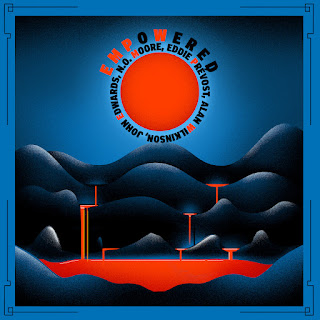
Experimental Ensemble with writer Iain Sinclair’s narrative performance. EMPoWered, a two-segment, 51-minute improvisation, is just as
powerful, and its title would be no less apt even if it weren’t emphasizing
the initials of bassist John Edwards, guitarist N.O. Moore, drummer Eddie
Prévost and alto and baritone saxophonist Alan Wilkinson. This is forceful
music, but it’s also music imbued with mysterious powers, suggesting at
times trance and shamanic possession. Wilkinson, an active member of the
English improvisation scene for about forty years, is a player of
tremendous force, particularly on baritone, an instrument that he wields
with singular ferocity. Wilkinson toured in 1996 in a quartet with Peter Brötzmann, an early influence; he’s among the
very few musicians who can match Brötzmann’s raw force and combines it with
an expansive sonic invention.
Part one, thirty minutes long covers much of the terrain of free
improvisation and close listening. The music opens subtly, Edwards bowing
glissandi with a cello\s lightness, a few bright flurries from Moore and Prévost randomly tapping his drums into a state
of alertness. When Wilkinson comes in on alto, it’s with deliberate
purpose, an intense repeat of several notes, pause, the same but lower,
then a compact, repeated, multiphonic blast. The group both rises to this
and presses forward, Moore finding his own squall as Edwards and Prévost
build an energized polyrhythmic ground. When Wilkinson re-enters, he brings
an intense alto free bop, which eventually breaks up into a field of almost
random group noises. It’s highly collective music that lives happily in a
state of flux, always moving, always changing. Prévost, strongly associated with AMM’s spacious
style of free improvisation, here reveals the other side of his art,
drumming in a driving, free jazz tradition with aplomb. N.O. Moore,
strongly associated with electronics, even plays a gentle tonal line of
classic modern jazz guitar in one of the quieter moments. Amidst these
developing gestures, Edwards comes very much to the fore, his articulate,
resonant lines providing a singular focus, moving readily from formative
lines to forceful insistence. The dialogue assumes a much harder edge as
Wilkinson begins to reveal the power of his baritone, at times generating
blasts that announce a forcefield to which every member of the group will
contribute. The force, though, is no more impressive than the pastoral, the
ruminant warmth of the baritone, the melodic precision of the shifting
exotic draperies of Moore’s guitar. There are even moments here that might
suggest far-fetched instances of West Coast jazz, something Jimmy Giuffre
and Jim Hall might have fabricated, before it suddenly rises to yet another
dimension of free jazz intensity, ultimately falling off into birdsong,
light baritone bleats and cymbal scrapes.
As achieved as the first part is, the 21-minute Part Two is the
more powerful, a transformative music filled with foreboding and the
possibility of revelation. What’s most memorable here, apart from the
force, is the extreme kinship revealed in the music. At some levels, free
improvisation is an invitation to spirits, and here it seems especially
strong, a séance in a battleground. Without a visual presence, the music
becomes even more mysterious. Towards the conclusion, there’s an intense
sustained high pitch sound, almost a squeal, that’s evidently passing
between Wilkinson’s alto and Moore’s guitar. There are sudden shifts in
density and volume, but at times the music becomes a variegated, moving
wall into which individual instrumental identities have blurred. This is no
mere studied effect, but a significant feature of the heightened mental
state of great free improvisation, a suspension of identity in sound, a
psychic group formation in which a kind of literal hive mind forms, parts
resembling one another in ways that might seem impossible among unalike
instruments, but which nonetheless occur.
This is very powerful music, but it’s also imbued with the kind of
subtlety that will reveal new life with repeated hearings. Collective
improvisation may be small audience music, but its significance can
resonate far beyond its performance spaces.
The wonderful thing about free improvisation is that musicians might
assemble in a traditional format and then proceed to do something that
seems unlike the tradition. Consider the tenor saxophone/ bass/ drums trio,
a format employed by Sonny Rollins (Live at the Village Vanguard
and Freedom Suite), John Coltrane (the quartet when McCoy Tyner
dropped out ‒ “Chasin’ the Trane” or “Impressions”) and Albert Ayler ( Spiritual Unity and Prophecy) on some of the most
memorable recordings of improvised music from 1958 to 1964, enough to make
the tenor trio a classic format, extending to different sides of the
tradition embodied in Joe Henderson’s Art of the Tenor or anything
you might care to cite by the Parker ‒ Guy ‒ Lytton trio.
We Met – and Then
might seem to break with the few commonalities of those recordings. While
Phillips and Solberg play “time,” it might seem far from the metrics
(swinging, polyrhythmic, implied) heard above. It’s time as grain, time as
suspension, time as interruption or corroboration of an infinite movement,
but then, time in any of those significant precedents is always complex,
multiple, not something to be checked for consistency but rather its own
plurality as well. The distinction may be the extent to which this music
reflects the slowness of the passage of time, the gradually emergent
equivalence of voices, the tone as drone, the harmonic as window, the
deconstructed and disintegrated line. Heard here consistently is an
expanding sense of the possibilities of individual voice and timbre,
including closeness, something continued here in that sense of harmonics as
transparencies. The line is a collective invention, individual sonic events
that are also, somehow, a conversation, a soundscape.
The first 34 minutes come from a 2019 Oslo performance. It’s the more
intense of the two contributing performances, especially in the long
opening title track, the three achieving mystery as well as confluence.
There’s a mimetic possibility here, a welcoming of birds, voles, other
creatures. In the sightless world of the CD, we’re returned (repeatedly) to
the art of the cave, the flickering of sound and the immediate call for
attention, whether identification or curiosity, caution or reward.
Solberg’s role is central here, often as the measure of space, but also
continuously turning his drum strokes into the narrowest of melodies,
insisting on the significance of inflected pitch shifts.
But then (that word itself the anticipation of the future in the
past), Phillips is that rare musician who spans creative generations (it’s
a gift to, of, from bassists, apparently, consider Reggie Workman as well,
and the special durability of Henry Grimes, Richard Davis and Cecil McBee)
Phillips a messenger from that past previously alluded to, sign of the
persistence of creativity (consider the recent solo recordings End to End
and Thirty Years in Between, the latter taped at Victoriaville, between the
two sets represented here) from recordings with Jimmy Giuffre and Archie
Shepp to now.
The final 20 minutes come from a 2018 Munich concert with more emphasis on
the group’s components than the totality. The initial “Travelling” is a
Phillips’ solo, the same kind of graceful, melodic resonant reflection
apparent on his solo discs, sounds sometimes swelling in volume as well as
meaning after they’re plucked. The duo of Butcher and Slavik is more
insistently ancient, ceremonial. The final piece, “We Met”, is, then, both
the conclusion of the CD program and the earliest trio piece heard here,
already meaningful, the three playing micro phrases, a pedal tone, a
glissando, a wisp of melody, finding their way into one another’s sounds,
processes and vocabularies, establishing identities and presences, all with
the sense of sacrifice and growth within the possibilities of the
encounter.
Cologne-based, Austrian pianist Philip Zoubek integrates many fascinating
sonic universes. You can find in his composed and free-improvised music
echoes of the chamber jazz of Jimmy Giuffre, the free jazz of John Coltrane
but also ideas coming from innovative, contemporary composers like John
Cage, Iannis Xenakis and Gérard Grisey. Here are a few recent releases of
the prolific Zoubek where he plays on the piano, prepared piano and
synthesizer.
The unique instrumentation of this free-improv trio - fellow, Cologne-based
tubist Carl Ludwig Hübsch also plays on various objects, Canadian,
Montreal-based Pierre-Yves Martel on the rarely-heard viola da gamba,
harmonica and pitch pipes and Zoubek on piano and synthesizer - defines its
mysterious, almost transparent sound. This trio is an anomalous
reconfiguration of chamber classicism but also suggests a patient,
minimalist and almost static aesthetic, expanding and transforming the
Morton Feldman-esque and AMM legacies. This trio began working in 2012 and
Ize is its fourth album, recorded at the Loft Club in Cologne in November
2018. Hübsch and Zoubek collaborated before in several projects and Hübsch
and Martel collaborated in another band Fleur de chaos, with Candian
vocalist Joane Hétu and synthesizer player Émilie Mouchous (HMMH, Ambiances
Magnétiques, 2019).
The five pieces emphasize that Hübsch, Martel and Zoubek are not only
resourceful and imaginative improvisers. Naturally, they excel in the fine
art of deep and sensitive listening, but all are well-versed in the art of
spontaneous and instant composition, while keeping a delicate balance and
organic fluidity. Together they create a mostly acoustic entity with
minimalist electronic layers, subtly incisive, with a poetic collective
entity, where the three musicians sound as extending each other’s palette
of sounds. The static oscillations of “Any'' introduce the minimalist,
reverberating aesthetics of this trio. The hypnotic vibrations of the dark
“Kolt” echo the innovative work of John Tilbury. Hübsch, Martel and Zoubek
turn their instruments to noisy, sonic objects on “Letik” and suggest an
enigmatic-cinematic drone on “Bard”. Only the last piece ‘Kult” attempts to
offer vivid contrasts between the dissonant, sparse piano chord of Zoubel
and the quiet deep tones of Hübsch and Martel. A fascinating masterpiece,
that is guaranteed to send you looking for more albums of these master
improvisers.
Zoubek plays the piano in a quartet with Berlin-based reed player Frank
Gratkowski (who teaches in a conservatory in Cologne, Zoubek and Gratkowski
also collaborate in the quintet Shift), and fellow, Cologne-based, double
bass player Robert Landfermann and drummer Dominik Mahnig (who also plays
in Zoubek's Trio). The quartet has performed sporadically since 2016 and its debut
album was recorded at the Loft club in Cologne in February 2020. This
quartet borrows guitarist-producer T-Bone Burnett’s description of string
theory to describe its art: “Beneath the subatomic particle level, there
are fibers that vibrate at different intensities. Different frequencies.
Like violin strings. The physicists say that the particles we are able to
see are the notes of the strings vibrating beneath them. If string theory
is correct, then music is not only the way our brains work, as the
neuroscientists have shown, but also, it is what we are made of, what
everything is made of. These are the stakes musicians are playing for”.
The interplay of this free-improv quartet is intense, even in its most
sparse and contemplative pieces, and stresses the strong-minded
personalities of Gratkowski, Zoubek, Landfermann and Mahnig. Gratkowski is
the natural leader of the quartet, even though all the pieces are credited
to the four musicians, and he often sets the uncompromising, energetic tone
and uncompromising course of the pieces. But Zoubek, Landfermann and Mahnig
are ready for this roller coaster challenge. Zoubek shines on “First
Echo'', where he takes the quartet into a series of poetic and lyrical
conversations. He balances Gratkowski’s furious and muscular energy with
elegant and playful gestures, especially on the last piece, the explosive
“Catalyst'' and the hidden, untitled piece, both demonstrate the strong,
vibrating fibers that connect this quartet.
Zoubek plays here in another free-improv trio with French guitarist and
electronics player Ivann Cruz, and Polish drummer and electronics player
Marcin Witkowski, recorded at La Malterie in Lille, France, in December
2017. Radium is a meeting of prepared piano, primed guitar and extended
drums, aimed at deconstructing the respective instruments in a search for
challenging electro-acoustic ambient textures and unstable harmonies.
Zoubek, Cruz and Witkowski are driven by the idea of building a meta
instrument, an egoless creative process to open up new sound worlds and to
explore uncharted musical territories.
Radium is the first opus of this trio, conceived after two years of working
together. The sounds of the prepared piano, the effects-laden guitar and
the prepared drums never cease to metamorphose or fade. Their inventive
sonic palettes collide, bang, crackle, resonate and intertwine to seek a
counterpoint of strings, skins and electronic sounds from which enigmatic
harmonic landscapes and weird sounds and noises emerge. Each piece explores
a distinct soundworld, moving from the rhythmic and suggestive to the
atmospheric, from the urgent and energetic to the intriguing, symphonic
drones, and from the sparse and the minimalist to the noisy and intense,
mainly on the dark, sci-fi textures of “Tungsten” and “Lithium”. Then the
piano, guitar and drum-set soar and lose their original syntax and
vocabulary in favor of a new, brave one.
Christian Lorenzen / Philip Zoubek - Scales (Self Produced, 2020) ***½
Zoubek collaborates here with fellow Cologne-based pianist Christian Lorenzen in a concert at the Loft in Cologne in May 2020 as part of piano duo series curated by Zoubek. Zoubek plays the piano and analog synth. Lorenzen plays a prepared piano connected with a modular synth, an electro-acoustic setup with contact loudspeakers that channeled the electronic sounds into Lorenzen’s acoustic grand piano. The album is released on Zoubek’s Bandcamp page. The two extended pieces, “57 Feet” and “247 Ohm”, are mysterious, carefully layered soundscapes of elusive percussive sounds, gentle ripples of acoustic piano alien, eerie sounds and subtle, noisy feedback loops. Surprisingly, this kind of highly nuanced but weird sounds blends organically.
Philip Zoubek - Vortex (WhyPlayJazz, 2020) ****
Zoubek plays on his solo album Vortex the prepared piano. He composed all
pieces and recorded this album in December 2018 at the Loft club. This is
the second solo album of Zoubek playing the prepared piano, following Air
(WhyPlayJazz, 2014). The sonic palette of the prepared piano is manipulated
with wooden objects, e-bows, rubber, and a variety of plastic and metal
screws and transforms the acoustic piano into an exotic, futurist orchestra
of fascinating, precisely layered sounds.
Zoubek’s prepared piano explores the full resonating characteristics of the
keyboard, strings and wooden body and corresponds with far and traditional
music legacies. Zoubek creates a vortex of cyclical-hypnotic soundscapes
with a great sense of focus, coherence, and percussive force. Zoubek
patiently exposes more percussive layers of the piano that becomes an
abstract sound generator, and later finds more playful nuances throughout
the percussive qualities of the prepared piano. There is also an enigmatic
texture in Vortex, suggesting an ancient, meditative, ritual, and another
texture that alternates between hymn-like segments and highly emotional
elements. The last one travels to faraway, industrial galaxies.
Philip Zoubek Trio - Nonplaces (WhyPlayJazz, 2020) ****½
The sophomore album of Zoubek trio - Zoubek on piano and synthesizer,
double bass player David Helm and drummer Dominik Mahnig, was recorded in
December 2019. This trio experiments with new dynamics in the classic
format of the piano trio. Often these dynamics may sound at first listening
as diving into deep chaos, with its extreme, emotive twists and turns, but
this trio executes its radical and complex vision with precision and clear
joy, as well as constructive spontaneity.
Philip Zoubek envisioned Nonplaces as poetic, imaginary places that do not
yet fit into the usual categories, or as a strange dream. The trio
alternates between intense dynamics, and never settles on familiar
narratives but maintains a coherent dramaturgy in which improvisation and
composition exquisitely separate and combine. Zoubek, Helm and Mahnig sound
as colliding with each other with fierce energy on the opening “Alarms” and
the last piece, “Alarms Postlude”; searching for sparse yet mysterious
sonic territories on “Mirrors”; deconstructing and re-construction the
pulse on “Memento” and “Kran”; sketching balanced beauty on the ballads
“Silver”, “Those” and “The Other Life”; enjoying a fast, comic interplay on
“Gorilla” and “Mind at Play”, and always sounding fresh, restless and eager
to expand its sonic envelope.
Brilliant.
TAU5 - Kreise (Fun in the Church, 2020) ***½
TAU5 is the Berlin-based electro-acoustic quintet. Zoubek focuses here on
the synthesizer and plays with sax player Philip Gropper (who leads the
PHILM quartet), bassist Petter Eldh (of Koma Saxo and Punkt.Vrt.Plastik),
drummer Moritz Baumgärtner and electronics player-producer Ludwig
Wandinger, who edited and mixed the original improvisations of Zoubek,
Gropper, Eldh and Baumgärtner, conducted in 2015 and 2017. The reliance on
electronic, manipulated and processed sounds and shifting, rhythmic
patterns sends this band far away from the legacy of modern or free jazz
bands, even the ones that have integrated electric instruments into their
aesthetics, into the territories of prog-space-rock, post-rock, noise and
even hip-hop and IDM territories. The focus here is not on composing
melodies or clear narratives but on the elastic and transformative
qualities of all sounds and how these sounds can be deconstructed and
reconstructed into an uncompromising amalgam of new, weird sounds and
complex and irregular rhythms. Or as TAU5 articulates its mission: “We send
our blindfold signals / to a listener in dim Andromeda / We send out our
folded signals / to the listener in all Andromeda / hoping for dreading
response /Alpha rhythms delta rhythms / dark transmissions old as a
sandstorm / wild as pop / beetween the communiques / another sleep-form new
invented / toparies upwards outwards”.