We've reviewed many trumpet-bass-drums trios over the years. Here's a new update on some recent material with this line-up. Styles are completely different, yet all of high quality within their subgenre. Interestingly enough, three of the trios presented here are initiated or led by bassists: John Edwards, Joe Morris and Linda May Han Oh.
John Edwards, Luis Vicente, Vasco Trilla - Choreography Of Fractures (Fundacja Słuchaj, 2025)
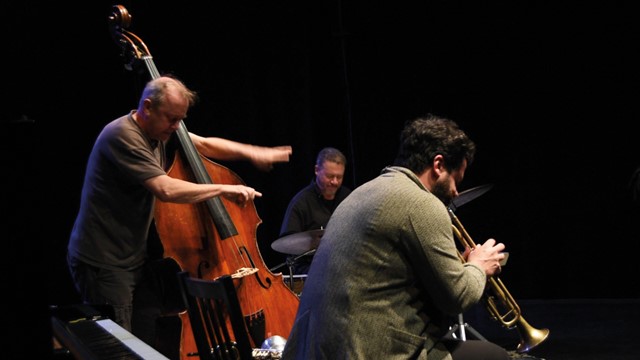
"Choreography Of Fractures" is my personal favourite in this list. It's a trio of British bassist John Edwards, Portuguese trumpet player Luis Vicente and Spanish percussionist Vasco Trilla. Their sound is totally open-ended and improvised. The overall tone set by the trumpet is one of melancholy and deep sadness. Vicente’s playing stretches into sensitive, resonant depths, while Edwards and Trilla intensify the sense of desolation through delicate accents and scattered sonic details that form a fractured world struggling to unify.
Vicente and Trilla have released several albums before, either in duets "A Brighter Side of Darkness", "Made of Mist", or in larger ensembles "L3" with Yedo Gibson on sax, or "Live At 1st Spontaneous Music Festival", on "Muracik", "Dog Star", "Chaos And Confucius", "Gravelshard", and I've probably missed a few. The collaboration with Edwards is a winning situation. The music remains wholly unpredictable; even within its sensitivity, it can become harsh and ferocious without growing louder, relying instead on sheer expressive force. Edwards delivers remarkable tone and presence, both in plucked passages and bowed ones. Its relentless intensity is phenomenal.
This is surely one for my end-of-year-list. I'll share also a video below of a performance by the trio. I'm hesitating to share it because the album is even better.
Joe Morris, Tyshawn Sorey , Peter Evans - Comprehensive (Fundacja Słuchaj, 2025)
"Comprehensive" is presented by Joe Morris on bass, Tyshawn Sorey on drums and Peter Evans on trumpet and piccolo trumpet. It is equally outstanding and highly recommended. None of the three musicians need an introduction. Morris and Sorey have performed together before in various bands, Sorey and Evans did on Ingrid Laubrock's "Serpentines". I'm not aware of Morris and Evans collaborating before, yet the interaction works well.
The trio offers four expansive, fully improvised pieces—fascinating, kaleidoscopic sonic visions. The music moves with complete openness, shifting effortlessly from subdued, muted textures to playful staccato exchanges, often in an instant. Evans’ remarkable range and timbral acrobatics are nothing short of spectacular, sparking genuine delight (at least for this listener), yet always remaining fully integrated within the group sound. Morris and Sorey inhabit this terrain with equal assurance, showcasing not only their deep listening but, above all, their creativity in shaping a coherent and intensely engaging musical experience.
The music was recorded on January 30, 2025 at The Bunker in Brooklyn
Russ Johnson, Christian Weber & Dieter Ulrich - To Walk On Eggshells (ezz-thetics, 2025)
This trio is less adventurous yet highy enjoyable. Russ Johnson is on trumpet, Christian Weber on double bass and Dieter Ulrich on drums.
The three musicians are in great shape, as are their boppish tunes and improvisations. The nine tracks are almost equally composed by each band member, showing the total lack of hierarchy in this ensemble. It is fun, upbeat, joyous, energetic and infectious, and alternated with some sad pieces, such as "For A.R" - presumably a tribute to Aderhard Roidinger, an Austrian bassist and graphic designer, and one-time teacher of Christian Weber - and the beautifully old-fashioned and bluesy "Confession".
The recording already dates from December 2009, recorded in a studio in Zürich, but it gets its release only now. Like his "Live At The Hungry Brain" released last year, yet also recorded in 2018, it takes some time before Johnson's trumpet trios get released. Let's hope we do not have to wait that long for the next one.
It's a studio album, and this is music that will only come fully to its right when listened to in a live setting. The recording quality is excellent, as is the playing.
Linda May Han Oh, Ambrose Akinmusire & Tyshawn Sorey - Strange Heavens (Biophilia Records, 2025)
One more trumpet trio album with Tyshawn Sorey on drums, but now with Linda May Han Oh on electric and acoustic bass and Ambrose Akinmusire on trumpet. The drummer and bassist have also collaborated on Vijay Iyer's "Uneasy" and "Compassion".
Akinmusire was member of the trio on Linda Oh's debut album "Entry" from 2008. Sorey and Akinmusire collaborated on John Escreet's "Consequences".
On this album they are in superb form. All the pieces are composed by Linda Oh, with the exception of "Skin" by Geri Allen and "Just Waiting" by Melba Liston.
The title refers to the saying that human beings tend to choose a familiar hell over a strange heaven. Oh explains: "We all experience how easy it is to be lulled into the comfort of something that may actually be quite negative and detrimental to our well-being. We see that often in our daily lives, but I also see it in politics and in grander aspects of humanity.”
All compositions come with a background story or specific inspiration or tribute: "“Living Proof” draws from inspirational stories of self-improvement, in particular that of her own mother. “Acapella” is a reflection on Joni Mitchell’s “The Fiddle and the Drum". “Home,” “Paperbirds,” “Folk Song” and “Working” are elements in an informal suite, inspired by images from Australian author Shaun Tan’s wordless graphic novel "The Arrival".
The music itself is first-rate, more boppish than free, yet the real delight lies in hearing three remarkable musicians giving everything they have. Akinmusire’s radiant tone and stylistic range make every trumpet line a pleasure. Oh’s bass work shines throughout—anchoring the music, steering the compositions, and delivering solos of real character. Her choice of a chordless trio opens the space beautifully, giving her instrument greater presence and allowing the narrative of her music to emerge with striking clarity. Sorey, predictably superb, continues to show why he’s in such high demand, contributing yet another stellar performance to an already prolific couple of years.
And now for something completely different. Or not. The trio of Royal Flux brings an interesting inter-stylistic or eclectic combination of improvised music with a "nu jazz" sound and funky rhythms. The trio are Sarah Kramer on trumpet, flugelhorn, effects, percussion and sounds, voice, Joe Berardi on drums, percussion, electronics and sounds, and Jorge Calderón on bass and percussion.
Kramer released her debut album, "Home", in 2013 and was mostly active as a session musician, and probably best know from the trumpet part in Leonard Cohen's "Dear Heather". The rhythm section is also relatively new to me, with little references of other output.
Listeners drawn to Nils Petter Molvær or late-period Miles Davis may take to this album. It doesn’t strive for grand artistic statements; it’s simply fun. The sound may come across as somewhat synthetic—perhaps too tidy or programmatic for this blog’s usual tastes—but its cool vibe and infectious energy make it worth your attention.
Some will say that a cornet is not a trumpet, but we do not go into too much semantics here and add this great trio too, with Kirk Knuffke on cornet, Stomu Takeishi on bass, and Bill Goodwin on drums.
As we've heard on previous work by Knuffke, he loves that jazz and musical tradition of the United States, especially the deeply emotional and rhythmic bluesy sound of the south. On the thirteen relatively short tracks - all between 3 to 5 minutes - he brings easy to memorize tunes and themes that are often infectious. Knuffke's vision is that he's "concerned with making beautiful music. Even when the music is free and avant-garde, I want it to reach into people’s hearts".
On some tracks, Knuffke sings, in a bluesy baritone voice, something he's done before on other albums, and it works well to provide some variety to the music. Variety is also brought by the three "Gong Suites", freely improvised pieces that are sprinkled among the other tracks, minimal and percussion-driven.
Bill Goodwin also recites "A Divine Image", a William Blake poem.
A Divine Image
Cruelty has a Human Heart
And Jealousy a Human Face
Terror the Human Form Divine
And Secrecy, the Human Dress
The Human Dress, is forged Iron
The Human Form, a fiery Forge.
The Human Face, a Furnace seal'd
The Human Heart, its hungry Gorge.
This is music without pretence, with the only ambition to develop high quality music that listeners enjoy.
"Ohrenschmaus" is a German word that means "something that sounds very nice and pleasant, and that makes you happy", or liberally translated as "ear candy" or "a feast for the ears".
"Flip Side" is the second album of one of Canadian trumpeter Lina Allemano's several ensembles, next to the Lina Allemano Four, Titanium Riot, and Bloop. The artist is moving regularly between Toronto and Berlin, and this is her "Berlin ensemble", with - next to herself - Norwegian Dan Peter Sundland on electric bass, and German Michael Griener on drums. The wonderul Andrea Parkins joins on three tracks on accordion, objects & electronics.
The result is a real treat for the ears. The trio and quartet move in the dreamlike zone between compositions and improvisation, between thematic lines and total freedom. All pieces have a clear thematic focus and core, and the musicians make their sounds weave organic tapestries around them.
The tracks are called "Sidetrack", "Signal", "Heartstrings", "Sideswipe", "Stricken", "The Line", and "Sidespin". They are of medium length, clocking between four and six minutes each, little miniatures each with its own character and sound. Some are a little 'messy' on purpose, especially with Parkins' electronics thrown into the mix, yet it works really well. The titles suggest this being a little bit "off mark", not really on the target but close enough, while at the same time expressing the emotional and stylistic power of the music. The lead voice is of course the trumpet, and Allemano's mastership on the instrument is remarkable, from pure classical tones to emotional jazzy phrases and explorative try-outs. Yet the whole band is excellent. It's remarkable how close Sundland and Griener are to Allemano's musical concepts. And if only on three tracks - well balanced on the first, the middle track and the last - Andrea Parkins adds the right amount of additional unconventional sounds to the whole. Some pieces are weird, such as "Sidespin", and others, such as "Stricken" present us with a beautiful bluesy ballad. It's all a pleasure for the mind, for the heart and for the ears: risky, recalcitrant, smart and coherent. It's a treat from beginning to end.
Some albums have a sound that catches your attention, then sucks you in, and you cannot let go until you get to the very end, paralysed by the experience, stupefied by the experience, ecstatic by the experience. The original intention of our "Happy New Ears Award", was not to select the best album, but rather the one that gave a totally new and unexpected listening experience, offering some new creative ways to use sound to tell something unheard of, with a totally new voice, presenting new feelings and concepts and possibilities.
The trio her is led by Gonçalo Almeida who penned all the compositions, and playing double bass and electronics, with Susana Santos Silva on trumpet and Gustavo Costa on percussion.
All the tracks are called "restraint" and numbered in sequence. The sound is full, with bass, trumpet and percussion moving together through the minimalist compositions. The "restraint" is that the tree instruments work around a core sound, without moving too far its center, resulting in a shimmering universe that is intense, dark, ominous, unexpected yet also compelling and appealing.
On the first track, the sounds of the bowed bass and trumpet are stretched, extended, like an endless wave, with Costa's percussion on bells gives a steady and hypnotic rhythm. The wave stops are regular intervals into absolute silence, only to start again.
The second track gives a different context, as a collage of sonic bits coming from the three instruments, desparately seeking to find a common voice and interaction. The trialogue remains one of hesitation, quiet approaches, like three people speaking in sentences that never finish, again and again, full of surprise and willingness but failing. Yet the "Restraint III" brings release, continuing the end sound of the second piece to give single tone linearity, with again limitless extended notes from trumpet and bass. The pitch increases, and a kind of minimal melody emerges, slow and gentle, with rumbling drums and incredibly controlled bass and trumpet, the latter creating deep moans, and ending with the bowed bass drawing everything to a deep and dark closing.
The final piece recuperates the sound of the first track, the full sound of bowed bass and trumpet, the hypnotic and mesmerising little bells providing a maddening rhythm, now duplicated by the electronics giving a circular fast wave movement to the sound. It's also a finale in the sense that many other aspects of the other tracks also seem integrated. It is spellbinding, moving, impressive.
This is Gonçalo Almeida's success, his ideas, his creativity, his compositions, his musicianship, yet the end result of course could not have been possible by the brilliant contributions of Susana Santos Silva and Gustavo Costa. All three are excelllent, and the restraint, the control and the discipline and the mastery they have over the sounds they produce is fabulous.
Even if the drone-like and minimalist music sound dark in essence, I have been full of joy each of the zillion times I listened to it, just of its incredible power.
This is the sophomore album of the Luis Vicente Trio, after their 2021 release "Chanting In The Name Of", with Luís Vicente on trumpet, bells, whistle and mbira, Gonçalo Almeida on double bass, and Pedro Melo Alves drums, percussion and objects.
It's again a treat from beginning to end, music with deep roots in jazz tradition and even much older folk music, but with a totally modern openness to the world, full of brightness, joy and heartfelt emotion.
All compositions are penned by Vicente, with the exception of the Brazilian traditional "Mandei Caiar O Meu Sobrado", a song that exemplifies the communal power of not only connecting the musicians to each other, but including the audience as well. It strikes a direct emotional bond, reaching out to what we all feel, the sadness, the comfort, the joy of being part of something bigger.
And then there's the beauty of the musical freedom: the intensity of three musicians who interact with solid experience of when to emphasise, when to change, when to take a step back ... it all comes so natural and organic, fascinating in its technical quality and openness.
The title track is a wonderful uptempo and powerful song full of rhythmic dynamics supporting a jubilatory mood, and with a superb role for the drums. On "Why No Is No" they unleash their demons in a very Ornette Coleman type structure, with an anchor theme allowing for some wild and powerful group dynamics. "Nascente" is more gentle, led by Almeida's deep bass sounds, reinforced by the precise percussion of Melo Alves, and the melancholy trumpet joins for closure.
The most amazing track is the long "Penumbra" that ends the album, and which navigates between an expressive trumpet against a background of an ominous marching rhythm: it expresses pain, anger, distress, sadness and the subtle nuances in between for which no words exist, offering us a song of pure beauty.
Eddie Prévost no longer needs any introduction. As one of the founding members of AMM he has shaped and participated in the long development of free improvisation, with impact on music and musicians worldwide. He is here in the company of Tom Wheatley on bass and Silvan Schmid on trumpet.
Wheatley has been active in Tennota, a band that explores the boundaries and possibilities of old and new forms, of acoustic and electronic music, of physical and digital sounds, and with which Swiss trumpeter Silvan Schmid also at some time participated in. Schmid only has three albums released so far, including this one, so his name did not immediately ring a bell, but he was the curator of the Taktlos Festival last year.
As can be expected, this is in-the-moment music, at any time full of future possibilities, full of intensity, openness and unexpected next moves, like chess-players who decided to smartly engage for the fun of moving without any ambition to win. Schmid has a natural deep and warm tone in his playing, relatively accessible in his phrasing (relatively!), and Prévost at all times colours the total sound by incredible sophisticated drumming. Wheatley is often the one holding the sound together with his deep bowed bass sounds. The title tracks of the three pieces are almost programmatic: "Clearing The Detritus Of Time", "The Parsing Of Sounds" and "Remembering To Forget". Creativity requires a freshness that cannot be burdened by concepts of the past. Every note and its relationship to any other sound is thus fresh, full of surprise and potential.
The album was recorded at All Hallows Church, High Laver, Essex, on 3rd April 2023, and the sound quality is absolutely excellent, as if you were sitting next to them.
Sixty-five minutes of musical joy and creative craftmanship.
We praised "Remedy", an album by Thomas Heberer on trumpet, Joe Fonda on bass and Joe Hertenstein on drums for its wonderful combination of deep-rooted jazz genes and modern day abstract freedom. The album got a lot of positive response, not only by us, which led to a grant from the German Music Fund to create and publish their sophomore album, which was recorded in 2022.
As a band of equals, all three musicians penned two or three pieces, spread in alternation across the album. The compositions - structural and thematic agreements - are of cours the backbone for the groups improvisations, solos and common interaction. Like on the fist album, this is an album of enjoyment, for the players as well as for the listeners. A tribute is made to Mark Whitecage, the former saxophonist of the Nu Band.
The nature of the music is the same as the debut album, and even if the boppish nature of the music is still very present, the explorative nature is even stronger than on their first one, even with their very straight approach of keeping the basic sounds of their instruments unaltered.
I'm not sure what the title actually stands for, but I can imagine that 'remedy' could be interpreted as a kind of mental boost or musical encouragement during the lockdown of the Covid years. Even if the pandemic is over now, the quality of the music, the joy of the performance, the wonderful example of what people can achieve when creating together, are still a strong 'remedy' to stay positive in life. And of course the big part of the joy is the incredible musicianship of the three artists, their listening skills and the deep emotional power that their music radiates.
I hope the German music fund has some money left for a third installment.
In the meantime, I'm sure you will enjoy this one.
This is the tenth album by master trumpeter Russ Johnson as a leader, next to appearances on more than a hundred albums. The latter fact demonstrates that he is very sought after and able to perform in various contexts and styles. He is classically trained which you can hear not only from the purity of his tone, but also from some of his phrasings when improvising. I came to know his music and playng in the beginning of this century when I discovered in my local music library the New York modern jazz scene with musicians such as Michael Blake, Jenny Scheinman, Ohad Talmor and bands such as The Other Quartet, Roy Nathanson, Touch Acoustra, all with Johnson on trumpet.
On this album as a leader, he is in the company of Tim Daisy on drums and Max Johnson on double bass, also two musicians with brilliant mastery of their instruments. The trio presents us with two long collectively improvised pieces, with a quality, intensity and inventiveness that you wish they did more often, and with a sense of freedom that we have seldom heard the trumpeter perform in.
All three musicians have their share of the creation, with strong moments for the percussion and bass too, seperately or collectively. They move us to different moods and dynamics, with very nervous and jazzy agitation to quiet almost modern classical music, especially in the last half of the second improvisation, when Max Johnson switches to bowed bass, and Russ Johnson's crystal clear tone weaves wonderful meditative phrases, subtly accentuated by Daisy's precise percussion. They lead us to two long soundscapes with many different ideas and pieces without losing the coherence of the overall sound
The performance was recorded live in the Fall of 2018 at the Hungry Brain, Chicago.
I think Russ Johnson and this trio deserve wider attention. It's such a treat to hear them play.
The late Roy Campbell has always been one of my favourite trumpet players: soulful, free, creative, and most bands in which he performed offered music of exceptional and boundary-breaking quality. I'm a big fan of all "Other Dimensions in Music" albums, of the "Nu Band", and also of his collaborations with Jemeel Moondoc, Ehran Elisha, Matthew Shipp, William Hooker, William Parker, and many more. But he also had his own ensembles, including some trio albums, of which the Pyramid Trio is the most formal band, with William Parker on bass, and Zen Matsuura on drums, except on their first album "Communion" (1994) on which Reggie Nicholson plays the kit. The other two albums are "Ancestral Homeland" (1998) and "Ethnic Stew And Brew" (2001), and all three albums are easy to recommend.
It's again an incredible treat to have this even older recording suddenly available, with a great thanks to the NoBusiness label for having released it again. The album gives a performance recorded on the 21 February 1985 at The Joint, Usdan Student Center, Brandeis University, Waltham, MA, and has actually been circulating for many years as a bootleg that was aired on WBR FM community radio. Now that it's official, it will hopefully get better visibility to even a broader audience. Because of the radio performance, the recording quality is absolutely excellent, and thus far from the usual bootleg material. Roy Campbell passed away on January 9, 2014, and that's almost ten years ago, which is hard to believe. Zen Matsuura passed away on September 19, 2015. This makes this album even more valuable.
Campbell's music is strongly rooted in free bop, with great and jubilant themes setting the scene for long improvisations, coming again to a closing with the themes. Campbell says about his own music in an interview: "I don’t write any one particular style. I incorporate whatever I’m feeling or whatever I hear from wherever the music’s coming through from and just put something together.”
Everything between the beginning and the end is open for improvised parts by all three musicians, and preferably all together. Four of the five tracks will become material on later albums by Campbell: "Charmaine" on 'La Tierra Del Fuego" (1994), "Imhotep" on "Ethnic Stew & Brew" (2001), "Vigilance" on "Communion (1994), and "Brother Yusef" on 'Ancestral Homelands" (1998). Only the last track, equally with an infectious theme, is less easy to identify, even if it sounds familiar (I've racked my brain and memory over this, listening to many albums again, and even used Shazam, but to no avail).
In any case, this is a great and fun album. There a few minor weaknesses, such as at times the transition from improvisation back to the core theme, and I must say that at times Matsuura could have been a little more subtle, but that's a purely personal appreciation.
Campbell also shares this reflection on his music: "The rule in the inner circle of musicians is that the visitation of spirits always supersedes music theory. The players, if open to this agenda, can form a relationship with their higher self. The only concept is love and compassion for all human beings. All great musicians follow the spirit to tap into the unknown without trying to own it."
To his credit, all his music is deeply soulful, uplifting and moving. This album is no different.
"All great musicians follow the spirit to tap into the unknown without trying to own it."
This is the third album by the trio of Wojciech Jachna on trumpet and cornet, Jacek Mazurkiewicz on double bass and electronics, and Jacek Buhl on drums and percussion. Somehow we got it too late for our recent "Trumpet Trios" update, which allows us to give it some more dedicated attention.
The trio's music is adventurous and welcoming at the same time. Even if fully improvised, some forms emerge, possibly due to the long-standing collaboration of the trio, and possibly snippets of sound that remain from long rehearsals and collaborations. Jachna's tone is warm and clear, and Mazurkiewicz electronics add a distinct colouring to the sound without being too obtrusive, although I prefer his work on the double bass. Buhl's percussion work is loose, supple and inventive. Some pieces, such as the third one - "O" - start with a clear and recognisable theme that quickly dissolves into further improvisation.
The single letters that are used as the titles of the five tracks of the album form the word "emotions" when read in sequence, an indication of what their music is all about.
In the liner notes, Jacek Mazurkiewicz explains that the band had more material that they recorded over the years, but they threw it away because they were not too satisfied with it. They went back into the studio for two days with this album as the result.
As listeners we can only appreciate their sense of self-criticism, which obviously also increased the quality of the album itself.
Fans of small ensembles with trumpet, bass and drums will surely fully appreciate this album.
Trumpet trios are less rare than we assume. Here's an update, a completist's list, because these are the albums that we received/bought in the past months that comply with the broad definition of a trumpet trio: a horn with rhythm section, usually a double bass and a drums.
We do not go into much detail, but just try to point the reader in the right direction in terms of musical taste. Not all albums would be high on my list, but I will rank them in order of my personal preference.
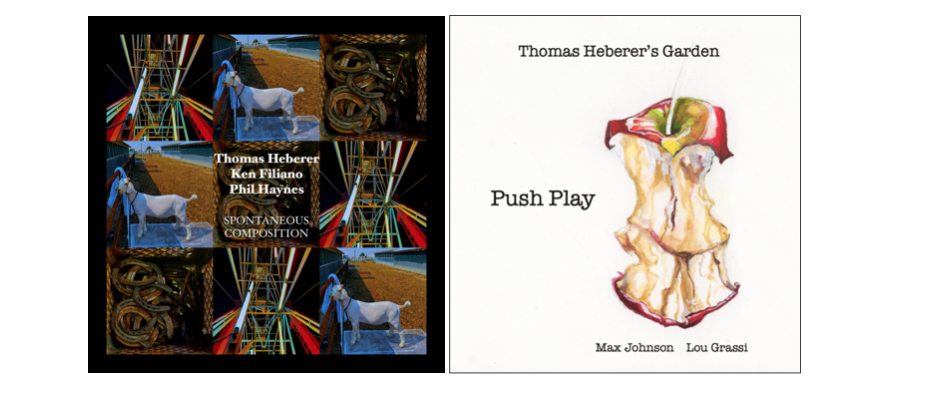
Thomas Heberer, Ken Filiano & Phil Haynes - Spontaneous Composition (Self-Released, 2022) & Thomas Heberer's Garden, Max Johnson, Lou Grassi – Push Play (CIMP, 2022)
The best of the list are two trios with Thomas Heberer on the horn. Two very different albums in nature yet both easy to recommend. The first one is called "Spontaneous Composition" with Ken Filiano on double bass and Phil Haynes on drums. The music was recorded in September last year and released a month later. As its title suggest, the five tracks of the album are entirely improvised. All three musicians play equal roles, and sometimes with a strong lead from Filiano on bass, who comes with the drive and the ideas for the improvisations. Heberer's improvisations are so strong and lyrical that you wonder why he ever wants to compose. It all comes naturally to him, especially in the company of this extraordinary creative rhythm section. The precision and skills of the three musicians are in stark contrast to the music's direct and unpolished authenticity, a wonderful paradox that makes the overall result even stronger.
The second album - "Push Play" - has a more composed nature with Heberer clearly holding the pen to some of the tracks, and with Max Johnson and Lou Grassi on bass and drums respectively. The recording already dates from 2013, performed in the famous "spirit room" of the CIMP label. The music is intense, and the themes often nothing more than scene setters. The sound quality is excellent, with a great balance between the instruments. One of the tracks is a tribute to Mongezi Feza, the great South African trumpeter.
It is hard to say which of both albums I would prefer, so I recommend that you look for both of them, even if the CIMP one may be a little more difficult to find.
Listen to "Spontaneous Composition" and download from Bandcamp.
Trumpeter Vance Provey appears on just a few albums, in the Leap Of Faith Ensemble", in "Turbulence" and the "Gunther Hampel New York Ochestra". On this recording from 1983, we find him in the presence of With Dickey on drums, and Spin Dunbar on bass, whose musical output is limited to this album, and who is now a stained glass artist in New Mexico. Both Provey and Dunbar worked with Bill Dixon at Bennington College.
I am not sure where this album suddenly appears from, or why this studio recording from 40 years ago was suddenly dug up, yet it's a great album, straightforward free jazz improvisation, with great band dynamics and Provey constantly taking the lead voice, a voice which is full, warm and lyrical, somehow wonderfully contrasting with the nervous bass of Dunbar. Dickey's drumkit is somehow a little bit lost in the overall sound, somewhere a little too much in the background.
The late Japanese trumpeter Toshinori Kondo fits in a musical space all his own, performing on his electric instrument, creating atmospheric soundscapes that mix new age slow spaciousness and high reverb with raw electronic distortions and elements of free improvisation. Here he is in the company of Massimo Pupillo on electric bass and electronics, and Tony Buck on drums and percussion. His sound is not really my cup of tea, yet fans will appreciate that the label makes this music still available.
Peachfuzz is a Portuguese trio with João Almeida on trumpet, Norberto Lobo on electric guitar and João Lopes Pereira on drums. Their music is a great mixture of styles (a little funk, contemplative moments, a little skronk, and just free jazz), and luckily they don't take themselves too seriously, as the track titles already suggest: "Peaches Brew", "Maria João Peach", "Peachinguinha" and "Peachhiker's Guide To The Galaxy". The trio leave each other lots of space to develop each musician's ideas, and somehow it all gells well.
Zack Lober is a Canadian bassist, here in the presence of Suzan Veneman on trumpet and Sun-Mi Hong on drums. Lober, Veneman and Hong are all based in the Netherlands.
Their trio performances are more post-boppish modern jazz than free improvisation, yet the quality of their playing is so good that it's worth sharing. All three are not only excellent instrumentalists, but they also share a great sense of lyricism and ensemble playing. The music itself stays too much within its own comfort zone to my liking, and is insufficiently challenging to my ears, but that was also clearly not their intention either.
The French trio of Quentin Ghomari on trumpet, Yoni Zelnik on double bass, and Antoine Paganotti on drums is easy to recommend for fans of modern jazz. The technical skills are excellent. Ghomari has been the trumpeter in French bands such as Ping Machine and Papanosh. The music of the trio is deeply rooted in the jazz of the sixties, but with a very modern attitude to compositional structure, including the occasional increase of power, even if the boundaries and patterns in the music remain relatively stable throughout.
You can listen to the entire album on Youtube and other digital channels.
Derby Derby - Macadam (Ormo Records, 2022)
The trio are Alan Regardin on trumpet, Sylvain Didou on bass, and Fabrice Lhoutellier on drums. The beat is more rock than jazz, the starts with one long stretched slightly shifting sonic drone supported by repetitive drum beats, creating a hypnotic psychedelic sound. It lasts eighteen minutes. The second track starts with a basic rock drum beat, again endlessly repeated, over which the now a little more discernable trumpet starts weaving ephemeral sounds. This lasts nine minutes. And that's it.
“The album is a dedication to the world of birds, to the creatures of the
world and their migrations.” With this statement from Three Tsuru Origami's liner notes, Mitelli (trumpet, soprano
sax, electronics, voice) fixes the ideal coordinates of his work with John
Edwards (double bass) and Mark Sanders (drums, objects).
The word “migration” in a broad sense seems to be the key to this work,
migration as a display of great energy, everyday courage; migration as the
artist’s sound: an “alien sound that comes in peace to find its own space
(…) and, like everything that is different, is greeted with suspicion (…).
Inspiration and the creative act come from afar(…) they have to go through
a long process of migration and integration” (from Mitelli’s cover notes).
Birds like symbols: The Eagle and the Hawk - Go Godwit Go - Three Tsuru
Origami - The Indian Geese and Himalaya - Green Lake, Black Bird - their
stories give shape to the sound of the trio and open a different point of
view (The stories behind each of these titles can be found in the cover
notes).
photo by Giubracalia
Those are the thoughts that make up the framework in which music plays, and
music is played with intensity and commitment.
The record opens with “The New One” a piece by Sean Bergin, he himself a
migrant, one of the expatriates on South African jazz scene during the
apartheid. It is a classical free piece reminiscent of the lesson of Don
Cherry and Ornette Coleman in which the three musicians exhibit their
carefully carved intersections.
The second track, “The Eagle and The Hawk,” shows the other side of the trio,
electroacoustic noises and a double bass that extends its sonority in the
lower level of the mix.
Now the coordinates are set and the rest of the record moves between these
extremes with feathery freedom.
The third piece, “Go Godwit Go,” is dedicated to the bird which can be
taken as symbol of the idea of migration itself: The Godwit (Limosa
lapponica) every year migrates from Alaska to Australia and New Zeland with
a ten days nonstop flight.
The music starts from sparse noises on free bass and drum lines then the
trumpet emerges to build a fragmented melody, which seems to translate the
godwit bird song into a sonic memory.
“Fly Away” is marked by a beautiful bass solo and all of the other pieces
confirm the perfect interplay that the three musicians have developed
gifting us with a music that is always on the edge, with a sense of balance
between sound and silence, melody and noise (Three Tsuru Origami). My
favourite piece, “The Indian Geese and Himalaya”, displays at his best the
sound of three talented musicians intensely conversing and listening to
each other.
The final “Ritual part 3” is a rendition of a Composition by Mariam
Wallentin, Mats Gustafsson, Johan Berthling, Andreas Werliin, a beautiful
piece that concludes a work that is absolutely worth listening and makes me
hope that the three of them will re-join in the future for another flight
together.
This year marks Wadada Leo Smith’s 80th birthday. It is also the year
that master-percussionist Milford Graves’ died, just short of his own
80th birthday.
Beyond just this coincidence of birth-year, it is fitting that these
two figures would team up on Sacred Ceremonies. Despite emerging out of
different scenes and cities (Smith, an early participant in Chicago’s
sharply abstract AACM collective and Graves finding his voice in New
York’s jazz-oriented free music circles), both have since become
legends in the free jazz world and have unapologetically and
undauntingly pursued their own avenues of creative expression. Both,
moreover, came into their own as part of a generation that struggled to
get this type of music recognized as the high art that it is. On Sacred
Ceremonies, they are joined by downtown bass and production guru Bill
Laswell, who, at a sprightly 66, represents the subsequent generation,
which took over after the loft scene dissipated and pushed the music
further from the acoustic realms of Smith and Graves’ early days into
darker electronic, dub- and rock-inflected soundworlds still
influencing the free jazz experimentalism of today.
Rather than diving further into the biographies and discographies of
these figures myself, however, I will leave that to the booklet that
accompanies this set. Instead, let us move directly to the music.
Sacred Ceremonies is a three-disc collection of Smith duos with Graves
(Disc 1) and Laswell (Disc 2) and a trio session with all three
musicians (Disc 3). Along with the three-disc solo set Trumpet, it is
the first of a projected six albums Smith will release through TUM this
year in celebration of his 80 years (and counting!) on earth.
Disc 1: Wadada Leo Smith & Milford Graves
I have been listening to Milford Graves more attentively over the last
couple of years, and especially since his passing in February. Recorded
in 2014 and 2015, this captures Graves past his physical prime but
before the amyloid cardiomyopathy took its toll. That said, maybe
because of the physical limitations imposed by old age and his years of
theorizing and performing, Graves’ playing is as curious and engaging
as anything I have heard from him. Some of this is the duo setting. It
lends space, and Graves fills it with his singular sense of rhythm (or
concerted lack thereof) and his woody tunings. Indeed, it often sounds
like Graves is implying rather than playing a beat, while spitting out
endless sheets of coarsely textured polyrhythms.
From his earliest days in with Anthony Braxton, the AACM, or in his own
solo expeditions, Smith has carved out his own singular space in such
environments. His trumpet alternates between impeccable clarity and
bluesy decay. One hears echoes of Smith’s celebrated work on The Great
Lakes Suites, America’s National Parks, 10 Freedom Summers, and some
other of his more epic releases from the last decade. That said, the
context of such aesthetic decisions here is quite different, and he and
Graves quickly establish an intimacy that is absent those more sweeping
and soaring projects. Indeed, Graves keeps him grounded, both
complementing and challenging him. In the process, he forces Smith from
the more majestic apotheotic narratives of those other projects to more
personal explorations of interiority and the beautiful imperfections of
the human condition. The result is utterly mesmerizing.
Disc 2: Wadada Leo Smith & Bill Laswell
I was lucky enough to catch Laswell and Smith at the old Stone a few
years ago. This disc reminds me of their first set that night, which my
friend, who ended up loving the second set with the Najwa ensemble,
observed sounded a little aimless. Maybe there was an overconfidence,
or an overreliance on the power of their physical and sonic presence in
such a compact space. Maybe they were just warming up. Whatever the
reason, it sounds like a similar process is going on here. Disc II
sounds like two legends jamming, just before for the big show when
Milford will join them.
This disc also reminds me of a cleaner take on The Bells, a bass heavy
collaboration between Don Cherry, Lou Reed, Ellard ‘Moose’ Boles
(bass), and a few other Reed-men. Or, a pared down take on the
aesthetics that underlay Dennis González’s Nights Enter, though this is
much sparser, and the isolation of the bass, synth, and trumpet create
the impression of incredible depth. It is engaging, but it is also
somewhat meandering between shades of ambience, periods of pulsing
grooves wherein Laswell seems finds his funk (Minnie Ripperton-The
Chicago Bronzeville Master Blaster [what a tribute]), and Smith’s
ethereal but ephemeral runs and yelps. This is good music, but somehow
lacks the punch or the conviction of the discs that precede and follow
it.
Disc 3: Wadada Leo Smith, Bill Laswell, & Milford Graves
This is the culmination. A quick glimpse at the liner notes reveals
that Smith composed some of these pieces, though I have trouble
distinguishing the composed from the improvised. (Some of this
uncertainty on my part might derive from Smith’s tendency toward
graphic scores, though I am not sure whether or how he used them on
this project.) Laswell seems more inspired than on the second disc.
Smith attacks harder and plays with more concertedness. Graves lays
some unrelenting percussive groundwork on which Laswell constructs his
dark, liquid atmospheres. Much of the time, the pulse of the bass drum
and the bass guitar blend almost indistinguishably as Graves adds his
tangent pitter-pat rhythms and Laswell, his plucks and wahs. It sounds
as if the percussion and the electric bass are mimicking the gurgling
and hushed energy of a swamp, creating their own unified ecosystem of
disparate sounds. When turned low, it sounds like a disorderly drone,
but when played at a proper volume, one can hear a music humming with
energy.
It is out of this beautiful mire that Smith’s trumpet arises posing a
shimmering contrast to the burble of activity. Indeed, the horn seems
to cut through the water, the mud, the humidity, the fauna to fill the
sky, only to dive back into the muck. It is this vining pattern of
unsteady aerial dance and dive that unites these pieces. Graves and
Laswell push and pull but play remarkably tightly. Smith weaves, wends,
and breaks through the interweave at calculated will. Indeed, this
tension between Laswell’s producer’s ear, which lends itself to smooth
transitions and juicy bass lines, Graves’ heart-beat percussive
rootedness, and Smith’s singular quest for the perfect tone (whether
crisp, jagged, or dragged off into infinity) in the perfect place make
this disc work so brilliantly.
NB: For those who fetishize the physical release, the packaging is
sleek and the booklet includes some striking photos of the three
musicians, including some particularly fine ones of Graves, to whom the
project is dedicated. It also has pithy bios of each musician, examples
of Smith’s beatific poetry and reproductions of some stunning
reproductions of paintings by the Finnish artist Leena Luostarinen.
This is one to own.
It may be a little much for one review, yet we have to follow the prolific output of some of Europe's strongest talents: Luis Vicente and Marcelo Dos Reis. In ideal circumstances we can review each album separately, but of course many other albums have been released recently, so we thought it best to combine.
Both musicians managed to create a distinct sound in improvised music: hypnotic, intense and lyrical. The backbone is often the unique approach to guitar by Dos Reis, who - preferably acoustic, but also electric - uses his instrument more as percussive tool than a harmonic one. Playing single chords with relentless insistency generates a trance-inducing atmosphere over which the other musicians improvise. Vicente is a stellar artist too, not only by his trumpet technique, but even more by the sound of his instrument and his natural sense of lyricism and emotional depth. Their combined sound has a unique voice, and even if they find themselves in a variety of different line-ups - and even without each other - their signature sound is there to enjoy.
In Layers - Pliable (FMR, 2020) ****½
After "In Layers" from 2016, This is the sophomore album by the quartet consisting of Marcelo Dos Reis on guitar, Luis Vicente on trumpet, Onno Govaert on drums and Kristjan Martinsson on piano. The album was recorded live on May 17th, 2018 at Salão Brazil in Coimbra.
Its sound is constantly switching between the gentle and the abrasive, between flow and counter rhythms, between traditional aesthetic concepts and adventure.
The six tracks are titled to illustrate the flexibility of their approach and care called "Supple", "Malleable", "The Whippy", "Elastic", "Ductile" and "Pliant". The interaction with Govaert and Martinsson is absolutely stellar. The former is a very intense drummer, and without needing to develop the pulse of the improvisations, he can content himself by adding emphasis or subtle contrasts, while Martinsson adds a freshness to the music by minimal runs on his keyboard or by taking over the hypnotic rhythms. He opens the strong "The Whippy", with very short phrases, full of surprise and intensity, generating a similar response from the other band members, resulting in an impromptu dance of piano, guitar and drums. Halfway the track Vicente joins with slow and moving trumpet sounds contrasting with the ever continuing and intensifying sharp cracking sounds of the rhythm section.
Despite this, the music remains quite airy, with low density. Vicente's playing is strong, building his sound so carefully, using microtonal timbral shifts and changes of pitch, resulting in melancholy moans, quiet whimpers, bird chatter, angry shouts or jubilant singing. Just listen to his stretched phrases on "Supple" (on the video below) or his rhythmic repetitive patterns on "Ductile". Dos Reis again demonstrates that an acoustic guitar can do more than is generally expected, and possibly because he takes away all the normal roles of a guitar: there are no solos - with the rare exception of a dissonant very unconventional multi-string solo on "Malleable" - or harmonic progression, but he uses a whole array of extended techniques. One of the highlights are his slowly ascending guitar chords on "Elastic", interspersed by heavy rumbling of the drums, pushing both Vicente and Martinsson to a crescendo.
I think I must have listened more than fifty times to this album over the last months. It keeps surprising me. I hope it will do the same for you.
João Valinho, Luís Vicente, Marcelo dos Reis, Salvoandrea Lucifora - Light Machina (Multikulti Project, 2021) ****½
A new ensemble creates new perspectives on the common approach. It's not clear who leads the dance for the entire album, but the tone is set by Italian trombonist Salvoandrea Lucifora, who opens the album with the plaintive "Machina Girl", by a stunning show of surprise evolving into sad repetitive phrases. Marcelo Dos Reis' electric guitar offers a drone-like background with Joã Valinho's sparse percussive effects creating a gloomy atmosphere. Vicente joins and his sounds echo the slow trombone. Both horns lean on each other, embracing like soul brothers mourning a deep loss. The almost ten minute long piece is slow, deep and moving. Then suddenly dos Reis plays guitar chords, subtle, fresh, opening up the piece to Vicente's trumpet again, increasing the intensity and expansiveness of the piece, supported by Valinho's arhythmic rumbling on the drums.
On "Saving Pigs", short organic noise bytes interact, like pigs aimlessly wandering around in their pen. Lucifora slowly grows music out of this, by lengthening his phrases and adding melody, but it's Vicente who comes up with a beautiful lyrical phrase, melancholy and pure, changing the dialogue with the trombone. In the meantime, the guitar and the drums keep stubbornly doing anything but conventional things, wayward and obstinate, adding raw and disruptive sounds forcing the trombone into a paroxysm of anxiety near the middle of the piece, full of agony ... until almost silence, lightly disturbed by voiceless stutters of the trumpet, rhythmic strumming of the same non-chord on the guitar, drums rumbling, and both horns picking up their slow moaning again.
"The RainGoat" starts with a funny interaction of short rhythmic bursts by trombone and trumpet, a dialogue of friends, echoing each other and taking the conversation into a different direction, all parlando style. After two minutes the drums start adding intensity, and Vicente starts building up snippets of phrases that will evolve during the improvisation into a theme. There is - believe it or not - even a guitar solo by Dos Reis, raw and angular, as an invitation for both horns to play a warm unison theme, totally unexpected but welcoming before moving the piece back into ferocious space for the intense finale.
The recipe of Vicente and Dos Reis works well with both Lucifora and Valinho. Lucifora is a wonderful trombone player and it's a shame he is not better known. The interaction of both horns on this album, each with its own timbre and sonic possibilities is stellar, and Lucifora's emotional quality on the trombone also finds a good match with Vicente. Valinho is known from his work with Ernesto Rodrigues on the Creative Sources label.
All four musicians manage to challenge the conventional approach to ensemble playing without alienating their audience. Its raw ferocity is balanced by its gentle sensitivity. Their music is compelling, infectious and intense throughout.
The performance was recorded live on March 1, 2020 at Salão Brazil in Coimbra, Portugal.
Luis Vicente Trio - Chanting In The Name Of (Clean Feed, 2021) ****½
The most recent addition to the list is the Luis Vicente Trio, with Gonçalo Almeida on double bass and Pedro Melo Alves on drums.
The liner notes are by Hamid Drake, explaining some of the titles "Music is much more than an entertaining pastime. It is, in fact, the underlying code of the whole universe", quoting the Sufi mystic Hazrat Inayat Khan (1882-1927). "Music has the potential to give scope, meaning and lightness to our often times congested lives. It can open new portals of our creative imagination and stretch in ways that we never though possible (...) The music echoes of hope, compassion, beauty and understanding that the human spirit cries out for not only in the times we are now living in, but at all times."
The album is stellar. Vicente's compositions are losely structured around core themes, often beautiful meandering lines, allowing the trio to expand and improvise. The album starts with the gentle 'Anahata', with plucked bass, a wonderful intro for the theme, and evolves into a peak of high intensity, a challenge and a physical effort for bass and drums to keep up with the soaring trumpet. "Keep Looking" is more exploratory, an open invitation to welcome more organic sounds, and the knowledge that the search itself is important, the open attitude of ears and eyes and minds. Vicente integrates subtle rhythmic and tempo changes, culminating in a repetitive theme on the trumpet that gradually and deliberately dissolves into chaos.
The centerpiece of the album is also the title song, with a fascinating intro of dissonant bowed bass and lyrical, solemn and spiritual trumpet. It is a chant indeed, a bluesy incantation full of melancholy and hope, full of gentleness and decisiveness, gradually guiding the bass into the same spirit, as it does with Melo Alves' percussion. It is a piece that resonates and will continue to resonate long after you've finished listening. Vicente opens all registers, shifting between intensity and the ethereal, without disrupting the coherence of his sound. It is also clear why Vicente asked Gonçalo Almeida and Pedro Melo Alves for this trio: both musicians have ideas and sufficient character to take the music to a higher level.
"Connecting The Dots" starts with a more angular and jazzy theme, nervous and agitated, a wonderful playground for the rhythm section. The trumpet oscillates between clarity and ferocious shouts.
The final piece, "May's Flavour", is another quiet and spiritual incantation, in which the initial gentle theme gets deconstructed, modified only to reappear again in its full beauty at the end.
Vicente's art, like on so many other albums, gets its magic from its inclusive approach, with elegant themes inviting the listeners in, connecting aesthetically and emotionally, and then taking them forward to more exploratory places, increasing the depth of the music and its unversal trancendence, showing them places of unheard beauty, out of their comfort zone, while at the same time keeping a level of humble authenticity and musical honesty. Even if the result is not boundary-shifting musically, the quality of the music is possibly among the best you will hear this year.
Marta Warelis, Carlos Zíngaro, Helena Espvall & Marcelo dos Reis - Turquoise Dream (JACC, 2021) ****½
On "Turquoise Dream", we find Marcelo Dos Reis and his acoustic guitar in a string ensemble, with Marta Warelis on piano, Carlos Zingaro on violin and Helena Espvall on cello and effects. Their approach is minimalistic, with little sonic bits creating shimmering and fragile soundscapes, gently and cautiously. There is no real soloing taking place, nor harmonic or rhythmic development, and that allows the musicians to focus on active listening and tight interaction, and free sonic creativity. The result is as fresh as it is fascinating. The five pieces each have their own character, ranging between nervous interplay and quiet intensity.
The real discovery in this ensemble is Marta Warelis, who graduated with honours in her native Poland before moving to the Netherlands to attend the Prins Claus Conservatory. She has become an active member of the Amsterdam free improv scene, playing in a dozen ensembles and with now seven albums released. She manages to nicely balance hypnotic runs on the keys with unexpected sounds from the inside of the piano. Swedish cellist Helena Espvall has credits on more than 100 albums, and her career has fluctuated between the genres of rock, folk and the avant-garde. We probably now her best from her collaborations with the Portuguese Creative Sources ecosystem. Carlos Zingaro no longer needs to be introduced, apart from the fact that he manages to keep his playing and improvising young and new.
Regardless of their backgrounds, age differences ... or maybe because of this diversity, the music moves as one. The respectful co-creation of the music results in fascinating moments, mesmerising and compelling. And like with the other music of Dos Reis, the combination of repetitive elements and completely free notes works. It would be hard to speak of real rhythms, but rather of pulse, a forward-moving dynamic that captures the listener physically, and that offers a backbone for the other musicians to join or escape into wilder territory, knowing they can return to the base.
This results in gradual movements, minor shifts and changes, lightly touching on the possibility of forms and patterns to be created, but still withdrawing into abstract shapes and colours, and back, in line with the dreamstate suggested by the album's title. The canvas they create is intense, full of fantasy, kaleidoscopic, unpredictable and smart. The result is music that you can listen to endlessly without tiring of it.
This the third album by the ensemble, but now with Marco Franco on drums and Albert Cirera on saxophone. José Miguel Pereira remains on double bass next to Vicente and Dos Reis.
Of all the albums reviewed here, this one is without a doubt the most ferocious and raw. It starts with electric guitar and drums, allowing for wild entries for bass and horns. Dos Reis quickly resorts to a manic rhythm on his guitar, allowing the normal rhythm section to join in the mayhem of the lead instruments.
The second track, "Rise Up" is built around a sax vamp by Cirera and does diminish the dense and intense interaction. It's only on the long "Falling Stars" that we get some time to breathe, as the density is significantly lowered, allowing the musicians to create a slowly developing soundscape of interacting sonic bits, first loosely, then coalescing in a more rhythmic pattern. It is equally raw and unpredictable, strange and compelling at the same time.
"Skyfall" starts with a relatively fast rhythm on acoustic guitar, supported by drums and bass, and with both horns playing slow entwining phrases, both with an incredibly strong wailing component to them. It is an impressive piece of being emotionally crushed. The album ends with an organic piece, initiated by Cirera, evolving into intense utter chaos, slowing down halfway, and allowing the guitar to bring a sense of pulse into the improvisation, subduing the horns and rhythm section. It ends with human frailty and sensitivity.
As mentioned earlier on this blog, the band's name comes from surrealist author Samuel's Becket short piece of prose: Worstward Ho!:
“Ever tried. Ever failed. No matter. Try again. Fail again. Fail better. First the body. No. First the place. No. First both. Now either. Now the other. Sick of the either try the other. Sick of it back sick of the either. So on. Somehow on. Till sick of both. Throw up and go. Where neither. Till sick of there. Throw up and back. The body again. Where none. The place again. Where none. Try again. Fail again. Better again. Or better worse. Fail worse again. Still worse again. Till sick for good. Throw up for good. Go for good. Where neither for good. Good and all.”
This short extract encapsulates the physicality, rhythmic pulse and the open-ended risk of the music. It is not a very positive message.
This will not be for everyone's ears, but keep listening, and repeatedly.
This trio with João Madeira on bass, Mario Rua on drums and Luis Vicente on trumpet was recorded in December 2020. Madeira has released a few albums in the last years with George Haslam, Ernesto Rodrigues and Hernani Faustino. Mario Rua too released two albums with George Haslam.
The trio offers us four tracks of improvised music. Even if Vicente's familiar trumpet is the lead instrument, the music is really a collective achievement. The first track is called "Amor Supremo", a nice wink to John Coltrane. The third track, "Grão" (grain) is more adventurous, starting with voiceless trumpet, bowed bass and single percussive beats, slowly creating a combined growth of the sound, picking up a voice and rhythm as it expands, drone-like, intense, with stuttering trumpet sounds, manic bass and raw percussion. The long last track is called "Desassossego" (restlessness), as its title suggest, it is nervous, built with granular bits of sound, little sharp beats and bass plucks, over which the trumpet weaves sustained notes in strong contrast with the rhythm section, but the free improv sound gradually shifts into more free jazz territory, with stronger pulse and a more collective approach with the exception of a drums solo in the middle part.