Click here to [close]

Wednesday, November 16, 2011

Kamil Szuszkiewicz - Prolegomena (Slowdown Records, 2011) ****

By Stef


In January last year I wrote my first review of some albums with Polish trumpeter Kamil Szuszkiewicz, already sensing that it would not be the last. We find him back as the leader of a full band and with a somewhat more ambitious programme. The band consists of Kuba Cichocki on piano, Tomasz Duda and Marcin Gañko on baritone saxophonen Wojciech Traczyk ion double bass and Marcin UÅ‚anowski on drums.
 
Szuskiewicz's compositions and arrangements are really strong, with lots of variation and shifting between melancholy pieces for small ensemble ("Aria", "Pawana"), a pianoless quintet that bookends the album, using the warmth of the horns to the full, but it is when Cichocki's piano joins that the music gets its full dramatic power. The compositions are inventive and contain a wealth of clever rhythmic changes, great arrangements and a kind of inherent tension, with lots of a kind of stop-and-go feel.

All musicians are excellent, but what is really strong for a debut album is the coherent vision and sound, something special and unique that is captivating and enjoyable. If you need comparisons, then Darren Johnston and Kirk Knuffke come to mind, two trumpeters who also understand how to create complex music with substance.

Modern jazz at its best. I truly hope Kamil Szuszkiewicz gets audiences outside of Poland.

Listen to a promo sound trailer that compiles moments from various tracks.
Kamil Szuszkiewicz "Prolegomena" (trailer) by szuszkiewicz

© stef

Saturday, November 12, 2011

Duets with Delbecq

French pianist Benoît Delbecq fits in a musical category of his own, with last year's "Circles And Calligrams" so far his best album in my opinion. His great gift is that he looks at his instrument as more than a keyboard and he thinks as music as more than genre or fashion. His approach is his own, with jazz, classical, African and new music as his influences, demonstrating incredible rhythmic inventiveness, sonic novelties and lyricism throughout. The latter is the result of his almost obsessive sense of openness, with sonic textures that weigh little, in stark contrast to their musical solidity.

Not suprisingly we find him back in small ensembles mostly, lately with "Silencers", and now - equally not suprisingly, although by coincidence - in two duo setting with a clarinet player.

Benoît Delbecq & François Houle - Because She Hoped (Songlines - 2011) *****


On the first recording, Delbecq plays with Canadian clarinettist François Houle, with whom he's been performing and recording since 1995, and that can be heard on these ten pieces, all composed, with tunes by Ellington ("The Mystery Song") and Steve Lacy ("Clichés"), but mostly by Delbecq and Houle.

Both artists create silk-like music, soft to the touch, natural and warm and shiny, with an ease of interaction and joy of interplay that is fantastic to listen to. Delbecq can make his piano play odd-rhythmed percussive parts by plucking the strings while playing fluent unision lines with his other hand, as on "Ando", or "Nancali", incredibly captivating, and keeping a safe distance from the often bland sweetness of romantic piano music.

Both musicians have this light touch to their instrument, full of sensitivity and deep emotion, clever in the musical inventiveness and effortless, as if every note bubbles up from a common well, forming nice patterns when rising to the surface.

Compare it to silk, to a warm breeze, to champagne, ...

Incredibly beautiful music.

Listen and download from eMusic.


Antonin Tri-Hoang & Benoît Delbecq - Aéroplanes (Bee Jazz - 2011) ****

Delbecq also teams up with 22-year old French clarinettist and alto saxophonist Antonin Tri-Hoang, for what is without a doubt the debut album of the year. Tri-Hoang is member of the French Orchestre National De Jazz, and without a doubt one of the most promising young musicians to arise in the past years.

He had the chance to be able to work with Delbecq for this album, and even if all the compositions are Tri-Hoang's, the pianist's influence is very present, both in the overall sound as in the created texture. Comparing both albums is not entirely fair, but incredibly enough they can be listened to side-by-side. The music is a little more abstract, as light-footed and equally genre-defying, with the young reedist demonstrating his fantastic breadth of timbral explorations, fully controlled and with a musical accuracy - it sounds as it should sound at the right moment - that is highly unusual for someone of such a young age.

Not all the compositions are of the same high level, but the coherence is strong.

Recommended!

Listen and download from eMusic.

Buy from Instantjazz.


© stef

Friday, November 11, 2011

Combat Astronomy - Flak Planet (Zond, 2011) ****

By Stef

You can call it headbangers jazz, or metal jazz, or industrial jazz, the band itself tags its own genre as "ambient avant doom metal brutal prog free jazz". If you have difficulties grasping what this means, I can recommend that you listen to this Bandcamp link. The band is Martin Archer on organ, electronics, zither, tambourine, sopranino, alto and baritone saxes, Bb and bass clarinets, and bass recorder, with Mick Beck on tenor sax and bassoon, James Huggett on fretless 5 string bass, Mike Ward on tenor sax, bass and concert flutes, reindeer horn and drone flute, and Derek Saw on trombone and trumpet. The drums are all programmed.

The result is quite stunning and even better than "Dematerialised Passenger", the only other album I ever heard by the band, because they take their concept to the limit, using jazz instruments (basically) to generate the rock feel of heavy metal with all its connotations of slow and relentless doom and oppression. 

It is actually great fun, although some might call it torture to the ears, and well, I'm sure the band won't mind this description either.

Listen and download from Bandcamp


Kumiko Takara, Massimo Pupillo, Paal Nilssen-Love - Raids On The Unspeakable (2011) ***


Less impressive but equally violent is this EP by  Kumiko Takara on vibes, Massimo Pupillo on electric bass and Paal Nilssen-Love on drums. The trio manages to create a heavy and powerful sound, full of darkness and forward drive, keeping the tension even in the sparse lower volume moments. Despite some really strong parts, and the unidirectional strong musicianship of Pupillo and Nilssen-Love, the sound quality is not excellent, and at times the sense of cohesion gets a little bit lost.


For those interested in the genre, I can also recommend the French band Kolkhöse Printanium. 

Keep those heads banging!


© stef

Raoul Bjorkenheim, Bill Laswell, Morgan Agren - Blixt (Cuneiform, 2011) ****½

By Paul Acquaro

I suppose that Blixt is best described as a rock power trio. Working with industrial strength rhythms, thickly distorted leads and dark enveloping bass, the trio moves through a series of tough minded improvisations bracketed by short heads. However, as tough and stormy as the tunes may get at times, the musicianship and sensibilities of all involved provide enough nuance and sophistication to keep even the heaviest moments buoyant.

That being said, the album begins with a flat out hard rock tour-de-force. Bjorkenheim's guitar is dressed up in crunchy distortion and highly stylized mayhem as he leads bassist Bill Laswell and drummer Morgan Agren through a Hendrixian opening statement into a series of dark riffs. As the tune opens up, Bjorkenheim's jazzier proclivities bends the metal a bit. Throughout the next two songs, the three musicians cohere to create a densely rhythmic workout.

Halfway through the recording there is a quiet moment. More world fusion than shredding, "Shifting Sands Closing Hour" settles into percussive groove and Bjorkenheim puts down the guitar momentarily as other more exotic instruments enter the fray. This song also seems to mark a shift in the dynamics, as the next eight and a half minute of "Ghost Stokes" and eleven minutes of "Invisible One" features slightly less distortion, more texture and space for the melodic bass lines. The shift brings the trio slightly closer in style to Bjokenheim's Scorch Trio without duplicating it in any sense. Laswell's processed bass sound and evocative lines lends the music a unique aesthetic and Agren's strident and precise percussion gives Bjorkenheim's guitar more than adequate space and support to dive into some heady improvisation.

While the aforementioned slow build in "Ghost Stokes" serves as an excellent example of how well the players listen and empathize with each other, this is true throughout. Overall, there is not a song that feels out of place or seems like filler, 'Blixt' is an excellent jazz rock album, from the full on shredding workouts to the smouldering tunes and back.


Listen to "Moon Tune"

Wednesday, November 9, 2011

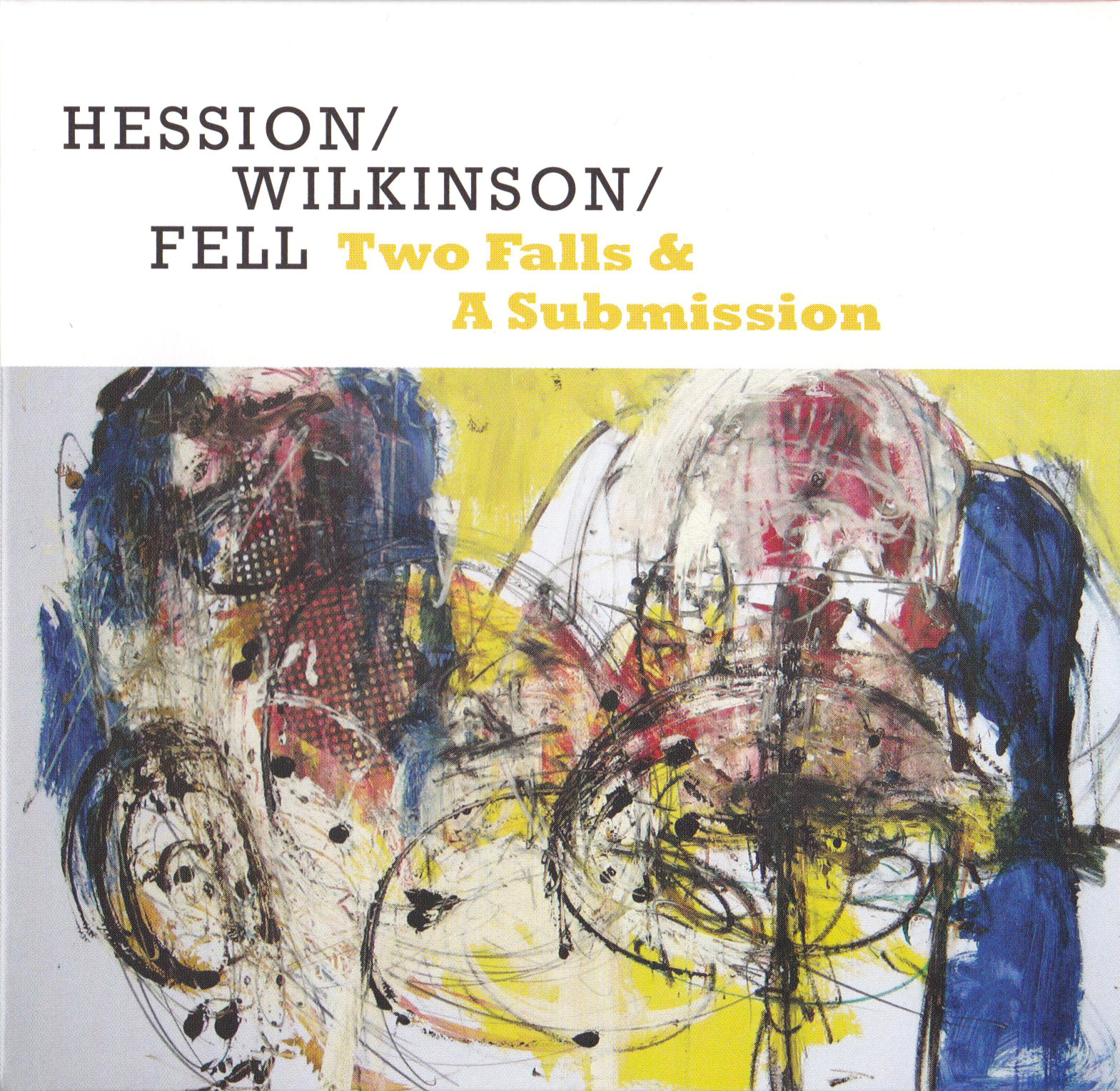
Paul Hession, Alan Wilkinson, Simon Fell - Two Falls & A Submission (Bo Weavil, 2011) ****½


By Stef

This album will surely blow your socks off, and I can already start by highly recommending it to anyone interested in forceful free jazz and in sax trios. The band is Alan Wilkinson on alto and baritone sax, Simon H. Fell on double bass, and Paul Hession on drums. The three lengthy pieces on this album are freely improvised, yet all three have an uncanny sense of unity and direction : raw, merciless, powerful, loud, but interestingly enough never noisy - although that is of course relative.

The trio has been playing and recording together for the last twenty years, and that can be heard, felt even, as all three move forward as a three-headed monster, but then one with a heart as big as it is raw, because they do not shy away from emotional delivery. Sometimes the storm dies down a little for slower, calmer moments, yet the intensity and the raw sensitivity never diminish, an amazing accomplishment.

The trio demonstrates how musical drive, expressivity and forward motion can be achieved without clear rhythm but with incredible pulse and collective energy.

You could ask whether I have not heard this kind of music before, and you can ask how it differs from Frode Gjerstad trios or Paul Dunmall trios or The Thing or ....and the answer is yes to the first question, this is not new nor innovative, yet it differs from Gjerstad and Dunmall and Gustafsson because the trio developed its own approach over the years, and one they bring to perfection on this album.

It is in any case their best album so far, rawer and with a more attentive audience than on "Bogey's", with more unity and coherence than "Foom! Foom!", less chaotic and with better sound quality than "The Horrors Of Darmstadt",   ... and it shows how the trio has managed to perfect its style and approach, making it even more direct, more impactful and cohesive.

The real deal in free jazz!


Listen and buy from Bandcamp or eMusic.


© stef

Monday, November 7, 2011

Agustí Fernández - El Laberint De La Memòria (Mbari, 2011) ****½

 By Stef

Listeners familiar with Spanish pianist Agustí Fernández will be surprised when they hear the first notes of this beautiful album. Fernández is known primarily for his free improvisation and the use of extended techniques, often with stellar results, but for this one he was challenged by João Santos from the label Mbari, who asked him to play music inspired by classical Spanish music from the 20th Century.

After extensive listening to the original music, Fernández selected details, like memorable traces of the music that somehow resonated with him. And with the exception of the long "Joan i Joana", most pieces are relatively short and just touch upon one aspect of the musical story, or to put it differently, Fernández just gives a quick sketch of an element that grabbed his attention in the original, transforming it and bringing its essence to the foreground in a quite expressive way. "Less is more", and that works for me: the pieces are like short poems rather than epic explorations, and like good poems they capture an interesting angle, are refined and fresh, they leave the listener with a sense of wonder and surprise, waiting to hear more, but somehow he or she is left in mid-air, as this open-ended music intends to, free to muse over it, and make it resonate internally.

Some pieces, like "Tonada" clearly fit in the Spanish tradition, others, such as "Pluja Sorda", played inside the piano, are more experimental.

It is romantic and lyrical, but because he refrains from adding too much context or excessive ornaments, the overall sound results in one of sober warmth. Beautiful.

It may be too sweet for regular listeners of this blog, but it will hopefully bring a broader audience to the pianist's music.

For those who don't like sweet stuff, I can recommend the following album.


Agustí Fernández and Joan Saura - Vents (Psi, 2011) ***


The perfect antidote for the sweetness of "El Laberint De La Memòria" is "Vents", a duo album of Agustí Fernández on piano and Joan Saura on electronics and live sampling. The title is the Catalan word for "winds", and all eight tracks evoke the sound of the indicated wind. 

On some tracks, such as on "Tramuntana" you can feel the wind, its powerful force making all kinds of object howl and clatter, other pieces are more raw giving the impression of garbage bins being blown away over cobble stones, so you hear the wind and the acoustic mayhem it may create in its wake.

This is not an album that I will listen to often, because it is basically a collage of noises, but then of the kind that is cleverly created and put in a context.


Sweet romanticism and raw noise : two extremes by one musician? Why not? Adventurous listeners may try to listen to both simultaneously. Why not?

Buy from Instantjazz.


© stef

Sunday, November 6, 2011

Paul Kikuchi - Portable Sanctuary, Vol. 1 (Present Sounds, 2011) ***½

By Stef

I knew drummer Paul Kikuchi from his recordings with the Empty Cage Quartet, but now he sent me some of his own material, in a different musical category entirely. The approach is minimalist, with dark soundscapes that take their time to develop and gain momentum. On these albums as a leader, he is more of a percussionist than a drummer, using all kinds of instruments and object, often self-made, to create their eery soundscapes.

On Portable Sanctuary he is accompanied by Stuart Dempster on trombone and conches, Bill Horist on electric guitar, Jesse Olsen Bay on percussion and guitar, Alex Vittum on percussion and electronics.

The words that best describe the music are "restraint" and "tension", with notes being used sparingly, adding slight changes in color and mood. The sound of Horist's electrical guitar is like the worst of fusion guitars - a little vulgar, but to the musician's credit, he is sufficiently disciplined to use his instrument to create music, with the exception of one outburst at the end of the long first piece.

The three other tracks have less of a story-telling nature, yet the mood they capture is again strong and ominous.


Listen and buy from CDBaby.


Open Graves - Flight Patterns (Prefecture Records, 2010) ****


The album "Flighpatterns" by Open Graves is even more minimalist, with Paul Kikuchi on percussion, Jesse Olsen on guitar and Stuart Dempster on trombone, and that is not only the result of the more limited line-up. The unusual percussion combined with the slow moaning sounds of the trombone create a kind of solemn, majestic feeling, while at the same time being utterly dark and gloomy.

Much of the atmosphere is intensified by the recording venue, the Dan Harpole Cistern in Port Townsedn, WA, an empty water supply system with a 45-second reverberation time, wich gives a feeling of utter drama to the overall sound. I'm not sure how much the musical vision presented here leaves room for further and future exploration, but the result here is so exceptional, that is really easy to recommend.


Listen and download from CDBaby.

© stef

Brad Dutz Quartet - Fashionably Impaired (self-published, 2011) ****

By Stef

I am not quite sure how to classify the beautiful music on this album. Clearly, jazz is the main source of inspiration, but so is baroque classical music, and so is folk music. The band is Brad Dutz on marimba, vibraphone, cajón and percussion, Paul Sherman on English horn and oboe, Chris Votek on cello and Jim Sullivan on bass clarinet and contrabass clarinet. Indeed an unusual line-up, and so is the music.

Rhythm, playing around tonal centers, and shifts in intensity seem to be the core of this thoroughly composed music. The quartet manages to integrate real forward thinking with relative accessibility and musical warmth. It is like drinking a warm cocktail of various ingredients, smooth to drink but with a sharp edge of lemon and the profound taste of alcohol. The adventurousness is less in the expressivity of the improvisations than in the strange blend of beautiful sounds, that match despite the unclear perspectives from which they arise.

In terms of approach and overall sound, vague comparisons may be Ken Schaphorst's "Indigenous Technologies". Carefully crafted, innovative in its overall sound texture and highly enjoyable.


© stef

Friday, November 4, 2011

HEMPHILL!

By Stef

In 1995, saxophonist Julius Hemphill passed away, after having given the world two decades of fantastic music, be it with his own records, or with the World Saxophone Quartet. He was a free thinker and improviser, but he liked themes and rhythm at the same time. Two major things are happening now : his brilliant debut album "Dogon AD" is re-issued, and No Business dug up old recordings and released those as a new album.

I can encourage you to read Tim Berne's interview in which he describes Hemphill as a person and as a musician. 

Julius Hemphill and Peter Kowald “Live at Kassiopeia” (No Business, 2011)****


On the first disk of this double CD, we find Hemphill playing solo on three pieces, and German bassist Peter Kowald solo bass on one long track. On the second disk, both artists perform duets. The performance was recorded on January 8, 1987 at "The Kassiopeia" in Wüppertal, Germany.

It is pretty unique to hear Hemphill play solo, mainly on alto, and it is a real treat. His playing is playful, jazzy, rhythmic, using phrases from old jazz traditionals and from the blues, and with an incredible sense of focus, he keeps close to the path he embarked on when starting his improvisation, and as a result the three tracks clock around six or seven minutes. Kowald is something else : his approach is more open and shifting with the new ideas coming, moving into different directions and developing his improvisation over more than thirty minutes. We have heard Kowald play solo before, but again his great mastership on the bass is demonstrated here, pizzi and arco, as well as his incredible musical vision of what music can express and how it can be presented.

The second CD is the real treat, starting with bowed bass and screeching alto, and I must say that Hemphill sounds a little unsure of what to do until he starts playing more rhythmic phrases, immediately picked up by Kowald for a really strong interaction. The second improvisation is the pièce-de-resistance with both artists starting to feel really comfortable with the set-up and playing up a storm, full of intensity and sensitivity, with moments of high energy alternated with calmer passages, and especially the latter are excellent. The last track is exceptionally short, and starts with an arco and some crazy and wild ideas by Hemphill, playful, with all sorts of funny phrases interspersing his normal playing. I'm not sure whether this was an encore, but it sounds like it. In any case, the audience is happy, and so are we.

Buy from Instantjazz.


Julius Hemphill - Dogon AD (International Phonograph, 1972-2011 re-issue) ******


Out now, again, and no doubt the reissue of the year, with Julius Hemphill on alto and flute, Baikida Carroll on trumpet, Abdul Wadud on cello, and Philip Wilson on drums.

The original album is thirty-eight minutes short, and actually the title track is without a doubt the piece that carries the album's legendary value. Listen how Wadud and Wilson's economic and repetitive playing leads to a trance-inducing hypnotism over which Hemphill and Carroll make their instruments express any mode and mood possible. On the re-issue "Hard Blues" was added, a track that was recorded during the same session and with Hamiett Bluiett on baritone saxophone.

A "must have".

Buy from Instantjazz.


© stef

Thursday, November 3, 2011

Kidd Jordan - On Fire (Engine, 2011) ****

 By Stef
 
Saxophonist Kidd Jordan is no doubt one of the most under-recorded artists in free jazz, and this despite his age, musical skills and vision. His "Palm Of Soul" from 2006 was one of the best albums of the year in many lists, including mine and rightly so. Now, five years later, we find him back in the company of Warren Smith on vibes and drums, and Harrison Bankhead on bass, two musicians who are the perfect complement for the master from New Orleans.

Like the late Fred Anderson, Jordan is a highly rhythmic lyricist, someone who can build an improvisation and vary it endlessly, keeping the pulse, the concept and the focus throughout. Smith is the ideal sparring partner for many, but his percussive story-telling is picked up perfectly by Jordan. Their interaction on "The Evil Eye" is both subtle and ferocious, inventive and powerful, lyrical and wild, emotional and raw. It is during the softer, more spiritual second part of the piece when Kidd Jordan plays some of the most sensitive gospell-like phrases you will have heard in a long time, that Bankhead's warm bass underpins the mood perfectly, and gets a free opening to a lengthy bass solo, one that captures the spirit of the piece and moves it to a silent end, supported by some precise percussive effects by Smith.

Warren Smith starts the third track, "We Are All Indebted To Each Other", on vibraphone and accessory percussion, for a slow improvisation, with Bankhead, then  Jordan joining, again plaintive, deeply emotional in this overall quietly floating piece.

Bankead takes the lead on the last track, "Harrison Carries Out The Coffin", as an illustration that this is actually a trio creation, ending the album also in a very bluesy fashion, with the deep sounds of the Mississippi delta rising up through every note and lifting in today's free world, with sentiments of anger and anguish and joy resonating throughout, capturing history and delivering great art. Again a strong achievement.

 Listen and download from eMusic.

© stef