Click here to [close]

Tuesday, January 9, 2018

Itaru Oki, Nobuyoshi Ino, Choi Sun Bae - Kami Fusen (NoBusiness Records, 2017) ****

By Nicola Negri

"Kami Fusen" is the second volume in the ongoing collaboration between NoBusiness and Chap Chap Records, after the excellent "The Conscience"by Rutherford and Toyozumi.

This time, all the musicians come from the Far East: Itaru Oki was one of the first Japanese musicians to explore the free jazz idiom in the early Seventies; Nobuyoshi Ino comes from the same country and musical scene, even if he has often played in more traditional contexts; similarly, Korean trumpeter Choi Sun Bae has often worked in different, and often contrasting contexts.
Kami Fusen (“Paper Balloon”) documents the concert held by the trio in 1996 at Cafè Amores in Hofu, Japan, and comprises inventive originals by Oki and Ino, as well as classic jazz standards like "I Remember Clifford"or "Tea for Two". 

"Pon Pon Tea" opens with busy bass lines in direct contrast with the theme's long unison lines, the trumpets soon engaging in a frenzied exchange of high register runs and brief interlocking melodic statements. Ino's trajectories are hard to anticipate, a muscular solo might lead to a tight walking bass to support the call and response of the muted trumpets, or dissolve in disjointed stuttering. Oki and Choi follow the lead with exquisite aplomb, always ready to ride the rhythmic flow or explore less familiar terrains.

Ino's strong arco work delineates "Yawning Baku"'s structural frame, until the trumpets enter with a beautiful, relaxed unison theme leaning on an elongated bass vamp that gently pushes the piece forward.

"Ikiru" is a sonic postcard from the outer limits of sound, all clanging and shrieking, with flute and bass slowly building a menacing soundscape, eventually leading to a lyrical double trumpet solo over bowed bass.

"Kami Fusen" returns to the episodic, yet carefully crafted structures of the first pieces, adding unexpected latin flavors to the mix.

"I Remember Clifford" is a solo trumpet showcase for Choi Sun Bae, his ability to work around the melody, delineating the theme just enough to be recognizable, on full display; while the duo of Oki and Ino approaches the final medley of "Old Folks" and "Tea for Two" with equal doses of respect and inquiry. 

In a sense, innovation is the only constant in the jazz tradition, despite the conservative tendencies of the mainstream, and Kami Fusen brilliantly embodies this contradiction, as the musicians approach the performance with evident affection for the jazz language without losing their adventurous edge.

Itaru Oki – trumpet, bamboo flute
Nobuyoshi Ino – bass
Choi Sun Bae – trumpet

Monday, January 8, 2018

Alex Ward - Proprioception (Weekertoft, 2017) ***½


Earlier this year, Alex Ward started a blog for exploring the music of Cecil Taylor in depth. There’s a great deal of excellent writing here (please join me in prodding him for additional posts), in particular Ward’s close listening of Taylor’s use of motifs and patterns, recurring across multiple compositions, never in quite the same way. Through Ward’s writing, I’ve come to think of Taylor as more of an iterative composer and improviser. This isn’t to suggest that his writing provides a specific guide for listening to Proprioception, his new solo album, but it does give some sense of the level of precision Ward brings to any project.

“Vestibular” and “Tiptoes” feature Ward on clarinet only, while “Chasm” has him on clarinet with amplification. The two sets, for lack of a better term, were recorded nearly a year apart. “Vestibular” and “Tiptoes” were recorded in June 2016, and “Chasm” in March 2017. The immediacy of the release transfers somewhat to the recording itself, which feels urgent and necessary. I liken Ward’s solo improvisations to a cross between narrative and a kind of meiosis, with Ward taking cellular blocks of notes, breaking them into pieces, and subsequently breaking them further apart until he has moved onto an entirely new block of notes.

Everything about this album seems to represent self-reflection, from the title to track names, but Ward’s playing feels quite outward-facing, inviting its own close listening. On “Tiptoes,” where Ward plays some of the quietest and most extreme unamplified clarinet, the instinct is to lean in and listen more closely. The graceful denouement has a calming effect, which prepares you for the delicate opening of “Chasm,” which takes its time stripping the clarinet apart and wrecking your brain. I mean this as a compliment, there are stretches that sent my dog and cat into far corners of the house. The distance traveled from the open, acoustic playing on “Vestibular” to the fearsome experimentation of “Chasm” is striking, and the album plays best as a whole, allowing listeners to experience the full range, from soaring to searing.


Sunday, January 7, 2018

Guitars! (Part 2 of 2)

By Paul Acquaro

Part two of my guilty pleasure. There just may be a third on the way too, but not before I get to a few other items on my list.

Ross Hammond - Mason Lawn (Prescott, 2016) ****½


Typically when I am listening to an album for review, I am on the way somewhere, maybe to work, maybe to a concert, on a train, in a car, on the go, in the busy throes of life and work. However, when I finally got to guitarist Ross Hammond's duo record with percussionist Jon Bafus, it was early on New Years Day and I was taking a spatziergang in the German countryside. Long rolling hills, open fields, bare trees blowing in a gusty and sometimes rainy wind; however, with blue skies on the horizon, the first tune just felt like the perfect soundtrack to a new year. On 'Like Being Kissed by God Herself', Hammond's acoustic resonator guitar spills forth with purposeful motion, riding on Bafus's insistent yet feather light beat. It's like being swept along by music itself, open and chiming, hope and creation is woven deeply in its melodic simplicity and forthrightness. The next track, 'On the Incline', Hammond is on the electric guitar, a sound we haven't heard from for a while on record, several of his latest recordings have focused on the solo acoustic guitar. It's a good sound. Hammond prefers a slightly distorted sound and saturated in the type of Americana jazz-rock that takes cues from both Neil Young and Bill Frisell and makes it entirely his own thing. The track itself unfolds slowly, building vistas with care and patience. The title track begins with a dark blues riff from the open tuned lap steel guitar. Bafus's percussion is hypnotically repetitive, providing a groove for Hammond's evocative and slightly sinister melodic ideas.

Masonic Lawn, is a mesmerizing musical statement from the always searching Hammond. His focus on American folk and blues, and synthesis with improvisation and jazz elements has yielded musical treasures before, and it seems like he may have hit a mother-load here. A perfect soundtrack for a walk in the country and most likely, anywhere else.


Eric Hofbauer - Prehistoric Jazz Volume 4 (Reminiscing in Tempo) (Creative Nation Music, 2017) ****


Boston based guitarist Eric Hofbauer has been on my radar for a bit of time now, his Prehistoric Jazz series - named after a Leonard Bernstein description of Stravinsky’s Le Sacre du printemps - has been an exploration of early 20th century modern classical composers such as Shostakovich, Webern, Ligeti and Machaut. On Volume 4, Reminiscing in Tempo, Hofbauer takes on the through composed piece that Duke Ellington wrote in honor of his mother. With his quintet of himself on guitar, Jerry Sabatini on trumpet, Todd Brunel on Bb clarinet & bass clarinet, Junko Fujiwara on cello and Curt Newton on drums, the guitarist shifts around the tonal arrangements and discovers parts of the piece that allow for improvisation and expansion doubling the length of the original song to 24 minutes.

The start of the song feels very traditional, almost reverential to the original, but listen closer and Hofbauer's clean clear acoustic guitar is doing something else. There are breaks in the cadence, and a later break down that may have you thinking of Derek Bailey, especially his late career take on standards. It's a musical jungle gym for the guitar fan, a close listening to Hofbauer's note choices and abstract connections to the song's structure is absolutely required listening. This short album is packed tight with ideas. Check out the other volumes as well!


Rob Price - All Regions Player (Gutbrain, 2017) ****


I ran into guitarist Rob Price a while back at the Stone in NYC. I cannot recall what the show was, but it was a guitarist ... maybe Frisell or Ribot ... either one would make perfect sense. Anyway, I had been a fan of his earlier works - 'At Sunset' and 'I Really Do Not See the Signal' - both smart and adventurous works with a crack quartet touching on many musical styles. I asked what he has been up to and he said he was working with a trio working out post-surf guitar takes on soundtrack themes, often playing the music set to film projections. Then, last year (2017) he released a special 100 copy run of an album from the trio, All Regions Player, which indeed sounds just like his description, a spaghetti western imbued set of tracks that draws on both Morricone and the Ventures. This is a really fun album, from the opening arrangement of 'Gunfight at the OK Corral' to the fantastic version of the theme from 'The Taking of Pelham 123' - the song reflecting the barreling of a runaway train in full blown jittery glory. 'Star Trek II: The Wrath of Khan' takes an approach that stretches the anthem way beyond its natural shape.

This set is certainly not free jazz, but it is full of imaginative arrangements of soundtrack music that has been molded into a highly enjoyable power trio fusing a love of film music and surf music. The trio is, in addition to Price, Ben Gallina on bass and Andy O’Neill on drums. Price is also long time figure in the Downtown New York City scene and is donating the proceeds of the album to support the Downtown Music Gallery. So, two great reasons to buy this CD: excellent and fun music, and supporting the beating heart of free music. (Check out the DMG event calendar, they have live music every week, including shows by Price). Buy here.


Samo Salamon - Free Sessions Vol 1: Planets of Kei (NotTwo 2017) ****½


Before digging into Slovenian guitarist Samo Salamon's Planets of Kei, I did a little research on the blog. My colleagues Chris Haines and Conor Kurtz covered two different Salamon recordings of recent vintage and both similarly remarked on how the guitarist himself had the least amount of play-time on the recordings. On Free Sessions Vol 1: Planets of Kei this seems to be fully rectified. Salamon delivers a health dose of acoustic guitar on this album, in full free interplay with Szilard Mezei's viola and Achille Succi's bass clarinet and alto sax. The lack of drums and bass, and the use of only acoustic instruments, may seem to suggest a somewhat quiet album, and to some extent that is true, but it exhibits more than a few moments of fire and intensity that seems to be inspired by the sparseness of the instruments rather than held back by it. Right away on the opening track "Trio 1", the three are a-buzz, literally. From the rattle of the acoustic guitar stings, to the fizz of the bass clarinet, and the rub of violin strings, there is a crackling energy emanating from the group. To break things up, the next track is entitled 'Duo Achille & Samo', which is just that, the guitar and bass clarinet in a complex rhythmically interlocking dance. Salamon's lines grow longer and filled with chordal tones, while Achille plays elongated notes behind him. A later track 'Duo Samo & Slizard' begins in a similar fashion, but now with the guitar and viola. The two engage in a spirited melee, the viola often producing melodic lines spiraling out, while the guitar delivers staccato rhythmic figures. The track 'Trio VI', may be my favorite on the album. Starting with a repetitive finger picked figure on the guitar, the saxophone soon joins with an entropic melodic snippets. The free lines are quite interesting to follow, and the trio is adept at utilizing the spaces between their notes as much as the notes that they make, to propel themselves, especially in the final moments of this track where the friction between the three starts smoking.

Saturday, January 6, 2018

Guitars! (Part 1 of 2)

By Paul Acquaro 

Oh, I've been taken to task for my Guitar Weeks. They say, "why single out the guitar? Why not have sax weeks? Why not a euphonium fortnight?" Well, I have no excuse except that I love the instrument and have a bunch of albums with the guitar at the center that I'd like to share with you...

Miles Okazaki - Trickster (PI Recordings, 2017) ****

One of the albums that has been on my mind for a bit but haven't written about yet, is Brooklyn based guitarist Miles Okazaki's album 'Trickster'. Okazaki is a fleet player, steeped in the language of mainstream modern jazz guitar (I hear hints of Abercrombie in his spaciousness, and Scofield in his blues) and the avant leaning (he works with Mary Halvorson on Paimon: The Book of Angels Volume 32). Knotty lines are festooned with finger twisting passages, but they never lose their melodic core. Tracks like 'Box in a Box' find the guitarist engaged deeply in a funky give and take with pianist Craig Taborn, and the opening 'Kudzu' is indeed as fast growing and enveloping as the plant its named after. Playing in bursts, bassist Anthony Tidds lays down a fluid and propulsive structure and the tight drumming of Sean Rickman nails it together. Trickster is a great album, and Okazaki melodic crisp and clean tone is a treat to the ears. 


Jessica Ackerly Trio - Coalesce (s/r, 2017) ****


The opening measures of this album may have you have thinking Mary Halvorson perhaps adopted an alter ego but that moment is fleeting as the Brooklyn based/Canadian transplant Jessica Ackerly proves to have invented her own angular and modern approach, and Halvorson is simply a touchstone. The opener 'Clockwork' has a captivating openness that expands in several direction simultaneously, free but melodic, you can hear Ackerly thinking with her fingers. 'Discoid' also allows for a lot of space, but takes a more deliberate  and plodding approach that gets into some clean skronk - perhaps more like Marc Ribot or maybe Elliot Sharp at this point. A short solo track appropriately tiled 'Solo Guitar' showcases the guitarists use of open voicing and suspense. The trio is Matt Muntz on bass and Nick Fraser on drums. They give Ackerly the space and support that this guitar driven music thrives on, and it's a blast. 


Elliot Sharp, Marc Ribot, Mary Halvorson- Err Guitar (Intakt, 2017) ****


How the hell did I not write about this one immediately? Three of the top avant-garde guitarists on one album? Maybe my only excuse is that it is too much of a good thing ... raised expectations? Preconceived notions? Well, I finally dove in, and what an experience it was. I immediately thought of the trio Nels Cline had been a part of, The Acoustic Guitar Trio with Rod Poole and Jim McAuley, when the first track 'Blindspot' began with the clean guitar chord tones and tight strumming, but soon the preconceived notions melted and the exploratory, arrhythmic, and unanticipated took over. I stopped trying to discern the individual players (though all three have enough distinct approaches that it's not impossible to guess) and enjoy the adventure. The call and response of the track 'The Ship I am On' leads the trio up to a peak that is shot through by some familiar pitch bends, used to great effect by Halvorson. 'Wobbly' is neat track that features an acoustic guitar, and expertly demonstrates the intriguing balancing act between the askew melodies and atypical chord voicing that permeate the recording.

If you are looking for a new Halvorson or a Ribot or a Sharp album, keep looking. Err Guitar is something entirely different and for guitar fans seeking new approaches and fresh ideas, you could not do much better. 


Scott DuBois - Autumn Wind (ACT, 2017) ****


Autumn Wind is New York based guitarist Scott DuBois' second release on the Munich based ACT, which like another famous Munich based label, is highly curated and meticulous, with a strong interest in modern jazz. On Autumn Wind, DuBois tries to capture the visceral and metaphorical feel of autumn, employing a group that features in demand bassist Thomas Morgan (currently working with Bill Frisell), drummer Kresten Osgood, and reed player Gebhard Ullman. For a portion of the tracks, DoBois has as string section for which he has written arrangements. 

DuBois has an approach similar to the spaciousness and judicious intensity of John Abercrombie and his writing is strong throughout. The first track, 'Mid-September Changing Light', begins with a throb of bass and DuBois' carefully placed notes, building into a full but delicate duet of bass and guitar. Moving along to 'Mid-November Moonlit Forest', lush string passages give way to a rocking moment, like emerging from the cradle of a tree covered path into a clearing full of a bright star filled night sky. Hints of Americana and Ullman's earnest reed work follow that moment in 'Late November Farm Fields'. 'Early December Blue Sky and Chimney Smoke' is an upbeat and vigorous melody like a crisp cold day while wispy clouds hang effortlessly in a baby blue sky.

Evocative, moving, and successful in it's mission, DuBois' concept is mature and meticulous.


Vitor Rua - Do Androids Dream of Electric Guitars (Clean Feed, 2017) ****

Its simply a fact: Clean Feed is fucking incredible. I do not believe that any other small label is as prolific, releasing recordings by veterans like Joe McPhee, welcoming new voices like Chris Pitsiokos, and providing a platform for important multi-faceted Portugese artists like Musical polymath Vitor Rua. Rua is primarily a composer whose main instrument is the guitar. Early on in his career played in the rock group GNR, and has been involved in free improvisation, classical and minimalist composition, and even opera. Do Androids Dream of Electric Guitars is a fascinating look at both the minimal and jazz-rock side of Rua.

In this two disc set, the each CD features the same set of compositions, the first set played solo with over dubbing on guitar, the other set with the band The Metaphysical Angels featuring Rua on guitars, Hernâni Faustino on bass, Luís San Payo on drums, Manuel Guimarães on piano, Nuno Reis on trumpet, and Paulo Galão on clarinets. The first track 'The Amazing Worm' on the solo CD begins with acoustic guitar playing a single line melody, soon a brittle distorted electric guitar creeps playing chords like Ribot on Tom Wait's Rain Dogs, and soon the track is becomes an intertwining mass of melodic vines. On the group CD the same song features clarinet and drums taking the electronic guitar lines. Electric guitar delivers the same chords, but the jerkily rhythmic melodies carried by the different instruments lends a totally different feel. Both versions have a feeling of chic decay, a crumbling delicate beauty, held together, but barely. The track 'Flamenco is Dead' is a quick shifting of textures from electric slashing and skronk to the smacks of bass strings, and musical shavings cluttering the floorboards. The group version? Well the mayhem is spread across a broader tonal pallets and sprays shards of musical debris everywhere. The lovely faded elegance of the title track evokes a past future, with skeletal melodies and distorted accompaniment on the solo side and an even more delicate full band version.

Rua's album is a fascinating report from an artist drawing from all his interests: rock, classical, and experimental influences abound. Rua presents an exciting juxtaposition of solo and group takes of the same song, presenting both the drafts and expansions of his work simultaneously. Very interesting and well worth the double listen!


Friday, January 5, 2018

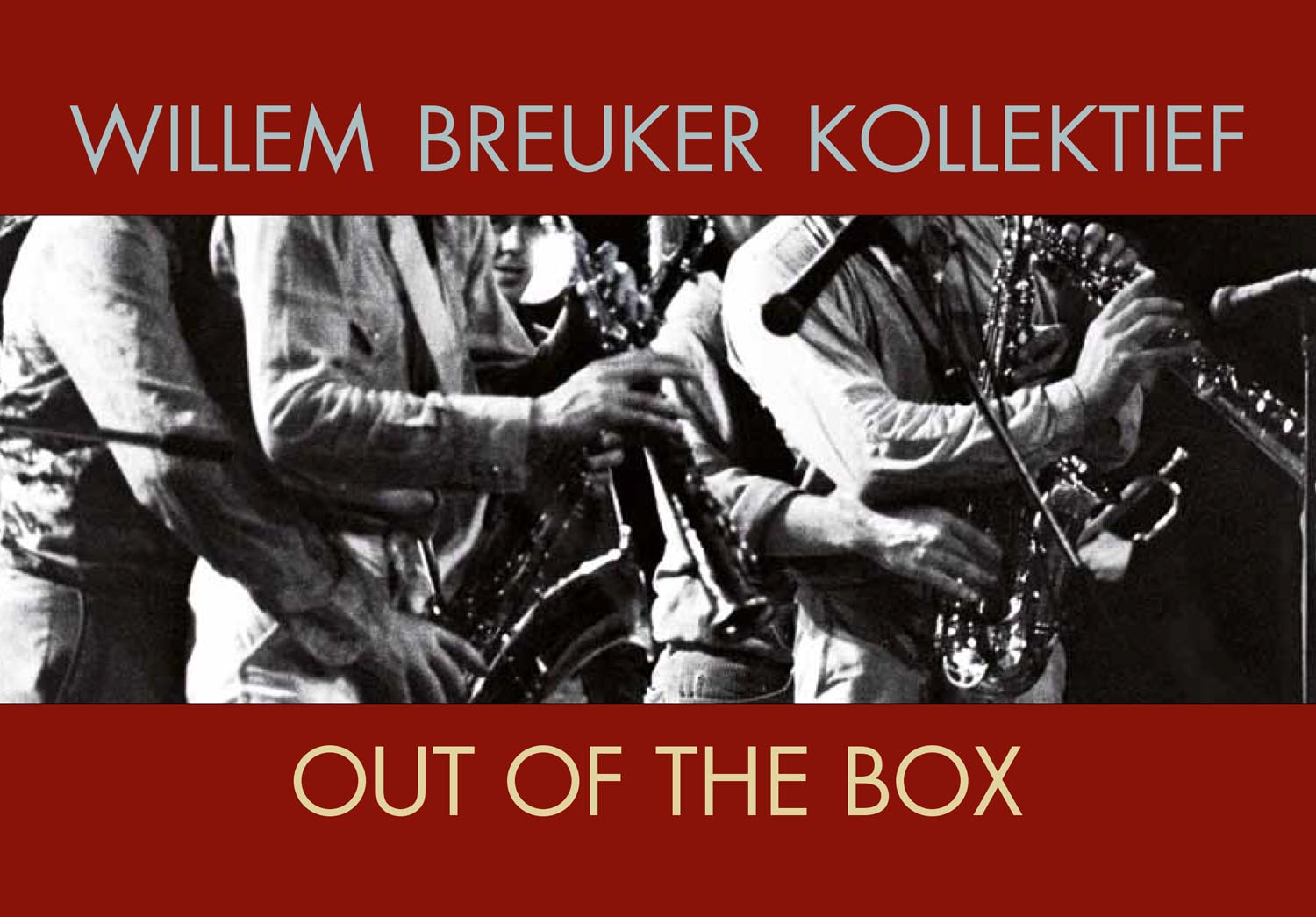
Willem Breuker Kollektief - Out of the Box (BVHAAST, 2017) *****


By Lee Rice Epstein

I recently put on a disc from this new 11-disc Willem Breuker Kollektief retrospective, and my wife quickly acknowledged that, while the musicality was impressive, she never wanted to hear the group again. This was disc 6, UmeÃ¥ 1978, a previously unreleased concert features the group in one of its many peaks, playing classics like “Antelope Cobbler” and “Florida.” The fact is, this was her first exposure to Breuker, and it’s not an easy one to jump into. For all the density of his composed music (more on that in a bit), the jam-packed, theatrical live performances by the Kollektief can be difficult to follow if one is just coming and going from the room, tackling various chores, and attempting to have casual conversation with one’s spouse.

That said, Out of the Box, as a whole, is a really fantastic primer of mid-to-late career Breuker. At least five of the 11 discs on Out of the Box contain previously unissued recordings. In addition to the UmeÃ¥ set, there are two discs featuring Breuker’s radical score to F. W. Murnau’s Faust and two discs from the group’s 2012 tour, following Breuker’s death in 2010. The remaining seven discs are compiled from various releases, some of which are now out of print, organized into thematic groups: Big Chunks, Songs and More, Plays and Movies, Heibel / Fuss, and Strings. The final disc, Angoulême 1980, compiles highlights from a Fou Records double-disc release.

Out of the Box makes a strong case for Breuker as a preeminent composer and arranger. Much can be made of the remarkable “Rhapsody In Blue” from Strings, but Songs and More features a 12-minute reading of “Night and Day” that must absolutely be heard to be believed. With knowingly torch-song vocals by Greetje Kauffeld, the Kollektief pivots from nightclub backing band to free swingers for an extended middle section. Here, it’s followed by Kurt Weill’s “Song of Mandalay” and a fabulous rendition of Breuker’s own “Potsdamer Stomp,” with strong soloing by trombonist Bernard Hunnekink. It’s Hunnekink, along with bassist Arjen Gorter, who compiled this set, and their work is to be commended. In keeping the Kollektief alive, they’ve not only continued to release new albums, but they kept touring and playing live through 2012, a final tour captured on Happy End I and Happy End II.

The two sets that make up Happy End showcase a band that, for nearly 40 years, took on the high-wire feat of performing Breuker’s music. The breakneck speed and Dadaist mashup of Breuker’s music live and breathes here, beginning with the one-two punch of “Husse II” and “Steaming,” and extending into the “To Remain” suite, and deep cuts like “Ricochet.” If these final shows were meant to serve as a kind of honorific, there’s no diminishment of the playful theatricality that reigned throughout the Kollektief’s history. “Hallo, Hallo,” with its cheeky tempo change and ringing phones, is a particularly fun highlight.

But the strongest of all highlights may be the two-disc score to Murnau’s Faust, originally released on DVD in 2005, the score has not previously been widely available in an audio format. It’s a magnificent work, with Breuker stretching out, stitching together folkish rhythms, Tin Pan Alley melodies, carnivalesque modes, Weill and Berg references, and a range of pop, jazz, funk, and rock motifs. It’s a heady mix, a total trip. I’ve never watched the film synced with the score, but I understand Breuker uses a lot of odd juxtapositions between sight and sound. But, knowing Breuker’s music, I wouldn’t have expected anything less.

Speaking with Jon Pareles for The New York Times in 1983, Breuker said, “'People never fall asleep when they listen to us… The music is like a bird going from one branch to another. I like to make these cuts, changing subjects and objects all the time. Or I might do something for a shock effect, or the feeling of having two record players on at once, or of changing channels on the radio.”
One of his greatest accomplishments was combining humor and music, bringing an ironic slant to a sometimes self-congratulatory intellectual music. Breuker brought all his intellect and training to bear on his riotous and clashing compositions. There is richness and depth in the many interpolations that combine to make a Breuker score. Out of the Box celebrates all of the different expressions of this, extended, brief, majestic, kitschy, and seriously fun.

Available direct by mail order.


Thursday, January 4, 2018

Johannes Bauer / Peter Brötzmann ‎– Blue City (Trost, 2017) ****


I’m not sure I’m worthy to write a review about anything with the late Johannes Bauer's playing. I’m not a seasoned reviewer, nor do I have the experience and language skills like many of the reviewers here on FJB. But I’ll give it a try anyway. I’d like all of you to first head over to Martin Schray’s well written obituary following the link above. As far as Brötzmann goes, the German reedist giant has been on and around the scene of improvised music for 55+ years and counting. I can highly recommend his own website with discography but also Peter Stubley’s extensive website which contains a whole lot for the Brötzmann rookie to read and indulge in.

Listening to this lost, and luckily found, duo live performance with Bauer and reedist Peter Brötzmann I’m immediately struck by the intimacy of this recording which really gave me confidence to sit down and put pen to paper. This album features reedist Brötzmann and trombonist Bauer at the Blue City in Osaka, Japan, in 1997. I’m not sure anyone has taken credit for recording this performance, but it’s been done in a very nice way.

Brötzmann, playing tenor and alto sax, b-flat clarinet and tarogato on this album, together with Bauer gets straight to the point with the first close to half an hour track, opening the album. Brötzmann’s right there throughout this first track, and clearly is in great shape. There’s a constant stream of raw notes flowing right at me, and then at around the 8 minute mark we get to hear Bauer on his own. I’m not sure I’ve ever heard a trombone sounding like this. Extended techniques, breathing, moaning as the improvised section build up.

The way Bauer and Brötzmann collaborates on this album is really moving. There’s a mutual respect and obvious camaraderie. The duo format allows me to pay close attention to small details and nuances. I’m not used to sax-trombone duo and perhaps that’s why I like this album so much. It’s clear that they both are enjoying their performance most when allowing themselves to let it all out there with extended improvised bursts of notes. There’s this extreme sense of having so much to say as they push through the twenty-five-minute mark without any sign of wanting to stop. Finally, the relaxed and satisfying feeling when ‘being done’ so to say, is obvious when this first song is over. I personally need to stop for a few minutes before continuing to listen.

‘Blue City’ has Bauer starting off alone looking for a way in, or a way out. Glasses clinking has me thinking that Bauer and Brötzmann are standing in the middle of an eating and drinking audience. I don’t know that of course, but it’s fun to think they would be right there with tables and chairs and people eating steak, or sushi. Brötzmann joins in to add flavor and suddenly they both explode. But just briefly. It’s soon back to the searching and more introspective sound again.

'Poppy Cock’ is a peaceful improvisation. This is a very delicate piece of music. Bauer has a very sensitive tone throughout the track. Not at all edgy and raw as opposed to the first track of this album. It’s lovely to hear the trombone alone for an extended improvised part. It’s not something I’m used to hearing, it catches my interest to go looking for more solo or duo trombone albums of the improvised kind. Anyway, Brötzmann and Bauer joins forces to close the song.

In ‘Heard and Seen’ there’s a more pushy and aggressive improvised feeling heard. Slurs and long runs of notes that sometimes follows each other, sometimes travels off into different directions. Bauer works around a theme and Brötzmann travels in and out and around. Eventually Brötzmann goes off on his own and delivers a true “Brötzmanian” solo. Bauer joins back in and it’s over.

The last track on this album is ‘Hot Mess’ in which extended techniques, grunts and screeches creates…a hot mess. What a nice way to end a highly recommended album, that could’ve easily never seen the light of day.

Here’s a search page for Johannes Bauer


Wednesday, January 3, 2018

Bernard Santacruz - Tales, Fables, and Other Stories (Juju Works, 2017) ****½

What do I hear when I listen to the improvised solo bass music of Bernard Santacruz on his live album Tales, Fables, and Other Stories? To hear is not the same as to listen. We hear sound. To sound, we merely react. We listen to music. Music makes us see the world and ourselves in it; it makes us think. Franz Liszt once said,
Music presents at one and the same time the intensity and expression of feeling; it is the embodied and intelligible essence of feeling; capable of being apprehended by our senses, it permeates them like a dart, like a ray, like a dew, like spirit, and fills our souls.
“Music” does not exist in the world as other phenomena do; it exists—and is sensed, is understood, and affects us—in that place we might call the soul, or consciousness, or wherever we are moved by emotions and ideas. When I listen to Santacruz play his bass, I comprehend an “intelligible essence of feeling,” which is not the product of nature or of the object, nor does it derive from the technique of the craftsman nor even of the artistry of the musician. Those things are all be beautiful in their ways, but what music unveils is beauty itself. The world of things exists for my senses. Music exists like love exists: I know it when I am in it.

Three tracks from a live set make up Tales, Fables, and Other Stories: “In the Joyful Whirlwind of the Spirits” (26:51), “From Missirikoro to Sikasso” (11:45), and “Alta Mar” (5:41). Each song unfolds meditatively, poetically. All three are improvised. They bring forth an experience that happens for the first time. Such improvised music will never be a familiar sort of thing existing for habitual experience. We shouldn’t subject it to our ordinary musicological values or marketing preconceptions. Bernard Santacruz does not make familiar, useful, easily assimilable sounds. He alchemizes wood, sheep gut, horsehair, and steel into music.

The solitary music Santacruz creates—percussive, dramatic, harmonic, swirling, reverberant—demands solitary attention. Like the music of Karlheinz Stockhausen, Santacruz’s avoids “any recognizable shape, any melody you could whistle or sing because it would take away your attention and you would always be listening to find out what was happening to it during the course of music.”

Even when Santacruz repeats a figure or a nearly-melodic line until it almost becomes familiar, he alters it, punching through into another style. And when Santacruz, near the end of “In the Joyful Whirlwind of the Spirits,” seems to quote the melody of “Lush Life,” this moment of “respite” highlights how unfamiliar his music is and how carefully we have been listening. I experience this music as art when I submit to it, abandon usual ways of listening, and refrain from normal ways of thinking and evaluating to, as Heidegger says, “dwell within the truth that is happening in the work.”

What I love about Tales, Fables, and Other Stories is that man, machine, and music meld. To say that a solo bass record puts emphasis on the bass, which this record uniquely does, would be to state the obvious. When I listen to Santacruz play the bass, I think about primordial forces moving through elements of nature. I hear wind in the forest bending trees that gave shape to the airy body of the bass. I hear calls of a shepherd, barking of dogs, and bleating of sheep from whose guts the strings were made. I hear the tools and the skill of the craftsmen who designed, carved, and built the bass. I hear the body and breath of Santacruz, his technique and his passion, and how he honors the bass. These are the earthy, ephemeral things I hear, but from them all Santacruz draws timeless pathos that moves us more ways than one. Tales, Fables, and Other Stories is music to listen to when you’re in the mood to flee the quotidian and enter onto the path of transcendence toward where the art of music dwells.


Tuesday, January 2, 2018

Ex Eye - Ex Eye (Relapse Records, 2017) ****

By Martin Schray


After the last part of his New History Warfare trilogy Colin Stetson was somehow in a cul-de-sac. With these albums he had created a unique cosmos of sound, distinctive and captivating. But it was clear that this concept was also limited, which is why Stetson had to change something. He also seemed to realize that and recorded a very accessible duo album with his partner Sarah Neufeld, a violinist who has worked with Arcade Fire. In addition, he interpreted Henryk MikoÅ‚aj Górecki’s Symphony Nr. 3. However, both albums received mixed reviews. Then, earlier this year, he released a new solo album, All This I Do For Glory. In his review for the follow-up of New History Warfare Part 3, Daniel Böker claimed that Stetson had managed to change because he included catchy tunes and more beats in his music, that he obviously had made an effort to reach a bigger audience. But beats have always been an integral part of Stetson’s music, even if they’re more prominent on All This I do For Glory, and there has always been a certain catchiness in his solo pieces as well. So, if there was change, it was only a slight one. Shortly after the release of All This I do For Glory though, the man presented a project which promised real change: Ex Eye.

Apart from Stetson the band is Greg Fox on drums (of Liturgy and Zs fame), Toby Summerfield on guitar and Shazad Ismaily on synths, and actually their music is an amalgam of black epic metal, kraut, techno and free jazz. Electronics, guitar and drums circle around Colin Stetson’s alto and bass saxophones, his stoic intensity and versatility holds the compositions together and pushes them into new directions. 

The short opener “Xenolith“;The Anvil“ is a perfect example. Stetson’s sax takes the role of the bass, heavy chords dance around him, and then he breaks out into monotonous squealing cries, reminiscent of Mats Gustafsson or Peter Brötzmann.

Stetson’s spiraling melody in “Opposition/Perihelion; The Coil” presents him in the role of the soloist, the master of ceremonies. Greg Fox and Shazad Ismaily start with a wild coursing, and Stetson complements them with his typical minimal lines. Again and again the track moves up a gear, there are few, clear chord shiftings, the atmosphere is immensely tight. The music reminds me of Liturgy’s best songs like “Generation“ or “Sun of Light“, but here the voice is replaced by the sax. Then the track flows in ambient like areas before a synthesizer riff chases it into complete exhaustion. It’s a mixture of hallucination, invocation and nightmare - a definite highlight. 

“Anaitis Hymnal; The Arkose Disc”, the next track, presents Stetson’s ability to sustain notes like a dark, gloomy foghorn. He keeps his voice low at the beginning, delivering a melancholic melody. Then the sounds of the instruments melt, providing a gigantic texture, awash with overwhelming noise. 

The album is closed with the 8-minute “Form Constant; The Grid“, on which you can hear the old Stetson at his best - circular breathing lines in front of airy guitar chords. But just when you’ve accustomed to it, the piece morphs into another metal monster dominated by a slow guitar riff.

Here LP and CD end, but the download included in the vinyl version presents another gem: “Ten Crowns: the Corruptor“, a piece that gathers round a super slow Black Sabbath riff that becomes even slower towards the end. However, before this riff captures the track, Summerfield’s high guitar tremolos and Stetson’s bass saxophone collide in a fierce battle just to be relieved by weird synthesizer lines creating a fusion-like sphere, although dirtier and sleazier. When the aforementioned dominant riff turns up, it releases the tension, it’s like a catharsis.

Ex Eye’s music is complex and dramatic. A very interesting project, at least to me it’s more convincing than Stetson’s last solo efforts.


Watch and listen to “Xenolith“;The Anvil“ here:


Ex Eye’s debut is available on vinyl, CD and as a download.

Ojai Music Festival 2017 : Sunday, June 1,: 5:30pm -7:30pm


By Gustav Lindqvist

Vijay Iyer Sextet – Far From Over (Live).
Steve Lehman on alto sax
Mark Shim on tenor sax
Graham Haynes on cornet, flugelhorn
Stephan Crump on bass
Tyshawn Sorey on drums
Vijay Iyer on piano.

The ECM release of this sextet’s latest album Far From Over has been getting rave reviews. For me expectations were quite high when looking at the line-up which of course is spectacular. This is truly an all-star sextet. In terms of the album it didn’t disappoint, delivering musicianship of the highest order.

Troy reviewed the album back in September, and I will not dive into the details of the musicians in this ‘addendum’. I’d just like to add that there’s a very nice performance available on youtube, and embedded below on which Iyer, Music Director of the 2017 Ojai Music Festival, presents the complete album live with this great sextet. It’s a very different experience, in my opinion. I loved following the sextet in such a great shape performing the album.

As you may know the Ojai Music Festival gives a new music director the opportunity to ‘lead’ the festival each year, and in 2017 it was Vijay Iyer. It’s been like this since the inauguration of the festival in 1947. In addition, almost all concerts are available on the Ojai Music Festival youtube channel. Highly recommended! A list of links to the concerts can be found here. I’ve spent hours watching concerts this past couple of months.

Even though I really like the ECM release, I must admit that watching such a great sextet performing an entire album – even “just” on video – is a very rewarding experience and I find myself going to the video rather than listening to the album if I’m not on the move. Also, the level of collaboration and interplay seen on video is amazing. Iyer seems genuinely proud over the sextets performance, as he should.

Monday, January 1, 2018

Happy New Ears - 2017 Award Winners


Welcome to 2018. Can you believe we made it? 2017 certainly was not an easy one, and to further shake things up, this year the blog held two consecutive votes: a poll for the Collective and a poll for the Peoples Choice. Both presented the same choices, which were culled from the reviewers top 10 lists.
 
And so, without further ado, the results are...

Album of the Year per the Collective:

jaimie branch - Fly or Die
1. jaimie branch - Fly Or Die (International Anthem Recording Company) [review]

Tom Burris says it well here of recent NYC arrival, Branch:
make no mistake, this record is still the sound of Chicago. It's a sharply focused work that moves from one great idea to another quickly and – while retaining its originality - is also very representative of the last 20 years of a certain Chicago sound, with its musical precision and post-production work in the electro-acoustic realm of Tortoise or Rob Mazurek's many projects.

2. Chamber 4 - City Of Light (Clean Feed) [review]
3. Nicole Mitchell - Mandorla Awakening II: Emerging Worlds (FPE) [review]
4. Nate Wooley - The Complete Syllables Music (Pleasure Of The Text) [review]
5. Vijay Iyer - Far From Over (ECM) [review]

Album of the Year per the People:

Chamber 4- City of Light

1. Chamber 4 - City Of Light (Clean Feed) [review]

For the winner of the people's choice poll, we turn to Rick Joines' words:
Clean Feed Records proclaims there were “no scores, no structures of any kind, no previous discussions about what to do or not to do or any type of conceptual reasoning,” yet the three movements impress as if they were a single impassioned composer’s carefully-constructed thoughts concentrated and immortalized in a written score. Each musician effortlessly nourishes an intimate exchange of tonal and rhythmic ideas and subtle alterations.
2. jaimie branch - Fly Or Die (International Anthem Recording Company) [review]

3. Anemone - A Wing Dissolved In Light (No Business) [review]
4. Wadada Leo Smith - Solo: Reflections And Meditations On Monk (TUM Records) [review]
5. Ken Vandermark - Momentum 1 (Audiographic Records) [review]


Congratulations to jamie branch and Chamber 4, both the winners and second place holders in our respective polls. Branch had a long journey to making her stellar debut this year, while Chamber 4's guitarist Marcelo dos Reis took the award in 2015 with his fragile explorations on Concentric Rinds. From all here at the Free Jazz Blog, a heartfelt congratulations.

As the initial top 10 lists were being assembled, I was struck by just how long this year has felt. For example, when Lee listed the wonderful Crop Circles from Sylvie Courvoisier & Mary Halvorson, I had to check that it was a 2017 release! Anyway, it doesn't seem like will be any less dramatic in 2018, so all we can hope for is a year with as an incredible offering of music as this past one, a more inclusive and supportive environment for all musicians, and for folks like you to keep listening.

Happy New Ears and good luck!

- FJB