Click here to [close]

Sunday, August 21, 2022

Cologne Jazzweek (Day 7)

By Martin Schray

On Friday, the penultimate day of the Jazzweek, as the festival entered the home stretch, a total of nine concerts took place. 4000 spectators have come to the concerts so far, the festival is a success even before its end. I decided to attend the last two events in the Stadtgarten, since they presented Isaiah Collier & The Chosen Few, one of the shooting stars of the last two years. In 2021 Collier’s second leader album Cosmic Transitions was released, which was recorded on John Coltrane’s birthday in 2020 at Rudy Van Gelder’s studio using the same equipment used for A Love Supreme, which proved the guts Collier has had. Our colleague Nick Metzger wrote about the album: “Though most true believers would shake in their boots at the thought of having to deliver anything substantial on such a day and in such a hallowed setting, Collier, pianist Mike King, drummer Michael Shekwoaga Ode, and bassist Jeremiah Hunt didn’t make the trip to kneel at the altar, they came to take up the torch and start new fires. The spiritual language of free jazz’s old guard is their native tongue. Not from, but of. This is ancestral music made manifest by a group of sonic shamans.“ In Cologne the band was the same with the exception of Jordan Williams on piano, who replaced Mike King.

Isaiah Collier & The Chosen Few

Already the start was terrific: Collier and Shekwoaga Ode stormed off like Trane and Rashied Ali on Interstellar Space, it was a firework including overblown riffs, vibrato-heavy, distorted, heavily reverberated, wild and unbridled. At that early moment I liked to watch irritated looks of some festival-goers. What was even more, after ten minutes in the duo it went on in the same way, only in the quartet. Of course Coltrane was the blueprint here too, but not A Love Supreme, let’s say rather Meditations. For over thirty minutes - until the bass solo - there was no energetic pause, the band offered a spiritual tour de force ride, enduring, mercilessly driven by the drums, without taking a breath. When Collier dropped out, he cheered on his fellow musicians, even dancing during his time-outs. What was particularly outstanding was how light-footedly the band returned, after long improvisations, to the harmonic and melodic starting points around which everything revolved. Only at the end of the set there was something like an echo of A Love Supreme, of the evocative, the sublime. In the end, it was like the sun coming out after a violent thunderstorm. A natural event, turned into music. However, I was wondering about some people in the audience: Already after five (!) minutes a couple literally ran away, of all people the two who had taken a selfie in front of the stage. The two next to me couldn’t take it anymore after 25 minutes, another one left shortly after. Sometimes I wonder what these people expect. Do they listen to the music, which can be accessed on the internet, beforehand? Or are they just expecting a fancy cultural event where you can have a nice glass of white wine? No matter what, they missed something, because apart from the somewhat too loud drums, which almost drowned out the the rest of the band here and there, Isaiah Collier & The Chosen Few were definitely sensational.

Jim Black

After that, Jim Black & The Shrimps had a hard time, of course. The last concert in the basement club Jaki had all the more something of a punk concert, because the three seated rows that usually had put up in the first concerts had also been cleared away. People were skiing on the floor, I felt like I was back in 1983. Black, an established musician in the improv scene, likes to look for new, musical challenges and decided to start a “Jugend forscht“ (Youth Research) project with Asger Nissen (alto saxophone), Julius Gawlik (tenor saxophone) and Felix Henkelhausen (bass). The gig from the jazz festival in Peitz, available on the internet, is promising, because with these young Berlin musicians Black tries to create a stylistically open, rhythmically explosive and energetic music, inspired by the music of Ornette Coleman, Thelonious Monk, Paul Motian and Joe Henderson. At the Jaki, however, it was also clear that the musicians are talented but still have a long way to go to reach the top league. Here they sounded like a band trying to follow The Thing or Dave Rempis’s bands. But the audience, consisting almost exclusively of young people, celebrated them anyway, which was absolutely okay.


The Shrimps

Saturday, August 20, 2022

Cologne Jazzweek (Day 6)

By Martin Schray

On the sixth evening of Jazzweek, the focus was on Cologne’s Ehrenfeld neighborhood, which is very multicultural and hip. Two concerts were to take place in the Loft, as well as in the Urania Theater. There was also a focus on world music and the festival organized a club night at the CBE, where two concerts had also taken place previously. I decided to go to the first concert at the Loft with Cologne saxophonist Angelika Niescier, Tomeka Reid on cello and Savannah Harris on drums, and later on I wanted to see Arooj Aftab at the Art Theater. 

Niescier/Reid/Harris

Niescier/Reid/Harris promised free jazz, and in the broadest sense they lived up to the expectations. However, the music was not freely improvised, they used pre-composed material that Niescier wrote just for this trio. Rhythmically, the music circled around small cells that were mirrored by the musicians again and again, only to break out and improvise. Every now and then, the cells had the character of rock riffs, the Chicago scene seemed to have an influence on the playing attitude of Niescier and Reid. Whenever the music was able to break away from the compositional guidelines and then skillfully turned back to them, those were the strongest and most intense moments of the concert.

Arooj Aftab

The concert I was actually most excited about had nothing to do with free jazz at all. Arooj Aftab, who won the Grammy in the World Music category for her album Vulture Prince last year, for which she transposed verses from ancient Sufi poems into the 21st century, stopped at the Jazzweek Cologne on her European tour. She traveled with a reduced band consisting of herself on vocals, Petros Klampanis on double bass and Gyan Riley on classical guitar. At first the location seemed inappropriate, as the Art Theater is a rock club, but this obviously suited Aftab. She joked that they had played in a church the night before in Winterthur, Switzerland, and the audience had been sitting in the pews (of course), hoping for a spiritual experience. Yet, Aftab said, her songs had hardly anything mystical, they were just about unhappy love and getting drunk. She was always joking between songs about the hotel hairdryers not working and the wrong lighting (green) on stage. The songs of the evening were mainly taken from Vulture Prince like “Saans Lo“, “Suroor“, “Last Night“ and “Mohabbat“. Aftab’s voice was heavily reverberated, which had the effect of making it sound as if she was singing in a Pakistani mountain valley at night and the stone walls were echoing her wails. The audience was very pleasantly disciplined and literally let themselves be enchanted by the music. Helping this was certainly Riley’s extremely virtuosic guitar playing and Klampanis’s smooth bass, with him also doing vocal and whistle parts. The absolute highlight of the festival so far. 

---
See: Day 1 | Day 2 | Day 3 | Day 4 | Day 5

Friday, August 19, 2022

Cologne Jazzweek (Day 5)

By Martin Schray


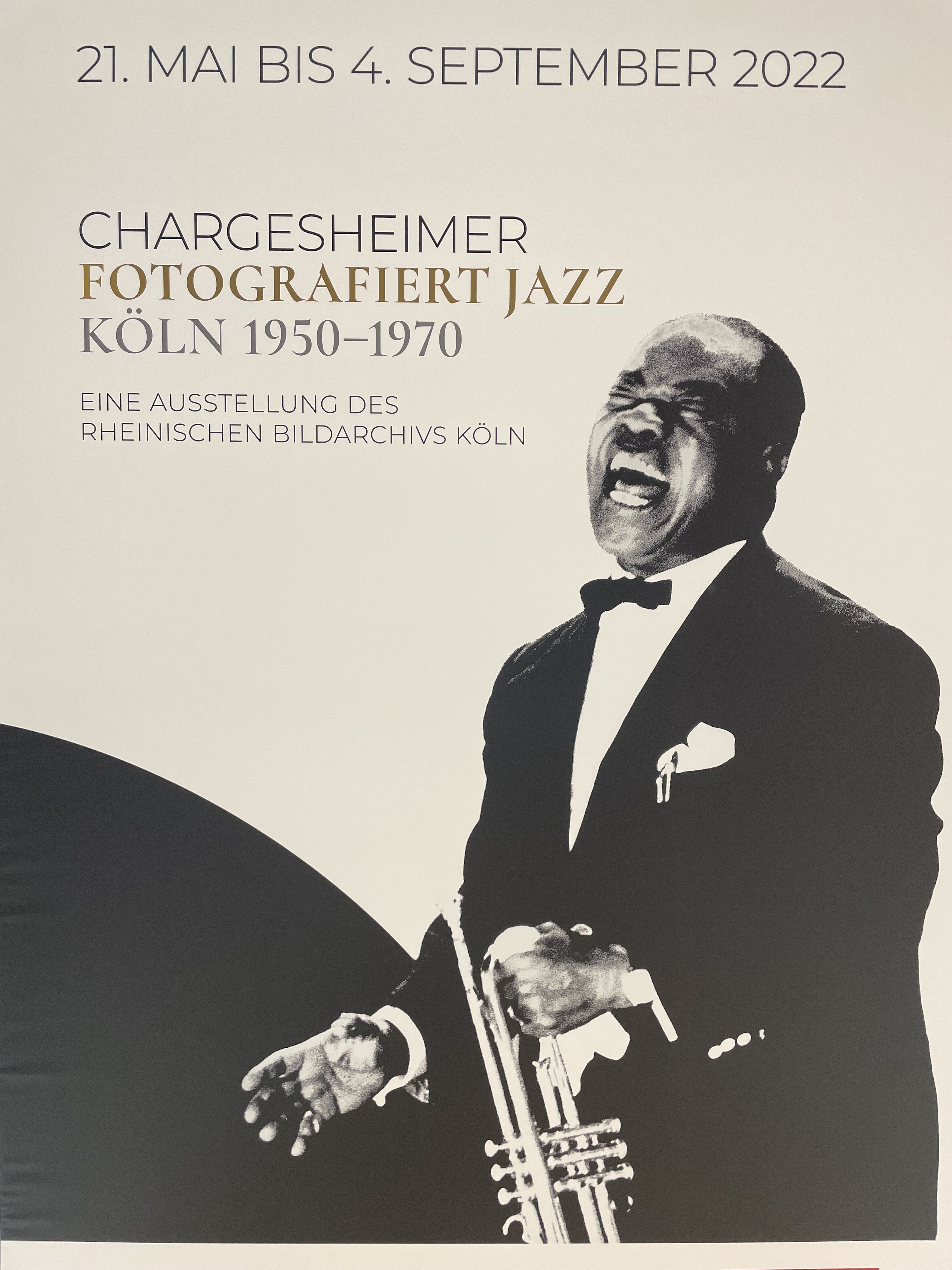
The hot weather has said goodbye and with it - perhaps - the adverse conditions that I felt almost haunted me (see day 3). I decided to start the day with an exhibition that is also featured by the festival. Entitled “Chargesheimer photographs Jazz“, it presents a look at an exciting chapter in Cologne’s musical history. The famous Cologne photographer Karl-Heinz Hargesheimer, who portrayed Cologne’s city history under his pseudonym Chargesheimer, photographed the city’s jazz scene in the 1950s and 1960s. His subjects included young Cologne jazz musicians as well as international stars such as Louis Amstrong, Chet Baker, Sidney Bechet, Duke Ellington, Ella Fitzgerald and Billie Holiday. 


The recordings were found in Chargesheimer’s extensive estate, which the city purchased in 1978. Making them accessible proved to be a real challenge. Chargesheimer’s films were stored in shoe boxes, which the photographer sorted rather intuitively and which were only marginally labeled. The contrast between the negative and the image as a vintage print, which was created by the photographer’s processing in the darkroom, is particularly exciting. The images and the very nicely curated exhibition itself are sensational, and it will be on view until September. That it is also free is hard to believe.


Then I went downtown to grab something to eat and on the way I came across some buskers that looked like the Italian version of the Buena Vista Social Club. They played smash hits like “Volare“ or “Don’t worry be happy“ with Italian lyrics. It was a total cliché but they were very good in what they were doing and had lots of fun. Me, too.

Joe Sachse Quartet

The fifth day of the festival presented its biggest star: Anthony Braxton. Together with Dieter Manderscheid’s Bassmasse (an orchestra consisting of 40 bass players), who was awarded a prize for his services to the Cologne jazz scene, Braxton played with his Lorraine Trio in the WDR broadcasting hall. And what did I do? I decided to go see the Joe Sachse Quartet at the Loft instead. 74-year old Sachse (guitar) and his fellow musicians - Manfred Hering (alto saxophone, 83 years old), Helmut Forsthoff (tenor saxophone, 77 years old) and Heiner Reinhardt (bass clarinet, 70 years old) - are all veterans of the GDR jazz scene, which makes them look completely out of time in the context of the festival. Their music, however, is a bit old-school but nevertheless modern, usually presenting a head in unison, then followed by a solo from one of the horn players. Sachse’s sound itself is a mixture of Jimi Hendrix, Derek Bailey and flamenco, in addition, he uses the corpus of the guitar for percussion interludes. What’s amazing is that although Sachse always seems very strained in his playing and the his style sounds a bit bumpy, he himself has great fun doing it and his whole approach is absolutely unique. It reminded me of a socialist idea of western rock-meets-jazz music, but the absence of distortion makes it pleasantly lack the typical macho attitude. On the last piece before intermission, the three horn players improvised freely, looping their runs around each other. There could have been more of that.

Gard Nilssen Acoustic Unity

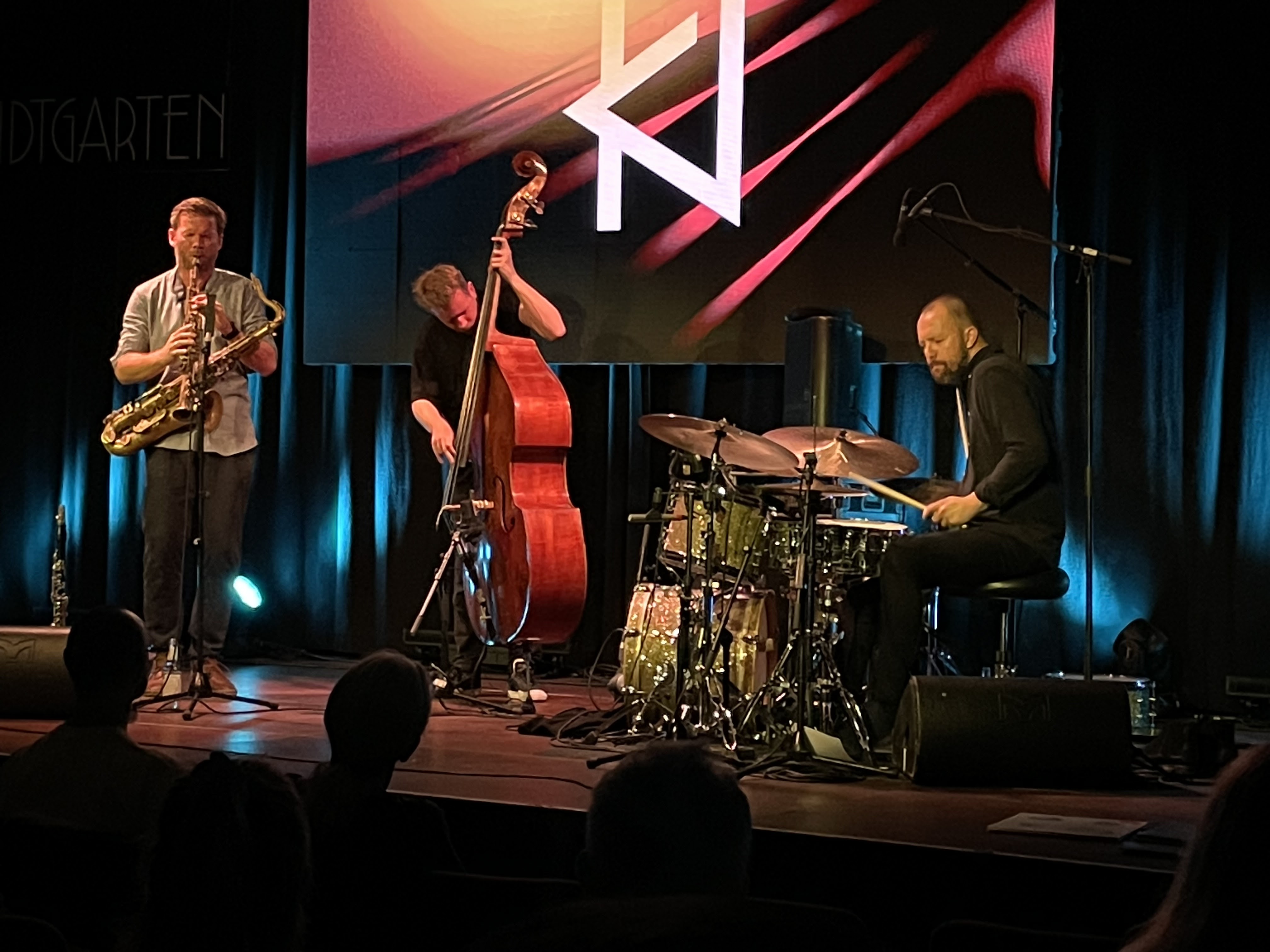
In order to see Gard Nilssen Acoustic Unity (Nilssen on drums, Petter Eldh on bass and André Roligheten on saxophones and clarinet) I had to hurry to the Stadtgarten, since it was one of the bands I definitely wanted to hear. The concert was the world live premiere for the new album Elastic Wave (ECM, 2022) and all in all a beautiful mix of hardbop, cool jazz ballads and free jazz, of subtle harmonics and alternating dynamics. At the center of Nilssen’s playing were drum rolls, around which he set his accents. This gave the improvisations a certain lightness, but kept them very focused. Especially in the first part, it was good to hear straight free jazz. In contrast to the album, much of it seemed less airy than the ECM production, but tighter. A nice, coherent concert.

---
See: Day 1 | Day 2 | Day 3 | Day 4 | Day 5

Ronny Graupe Off The Record - The Call (Out of the Shed, 2022)

By Paul Acquaro

Berlin guitarist Ronny Graupe's The Call opens with a bass and drum line that had me thinking of Dave Holland's opening on Gateway's 'Back Woods Song' - the moment is fleeting but it set my expectations high. Soon, the combination of vibraphone and guitar enter, setting the music off in a different direction entirely, ending the comparison but more than meeting my expectations.

Graupe's drizzle of notes turns into a cascade, with parts of the melodic lines doubled up by Dominik Bukowski's vibraphone. The piece settles into a syncopated exchange with bassist Phil Donkin and drummer Oliver Steidle and then quickly segues to the next tune, whose plaible rhythmic foundation opens ups the field for a enveloping solo from Graupe. By the time they reach the third track, 'Determination - There Are Only a Few' the group the momentum is strong and the ideas are flowing.

The Call is actually comprised of two suites - the one being described above, 'Determination,' and then later, 'The Call,' whose opening 'Enter' begins exploratorily but slowly brings itself to an intense peak, followed by number of knotty, melodic tunes. Each of the album's 15 tracks are short, averaging about three minutes each, and they are tied together thematically, flowing seamlessly - or purposely not -  together. Their length compresses the time, forcing the musicians to focus on the most salient parts in order to fit -- whether it is Graupe's flowing lines, Bukowski's choice chords, Donkin's sturdy basslines, or Steidles' colorful textures -- it all fits smartly together. The Call is modern and brainy, sleek but not smooth, digestible but requiring a good chew. 

Thursday, August 18, 2022

Cologne Jazzweek (Day 4)


By Martin Schray

Half-time at the Cologne Jazzweek and what has run like a thread through the week so far is the discrepancy between inconveniences during the time apart from the events on the one hand and the concerts themselves on the other hand. Initially, it was the heat and the noise that almost killed me, and then it was the loss of items. The most serious one was certainly the fact that my bank card was missing, which is why I have to rely on the help of my Cologne friends for cash. In addition, I’ve used a rented bicycle to commute between the various venues. Unfortunately, I lost the key for my bike lock and had to have it replaced (not for free, as you might imagine). Finally, after the first evening I left my pencil case in the Stadtgarten (I take my notes by hand), it hasn’t turned up again. I’d say I'm not on a roll right now. That’s why the concerts are the only consolation so far, and which is why I’m really looking forward to them.
 
Savannah Harris Trio

As a continuation of Monday’s concerts, I wanted to see the Savannah Harris Trio at the Loft the following night. She was already the secret star of the evening in Petter Eldh’s Projekt Drums, so I was curious to see what she could get up to with her own trio. The interesting thing about Harris is that she has a wide range of interests. Since she played with Peter Evans in his band Being and Becoming during the festival last year, I was interested whether she would choose a bit more ambitious path with her trio featuring Or Bareket (bass) and Mike King (piano) compared to the day before. However, to cut a long story short, the trio was also rather conventional modern jazz which oscillated between improvisation and tonal fixation, between shimmering pulse and concrete beat. The band’s music thrives much on dynamics and is based on the famous trios of jazz history - from Bill Evans to Ahmad Jamal to Keith Jarrett and especially Herbie Hancock’s trio with Ron Carter and Tony Williams (whose piece “This Night This Song“ they also covered). The music was not a simple reference though, the playing is expanded by tiny extended techniques here and there (especially by Harris). Mike King’s style is rich with arpeggios, trills and minor chords. Harris counters this with cascades on the cymbals and with her hard hits on the snare. Yet, her playing is characterized by great lightness. She also cleverly sprinkles in small hip-hop beats or drum’n’bass figures. The melodies of her original compositions are simple and folk-song-like, they become more interesting when the whole thing is thrown overboard and the band improvises intensely. However, this could have happened more often. I am curious how she will present herself in the trio with Tomeka Reid and Angelica Niescier.
 
Sons of Kemet

I left the show a bit early to get to see Sons of Kemet in time, who were playing at the CBE, a large tunnel-like vault. The concert was completely sold out, between 600 and 800 people crowded reminded me of pre-pandemic times. The audience was that of a rock concert, rather male, and they enthusiastically celebrated Shabaka Hutchins and his combo. All that distinguishes him as an instrumentalist, as a composer and bandleader, culminates in his his most successful project with Theon Cross on tuba, Tom Skinner and Edward Wakili-Hick on drums. The two drummers weave a polyrhythmic web reminiscent of John Lurie’s National Orchestra (does anybody remember them?). On top of this, Hutchings sets his wild agitprop sound, which is also interrupted by hard free jazz passages. Stylistically, the music oscillates between Afro funk, reggae and hard techno. Theon Cross’s tuba sounded like an extremely low bass and the whole thing presented itself as a trance-like happening that was enthusiastically received by the crowd.

Unfortunately, after 10 years together the band is going to split up when they complete their 2022 tour. This is particularly sad, for their vision of jazz was one that pointed to a possible successful future for this music.
---
See: Day 1 | Day 2 | Day 3 | Day 4 | Day 5

Cecil Taylor - Respiration: Live in Warsaw ‘68 (Fundacja SÅ‚uchaj, 2022)

By Gary Chapin

Respiration adds to the Cecil Taylor oeuvre a nearly perfect 43 minutes of Taylor’s solo power recorded at a beautiful level of quality. It comes from early-ish in his career—it’s always surprising to me, even though I know the history very well, how early Taylor was going this far away from the rails—when he had only just cemented his mature vision ( Conquistador! and Unit Structures were 1966). It feels as joyfully playful for him as it does for him as it does for us.

It’s hard to tell sometimes, when I listen to new (to me) Taylor, what qualities the recording brings and what frame I bring. What once (20 years ago) seemed wonderfully outrageous to me now feels like excellent storytelling. As I get older, Cecil Taylor gets better and better. Can that be right? Of course it can.

Wednesday, August 17, 2022

Cologne Jazzweek (Day 3)

By Martin Schray

The third day of the Cologne Jazzweek offered a large program, from seven gigs I chose three with a real focus on jazz rock, as it turned out. The odd man was a trio by Berlinde Deman on serpent (a reed instrument) and electronics, Elisabeth Coudoux on cello and electronics and Matthias Muche on trombone, which opened the evening. The performance took place in the Stadtgarten’s Green Room, a nice euphemism for an outdoor concert.


Matthias Muche, Elisabeth Coudoux, Berlinde Deman  

The trio immersed themselves in sound explorations, supplementing their instruments with all sorts of extended materials such as hoses, water glasses or small motors. Due to the fact that the concert took place the open air, parts of the soundscape were also ambient noises, joining the sounds created by the musicians. Footsteps on the gravel, snatches of conversation, fume hoods, the opening of water bottles, background music from the adjacent rooms - all this had an effect like John Cage’s “4:33“, since exploring silence was also part of the concept. However, it was most beautiful when the musicians designed sweeping melodic arcs, which one or two of them then countered with atonal sprinkles. Doing this, they generated some kind of whacky chorale. All in all a very nice start for the musical day.

After that I grabbed something to eat and met Louis Rastig, the organizer of the À’larmé! festival, who had just arrived to see three days of their sister festival. Seeing him reminded me of how much I missed his excellent, unique announcements.


Petter Eldh’s Projekt Drums

In the day’s center of interest should then be Petter Eldh’s Projekt Drums, a group based on an album on which Eldh employed different drummers for each track. He had already played at the Jazzweek last year, and at that time the organizers tried to persuade him to bring Projekt Drums to the stage in Cologne - ideally with Savannah Harris on drums. Eldh was skeptical at first, but then agreed, making it a world premiere live - and he seemed to enjoy every minute of it a lot. Yet, those who know Eldh from projects like Koma Saxo, Gard Nilssen's Supersonic Orchestra, Punkt Vrt. Plastic or Amok Amor, were at least surprised. Projekt Drums is flawless jazz rock, with all its advantages like excellent musicians (Savannah Harris on drums, Wanja Slavin and Tapiwa Svovse on saxophones and Tom Ford on guitar), but also with its inconveniences. There was little room for improvisation, instead there were many clearly marked heads, often presented in unison. Ford’s guitar was strongly in focus, sometimes his playing reminded a bit of Pat Metheny. Eldh himself, actually a bassist, was often heard on synthesizer and electronics, clearly steering the direction of the pieces. The whole thing sounded like Aphex Twin trying his hand at jazz, or it was reminiscent of Sons of Kemet (especially the unison parts of the reeds), but without their urgency and fury. The best piece was based on a sample by a Scandinavian composer, managing to build a free-floating atmosphere. The audience loved the band and enthusiastically demanded an encore. I, on the other hand, have to say that Projekt Drums was not my cup of tea. However, Savannah Harris on drums was absolutely convincing. And she still has two gigs with other bands at the festival.

Bushman’s Revenge

That Bushman’s Revenge also sail the Jazz Rock realms was already known in advance, but seeing that Even Hermansen used a Vox amp (a personal favorite) gave me hope that the guitar sound would definitely be great. Gard Nilssen, the drummer, described himself, Hermansen and Rune Nergard on bass as an old married couple, but that turned out to be positive throughout (for example how they dealt with sound problems in the last piece of the show). Bushman’s Revenge managed to create atmosphere at all times, Hermansen sometimes sounded like John Abercrombie, pearly and crispy, but then again like a weird mixture of Jimi Hendrix, ZZ Top’s Billy Gibbons and the unjustly almost forgotten Joe Baiza of Universal Congress Of. The secret of the band is that the guitar sound is clearly oriented to rock, while the drums are more jazz. In addition, Nergard’s bass remains stoic on maintaining a rock-solid base, in this not unlike their label mates from Fire! Hermansen’s sprawling guitar solos drew raves from the audience; if the band had played Woodstock in 1969, they’d probably had become superstars. Definitely a first highlight of the festival.


--
See: Day 1 | Day 2 | Day 3 | Day 4

Keefe Jackson/Oscar Jan Hoogland/Joshua Abrams/Mikel Patrick Avery - These Things Happen (Astral Spirits, 2022)


This one’s going on my list of “joyful” albums of 2022. Saxes, piano, bass, and drums explore the space of the characters of jazz—as in “That guy’s really a character!”. Monk’s “Epistrophy” sets a tone and intention. The quartet plays with downtown eyebrows, arched with (non-ironic) humor and a little swagger. It’s a short set, an EP, which is a reason to lament. I want more.

The three other covers are Monk’s “Bemsha Swing,” “Gotta Get Some Sleep,” by Dewey Redman, and “The Happenings,” by Herbie Nichols, who doesn’t get covered nearly enough. As much as Jackson’s sax is the lead voice, this feels sort of like a pianist’s album. Oscar Jan Hoogland seems to have the history of jazz piano at his fingers. Yeah, he’s building on the magisteria suggested by Monk and Nichols, but he’s using it to craft his own vision (he did all the arrangements).

His playing brings out hints of New Orleans and early swing. On his original “Aahanghuis,” he leans into Ellingtonian exotica such that I half expect to hear the quivering Cotton Club clarinet section come in. His other piece, “Wimpel,” is a lovely ballad with an askew and charming mid-tempo middle section that makes for one of the most satisfying tension/release moments I’ve had this year. “Bemsha Swing” is a far out deconstruction of the tune that demonstrates how far you can go and still be informed by the post-bop Monk ethic.

Jackson’s playing is broad and warm throughout. I’ve had occasion before to comment on his way with repetition. It brings Mal Waldron to my mind (it’s always good when Mal Waldron comes to mind.) Abrams and Avery provide the (intricate and empathic) sets for this theater, and change them in ways that add to the drama, rather than just support it.


Tuesday, August 16, 2022

Cologne Jazzweek (Day 2)

By Martin Schray

Apart from the music, the defining aspects of the last two days have been the noise and the sweat, especially when they occur in combination. The unbearable, long-lasting heat, particularly in the west and south of Germany, makes it very difficult to stay outside. Nevertheless, you do that because you can’t just hang around at home. However, as soon as you get back and somehow want to get some rest, you start to sweat indoors - unless the rooms are air-conditioned (and that is hardly the case in Germany). The sweat mercilessly seeps out of all your pores. Even at night it hardly cools down, so that even open windows are of little use. If then loud music is played on the streets and people rage through the streets, it becomes difficult with the necessary sleep. All the more, you hope that the music of the festival is able to provide a little comfort.

Unlike the first day of the festival, when it was possible to attend all three concerts because they took place at the same venue, from the second on you have to choose. There were five shows on the program, starting with Almut Kühne/Francesco Bigoni/Mark Slobbery in the Green Room of the Stadtgarten, then Christopher Dell’s Das Arbeitende Konzert (The Working Konzert) at the Loft, followed by Real Live Jazz (Alexei Aigui / Dietmar Bonnen / Lothar Burghaus) in the Filmhaus and Laura Totenhagen / Eve Risser / Maria Reich (again in the Stadtgarten), before Deadeye brought the day to an end at the Jaki. I have to say that I like the concept of having to choose between several acts, because then you don’t run the risk of getting too much - especially if you consider that the festival lasts eight days. For Sunday I chose Christopher Dell and Laura Totenhagen / Eve Risser / Maria Reich.

Christopher Dell’s The Working Concert

The decision for Christopher Dell’s The Working Concert was also made because it took place at the Loft, one of my favorite places for improvised music in general. Before the concert started, the audience was given some helpful information. While the The Working Concert project has been around for a while, the formation that day was a world premiere, although it was the ninth revision of the idea. The ensemble consisted of Dell on vibraphone, Elisabeth Coudoux on cello, Kathrin Pechlof on harp, Anna Neubert on violin, Evelin Degen on flutes, Pascal Klewer on trumpet and Stefan Karl Schmid on clarinet. Dell explained in advance that there would be three blocks of 30 minutes each plus breaks. The breaks would also be part of the concept, as would the discussions of what should be played. The question of the concert itself as a medium would be crucial. Attitudes as to playing would also be addressed (e.g., the musicians’ relationship to notation). Basically, the music was divided into so-called form blocks, which were very different. And this was then proven. The first form block was almost pointillistically plucked, with the composition repeatedly condensed and equalized by means of speed and volume, resulting in great intensity. Form block 2 was a concerto for harp and ensemble, which was a diametric contrast to form block 1. Dell only conducted here, and the harp took center stage only very briefly. Rather, the composition seemed to consist of many small parts, which Dell always introduced and ended with a hand signal. The third form block was then even more gauzily dabbed than the first; it was an exercise in silence almost reminiscent of John Tilbury’s celebration of his 80th birthday (ironically, also at the Loft). The notes were presented as light as a feather, as if one didn't even dare to play them. As a sequence, they often resulted in ravishing arpeggios.

The second part of the concert began with a discussion of what to play. Dell made several suggestions, and they were accepted without objection. In general, it can be said that Dell, unlike his other ensembles, kept a very low profile. Actually, the project seems to be based on a striving for transparency. In the second part of the second block, Klewer, Coudoux and Neubert played a trio that perhaps came closest to the term “jazz“. What was exciting here were the various timbres that emerged sharpened by the trio context. Unfortunately, I had to leave the concert after the second part in order to still be able to see Laura Totenhagen/Eve Risser/Maria Reich in the Stadtgarten.

Eve Risser/Maria Reich/Laura Totenhagen
 

Since I had to walk to the next venue I came there just in time to experience something which turned out to be the exact opposite of Theo Beckmann and Billy Test the day before. Laura Totenhagen (vocals) didn’t sing lyrics or even words, instead she presented the whole spectrum of human emotions and the sounds around us. She hummed, chirped, cooed, croaked, she sounded like a church bell, like a cuckoo, she squawked like a toddler, imitated water drops - sometimes I thought she sounded like the entire sound spectrum of a stalactite cave. She was supported by Eve Risser on prepared piano, whose percussive playing complemented Totenhagen very well. The same was true of violinist Maria Reich, whose sweeping melodic arcs rounded out the whole. As an approach, I liked that much more than the duo on the first day. Unfortunately, the trio decided to add a 20-minute piece after the first one, which already lasted about 40 minutes. That was a bit too much of a good thing.

All in all, the music did provide some comfort to the stress of the day. Since the street party in front of my hotel was over and the weather forecast promised some lower temperatures there was the chance to get some sleep.

--
See: Day 1 | Day 2 | Day 3 | Day 4 | Day 5

A L'ARME Festival Vol. 10 (Part 2)


By Paul Acquaro

My first visit to A L'ARME was for it's second installment in 2013 when I was still bedazzled by the shaggy chic of Berlin. It was there that I met up with my Free Jazz Blog colleague Martin Schray for the first of many times at the festival and took in the neighboring 'beach bar,’ just one of many that dotted the Spree river as it flowed through the city. These were typically scrappy shacks on the sandy river embankment that sold bratwurst and a beer for three euros and may or may not have offered a volleyball net for anyone interested in gathering a group to play. Nowadays, these have been mostly replaced by luxury condos and office buildings. 

This evening, next to the Radialsystem's grounds, a building was going up where the sand bar used to be, a luxury condo building, lots concrete and glass. "Things change," I thought, as I dug through the crates of LPs and CDs offered by the local dealer, No Man's Land, "but it doesn't seem that I will."
 
Nakama. Photo by Carlos H. Juica.

Tonight's program was the most free jazz of the nights, starting with Nakama. The Norwegian group's inspiration comes from Japanese culture, or as the program states, they "mix Japanese anime, minimalism, and Zen Buddhism." The group is Christian Meaas Svendsen on bass, Andreas Røysum on clarinet, Klaus Holm on saxophone and clarinet and Ayumi Tanaka on piano and Andreas Wildhagen on drums, and their music runs the gamut from said minimalism to colorful free improvisation. In the main hall, the group began quietly, with only a sprinkle of notes from the piano and breath from the woodwinds. Meaas Svendsen, in a hushed voice, recited lyrics. As the intensity of the band slowly increased, they achieved a delicate bittersweet balance between hope and despair. Between the hopeful chord voicing from the piano and darker tones from the others, they created an uncertain atmosphere that lasted until an extended drum solo. After, chanting from Meaas Svendsen began anew, and the two woodwindists engaged in a fluttery exchange. This clarinet duet grew stronger and more melodic with slight dissonances, then more dissonant with slight melodic moments, and finally to a folk-like melody that the band took over. Then came my favorite moment - nothing can squeal and squawk like a bass clarinet, and Røysum's turn on the instrument did just that, playing fantastically inside and outside tonality. A second piece, apparently based on the Sony PlayStation zombie game "Last of Us" gave saxophonist Holm the opportunity to play an evocative micro-tonal solo on his alto. The group ended with a hushed plink plonk of sounds and a recitation of a Buddhist chant.


(L-R) Macie Stewart, Ludwig Wandinger (out of view), Ken Vandermark

The trio of next set came together through an unfortunate situation. Percussionist Claire Rousay, who was scheduled to play with woodwindist Ken Vandermark and violinist Macie Stewart, had been in a car accident in the U.S.. Luckily, she was reportedly not severely injured, nonetheless, unable to travel. Her replacement was Berlin based drummer Ludwig Wandinger, who seemed to actually be quite a natural fit with Vandermark and Stewart, whose own musical relationship now spans many years with the group Marker and other projects. This evening, Vandermark kicked off the set with a burst of notes, Stewart reacted with a blend of violin and voice, and Wandinger used a foil space blanket atypically for rhythmic purposes, after which he focused on his drum kit and a bit of electronics. The trio acted as a cohesive organism, listening and reacting closely, for example, pointed, high energy moments would suddenly stop, almost telepathically. Wandinger's drumming was strong, but lithe, and Stewart instinctively wove her sometimes gentle, sometimes assertive, textures around Vandermark's clarinet or sax playing. It was a wonderful set of free improv, mostly acoustic with just a smattering of electronics thrown in by Wandinger. It was pretty damn perfect.


Frank Bretschneider and Jan Jelinek

The synthesizer work of Frank Bretschneider and Jan Jelinek followed in the same hall. The two Berlin based electronic musicians used modular synthesizers to create an evolving sound-world. The video screen above the stage added quite a bit to the performance, filling in a missing element of electronics shows, namely, how one ’see' the music making. The video, providing a changing perspective of the performers, offered at times a birds-eye or ‘hands-on’ views. The audience could see all of the switches and controls, a joystick that was used to bend the waves or control the attack, giving a more visceral feeling to the performance. Through these complex set ups the musicians created drones, crafted sine waves, and stirred the sense with oscillating bass frequencies.


Vincent von Schlippenbach, Farida Amadou and Warren G. Crudup III

The final set was by bassist Farida Amadou, who, like Vandermark, was a return performer to A L’ARME, with drummer Warren G. Crudup III, and DJ Vincent von Schlippenbach (a/k/a DJ Illvibe). The trio effectively blended the bass and drum format with the exploratory vibe of a free jazz concert. It seemed that without any preconceived notions, the group went at it with at it with fervor. The first out of the gate was Schlippenbach, whose dynamic scratching invited Crudup and Amadou to play a simple beat to begin. Heads started bopping and it seemed to be starting out as fairly straightforward, danceable set, however, it wasn’t too long until Crudup began shifting the beat around, separating from Amadou, who’s plectrum struck precise and thick notes and who then also began bending time. Slipping in and out of each others rhythmic orbits, Schlippenbach held the center with his textural samples and scratching. Sometimes slowing down to search for a new core idea, the group mixed the hypnotic joys of drum and bass with the excitement of free improvisation.

A L'ARME Vol. 10 still had one more night to go, and the program looked like a solid cross section of all the bold styles that the festival has been covering since 2012. A nice way to wrap the tenth anniversary ... onward to 2023! 

--
See: Part 1 | Part 2