Click here to [close]
Showing posts sorted by relevance for query Thurston Moore. Sort by date Show all posts

Monday, March 5, 2018

Two Ways of Using the Guitar: Thurston Moore and Loren Connors

Thurston Moore & Umut Caglar – Dunia (Astral Spirits, 2017) ***½

Loren Connors – Angels That Fall (Family Vineyard, 2017) ***½

By Daniel Böker

Two ways of using the guitar. I brought these two very different approaches together because there is a wide range of sounds and aspects that keep the guitar interesting, even after all these years. Maybe there is a connection to my own biography as a listener. First there was a-ha, I have to admit. Then there was the music my elder brother listened to, funk and soul. That had a great influence on me. But my next great influence, and that has never stopped was the sound of a guitar, and the fascination still sticks with me, always searching for new sounds. This brings me to the two albums here that I chose to write about.

First, Thurston Moore & Umut Caglar – Dunia. It is first and foremost a Thurston Moore album. An album as we know it. Just type his name in the search button on the Freejazzblog and you will find a whole bunch of reviews. That is because he is all over the place. He cooperated with almost all the 'big names' in the improvised music scene, and it is a pleasure to see or hear him play.

His sound, his way to treat and play his guitar is recognizable. That is with both his 'incarnations' with the song-oriented pieces with Sonic Youth and on his solo albums and with the improvized music, along with all the other 'heroes' like Mats Gustafsson, The Thing, Merbow, Joe McPhee, John Zorn, to name a few.

As I said his sound is recognizable, and this year for the first time I was bored, at least with his new solo album Rock'n'Roll Consciousness. I heard nothing new, nothing surprising. So I was a bit skeptical when I had the chance to review his collaboration with Umut Calgar. Would I meet just the same familiar sounds and structures?

On the one hand it is exactly that. It is, as I said in the beginning, a Thurston Moore album and following the question of what the guitar can sound like, Moore formed his answer years ago. He is in most parts refining the grammar and the vocabulary at this point, but he won't learn a new language.

While I listen to the album Dunia, I realize that it is not necessary to learn a new one. The one he is capable of is in this case sufficient to keep me listening with interest.

Caglar and Moore seem to speak the same language. (And from now on I will leave this image behind.) The two guitars fit together well.

The first track 'Kensaku' starts off with a lightness of sorts. The two guitars start with some high tones, some scratching over single strings and the more like that. That gives both players the opportunity to show their different sounds and their ways to play. As in a good movie (to pick another arbitrary image) you often know the end beforehand and the interesting question is how the protagonist will get there.

It is already clear in the beginning that the duo will reach a state of sheer noise and will build a so called wall of sound. And so they do. So the interesting question is, how will they get there? And in this respect they both do a good job. Especially with the first track.

The second track 'The Red Sun' is almost already there when it starts. Maybe it is too harsh to say that the variations in the wall of sound are not that big. I don't know how it feels to play such sounds. For me as the listener to this noise the power is very impressive but after a few minutes I realize that I am searching for changes. There are changes. of course, but the dominating impression it leaves with me is the power, the wall of sound, the end of the story without telling the beginning.

So Dunia is an album played in the language Moore developed throughout the years. It adds some words to it. And that is worth listening to it.

Second: Loren Connors – Angels that Fall. Connors on the other side chooses a completely different way of using the guitar. The album reviewed here is just a short detail of his output. Short because it is only one track of 17 minutes, a one-sided vinyl. And 'only' because it is one of his latest releases and we try to be as near to the present as possible with our reviews.

But writing about this album is also writing about Conners and I admit I like his sounds, his music a lot. It is a completely different and sometimes it sounds as if the guitar of Loren Connors was a total different instrument than the one Thurston Moore is playing. (I guess that is exactly what I've always liked about the guitar, it has an almost unending wide range of sounds and possibilities.)

There is a lot of echo on this album, also with other recordings Connors has released. There is a lot of echo and a lot of space. It is not silence exactly, but he has the time to wait for the next tone, the next sound, to add

There is a calmness to the music of Loren Connors that is almost unique. On Angels that Fall there is a constant swoosh of a background noise. Listening carefully you can hear him work his guitar. He uses the strings (of course) but also the corpus of the guitar. And he uses the silence in between.

Writing about all the calmness and silence it would be wrong if I created the impression of a slow or even boring album. (Album might be a huge word for just one track. This is actually one reason why I didn't rate it with four stars.)

Exactly that waiting for the next tone for the next thing to happen creates a great intensity. Near the end of the track there are percussion like sounds and the whole track gets louder and stronger, and then for a few last notes he changes the instrument and plays the piano with the same concentrated calmness he's played the guitar.

For sure Connors also has his own language he developed with and for his instrument. And with this language his sound is recognizable. But it is a total different language. He builds tension through calmness and it carries a dark notion with it sometimes.

His work is definitely worth a try.

And for me the guitar is still one of the most interesting instruments.


Sunday, May 17, 2015

Thurston Moore and Mats Gustafsson Round Up: Day 2

The Thing & Thurston Moore – Live (The Thing Records/Trost, 2015) ****½ 

By Martin Schray

Many people speculate on what kind of music Jimi Hendrix would have played if he hadn’t died on September, 18 in 1970 at the age of 27 only. His last regular album, the live recording Band of Gypsys, was more open to jazz, funk, rhythm and blues and jam elements, maybe due to the fact that he had a different rhythm section (Billy Cox on bass instead of Noel Redding; Buddy Miles instead of Mitch Mitchell on drums). So, what kind of music might he have made? In my wildest dreams I can imagine Hendrix playing with all kind of creative improvisers like Joe McPhee, Pharoah Sanders, Archie Shepp, Ronald Shannon Jackson or Peter Brötzmann. Especially in the band of the last two musicians, Last Exit, he would have been a great alternative to Sonny Sharrock. What such a line up might have sounded like you can experience listening to The Thing and Thurston Moore.

The Thing (Mats Gustafsson on saxes, Ingebrigt HÃ¥ker Flaten on bass and Paal Nilssen-Love on drums) have always been a blues/hardrock band in a jazz disguise, there have always been Led Zeppelin, Blue Cheer or White Stripes elements in their music (even if it is based on free jazz in general). And with Ex-Sonic-Youth guitarist Thurston Moore and Gustafsson’s and HÃ¥ker Flaten ‘s decision to use only the baritone saxophone and the electric bass the rock/noise influence is even more obvious.

Live consists of two long tracks, “Blinded by Thought” and ”Awakened by you“, which both lead to spectacular riffs at the end of each piece – “Blinded  by Thought” flows into a monotonous monster rock riff while “Awakened by you” ends with a blues theme reminding of Willie Dixon’s “Hoochie Coochie Man”. Both endings are initiated and held together by Ingebrigt HÃ¥ker Flaten’s bass guitar, so that especially Gustafsson can growl and cry and Moore can contribute a whole wall of noise texture. There is a real increase as to intensity and expressivity in both tracks as well, since they start in a rather meditative mood (the first one a dialogue between Mats and Moore, in the second one the whole band is involved with Gustafsson and HÃ¥ker Flaten responsible for the melody).

Live is like a mad rodeo ride, with Paal Nilssen-Love as the horse which is bucking and bitching, and the others are like pyromaniac rough riders always setting new blazes. Hellish, exuberant, devastating, delusional – great!

Play it loud and feel free to headbang now and then. Still my favorite band!

The album is available as a CD and on vinyl.

You can buy it from the label (http://thethingrecords.com/).

Listen to it here:


And here are two live gigs:


Merzbow/Mats Gustafsson/Balázs Pándi/Thurston Moore - Cuts Of Guilt, Cuts Deeper (RareNoiseRecords, 2015)


By Paolo Casertano

I tried not to review this album. Frankly. Most of all because sometimes I think that the blog over-covers (I admit I might be one of the most suspected about it) the production of some artists that supposedly don’t need anymore to be praised for their incontrovertible value.

We have here gathered a noise living legend, a ubiquitous (I mean this as a wish, Mats should be in schoolbooks!) saxophone ace and cultural firebrand, the guitar soldier that - you like it or not - has been among the few real sound-shapers of what we have listened in the last decades, and finally a young constantly growing drummer (no pressure on his shoulders). They do exactly what you may expect they do. Dangerous whistles, drillings, aural scratches, nitrites, trumpeting (I mean the one made by an elephant not by the notorious instrument - this must be specified), relentless hammerings, sweat, guitar swaths, the ignition of a rocket, whirlpools, condensation, slackening, whirling ascent and descent, fire cracks, strings and magnets tortures, noise shreds unravelling from a sound stream, a sound stream submerged by noise shreds, wounds, probably a couple of holes in the amps, maybe some corpses too. Without warning - and then with some disorientation for the listener - also some quiet moments opening and closing act three. Again and again. And again. Both for a too long and for a too short lapse of time. And they master all this hell as really few people can do. Rating this would be as rating the Pope for the way he celebrates Mass.

So, all in all, why should I not review this? I have just listened to it - undoubtedly and respectfully with in-earphones (I’m not a poseur guys!) - for the third time and I am noticeably confused and soberly happy.

Once in a while I went for the digital. The label provides also the HD FLAC 24bit/96kHz version, so that this maelstrom sounds particularly bright and analysable. All the other formats are also available.

Thursday, May 26, 2022

Dave Tucker, Pat Thomas, Thurston Moore, Mark Sanders - Educated Guess(es)

Dave Tucker, Pat Thomas, Thurston Moore, Mark Sanders - Educated Guess, Vol. 1 (577 Records, 2021)

Dave Tucker, Pat Thomas, Thurston Moore & Mark Sanders - Educated Guess, Vol. 2 (577 Records, 2022)

By Stuart Broomer

“I assume that he was shut up in that oval shaped studio and subjected to weird electronic music, which caused psychological confusion. Then, when he started to feel sick, he was given intermittent barrages of ultrasonic waves. I think that Waga knew that Miyata had a weak heart. In order to seal Miyata’s lips, Waga killed him by using electronic music and ultrasonic waves to cause a heart attack. I would like to stress that this is a method of murder that has not existed before.”

Seicho Matsumoto,

Inspector Imanishi Investigates (1961)
English translation: Beth Cary (1989)

Dave Tucker is a long-standing member of England’s free improvising community, including membership in the London Improvising Orchestra and numerous small ensembles. His notable small group recordings include Homework (Grob, 2001) by School of Velocity (a quartet with Evan Parker, John Edwards, and Steve Noble) and Scatter (FMR, 2007) with Phil Minton, Pat Thomas and Roger Turner. By free improvisers’ standards, Tucker doesn’t record often, but when he does, it counts. That certainly holds true for Educated Guess, a title based on Tucker’s positive expectations when forming this quartet, in which he plays guitar and electronics with Pat Thomas on piano and keyboards, Thurston Moore on guitar and Mark Sanders on drums and percussion. Recorded at Café Oto on March 4, 2020 (immediately prior to the lockdown), the first and second sets as two separate volumes, the first in April of 2021, the second in May 2022.

There’s a certain shift in character between the sets. The first emphasizes electronics, often with Tucker and Thomas both exploring the electronic ends of their palettes. There’s an initial passage of tweaks, brrrs, twitters and blips, sufficient to suggest that the astronauts have arrived at the electronic heart of the alien planet; however, it’s anything but unpleasant; rather, it’s a playful celebration of possibilities, friendly oscillators and slightly self-conscious sirens. The two tracks feel, as the titles declare them, like 'The New Normal Part 1' and 'Part 2'. A drill-like fusillade might suggest a potential-press roll from Sanders, whose own role in this is at times a metallic animation of other materials. The more one listens to this, the less one cares about the dialogue between acoustic and electronic elements: it’s the collective creation that matters, and once divorced from the original space of its creation, the music wholly assumes a life of its own, the electronics as consciously crafted and as subtle as acoustic materials, even feeling familiar and melodic, almost autonomous. There’s an early extended passage in which Thomas concentrates on the lowest range of the piano, creating a near-funeral ambience. A certain compulsion to listen to the paths of individual voices is gradually overridden; if Thomas’s keyboards and Tucker’s electronics blur, or Moore and Tucker’s guitars overlap, it’s entirely the point, and even the propulsive role of Sanders’ drums can slip into a collective animation. Individual agency disappears into the collective experience, one of the most “natural” fusions of noise, electronica and acoustic instruments you’re apt to hear.

The second set changes those associations. Thomas’s emphasis turns to the piano, and it’s an immediate focal point. 'Everything Is Something Part 1' begins in sustained dissonant chords around which muffled guitar sounds and light metallic percussion assemble. The music becomes increasingly spacious, shaped by the contrasting electric guitars, one altered, the other initially clean, the two gradually converging with varying timbral mutations, a dialogue as alien and “normal” as the electronics of Vol. 1. Then a kind of light dance figure emerges, sounding almost like a music box, with a degree of eeriness. It gradually turns into a guitar and a kind of dreamscape that’s distinct from the playfulness. As the ensemble grows, marked by Sanders and the distorted guitars, there’s again the suggestion of a hive mind as well as a hive, as if the music does not arise as a process of exchange but as a continuous collective development in which parts literally emerge continuously rather than as “individual” contributions, including a theremin-like melody that, though utterly unpredicted, sounds inevitable. Thomas’s piano is even more central to the brief 'Part 2', strikingly fleet, simultaneously precise and evanescent, but again a natural continuum, the stream-like flow of the group’s imagination defining it, a conversational flow brought to material and associations that are also somehow alien, a kind of collective automatic writing.

Volume 1 is available as yellow or black vinyl, CD or download; Volume 2 as CD or download.

Wednesday, March 14, 2018

Thurston Moore / Adam Gołębiewski - Disarm (Endless Happiness, 2017) ***½

By Eyal Hareuveni

Iconic experimental guitarist Thurston Moore explained recently what is his own Rock n Roll consciousness, the title of his recent solo album (Ecstatic Peace, 2017). Rock n Roll consciousness is actually about sex. When Moore’s defunct group Sonic Youth visited the Rock and Roll Hall of Fame Museum, he learned that the term Rock N’ Roll was an African-American slang for having sex. It took Moore some time to absorb this kind of realization and in a recent interview to Rolling Stone he already identified with this kind of logic: “sex is nature, and nature is everything, and then rock & roll is everything.”

Moore brings this kind of Rock n’ Roll consciousness to a series of free-improvisations with Polish experimental drummer Adam Gołębiewski. Indeed there is no doubt that they were channeling the passion, emotional intensity and the totality of the experience in the halls of Warsaw and Gołębiewski’s hometown, Poznan, in May 2014, when these sessions were recorded.

Moore and Gołębiewski met and played together for the first time in 2013, in a trio with Yoko Ono. Gołębiewski had already played with innovative improvisers as reeds player Ken Vandermark, cellist Fred Lonberg-Holm, trumpeter Mazen Kerbaj and Moore’s frequent collaborator, sax titan Mats Gustafsson. Like Moore, Gołębiewski seeks to extend and expand the sonic possibilities of his chosen instrument.

Moore sets the atmosphere of the first piece “Disarm” with free-associative, series of thorny, feedback-laden sonic collisions. All Gołębiewski attempts to discipline this abstract flow of fast-shifting collisions with some loose, rhythmic coherence fail and this improvisation heads into more physical and more brutal confrontations. But Moore and Gołębiewski did not lost faith in each other. Soon on the following “Distend” both calibrate on an immediate, noisy frequency and act as one wild, freakish entity that threatens to crash all on its way. The short and sparse “Disturb” serves as a suggestive, teasing interlude before Moore and Gołębiewski race after each other in another set of intense physical collisions, some explosive ones, others surprisingly comforting and caressing, all totally exhausting. The last piece, “Dislodge”, summarizes the essence of Moore and Gołębiewski's interactions - stormy, dissonant and noisy but at the same time attentive, curious and urgent.


Saturday, May 16, 2015

Thurston Moore and Mats Gustafsson Round Up: Day 1

By Matthew Grigg

Thurston Moore and Mats Gustafsson have a longstanding musical relationship, captured across numerous releases with a variety of projects and personnel. Over the next two days we'll look at recent offerings which find the pair together in action. 

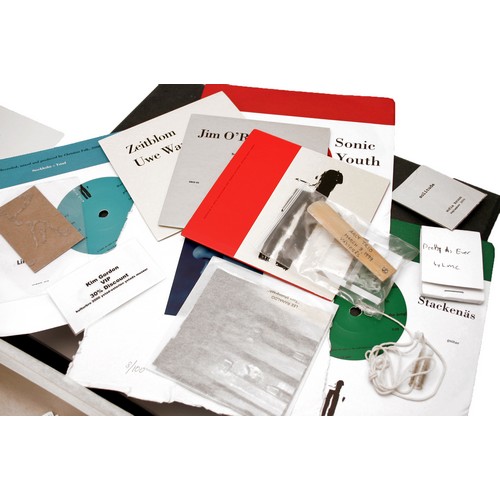
The earliest available recorded documentation of Moore and Gustafsson playing together can be traced back to an improvised 1999 session at Sonic Youth's Echo Canyon Studio, 'New York - Ystad' (featuring a quartet of Moore and Gustafsson, with SY's Lee Ranaldo and Steve Shelley) formed part of a box set (which included a 7" of Gustafsson with Sonic Youth from Kongsberg Jazz Festival in 2000, alongside signed reeds from 150 different Gustafsson gigs, amongst other objects) released on Gustafsson's and Thomas Millroth's Olof Bright label to commemorate a week of concerts in Ystad, Sweden 2000 which featured Sonic Youth. From that week the first Hidros 3 recordings were made (credited to Mats Gustafsson/Sonic Youth With Friends) which were eventually released in by Smalltown Supersound in 2004. 

Moore and Gustafsson, alongside then Sonic Youth member Jim O'Rourke, formed Diskaholics Anonymous Trio, a group who exclusively booked concerts in places which had record shops they wanted/needed to visit. Original Silence, a sextet which sees the Diskaholic Trio augmented by ex-Zu bassist Massimo Pupillo, The Ex's Terrie Ex and Paal Nilssen-Love, has released two LPs of blistering free rock to date. A live set featuring the pair with Chris Corsano and Bill Nace (Vampire Belt) was released jointly on Moore's Ecstatic Peace and Nace's Open Mouth labels. Gustafsson also appeared, with Merzbow, alongside Sonic Youth at their Roskilde Festival performance in 2005, which saw the light as the eighth instalment of the Sonic Youth Recordings series. Moore has guested with The Thing on several occasions, and both have reprised their association with Merzbow (and Balázs Pándi) on the sequel to 2013's 'Cuts' (more on both tomorrow!).

Mats Gustafsson & Thurston Moore - "Hit the Wall!" (Smalltown Superjazzz, 2015) ****


Originally scheduled for release in 2010, the pair's 'diskaholic' tendency is referenced in the title to this duo set, recorded in concert in Philadelphia in 2009, the same tour which yielded 2012's 'Play Some Fucking Stooges' single-sided LP. 'Hit the Wall!' is in reference to the first port of call when entering a record shop, the wall (usually behind or adjacent to the counter) where all "the rare shit" usually is, to quote Gustafsson. Of the two tracks on the disc, the first takes its name from the album title,'Hit the Wall! (First)', the second 'Buying Saturns on the Street!' is in reference to their shared love of Sun Ra sides. 

The opening exchanges are comparatively restrained, Moore scratching away at his guitar with a file whilst Gustafsson flecks overblown rasps in his direction, a bristling interchange in serrated tongues. In a moment of calm the distant rumble of Gustafsson's electronics begin to encroach, then comes the noise, Moore wringing prismatic colours from distorted barbs and lashing feedback, whilst the Swede controls the contours of a grumbling rockslide of malevolent circuitry. Somewhere Brötzmann is shaking his head ruefully. When the deluge finally subsides, the quality of the sounds are no less gnarled, but they are deployed with an almost meditative dialectic deftness for the remainder of the 48 minute title track. 'Buying Saturns on the Street' is the duo at their most compressed, 15 minutes which quickly escalates to the kind of feral sonic pugilism which dominated their OTOroku offering 'Vi Är Alla Guds Slavar'.

Thurston Moore + Mats Gustafsson - Live at Henie Onstad Kunstenter (Prisma Records, 2015) ****½


Released on Prisma Records, a label "dedicated to releasing music performed and recorded at the Henie Onstad Kunstsenter, Høvikodden, Norway," 'Live at…' documents an outdoor set from 2013. The dust jacket has photos of the crowd, perched on the steps of the amphitheatre conversing and sat back on the grassy slope, drinks and sandwiches in hand, enjoying a sunny June day. "Bring your own blanket, bathing trunks and towels and spend the day" the original concert listing read, "food from Bølgen&Moi and a dip in the sea." So often associated with transgressive imagery, this is the Free Noise equivalent of 'Jazz On A Summer's Day', albeit rendered in monochrome.

"This one fades in slowly," John Peel was given to say before bringing the fader up on the next cut from his playlist. No such thing happens here. Theres no tentative 'feeling one another out' looking for cohesion, no polite musical door holding to ensure everyone is in the same room. There is just noise. Instant, pummelling, glorious noise. Gustafsson is straight outta the gates on electronics, Moore headlong into blistering squall, both men out for blood. First off they work the body, softening you up, then the ferocity escalates, the results increasingly savage and sanguine. When the reeds finally enter they cry out in pained yelps, anguished bleating and lupine howls. Things don't back down on the flip either. Any sense that proceedings are more mannered or domesticated is most likely attributable to nerve endings having been cauterised, blows continue to rain down but nothing is felt but the heady displaced euphoria of adrenaline. 

Thats my kinda day at the beach. 

LP Ltd. to 300 copies


Friday, October 20, 2017

The Middle East Is Calling


These four recent recording may just offer new, challenging perspectives on the Middle East. The Middle East as a vibrant, urgent scene for some highly imaginative and creative improvisers, working in Istanbul, Beirut and Cairo, challenging our concepts about free jazz, free improvisation and experimental music.  

Thurston Moore & Umut Çağlar - Dunia (Astral Spirits, 2017) ****


Dunia - دُÙ†ْيا - is originally an Arabic word that travelled and has incorporated into many other languages such as the Turkish, Hindi, Javanese, Swahili and even the modern Greek and Bosnian. It refers to the temporal world and its earthly concerns and possessions. Dunia is a perfect title for the duo album of American guitarist Thurston Moore, ex-Sonic Youth, and Turkish guitarist Umut ÇaÄŸlar. It captures the essence of their first ever session. This limited-edition of 500 vinyls - the first vinyl release of the Astral Spirits label - and offers three improvised pieces, recorded on June 2016 at the Hayyam Stüdyoları in Istanbul, totaling in a dense and busy 32 minutes.

Dunia can be experienced as an immediate, emotional response of these gifted improvisers on the current state of our world, especially in America and Turkey. Moore and ÇaÄŸlar begin with “Kensaku”, a pastoral cacophony of ringing, thorny and jangled electric strings that slowly gets more messy, tense and intense. Moore and ÇaÄŸlar navigate this free-improvisation straight into the eye of a fiery, electric storm, but conclude with a few twisted-distorted bluesy lines. The second side begins with “The Red Sun”, a deafening meltdown of feedbacks, distortion and massive walls of noises. This metallic storm keeps sending more and even more extreme tsunami waves, eventually leaving you breathless and exhausted after only 15 minutes. Fortunately, Moore and ÇaÄŸlar choose to end this excruciating, highly gratifying experience with the brief, rhythmic outro “Echo”, leaving some signs of hope for our shared, endangered Dunia.


Konstrukt feat. Alexander Hawkins, Alan Wilkinson & Daniel Spicer ‎–L.O.T.U.S. (Omlott/OTOroku, 2017) ****


The Turkish group Konstrukt likes to expand its sonic palette with guest musicians. Since its foundation about ten years ago, Konstrukt has collaborated with some of the most seminal improvisers - sax players Marshall Allen, Peter Brötzmann, Evan Parker, Joe McPhee and Akira Sakata, double bass player William Parker and guitarists Eugene Chadbourne and Thurston Moore. Konstrukt - reeds player Korhan Futaci, guitarist-multi-instrumentalist Çaglar, bassist Barlas Tan Özemek and drummer Ediz HafızoÄŸlu, first met British pianist Alexander Hawkins and reeds player Alan Wilkinson at the 2013 edition of the Austrian Konfrontationen Festival in Nickelsdorf. Two years later the quartet met again with Hawkins and recorded their live performance at London’s Café OTO (released on OTORoku/Holiday Records, 2016).

The next meeting, captured on L.O.T.U.S., happened after Konstrukt was invited to in the Brighton Alternative Jazz Festival on September 2016. Hawkins joined Konstrukt in the Brighton and on the following performance at Café OTO reeds Wilkinson and multi-instrumentalist Daniel Spicer (the director of the Brighton festival, who is also a writer and critic, broadcaster and a poet) also joined. These British improvisers share Konstrukt passion to blend free jazz with cosmic chaos tinged with exotic folk themes. Hawkins played with South African drummer Louis Moholo-Moholo and Ethiopian percussionist Mulatu Astatke and Evan Parker; Wilkinson worked with diverse free-improvisers such as Derek Bailey, Brötzmann, Chris Corsano and Thurston Moore; Spicer also worked with Moore.  

L.O.T.U.S., the twentieth release of Konstrukt, is another limited-edition of 300 double-vinyls plus download option. Its high-energy, urgent spirit is infectious. It is a free-flowing, spiritual celebration of all kinds and modes of music, past, futuristic, western and eastern ones. The seven-piece ensemble sound as a close unit that has developed an organic and open interplay, shifting and morphing the sonic palette instantly and constantly, recalling ideas from the sixties cosmic and fiery-free jazz, the seventies psychedelic electric-funky-fusion bands with sudden bursts of enchanting and exotic sounds, including some fleeting Brazilian rhythms, even flirting with modern day dance vibes.


Karkhana - For Seun Matta (Holiday, 2017) ****½


Karkhana twists Konstrukt's cosmic chaotic concept with more Middle-Eastern flavors. This supergroup, bringing together improvisers from Turkey, Çağlar who plays here on exotic reeds, Lebanese guitarist Sharif Sehnaoui, trumpeter Mazen Kerbaj (who also drew the cover) and bassist Tony Elieh, Egyptian guitarist and oud player Sam Shalabi and keyboards player Maurice Louca, plus Chicagoan drummer Michael Zerang, who is a first-generation American of Assyrian descent. Karkhana - after the Turkish word كرخانة that alludes to the selling of taboo, often prostitution, but today is often used to describe wild parties - convened for the first time in Beirut in 2014. For Seun Matta is its third album and the first one to be recorded in the studio, released on a limited-edition of 500 copies (another album of Karkhana, Al Dar al Hamra, is already in the pipeline, again, as a limited-edition vinyl in 150 copies).


Seun Matta is a mysterious character. He was called as a substitute for Elieh and Zerang during the 2017 edition of the Konfrontationen Festival, but none of Karkhana members remember much about him, if anything at all. This recording captures faithfully the powerful transcendental atmosphere of Karhana's live shows. “The Seventh Seun” that opens side A offers an hypnotic trance of surfing guitars and oud, eastern folk reeds and driving rhythms. “Pony Ride” is an hyperactive mix of thorny, krautrock-tinged guitars, exotic, funny noises, Sun-Ra-like cosmic-spacey keyboards flights and reeds that sound like erupting from ancient Master Musicians of Jajouka album, all colored by Zerang's arresting drumming. “Gavur” is an enigmatic-dreamy oriental dance that seduces the listener even deeper into the untimely sonic universe of Karhana. Shalabi leads the last piece, “Nafas Kahrouba'i”, opening with a rhythmic oud solo, then accompanied with psychedelic-bluesy guitars but later all surrender surrender to the hallucinogenic, repetitive techno-like pulse.   


Oiseaux-Tempête - AL-'AN ! الآن (And your night is your shadow — a fairy-tale piece of land to make our dreams) (Sub Rosa, 2017)


Oiseaux-Tempête is the French experimental-post-rock-noise duo of multi-instrumentalists Frédéric D. Oberland and Stéphane Pigneul. The duo’s third album was partly recorded in the Lebanese capital of Beirut, “during the year of chaos 2016”. AL-'AN ! الآن - now in Arabic - radiates the eager, urgent atmosphere of the Lebanese capital, and a fairy-tale piece of land to make our dreams is an extract from the anti-colonialist poem “The Speech of the Red Indian” by the late Palestinian poet Mahmoud Darwish, who has lived in Beirut.

Oiseaux-Tempête ('storm birds' in French) hosts on every project guest musicians, and on AL-'AN ! الآن  they have ex-The Ex vocalist G.S. Wok, Lebanese vocalists Tamer Abu Ghazaleh and Youmna Saba, who plays here on the oud, fellow Lebanese guitarists Sharif Sehnaoui and Charbel Haber and French-Lebanese sax player Stéphane Rives. Adding to the local sessions from Beirut many field recordings and electronica layers, courtesy of Mondkopf (aka Paul Régimbeau).

AL-'AN ! الآن  offers a series of dense, labyrinthine soundscapes that capture Beirut state-of mind, a city that seizes the day, knowing that tomorrow all may collapse. These suggestive, intense soundscapes may sound at first as a Middle-Eastern, electronics-colored variations of the massive sonic blows of the Swans. But deeper listenings will highlight the hidden layers and nuances, especially in the most open and risk-taking moments. The most moving pieces are the ones when Oiseaux-Tempête add vocalists to their detailed soundscapes. Like the innocent plea of Tamer Abu Ghazale on “I Don’t Know, What or Why” or the quote of the great Lebanese singer Fairouz singing “Ya Habibi” on “Carnaval”. But it is the charismatic delivery of Darwish, reading - in Arabic - from his poem “The Strangest Creature on Earth” on “The Offering” and the like-minded delivery of G.S Wok reading - in English - excerpts from Darwish’s The Speech of the Red Indian”, that keeps lingering in your mind. Both Darwish and G.W. Sok recite these poetic texts with great conviction but also in a surprising reserved manner, that only emphasizes the painful message: 
Once a people, / now we'd rather flock to the land of birds. / We'll take a peek at our homeland through stones, / glimpse it through openings in clouds, / through the speech of stars, / through the air suspended above lakes, / between soft tassel fringes in ears of corn.


Wednesday, December 4, 2013

Mats Gustafsson & Thurston Moore - Vi Är Alla Guds Slavar (OTOroku, 2013) ****

By Janus and Karl

We love Austria. We don’t know if there is a country of that size which is so deeply into free jazz hosting so many great festivals (Wels, Nickelsdorf, Ulrichsberg, Saalfelden, just to name a few). And we also love Arthur Schnitzler, Thomas Bernhard, Ingeborg Bachmann and Werner Schwab as well as Topfenstrudel and Palatschinken, the lakes in the Alps, the accent etc. So we were in the best mood when we were driving our jazz mobile (a light violet 1974 Ford Capri with which we wanted to paint Vienna red) through Bischofshofen in Austria’s Pinzgau-Pongau region. We wore our usual Afro hairstyle wigs, Mats Gustafsson’s and Thurston Moore’s latest album “Vi Är Alla Guds Slavar” pumping out from our heavily modded stereo at crazy volume, when were spotted by a team of rock aficionados in Nirvana and Motörhead T-shirts. Since both of us like these bands we gave them our nicest smiles when we had to stop at a crossroads but they started yelling at us. “What kind of crap are you listening to? Is this slam dancing music or what?”  We remembered that our friend Colin once told us a story about a journalist listening to Chopin who was attacked by a bunch of yoofs and so we said something rather harmless like: “We are all slaves under God.” A collective grin broke out between us as they exclaimed, “We were just kiddin’, so are we!” They then tossed two bottles of a locally brewed beer in our direction. We caught them in flight and opened the swingtop bottles with a “plop”. “This is some crazy shit you’re listening to”, they said. “But it sounds cool”. “Yes, no wonder you are interested in it, it’s Sonic Youth’s Thurston Moore on guitar,” Janus told the guy in the Nirvana shirt. “Let’s drive to our farmhouse and then we can put the thing in a real stereo and have some more beers? You guys look funny, let’s have a great time.” And that’s what we did. At least until the coming of our latest bipolar disease attack that, clearly, in our case has a quadrupled effect…(you really should have not said Ludwig Wittgenstein is a wimpy windbag my dear Karl… you know our minor league German speaking friends tend to be touchy about the subject…oops - this note was not meant for publication!)

It’s no wonder these marvelous guys were so deeply fascinated because the great thing about Mats Gustafsson and Thurston Moore is that you never know what you get. Their first duo release “Play Some Fucking Stooges” does not contain any Stooges songs, it is just a great energy bomb. But if you expected the same thing here you might be disappointed because the first side of “Vi Är Alla Guds Slavar” starts with something that sounds like wind chimes in a Tibetan monastery (obviously created by Moore’s guitar on his lap). The evolution of the composition is very dull and, compared to their former releases, there is an almost meditative atmosphere. When Gustafsson, who only plays selected amplified table-top electronics on the first track, creeps into Moore’s sounds, the track takes a turn and becomes spooky and gloomy, the idyll is destroyed as if a terrible magnetic storm had haunted the Himalayan mountains. It sounds like exploding bombs, monstrous chainsaws and an earthquake were at work – simultaneously. Side B finally presents Gustafsson on soprano sax – but only for a few minutes (only here the music is close to classic free jazz, it is almost a reminiscence to the great Evan Parker/Derek Bailey albums). Moore clatters on the strings and the magnets of his instruments, then suddenly he throws in a Hendrix quotation and Gustafsson is back to electronics and the monsters of noise seize power again. If the surface is brutal and overwhelming, the background is no less populated of sound elements. Before the final outburst, the short intercourse around minute fifteen evokes a Kraut rock taste that remind us one more time of the versatility of the couple.
     
The miracle of this album is that it refuses to use the beaten tracks which is why it is able to create a starry universe of fragments and noises which whispers, roars, twinkles and rages, it seems as if its soundscapes are breathing. The texture of these two top class sound craftsmen is so dense that it dazes you on a maximum level, but at the same time it never really loses attention on details. Gustafsson’s and Moore’s music is exciting, full of empathy, broken and versatile - in other words: just great.

And, yes, if you’re asking yourself, we’re planning to go back to Bischofshofen (it’s a beautiful place and the people are really nice) with a really much powerful subwoofer soon.

The album is available on limited vinyl including a digital download or as a download only from the labels website.

Listen to them here and watch the video in which Moore tells the story how they first met:


Tuesday, December 15, 2020

Thurston Moore, John Edwards, Terry Day, John Butcher & Steve Beresford - Stovelit Lines (Weight of Wax, 2020) *****

By Stuart Broomer

During the Covid-19 pandemic, John Butcher has been releasing a series of recordings on Bandcamp under the general title The Memory of Live Music. So far, there are seven in the series, and each is of special interest. Stovelit Lines, the fifth of them, documents a quintet performance from November 20, 2017 at Iklectik in London. The band includes four London regulars ‒ John Edwards on bass, Terry Day on drums, Butcher on soprano and tenor saxophones and Steve Beresford on piano and electronics ‒ with the American Thurston Moore on electric guitar. The group seems to leap out, a full-blown, one-time band that ought to be legendary, producing music that is filled with mysteries, mysteries of source, direction and meaning that are filled with diverse kinds of resonance.

A 45-minute piece in three segments, the work begins with a suggestion of the uncanny. There is a series of sounds, but they do not immediately suggest or yield their sources. There are strings and percussion, but the strings behave like incidental percussion, the percussion like strings. John Edwards’ bass may be at the centre here, a few heavily struck notes suggesting string tympani. The amplified, high, metallic strings are likely Moore, though more abstract than expected. Day and Beresford are quietly abstracted as well. When Butcher enters briefly, his lower register suggests an organ; the next time it will suggest a primeval reptile. The growing knitwork of Moore’s glassily electric guitar strings and Beresford’s electronics quietly denies origin, conjoining at times with the blur of percussion and bass, a host of random noises that together become a dream-like netherworld until Beresford’s piano sounds actual chords and Butcher plays a densely textured, extended melody.

The second part begins in more mystery, with Edwards’ acoustic upper register acting as an additional, repeatedly blurring, seeming hand amidst the higher frequencies of Moore’s amplifier. There are instances of air passing through columns, a sizzle of electronics and resonance that create unknown voices, like messages from vague spirits, to be referenced, annotated, argued over later, then lost. When the full group assembles, there’s an explosion of perfectly coherent free improvisation, perspective and perception notably skewed and time fooled, the music convincingly mapping uncharted space. Eventually Butcher and Moore race through the forcefield of Edwards, Day and Beresford, saxophone and electric guitar becoming so intense that the other instruments become part of them until Butcher’s mad duck cackle and Coltrane-swirl drive through the looming mass of Edwards’ bass and a final rush of Moore’s squall.

There’s a long coda in which Beresford, Moore and Edwards recall all that has been gained and lost in the forty odd minutes preceding, then Butcher re-enters, playing all the moments, lyric and exploratory, of the saxophone tradition as Moore hangs about the others’ structural bearings like a fire in a cathedral. A final tenor explosion rises over that, the impending chaos here so shaped in its structural opposition to form that it might be more convincingly heard in the present year, three years after its making, with all its final burnt-out blips and smears and sudden brusque string strokings more apt now than in the year it originated.

Part of the joy of free improvisation is that it can offer up textures that one has never encountered before, that the band likely has never heard, whether it’s the particularly novel exploration of an instrument or the combination of approaches that are either oddly similarly or, likewise, divergent, textures arising that are not only new, but which reconfigure the music’s possibilities, textures original and sweet becoming original and haunted and then original and machine-like. There’s some of all of that here.

Tuesday, August 27, 2013

Thurston Moore and Alex Ward - Live at Café OTO (Otoroku, 2013) ****½

By Martin Schray

Cafe Oto, which was founded by Hamish Dunbar and his girlfriend Keiko Yamamoto in 2008, has a reputation that precedes the venue like a thunderclap, which is quite unusual for a place mainly supporting experimental music and free improv. It is actually a miracle that they have succeeded in running such a place (and the label they founded) with hardly any funding, even if last year the Arts Council England supported them with £20,000 and Oto has also won the new £25,000 Genesis prize for its work as an arts mentor.

This has now changed since they want to renew their equipment ( they need a new grand piano, for example) and their recording stuff so that they can record all the shows properly. In order to collect some money artists like Evan Parker and Eddie Prévost (among others) donated items for an auction, John Tilbury played a free concert for them and both Fred Frith and Christian Marclay and Thurston Moore and Alex Ward released limited edition vinyl album to support them.

Alex Ward, who is on clarinet and amplifier here, has known Sonic Youth guitarist Thurston Moore for almost 15 years when he worked with him and Derek Bailey. On March, 20th in 2012 they closed the first part of a set (which started with poetry reading by Moore and Tom Raworth) with a monstrously glaring performance. Moore started rather reluctantly with his guitar in his lap delivering feedback and sustained sounds (he used different metal equipment for it) for Ward’s meandering clarinet, before he stood up contributing the Sonic Youth noise sounds we all love so much. The result is a weird free jazz/klezmer/noise rock bastard, which is not far away from Mats Gustafsson’s and Thurston Moore’s “Play some fucking Stooges”, that brought the place to the boil.

“Live at Café Oto” is available as a single-sided limited edition of 100 LPs. It is incredibly expensive (£100) but actually it is worth every penny. Paul Lovens once told me that in such cases I should buy two albums just to sell the second one in three or four years because then the expenditures for both would have amortized - but I don’t want to speculate with music. There are some copies left. Don’t hesitate (if you can afford it).

Listen to an excerpt here:


You can buy it here.


Tuesday, November 12, 2013

John Zorn/Thurston Moore - @ (Tzadik, 2013) ****½

By Martin Schray

It is strange to write a review on an album by John Zorn and Thurston Moore shortly after Lou Reed has passed away*, all the more because the opening chord of “Jazz Laundromat”, the second track on this album, reminds me of “Venus in Furs”, my favorite Velvet Underground song. In general, the music of Velvet Underground, John Zorn (particularly Naked City) and Sonic Youth has always been like a New York soundtrack for me, and when I heard that Zorn and Moore planned to release an album I was really excited.

"@" actually is the first album of these two prominent figures of New York’s downtown scene, it’s a studio recording of duo improvisations - and let’s be frank: it is absolutely fantastic.

The album is bookended by two excellent pieces: “6th Floor Walk-up Waiting”, a twelve-minute-monster, which starts with Moore’s heavy, fragmented guitar explosions and Zorn’s typical angry saxophone screeches. It’s an emotional and musical rollercoaster ride in which both accelerate and slow down their intensity again and again. After a lot of feedback and guitar staccato hammering Zorn makes a U-turn and plays incredibly beautiful lines, as if another musician had joined the duo. Moore follows him with reverberating chords, creating an electrified wall of sound.  The last track, “For Derek and Evan”, on which both actually pay tribute to Derek Bailey and Evan Parker, maybe the most legendary guitar-sax duo in free jazz (interestingly enough Zorn worked with Bailey** and William Parker on the marvelous “Harras” album and Moore with Evan Parker and Walter Prati on “The Promise”), is equally great. At the beginning Zorn refers to Parker’s extensive techniques and Moore to Bailey’s flageolets before they slightly shift the piece with guitar tremolos and saxophone shrieks so that it becomes their own track.

In between – almost hidden – there are two more gems: “Her Sheets” is a real ballad with Zorn playing cool jazz lines while Moore delivers the edgy background. It is music for a New York film noir that takes place at 5 a.m. and in which the camera follows an exhausted protagonist walking through a deserted Lower East Side. “Strange Neighbor” also has balladesque moments but Moore’s guitar sound rather reminds of scratches, creepy cawing, drilling or distant howling, which creates a Kafkaesque atmosphere.

I guess Lou Reed would have liked this music if he had heard it, its abrasiveness, its harshness, its elegance, its sound, its diversity, its beauty (including the fact that it makes you feel uncomfortable sometimes) and because it is on the threshold of pain sometimes. He would have played it loud so that every tone could cut like a knife through flesh.

Enjoy!

* John Zorn has worked with Reed before and has expressed his grief via facebook.
    Zorn actually has no facebook site run by him but there is one which is approved by him
**Zorn also worked with Bailey on “Yankees” (with George Lewis) and on “Improvised Music 1981” (with Laswell, Frith, Sharrock, Noyes) and “Company 91”.


Saturday, August 5, 2017

A’Larmé! Festival Vol. V - Day 3


By Martin Schray

After the mind-blowing, excessive and vibrant night with the epic Seven Story Mountain V the hangover was inevitable - and it came in form of Caspar Brötzmann and his band.

Often the musicians of the A’Larmé! festivals can be heard in more than one collaboration and this tradition was picked up last night again. Brötzmann, who opened the festival with Thurston Moore at the Berghain, started the evening with his trio consisting of Massimo Pupillo (bass) and Berlin-based Swiss drummer Alexandre Babel. The band has played together only three times before. In the 1990s, when Brötzmann had his Massaker project, his whole approach was new and innovative. And even here, it somehow worked at the beginning. Brötzmann rejected to display his fascination for Jimi Hendrix’s sound, yet he let his guitar scream and whine, he used extreme feedbacks and distortion in front of two Marshall amp towers. Massimo Pupillo maltreated his bass, hitting and strumming it like a madman, while Alexandre Babel threw in lots of gong and cymbal sounds. The music was reminiscent of a huge press plant. However, this might have been interesting for 20 minutes, but Brötzmann and his fellows decided to play for almost one and a half hours. There were hardly any changes, the band was rather interested in creating a monolith, a symphony of loudness, pure horror - maybe they wanted to comment on the horrible situation in many countries of the world. But the whole concept was not sustainable, in the end it was too loud, too monotonous, too unstructured, stale and boring. On the other hand, some people might call that consequent.

A common remedy for hangovers are pickles and herring - and some good old blues. Joe McPhee and Paal Nilssen-Love were the perfect remedy. Actually scheduled for last year’s festival (their gig had to be cancelled) they were warmly welcomed by the audience. Joe McPhee showed his predecessors how to make a statement on the social and political situation by complaining how futile it is for music to change something. In a heartbreaking spoken word performance accompanied by Paul Nilssen-Love’s percussion he accused the greed of a powerful caste, stating “no more leaders, no more idols, only beggars“. Of course McPhee and Nilssen-Love didn’t re-invent the wheel but McPhee referred to the fact that some circumstances had changed only on the surface, which justifies the existence of the music he and Nilssen-Love play. They were at their best when McPhee indulged in his love for John Coltrane’s blues, when he was singing into the saxophone, when he was hollering - he’s still the great man of sorrows of free jazz. As usual, Paal Nilssen-Love accompanied him delicately. The audience thanked them with standing ovations.


Joe McPhee/Paal Nilssen-Love
The cut to the next project was a hard one, a rather female counterpoint to the muscular rock of Caspar Brötzmann and Thurston Moore (who was to close the evening): Chris Corsano (drums), Okkyung Lee (cello), Christine Abdelnour (alto saxophone) and Magda Mayas (piano) were actually a symbiosis of two duos. The press release of the festival announced that the new quadrophonic system would be ideal for this music, but unfortunately this wasn’t the case. Luckily, the quartet was really good, in spite of the sound problems especially Okkyung Lee seemed to have. The musicians were pushing the boundaries of their instruments, only Lee remained rather conventional (in a very positive way). Mayas played prepared piano exclusively, working the interior of the piano, which resulted in humming noises, muffled tones and kalimba sounds, while Corsano was rather wiping and scrubbing his drums than actually drumming. Abdelnour delivered lots of squeezed sounds (most of the time she didn’t use a mouthpiece) while Lee threw in a myriad of glissandi. They sounded like a beehive in turmoil, the seriality of their music gave it a very percussive character.


Chris Corsano/Okkyung Lee/Christine Abdelnour/Magda Mayas (not in picture)
Then the audience had to move to the big concert hall to salute the man many of the people were waiting for: Thurston Moore and his band with My Bloody Valentine’s Debbie Googe on bass,

James Sedwards on guitar and his old Sonic Youth pal Steve Shelley on drums. It was interesting to watch the many people in black dresses, jeans, shirts or T-shirts, some with No FX and Sonic Youth logos on it, who were overwhelmed with the two bands before and were thirsting for some old school rock. And Moore gave them what they expected: a very solid alternative rock show reminiscent of the melodic side of Sonic Youth plus a vintage audio-visual light show full of space pictures and particles dancing around. Songs like “Cease Fire“ and “Speak to the Wild“ were rawer than the album versions, on the second the band delved into a noise orgy, but here you could see that they were no skilled improvisors. All in all it was a nice gig, though.

Thurston Moore Group
The festival will end tomorrow with day 4.

Thursday, June 5, 2014

Thurston Moore / Gabriel Ferrandini / Pedro Sousa - Live at ZDB (Shhpuma 2014) ****½

By Matthew Grigg

Survival Records, October Revolution in Jazz, Tzadik and The Stone, Studio Rivbea, Jazz Composers Guild, El Saturn Records, Company Week and Incus, Mopomoso, Debut Records; there is a well established precedent of Free music practitioners having to create their own opportunities for exposure. Thurston Moore offers an alternative to this template. Sure, he has established his own record label, and helped curate concert series and festivals. But where his contribution really differs is in the profile he has within mainstream culture, and the manner in which that platform has been used to espouse the merits of what interests and informs him. A staunch champion of Free music, Moore once claimed to be interested in "playing with anyone" which has lead to countless ad hoc groupings with less-than-household names (as well as many of the cream of the current Free Improvisers). In addition to which, many of his recordings have been issued by small independent labels, affording them increased visibility often outside of their usual demographic.

With the release of this live set recorded in Lisbon, Moore has killed both these birds with one stone. Saxophonist Pedro Sousa (Pão) and drummer Gabriel Ferrandini (Red Trio) have been rightly lauded on these pages, and whilst their names are not entirely unfamiliar, this release affords them both individual attention and an opportunity to step out from behind the relative anonymity of their band's names. Similarly, fledgling Portugese label Shhpuma, baby brother to the excellent Clean Feed, now has its own turn in the sun.

According to the label's promotional spiel, during pre-gig discussion the trio had agreed they would "play soft, focusing on the details". They do not keep to this plan for long. Ferrandini and Sousa are straining at the leash almost from the off, the saxophonist's overblown textures keening to erupt, the drums verge on bubbling over, seemingly trying to goad the guitarist into following. Moore, so often the noisenik in these situations, is the coolest head, playing the long game like an old master. He keeps pace as the others race ahead without being fully drawn into the fray, calming the initial impetuousness with languid feedback lines. In so doing, part of the game plan remains intact and textural 'detail' becomes the foundation, albeit roughly hewn rather than 'soft'.

Texture is Moore's stock in trade and the grumbling low-end smears of Sousa's tenor and baritone work well in this context, furthered by the gritty electronics he deploys which often shadow or add surface detail to the contorted guitar lines. Ferrandini interjects serrated accents amid his propulsive percussion, often coalescing around the more knotted clamour as inertia pulls inextricably toward the red. The trio play with this sense of tension for the duration of the set, on countless occasions the heat their momentum generates seems certain to fully ignite and finally submit to its incendiary potential. However, even at its most scorched it feels like a controlled burn, with a large depth of field to the dynamics.

This inaugural encounter smoulders with potential and suggests more to come should the trio ever be reprised. Moore is on a fine run of form at the moment, as this blog will attest. Long may it continue.

Buy it here.


Monday, October 10, 2022

Thurston Moore, Mats Gustafsson, Stephen O'Malley – Born Without Word/At A Worn (Slowboy, 2021)


By Nick Ostrum

Born Without Word/At A Worn features Thurston Moore (Sonic Youth and so much more) and firebreather Mats Gustafsson (whose releases have been reviewed six times on FJB just in 2022!) along side Sunn O)))’s Stephen O’Malley. The result is exactly the type of churning haze, cavern-of-sound, misanthropic sorcery that one would expect with these three. Moore and O’Malley split guitar duties, while Gustafsson contributes sax and electronics. On the first piece, 'Born Without Word,' Gustafsson relies on the latter, and, in a manner similar to his soundsculpting in Anguish, produces gusty atmospheres of industrial decay. These are a perfect backdrop for Moore and O’Malley to pummel with their unrelenting chords (O’Malley) and wandering, broken radio-signal tremolo (Moore, I think). On the other track, 'At A Worn,' Gustafsson turns to his sax and absolutely tears with some doomy incarnation of the Scandinavian fire-music he has been developing and redeveloping for much of his career. And then comes the feedback, and that feedback is deep and dreary even as it periodically lightens. This, however, is not quite some endless Sunn O))) hellscape a la Monoliths and Dimensions, which incidentally is a personal favorite. Moore adds his unique noisy proclivities and seems as eager as Gustafsson to break through the pulverizing thrum. They can only break through so far, however, before O’Malley pulls them back into the morass, to which, it seems, they gladly return. For his part, O’Malley is much more versatile than his doom credentials alone might hint. Yes, he devours feedback. However, he can clearly stand his own with Moore and Gustafsson’s endless, playful curiosity. Just listen to the second half of 'At A Worn', which is leaden, but emanates a surprising vitality. Absolutely brutal. I just wish I could have experienced this one live.

Born Without Word/At A Worn is a limited edition of 500 vinyl LPs.

Thursday, August 3, 2017

A’Larmé! Festival Vol. V - Day 1


By Martin Schray

Everyone who followed the development of the A’Larmé! festival over the past few years knows that it is more than a conventional improv festival. Louis Rastig, the art director of the festival, and Karina Mertin, who is responsible for the concept of the festival, are rather interested in crossing genre boundaries. Rastig says that one of the main characteristics of the festival is diversity, he wants to take the free jazz bulls by the horns and tries to re-define term “free jazz“. Last year the festival was rather contemplative, female voices were highlighted. However, this wasn’t everybody’s cup of tea (see our review of last year’s festival here).

Besides the younger improv generation represented by Christian Lillinger, Kaja Draksler and Nate Wooley and rock acts like Thurston Moore, The Ex and Caspar Brötzmann’s trio, this year’s focus is on DJ-sets, electronics and audio-visuality. Again, the festival tries to explore artistic alternatives and intends to give back the boisterous attitude to underground culture.

This balancing act can already be seen by the choice of the locations. Like last year the festival starts in Berlin’s techno temple Berghain, a former combined heat and power station both famous and notorious for its relentless bouncers, drug scene, and darkrooms. Since the actual parties take place on the weekends and the concerts of the festival are in the Panorama Bar of the club, the festival goers are not confronted with needles and sadomasochists in crass outfits. The only thing they have to handle is the enormous volume of the sound system.

This year’s festival opened with Frank Bretschneider, a techno musician, sound/visual artist and founder of the Raster-Noton label, Thurston Moore/Caspar Brötzmann and Elephant 9. But the first surprise was the audience. It had nothing to do with the usual free jazz festival people, there were young couples, models in fishnet stockings, the typical Berghain techno in-crowd, an Alice Cooper impersonator, and alternative rock people. The room was packed and Frank Bretschneider delivered an interesting minimal techno set full of complex beats and rhythms. Bretschneider’s music is cool and strict, his set was backed by abstract black-and-white videos full of sine waves and geometric forms.
Then Thurston Moore and Caspar Brötzmann hit the stage and after a rather intimate beginning they delivered what everybody expected: pure noise. Like guitar gods in slow motion they built up layer after layer of sounds, distorted, brutal and close to the threshold of pain. Moore was the one who was responsible for the rhythm while Brötzmann displayed his Hendrix influence. But underneath all the noise, the screaming of the guitars, the feedbacks and the constant drones there was a certain beauty, especially in the melodies Brötzmann effortlessly scattered in his solos. The set ended like it started - with a contemplative exploration of microtones. Everything was improvised, but it had nothing to do with jazz. Nevertheless it was a great gig.

The first night was closed by Elephant 9, which is StÃ¥le Storløkken (of Supersilent fame) on hammond organ and analogue synths, Nicolai Eilertsen on electric bass and Torstein Lofthus on drums. What might have been a rather difficult and indigestive thing (like Steamboat Switzerland in 2013) turned out to be a really nice show. It was as if Pink Floyd’s Rick Wright, Deep Purple’s Jon Lord and Keith Emerson rose from the dead, Storløkken even looks a bit like Emerson. They started with a medley of “Psychedelic Backfire“ and “Walk the Nile“, which presented infectious grooves (the first one) and psychedelic excuses (the second). Instead of getting lost in complicated chord changes they stuck to that concept and the audience was grateful and danced the night away. In the last piece Eilersten played a Jack Bruce riff, it was as if the 1960s and 70s were back again.

All in all a promising first night, today the festival will move to Radialsystem V, its usual location, and the music will be quite different with Kaja Draksler, New Roots Trio, Dell/Lillinger/Brecht/Westergaard and Nate Wooley’s Seven Storey Mountain V.

Note: There are no photos of the concerts, since the Berghain doesn’t allow taking photos inside the building. Hopefully this will be different on the following days.


Friday, November 23, 2012

Mats Gustafsson/Thurston Moore: Play Some Fucking Stooges (Quasi Pop/Dumpster Diving Lab, 2012) ****½

By Martin Schray

Once upon a time there was one of these hip clubs in Brooklyn. Some in-crowd people were lolling on expensive shabby lounge sofas, some of them were enjoying the retro ambience after a hard day in an advertising agency sipping at their over-priced beers. A local DJ played discreet house and ambient music so that the crowd was not disturbed talking about the latest artsy fartsy hype. At one end of the bar there were two guys who did not really fit in there, a tall, almost haggard 50-year-old wearing a lumberjack shirt which made him look as if he was in a Seattle grunge revival band, and a shorter, chunky Scandinavian in cowboy boots and rolled up jeans. They already had some beers and they were passionately discussing about the music which seemed to bore them to death until the Scandinavian had enough, he obviously needed some raw power: “Play some fucking Stooges!” he yelled at the DJ who gave him a frightened look because there was something in the voice of the man that made it clear that you should better not mess with him. While the DJ and the bartender did not know what to do the two men shoved the DJ away and unplugged his laptop before they entered a rough-and-ready stage. They were up for something. The Scandinavian stud was Mats Gustafsson, he grabbed a baritone sax and fumbled at a set of live electronics, his cohort Thurston Moore (of Sonic Youth fame) belted on an electric guitar.

All of a sudden hell breaks loose.

Gustafsson throws his baritone up in the air, he is growling, hurling agonized sax stirs at the people, he is moving to and fro like a sailor on deck of a schooner braving the elements, while Moore attacks his guitar with the palm of his hand. He throws sound splinters and feedbacks into the audience, waves of noise are coming down on them, a ruthless purgatory to cleanse them from their musical sins. It gets even worse when Gustafsson enters the electronics and Moore uses a steel bar as a bottleneck. “Where am I?” a young woman seems to ask, her face in sheer horror. She is in a thunderstorm of nails, shards, shredded metal and debris of biblical dimensions. The apocalypse ends after 22 minutes but you think it has lasted three days, an ad exec is going to the toilets and has a look in the mirror to check whether his hair has turned white.

The Scandinavian and the grunge rocker left the stage keeping straight faces, the DJ had left the place with wide opened eyes, obviously terrified. Rumour is spread that he was seen later wandering about aimlessly asking people for help because he claimed to know that the apocalypse was here. They turned away meeting him with disbelief. The bartender had tried to find shelter under his counter and when the two men asked for another beer he slipped away through a back door. Most people in the audience just stood there, tacked to the floor, puzzled, scared.

At the other end of the bar you could see four men – Stef Gijssels, Paul Acquaro, Paolo Casertano and Martin Schray – with eyes outshining Christmas tree candles, cheering Gustafsson and Moore with their beer bottles.

If you want to get an idea what kind of biblical storm you can expect, watch this:


“Play Some Fucking Stooges” is available as a single-sided LP in a limited edition of 450 copies. Again it is annoying for those who only have a CD player but believe me: it’s worth every cent. But don’t expect any Stooges songs!

© stef

Tuesday, November 28, 2017

Sonic City Festival in Kortrijk, Belgium, November 12.


By Daniel Böker

I had the chance to attend the final days of Sonic City Festival in Kortrijk, Belgium this past month. The festival itself went from Friday to Sunday and was curated by Thurston Moore.

As you might expect when hearing this name, the line-up was quite diverse.

My train was late so I missed the first half of the first act. Which was sad because it was Keji Heino with Teun Verbruggen & Jozef Dumoulin. The part of the set I had the chance to hear and see was full of energy. The drums were at full speed, Heino was going crazy on his guitar and the keyboard and electronics joined them eagerly. Then, Heino started to sing or shout or tell something. With all the words he uses his voice to me is just another instrument he uses quite elaborately. In all his collaborations, I like these parts a lot and on Sunday it was no exception. This trio was his trio. He conducted Verbruggen and Dumoulin and showed them with his hands what he expected of them.

A fine beginning for a fine day.


Dennis Tyfus and Cameron Jamie

The next interesting show came from two guys I never heard of before: Dennis Tyfus and Cameron Jamie. Together with Cary Loren the form the trio Cannibal. On Sunday it was only the two of them but it was a fantastic intense show nonetheless. Their set took only 20 minutes but the people around me seemed to be either awestruck or annoyed, which I think is a good place to be in for improvised music. They built their sound with their voices and several electronic devices, for example the smartphone of Cameron Jamie. Great!

The next act was The Ex and I have to admit that I didn't expect much. But they were suprisingly good. The sound and the songs were tight and they seemed to enjoy themselves.

The next artists are well know to be difficult and their shows and sound to be hard to swallow.

The New Blockaders brought an old piano, an old record player and a concret mixer on stage. And they filled the room with an almost hurting wall of sound. Through the show the destroyed the record player and, of course, the piano. But how often can you destroy a piano as an act of no-art? Richard Rupenus and Philip Rupenus walked the stage under their ski caps as if they were lost. The whole show didn't quite resonate for me at all. They seemed to be bored while they destroyed the piano and so was I.

Moor Mother was something completley different!

Camae Ayewa, performing under the alias Moor Mother, from Philadelphia had all the intensity The New Blockaders lacked. The set was a mixture of Spoken Word, Hip Hop, Electro-Noise and some other genres I have no name for. But it wasn't the genre that made the set so interesting, at least not that alone. It was the presence and intensity of Moor Mother. The first minutes I thought she will just play some songs and sounds out of her laptop to get the show done. But over the course of the next minutes and the rest of the show she filled the whole room with her sheer power and underneath the music here message was very clear. This is probably the source of her anger and power: The discrimination of people of color and of women in America and around the world. I have to admit this show blew my mind.

The next trio was one of the reasons I made my way to Belgium: Stephen O'Mallev, Thurston Moore, and Mats Gustafsson.

They started off with Gustafsson on electronics and the two guitars adding a few feedback sounds. But all in all it didn't take long till we all got what we expected a fierce wall of sound. After they built that wall I had to retreat in the back area of the room because in the front their was no distinction possible of the different sources of sound. I blame that on the venue.

In the back the sound was better and I enjoyed the noise I signed up for by attending the show. But I have to admit, though I am a huge fan of Mats Gustafsson's style of playing the reeds, this set was better with him on electronics.

The saxophone couldn't keep up with the two guitars. All he did or could do was "utter" a few "statements" with long and fighting high tones. The duo of Thurston Moore and Mats Gustafsson is capable of more diverse sets as you can hear on Live at Henie Onstad Kunstsenter.

The next set was the second reason I made the trip and it was worth every minute of the ride: Joe McPhee with DKV-Trio.

Joe McPhee with DKV-Trio
It was pure joy to see and hear them play. On their faces and in the music was a lightness and a joy that infected the whole room. I can only guess that the audience wasn't an explicit jazz audience (at one point in the set I was not sure who ended the improvisation, McPhee or the audience because the rock-educated listeners thought it was over and started to clap.) But Vandermark, Drake, Kessler and McPhee took the room by storm. The improvisations were rather short and full of little melodic parts. Hamid Drake gave the set the groove. It was a great pleasure to listen to these four excellent musicians in such a good mood.

I guess the last act "This is not This Heat" was also worth a listen but I left the venue smiling and full of nice impressions.