Lazy labels cannot constrict him. An avalanche of accolades cannot contain him. Composer and multi-instrumentalist Tyshawn Sorey is among the most prolific and revered musicians of contemporary times. With his trio album Mesmerism, Sorey is now giving his devoted listenership an unexpected shock by travelling in a completely new musical direction – straight ahead.
Mesmerism features pianist Aaron Diehl and bassist Matt Brewer alongside Sorey on drums. They rehearsed for just a couple of hours before recording this six-track album of compositions from the likes of Duke Ellington and Bill Evans. “After having been typecast as being a so-called ‘avant-gardist’ for nearly two decades, I decided that it was finally time for me to make this recording date happen myself with musicians I deeply respect and admire,” Sorey says.
“Enchantment” by Horace Silver is one of the more faithful interpretations on the record, but the trio adds spicy subtleties to stimulate the listener on this first track. Sorey’s charismatic percussive force is never far from the surface, popping up and pushing onwards. Diehl teases open the sonic cracks, provoking an irresistible interplay of tension-and-release between three strong musical personalities.
The group dishes up a looser reading of Paul Motian’s “From Time to Time”. Nomadic piano patterns and percussive clunking form a precarious, thin-ice atmosphere. A closing melodic statement offers an optimistic sense of homecoming at the track’s conclusion. It’s a freer and more exploratory piece that showcases the trio’s expressive force.
“REM Blues” is the final track, a swinging number that Brewer nudges from bar to bar with a good old walking bassline. Sorey’s drumming holds a fairly straight lane, throwing out occasional tumble turns at the end of each 12-bar progression. Listeners are left in little doubt about the warmth and joy that Sorey and his buddies feel for this music. And the solos are proof, as if it were needed, that no musician is ever too widely admired or highly exalted to enjoy tearing the blues into a million shreds.
Listeners who are familiar with Sorey’s astonishing powers of imagination and invention may feel shortchanged by his decision to release a record featuring standards like “Autumn Leaves”, in the same way they might raise eyebrows if invited to watch Harry Houdini escape from a wet paper bag. Sorey has stated that his goal with this record was “not to reinvent the wheel or prove anything, but to document the unwavering love and appreciation I have for these songs in the most honest, earnest way I can.” Mesmerism is an album shaped by a spirit of fondness, familiarity and fun. And it contains more than a few surprises too.
The album is available on CD, digital download and streaming
here
By Nick Ostrum
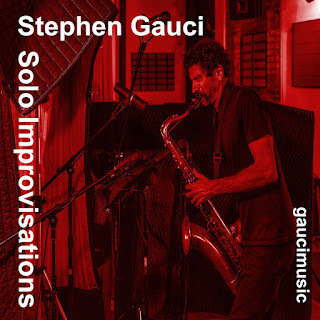
Stephen Gauci is a fiery and tireless Brooklyn-based saxophonist. Locally, he is likely most recognized as the curator and frequent performer in the Bushwick Improvised Music Series. Despite such activities, he is also a frequent traveler, touring across the US and Europe and cutting a few stellar live albums in the process. In this sense of scrappy DIY dedication, unrelenting performance calendar and widespread musical documentation, he is very much a product and pathbreaker of his times. He is so much so, in fact, that when Covid hit, he turned to his own label to stage and release an impressive series of 19 pandemic duets with the likes of Matthew Shipp, Kevin Shea, Wendy Eisenberg, Daniel Carter and others. Once restrictions began to loosen, he started to tour again, as well as record an apparent solo farewell to quarantine. A selection of these most recent recordings – live and in studio – are reviewed here. All are available as limited-edition CD’s and digital downloads.
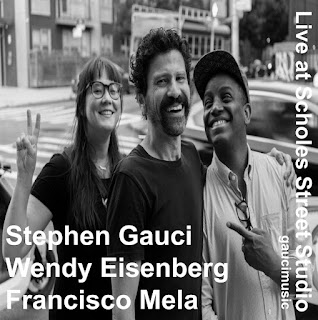
This is an interesting one. Wendy Eisenberg has been carving out her space as one of the next generation of New York avant-garde over just the last few years. (Check out Lee Rice Epstein’s review of her wonderfully trenchant solo guitar and banjo release Bloodletting for just one recent example.) Francisco Mela is a percussionist of renown for his work in Latin and jazz circles, though, as Live at Scholes Street Studio shows, he has considerable free jazz chops as well. Often, he keeps a busy but non-linear rhythm in the back. Eisenberg and Gauci, meanwhile, pull the album into that arhythmic, (largely) amelodic, exploratory space that one has now come to expect from the two. Relentlessly dynamic and unpredictable, this fits comfortably into its scene. It is top caliber improvising. Eisenberg runs the gamut of guitar techniques, refusing to settle on a phrase or style for more than a few bars before detouring into new territory. Gauci meanwhile swings from more rapid-fire interlacing scales to the piercing upper registers in manner that falls somewhere between Ornette and Charles Gayle. Mela, meanwhile, is the welcome surprise. He offers just enough feverish bopish rhythm to keep the others form drifting off into atonal space but stops short of falling into anything too steady. Refreshingly contemporary, but also refreshingly downtown free jazz.
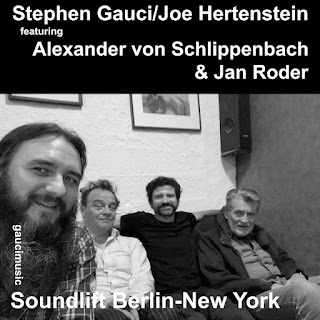
Soundlift Berlin-New York was recorded in Berlin in October 2021, when things started to fall into some sort of manageable normality, if not necessarily the normal that existed before. (I know, I know. Some observation like that will apply to many releases reviewed on this blog over the coming months.) Gauci, of course, trudged on through the pandemic extensively exploring the duo and doubling down on his own practicing. As did, it seems, his companions on this release, drummer Joe Hertenstein, bassist Jan Roder, and pianist Alexander von Schlippenbach. This one starts slow and romantic, first with some brittle piano, soft drums and elastic bass lines. Then Gauci steps in with a few blusey blows, and the session shifts from there into angular, amelodic territory. Each musician gets some space to show off a bit, but the core of this collaboration is its balanced group play. The result sounds organic, as if this were a practiced, working unit rather than, in essence, the combination of two long-standing duos. I am not sure this will surprise anyone familiar with these musicians, but it certainly will hit home with them.
Live at Sowieso, Berlin is another transatlantic collaboration, this time between pianist Liz Kosack, bassist Dan Peter Sundland, drummer Kevin Shea, and Gauci, that came together at the wonderful Berlin club Sowieso on October 23, 2021. Kosack, Shea and, of course, Gauci have been on my radar for some time. Sundland is an unknown entity to me, though a quick look at his bio and one spin of this recording indicate I have been missing out.
In short, this one runs hot. The first track sound like a bundle of energy trying to break out of whatever confines hold it. Longer, wilder runs give way to sections of choppier omnidirectional pulses which break into more extended full quartet pummeling. In this way, Live at Sowieso is similar to Soundlift Berlin-New York and I hear some Schlippenbach influence (or just a shared approach) in Kosack’s muscularity, classical sensibilities and boxy abstraction. Shea deploys a range of techniques most often intent on filling the air with as much fidgety clutter as he can. For his part, Sundland complements this well, laying into repeated pulsing single notes at times and running amok over the neck of the bass at others. I guess what I am trying to say is this has shed much of that distorted downtown influence on Live at Scholes Street in favor more Euro improv. (A notable exception comes through Gauci just before halfway into the third piece, but it is brief.) It has that sheer force and the unwillingness to strike a melody or steady groove for any amount of time. It has that restiveness. It also has the dynamics, which seem to be the driving force. Halfway through the first piece, the quartet goes quiet, then spends the rest of the piece in brief spasms, as if fighting to get back to that blast that commenced the set. The second piece picks up where the last left off but regains that initial energy quickly. At its eruptive peak, it reaches a blow-out of entangling but discrete threads, wherein the musicians are not struggling to be heard above the garble but are rising and falling together, each as a separate but essential component of the greater sonic whole. The third and fourth cuts are similar in range and jagged development, though the fourth is even more open and clattery than the rest, even if it retains that underlying energy that inaugurated the set.
For many years, the seminal free jazz meeting Environment for Sextet was available in a very good mix from drummer Andrea Centazzo’s Ictus Records. And yet, this brand-new remaster from the original tape reals is revelatory. Centazzo has recorded a number of times at Outside Inside Studio, so naturally he worked with Matteo Bordin on this remaster. One thing that’s been consistent about Bordin’s work is how expertly balanced his mixes are (see, for example, Konstrukt’s Molto Bene ). The album is a classic example of the formative approach to free jazz in the burgeoning downtown NY scene. On two early graphic scores by Centazzo, a sextet featuring the drummer with Polly Bradfield, Eugene Chadbourne, Tom Cora, Toshinori Kondo, and John Zorn play some of the most beguiling group improvisation. Remarkably, almost everybody here is fairly early in their careers: Bradfield, Chadbourne, and Zorn all appeared on Frank Lowe’s epic Lowe and Behold and had recorded School just ten months earlier; Kondo was fresh off recording Milford Graves’s Meditation Among Us; and this would be Cora’s first recorded appearance, to be followed by several Chadbourne albums. Only Centazzo had a sizable number of albums at the time, having performed and recorded with, among others, Steve Lacy for a number of years. But almost nothing predicts Environment for Sextet: the lineup is something of a miracle, gathered together as Centazzo was touring to meet and record with young players on both coasts. The initial album, U.S.A. Concerts, featured highlights from a number of sessions, but it was the release of “Environment” in two settings that made the biggest impact. Recorded live on the air at WKCR, November 7, 1978, the music displays an uncompromising dedication to the collective voice. Describing the mechanics of “Environment” would take away the magic of discovery, but the hallmarks of what we now consider collective improvisation all appear to be in place: smaller organized cells structured independently move in a gradual but nonlinear progression signaling something like momentum, but towards what remains undefined. There’s a charge in hearing these players so early in their careers, especially Bradfield, who remains relatively under-recorded, when she was still about a year from recording Solo Violin Improvisations.
Remarkably, another recording from 1978 has surfaced, featuring two performances of a classic Zorn game piece, “Fencing.” Before the guitar quartet Dither recorded a set of game pieces for Olympiad, Volume 1, “Fencing” had not appeared on any official recordings. Olympiad, Volume 2 starts with a quartet of Zorn, Chadbourne, and guitarists Duck Baker and Randy Hutton, recorded in July at the Theatre of Musical Optics, a setting Zorn devised in his own loft. On the second, Zorn and Chadbourne are joined by Bradfield in a trio setting, recorded in August at Bard College’s Center for Creative Education. While Zorn’s game pieces can be somewhat challenging without context, given patience, any listener can hear the early stages of Zorn’s later soundworld. As the game pieces came and went through the years, eventually getting folded into “Cobra,” additional elements have found their way into books like Moonchild, Nova, Simulacrum, and even more “classical” settings like the Hermetic Organ, Turner Études, and other notated works. The quartet gives some clear sense of the overarching concepts in “Fencing,” which, as Zorn quotes from the score in the liner notes, “is concerned with harmony and counterpoint: what to choose to play with, against (at the same time) another player, choosing the 3rd, 4th, 5th possibility of harmony, etc.: unusual juxtapositions the aim.” In the trio setting, where the quartet posed a set of duels moving about each other, instead Bradfield, Chadbourne, and Zorn are in constant motion, often using nontraditional techniques to broaden their vocabulary, using the game’s rules as a jumping off point to some of the most provocative and innovative group improvisation. If these recordings were released fresh today, without any archival framework, they would still be among the most innovative performances of the year. As much as these players pushed boundaries at the time, the places they went to are still out of reach of most groups.
One more recent recording surfaced in the past year putting Bradfield and Zorn out front, a live recording of the two in a quartet with saxophonist George Cartwright and drummer Charles Noyes. In an hour-long live set recorded at Inroads. Captured in 1982, Cartwright was just getting started with his radical downtown group Curlew. His piercing sax style pairs well with Zorn’s. Noyes had already played on some of Zorn’s game pieces and with Bill Laswell in Material, and his drumming brings an occasional crunchy edge to the performance. The players poke at and push each other forwards in equal measure. Admittedly, the audio is not as polished as on the formally remastered albums, but the playing is absolutely worth it. To hear Cartwright and Zorn together is an absolute treat, there haven’t been any other recordings to feature them both on sax together. And to have even one more recording of Bradfield is a gift, and much of the improvisation highlights Bradfield in trio with Cartwright and Zorn. A few years ago, Cartwright also released a performance from Inroads of his early trio Meltable Snaps It with Bradfield and Arto Lindsay. Hope springs eternal that he has even more radical free jazz in his personal archive.
“Hi, we’re Curlew, thanks for coming,” kicks off a 12-minute version of “Ray,” one of the harmolodic-adjacent group’s finest. It is 1987, and Curlew, a darling of the downtown NY scene, plays CBGB’s, one of their regular spots. When saxophonist George Cartwright later introduces the band members, his voice is Southern and laconic, disarming. The music, meanwhile, is all jittery limbs and downtown cool, a cousin to Decoding Society and Defunkt, miraculously descended equally from Prime Time, Parliament, and Patti Smith. Curlew’s sound is a heady mix of jazz, funk, country, blues, dub, punk, and rock, often all at once though not always in unison. And on two new archival releases, the group showcases all aspects of its sound across ten years and three hours of previously unreleased and newly mastered performances.
CBGB’s, NYC, 1987 features the “classic” (as much as any traditional concepts apply to Curlew) quintet lineup of Cartwright on saxophones, Tom Cora on cello, Davey Williams on guitar, Ann Rupel on bass, and Pippin Barnett on drums. Cartwright and Cora are a marvelous duo, brilliantly paired opposite Williams’s punchy guitar. Rupel and Barnett are a brilliantly nimble rhythm section, dropping dub-inflected heaviness into the opening of “To the Summer In Our Hearts,” then effortlessly sliding into the pointillist “Barking,” one of Curlew’s more obscure interludes scattered throughout the set. At times, the set feels like a flaming torch juggling act; “Oklahoma” starts on fire and burns hotter as it goes, with Cartwright playing a breathless solo before the mid-song changes lead to a brilliant, mid-tempo solo from Cora.
After Cora departed the group in the early ’90s, Chris Cochrane joined on electric guitar. Williams and Cochrane together strongly evoke the Bern Nix & Charlie Ellerbie lineup of Prime Time, with Kenny Wollesen on drums. By this time, Cuneiform Records had been Curlew’s home for several albums, and Phantasmagoria 1998 + WFMU 1997 features a hour-long set from a brief East Coast tour to showcase their latest for the label, Fabulous Drop. “August” opens the set with a quiet sax intro that slyly sets up Williams and Cochrane’s dueling guitars. Wollesen is, as ever, superb on drums, as fleet-footed as Barnett, with a slightly lighter touch, bringing in a swing feel where Barnett might have grooved. On “Argon,” Curlew kicks off with a reggae beat that gets chopped up and immediately reworked into a free-jazz freakout. By the mid-’90s, Rupel was playing a larger role in songwriting, and her “Fabulous Drop” (co-written with Cartwright) and “Gimme” highlight Curlew’s polyrhythmic chops. Sax and guitars swap melody and counter-melody, while Rupel and Wollesen gently (or not) urge them forward. Drawing entirely from Paradise and Fabulous Drop, the Phantasmagoria set finds the band still working through each song, unlike the relative stability of the 1987 set, where certain songs had been in rotation almost a decade. In this way, the WFMU set provides a fascinating alternate view of seven tracks, with the same quintet in a radio session the previous summer. For example, a slightly more raucous and ragged “Crazy Feet, Sensible Shoes” features Cochrane shredding and Cartwright screeching jubilantly.
The WFMU set has been online for a while, but the audio is slightly cleaned up and adds a ten-minute interview with Cartwright, Williams, and Cochrane. They discuss recording and mixing the album Fabulous Drop, and their other projects. The whole conversation is pretty much the kind of interview one would expect from Curlew, loose and goofy, generous and congenial. Everyone leaves smiling, exactly as it should be.
Available on Bandcamp
By Vid Jeraj
There is something thrillingly daring beneath the timbral streams of „Cold Wood”, an opening track of „Out of the Beast Came Honey”, a second release of an Amsterdam-based sextet Full Sun that involves some of the crescent city's most daring players, namely, Onno Govaert on drums and Michael Moore on reeds. Bass-clarinet and composer of Israelian descent Ziv Taubenfeld debuted with Full Sun on Multikulti records from Poland few years ago. Next to Taubenfeld's bass-clarinet and Michael Moore's alto sax, the overall atmosphere is emphasized by murky frontline of Joost Buis' trombone, and restrained pianism of Nico Chantieroli with Omer Govreen on double bass.
Known for his work with various Amsterdam projects, Taubenfeld has recently relocated to Lisbon. Skillwise, he showcases quite anti-Dolphean [sic] intentions in terms of what the soloists usually provide on bass-clarinet. No overtones and altissimo work here, the multiphonics are mainly employed in the middle register.
In a recently closed Konfrontationen Festival, sextet evolved into an octet and went for a landmine concert. This year's festival edition was dedicated to premature passing of border-crossing pianist, composer, improviser and instrument builder Cor Fuhler, also known as arranger with a „what if” hunch. In terms of genre-hopping, it was Taubenfeld's bold idea to bring a Senegalese griot Dudu Koyate to an otherwise chamber setting, reminiscent of risks taken by Fuhler's Corkestra.
Otherwise, Full Sun's drony melodies delve towards the margins of feeling of 'eerie', something „not here”, although it quite could have been, just like an elegy of Co-Vid's bodycount if you want. With „Spider Jungle” as much as „Andalus Fig Tree”, compositions rooted in Third Stream and coated in those surreal 11 PM dusks, this composer shouldn't be short of film music requests. Maybe also something else.
Sometimes it's nice to have nothing to hold on to.
When you think about it, even the most adventurous free jazz and free improvisation often use the same basic language as more "accessible" music, enough vocabulary for the uninitiated to be able to at least make out a couple of words and maybe piece its meaning together. There's nothing bad about this of course and it's important for a musician to be aware and respectful of each genre's tradition and rules, if only to better break them, but as this release's title suggests (in Greek mythology Maiandros was a god and patron of the river by the same name) you need to surrender to the flow and allow this album to carry you into unknown and unrecognizable territory.
Of the three musicians on this release the only one I knew what to expect from was Francisco Meirino, fierce experimentalist and very important voice in the noise/improv scene with countless collaborations under his belt that I won't bore you with by listing but I do strongly recommend you check out the rest of his discography if you like this album. Chessex and Noetinger both bring a lot to the table, namely magnetic tape, saxophone and amplifiers, even though the trio is in such lockstep that they sound like a single, complete entity.
A quick look at the lineup will clear up any doubt one might have about the instrumentation but not having read it before and having no prior knowledge made for a better experience, like hearing a completely new language for the first time. It's truly incredible how almost indescribable this first piece is. It defies expectations and will take you out of your comfort zone, because there's no comfort to be found here.
Listen and download from Bandcamp.
By Stef Gijssels
Intended initially for his own practice, Lacy wrote three books of etudes, comprising six pieces each. He only recorded the first such collection, Book H, written in winter and fall of 1983 (released as "Hocus Pocus—Book 'H' of "Practitioners" (Crépuscule, 1986)). In the late fall of that year he wrote Book W and then, in 1985-86, Book P. To date, this last book had only been recorded by the Belgian-based violinist Mikhail Bezverkhny ("Cross Purposes" (2022)).
It so happens that two saxophonists, Josh Sinton and Jon Raskin, independently ventured to take on the challenge of performing Lacy's études, and by coincidence without duplicating, with as a result that we have all three books now available, of course in the rendition of two other saxophonists. Sinton takes on Book H on baritone, and Raskin Books P and W, the former on baritone too, the latter on alto, which is by itself already strange, considering the works were written for soprano.
Josh Sinton - Steve Lacy’s Book of Practitioners, Vol. 1 “H” (Form is Possibility Recordings, 2022)
For once I will let the artist review the album.
Sinton says: “Steve said that each piece was a ‘portrait’ of somebody to whom he owed a debt of gratitude for their inspiration. I spent several years trying to hold a musical image of these people in my mind as I played each piece, but that didn’t seem to get me anywhere. The pieces still sounded inert.”Listen and download from Bandcamp.
Jon Raskin - Book 'P' Of "Practitioners" By Steve Lacy (Temescal, 2021) & Jon Raskin - Book 'W' Of "Practitioners" By Steve Lacy (Temescal, 2021)
Listen and download from Bandcamp.
Free = liberated from social, historical, psychological and musical constraints
Jazz = improvised music for heart, body and mind