Click here to [close]

Wednesday, December 13, 2023

Greg Davis & E. Jason Gibbs - Steam Fence (Superpang, 2023)

By Gregg Miller

Gentle, disorganized chaos. Electro-acoustic + found sounds and live sampling. Vague industrial banging; reverberations of something indecipherable. Birds, static, resonant triangles, hard bowing and plucking The noise is pulsing, and we’re moving about inside it, The landscape adrift. Post-apocalyptic sound-debris laden with twisted imagery and unwonted intrusions. If not outright threatening, then slightly dangerous, like walking barefoot in an abandoned machine-shop. At the close of the second track, a human voice comes through like a ray of light across the illumination of a crevice, and then it ends. Crows provide the outro for track 3. Sounds manifests and then takes flight in organic life.

Sometime the noise-field is claustrophobic, anxiety-inducing. Do you live in the loud part of town? Turn it up. It’ll transfigure the construction noise, traffic, crows, and airplanes into a pleasant backing chorus. The fourth track is gentler, less menacing. Long tones shift and pulse under an assortment of bells and chimes in various registers. Track 5 lets distortion slowly overtake the proceedings, taking us back inside the sonic enclosure.

Track 7 lays down moving planes of casio chords, augmented by Derek Bailey-esque guitar plucks, and possibly a trombone. Less machine-shop industrial, the sound evokes a cleaner, though still artificial environment. What symphony chorus of hums does office furniture enjoy after the humans have gone home? The outro gives us the sound of seashore waves and cricket drones, night falling through an open window. The 8th track is the close miking of something, or many things impossible to discern, but then also altered and looped back in.

In 2021, E. Jason Gibbs released Wolves of Heaven (Orbit 577, 2021) (mastered by Henry Kaiser!), a full-on acoustic affair: a panoply of self-conscious, angular outbursts. Paul Acquaro called it “haunting and unusual,” and the liner notes (Owen Maerks) calls Wolves “pastoral.” If that’s right, in Steam Fence, we have industrial pastoral.

Highly recommended!

Tuesday, December 12, 2023

Marc Ducret - ICI (Ayler Records, 2023)

By Gary Chapin

Guitarist Marc Ducret offers up some-place based music in this quartet recording, Ici, which means “here.” In the notes, he points out that it was recorded during the lockdowns. He thought “since it [was] currently impossible to play THERE, let’s make some music HERE.” Very good albums have been strung out on thinner concepts. If you need an excuse to get this great quartet together, go with it.

And it is a great quartet with Ducret on guitar; Fabrice Martinez on trumpet, flugelhorn, and tuba; Christophe Monniot on sopranino, baritone, and alto; and Samuel Blaser on trombone. All four compositions are by Ducret, each named for a season (Le Printemps, ici; L’hiver, ici , etc.) and are framed as explorations of the changes that occur in a place over time — light, weather, tides etc. Aside from this programmatic slant, the vibe harkens back to Ducret’s work with Tim Berne and Big Satan , which is a pretty heavy compliment coming from me.

Considering Ducret’s the lead and the composer this is a decidedly non-guitar centric recording. Not that guitar is absent or understated, just that this is very much an ensemble recording. The varied instrument choices mean the three horn players sound, at times, like a small brass quintet (or a large trio). The writing, orchestration, voicings, etc. add to that feeling. There’s some genuinely beautiful, evocative horn writing here, along with the improvisation.

The first track (L'été, ici) opens with the sound of summer buzz and roadwork (in Maine, US, we say there are two seasons, winter and roadwork), and then goes into a more frolicsome space, like friends walking together (but at COVID safe distance—there’s a lot of space) bantering and playing off one another. They take shots at one another. At nine minutes in, we’ve entered a marchlike space, the guitar keeping pace while the individuals sound off. Fantastic interplay between the brass.

Having no drums or bass makes a difference. L’automne, ici is more rhythmically hip and swaggery, with much collective improv. The story goes through phases and ends on a—dare I say it?—autumnal note. L’hiver, ici is darkness and ice cracking. Le printemps, ici is a more emergent piece (sorry, can’t help myself), an extraordinary trombone solo kicks in around 2:40 and just takes the top of your head off with its quizzical nature, then goes into a clockwork duet with (I’m guessing) the flugelhorn. Other solos follow. They’re like rivulets of water, running around the temporary islands of the ensemble.

Monday, December 11, 2023

Lina Allemano - Canons (Lumo Records, 2023)

By Sammy Stein

Lina Allemano is a Canadian trumpeter, composer, improviser, and bandleader with an international career primarily in improvised, jazz, and experimental settings. She splits her time between Berlin and Toronto and is recognized as one of the leading innovative trumpeters on the scene today. As well as collaborating with important international artists, she leads five groundbreaking projects and runs her artist-run label Lumo Records. ‘Canons’ is the second 2023 release form Allemano, and follows Pipe Dream, the release by Allemano’s quartet, the Lina Allemano Four, in May.

Canons (For Trumpet and Creative Chamber Ensembles) features Allemano performing nine original pieces, both composed and improvised, with five different creative chamber ensembles. This special-edition release coincides with Lumo Records' 20 th anniversary.

Of the recording, Allemano says, “I started writing canons as a fun and challenging compositional game of sorts. Five of the pieces here (tracks 1, 2, 4, 6, and 8) are written for trumpet and various unusual chamber ensembles in either 2, 3, or 4-part canon, all incorporating improvised sections alongside composed material. Each piece employs aspects of the canon form as a common thread, including the improvised pieces by trumpet/electronics duo Bloop.”

Allemano is respected by musicians, as becomes clear whenever mention of her name occurs. From the opening track, the music is lively and powerful and the canon, in terms of counterpoint-based music-making, could hardly be more explored. Lead and follower voices/voice creating the canons intertwine and bounce off each other in tracks such as the opener ‘3 Trumpet Canon’, including some pure air column versions of the melody.

Across the tracks, there are many techniques employed, including flutter tongue with its wonderful, growly tones, and close harmonies, such as on ‘Shadows’ (track 3). There is a link between different styles and genres. On ‘Bobby’s Canon’ the bowed ‘cello leads the ensemble as the trumpet and clarinet repeat the time patterns and phrases. By the end of this track, there is a certain glorious disassembly of cohesion as the individual musicians take their own diverse pathways – something that makes it at once glorious and beautiful - before the repeated harmonic descents restore order and a different kind of beauty.

There is much to recommend to the listener on this album, from the effects and coalescence of sound on ‘Shadows’ to the playful light-hearted steps of ‘Butterscones’ sandwiching an ethereal middle section, with the guitar and double bass adding their plucked tones, or the round-like canons of ‘Wilds’.

‘Twinkle Toes’ is the freely improvised track of the album and captures the outstanding contributions of the ensemble of double bass, trumpet, synth, and guitar as they improvise and then come together in a classically arranged section, the switch heralded by trumpet melody, which the others chime and echo.

The recording is a deep exploration of canons in many forms and formats but remains true to the concept of a melody, and imitations of that melody forming the essence of each piece. The musicians transform the melodies sometimes – and in some places, the original is apparently ‘lost’ briefly, before being retrieved by a musical diversion, having been never really lost to the player, but they know what they are doing and have the wherewithal to achieve their aims.

This is a glorious album, well crafted, and exploring one essence of music-making proves an intriguing and expansive concept.

Personnel:

Lina Allemano, trumpet
Peggy Lee, cello (track 2)
Brodie West, clarinet (track 2)
Mike Smith, live-processing / effects (tracks 3, 5, 7, 9)
Rob Clutton, double bass (tracks 4, 6)
Ryan Driver, analog synth (tracks 4, 6)
Tim Posgate, guitar (tracks 4, 6)
Matthias Müller, trombone (track 8)

Lina Allemano - Canons (Lumo Records, 2023)

By Stef Gijssels

I will not write a full review of this album, as this has already been done by Sammy Stein, but just a short appreciation for the music, and some insights that I received from Lina Allemano herself. 

At first listen, the listener will be surprised by the form of the music, namely the use of the medieval "canon", a compositional technique that uses counterpoint and thematic repetition with a specified time delay, resulting in superimposing different voices creating a kind of sonic fabric of interweaving phrases. 

We have reviewed the influence of medieval music before in modern jazz 

Several albums also were directly influenced by composers such as Josquin Deprez (1450-1525), Guillaume de Machaut (1300), and several others (check our Search function). 

Already on Allemano's "Proof", the medieval influence was noticeable, but now she makes it the focus of the album. 

The power of this albums is that it expands it into a kind of special level of ear candy, nothing pretentious or too ambitious, but playful, solemn, fun, surprising and interesting. More poetic than epic, with the right balance between composition and improvisation. 

Here are Allemano's responses to my medieval references:

"Mostly I was just composing canons purely for fun and as a way to amuse and challenge myself - maybe other people would play Wordle or Sudoku for the same reasons…? I had no intention of them sounding like anything in particular but I think the very nature of the polyphonic compositional technique lends itself to sound a certain way, and of course that will reflect historical polyphonic music. I haven’t studied the music formally but I do spend a fair amount of time listening to contrapuntal and polyphonic music (mostly Bach piano works)". 

For her grant application, Allemano submitted the following description. 

"The Canon form is of course not new, but it is fairly new for me as a composer. I’ve always admired canons for the musical workmanship required to write one, but rarely tried to create my own as it's not a traditional form commonly used in my area of work. With my canons, I will not try to recreate the methods, goals or musical effects of traditional canons, but rather use the form in my own artistic context to create something new - for example: atonal canons, canons that reflect my own aesthetics of 'melody', canons that incorporate improvisation, etc. My prior compositional approach was to conceive of melodies and whole pieces in their entirety, making small adjustments only afterwards and then making further adjustments during collaborative development with my bands. With canons however, one must take an entirely different approach as a composer, as the ‘melody’ or line is the entire piece in itself and it must weave together with itself, displaced 2, 3, or 4 times, in some sort of logical/interesting way. I find this compositional approach to be fascinating and almost like some sort of musical chess game that develops slowly and incrementally as it goes, note by note. Each next note chosen in turn creates new meaning as it is stacked upon itself, displaced in the different voices. My aim with these canons is to essentially create through-composed pieces that also contain improvisation. The improvisations weave in with the canon to create an interesting effect: composed & improvised worlds meet & meld together. The listener at times detects the symmetry of the canon, perhaps only subconsciously, but it inherently creates a strong musical form. This is a departure for me as a composer, as I normally attempt to blur the line between composition and improvisation based on a compositional approach from the ‘song form’ tradition: short melodies with harmony and repeating form, along with collaborative input from band members."

And so is the music: smart, intellectually playful, with a compact aesthetic. In short ear candy? 

Listen and download from Bandcamp. 


Sunday, December 10, 2023

Bernard Santacruz - Sunday interview

Photo by Chris Boyer
  1. What is your greatest joy in improvised music?

    I can think of three kinds: firstly, meeting again with old accomplices with whom it is possible to continue exploring the music further with complete trust. Secondly, ephemeral encounters where everything can be discovered in the moment and where the language is created collectively. Both are based on communication and sharing. Thirdly, the solo experience and confrontation with oneself, a kind of meditation, mental and sonic drifting.

  2. What quality do you most admire in the musicians you play with?

    There are many, but the first is creativity, followed by availability, a willingness to take risks and a spirit of sharing.

  3.  Which historical musician/composer do you admire the most?

    Without hesitation, Igor Stravinsky. It's all there: the relationship to rhythm, harmony and its frictions, and colours.

  4. If you could resurrect a musician to perform with, who would it be?

    Certainly Siegfried Kessler.

  5. What would you still like to achieve musically in your life?

    To continue doing what I've done since the beginning, trying to improve my musical outlook, sound, thinking and the way I relate with others.

  6. Are you interested in popular music and – if yes – what music/artist do you particularly like?

    I am passionate about what we used to call "Black music" when I was a teenager. Particularly the Stax and Motown labels, Stevie Wonder, Otis Redding, The Temptations, Booker T. etc.

  7. If you could change one thing about yourself, what would it be?

    For a long time I was plagued by self-doubt and hampered by excessive shyness, but that all got better with time and a succession of collaborations with artists who put their trust in me. Today, I wouldn't want to change much.

  8. Which of your albums are you most proud of?

    There's one album I'm very fond of for many reasons : After The Demon's Leaving, which we recorded with Frank Lowe and Denis Charles in 1996.

  9. Once an album of yours is released, do you still listen to it? And how often?

    Most of the time, I spend a huge amount of time listening and re-listening to the music once it's been recorded, right up until the album's release. Sometimes I like to immerse in it again years later.

  10. Which album (from any musician) have you listened to the most in your life?

    The piece I've listened to the most is Igor Stravinsky's "The Rite of Spring" in several versions, and there are always new ones. The last two that captivated me were by Esa Pekka Salonen and Klaus Mäkelä.

  11. What are you listening to at the moment?

    Penderecki's Cello Concerto N°2, which I discovered recently. You have to see the appetite with which Mstislav Rostropovitch throws himself into the composition; it's very physical and magical.

  12. What artists outside music inspire you?

    For some years now, I've been immersed in reading Erri de Lucca, a sensitive and ardent Italian writer. The paintings of Kandinsky and Picabia, the dances of Carolyn Carlson and Carlotta Ikeda, and the films of Tarkovsky and Cassavetes are inexhaustible sources of inspiration for me. 

Reviews with Bernard Santacruz on the Free Jazz Blog:

Saturday, December 9, 2023

Against Empire: an Interview with Bill Laswell

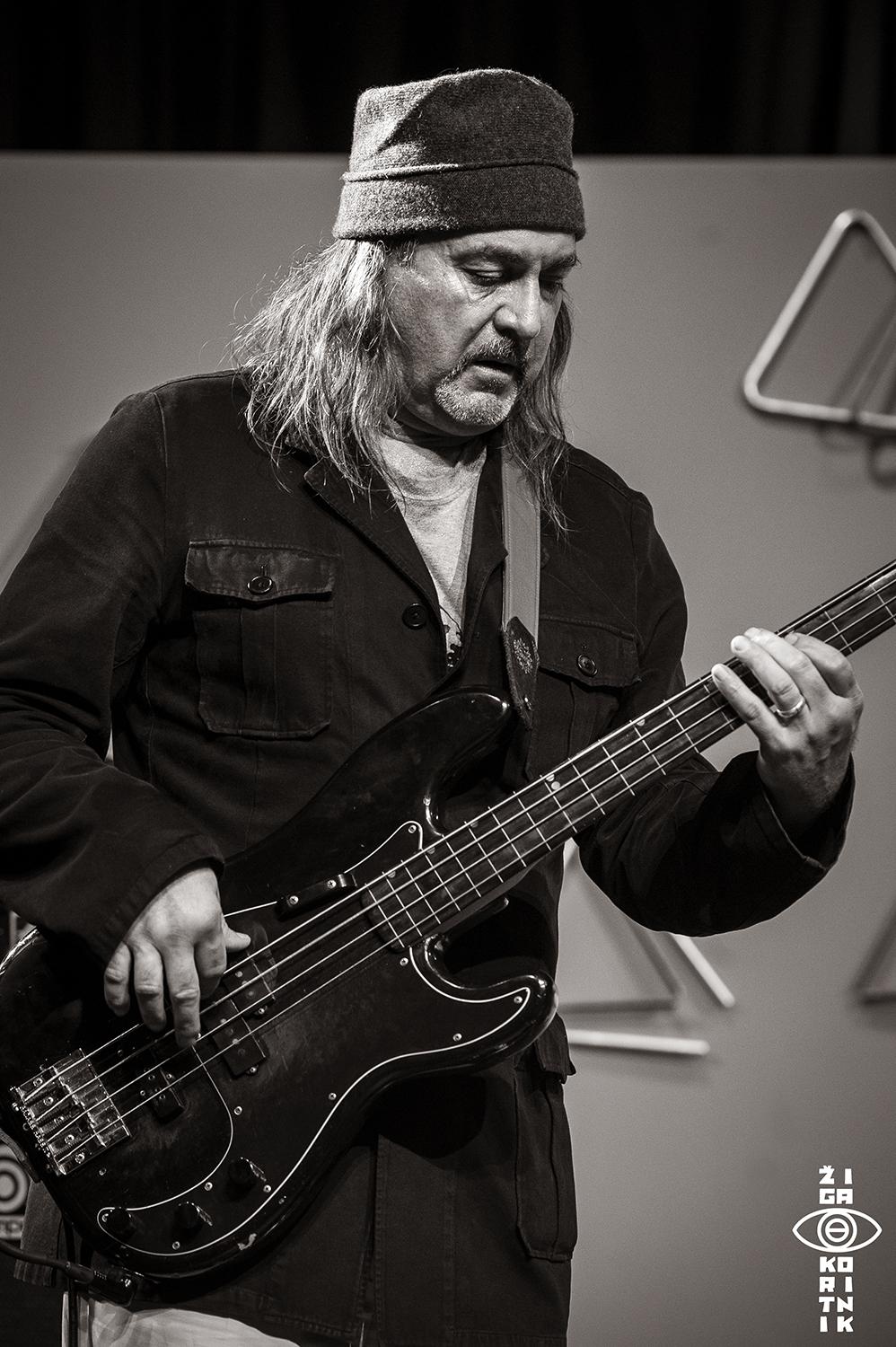
Bill Laswell. Photo by Ziga Koritnik
 

By Paul Acquaro and David Cristol

Both David and I have seen Bill Laswell perform a few times. For me, once at the old Stone in NYC and once at the A'LARME Festival in Berlin, and for David, starting in 2003, seeing Material in France, then Massacre at Lisbon’s Jazz em Agosto, and in Milano in 2018 in duet with John Zorn – and each time he was a stoic, somewhat ghostly, musically giant presence. His influence in modern music is, to me, similar. Whether as a player or producer, what he touches bears his sonic imprint, expressed in the sound of the drums, and of course, the bass, with elements of dub, funk, ambient and even a bit of jazz. From his discographic beginnings in the downtown New York scene in the late 1970s with Material and Massacre, and working with, among many others, Brian Eno, Ginger Baker, Laurie Anderson, Fred Frith and John Zorn, he has created his own musical universe.

While a career breakthrough was, of course, creating 'RockIt' with Herbie Hancock in the early 1980s, introducing the world to "electro-funk," the credits really go on and on. (For a more comprehensive listing, check out the Laswell discography at Dave Brunelle’s website silent-watcher.) Laswell's reconstruction of Miles Davis' electric music, Panthalassa, is a desert island disc. His vision for Davis' electric music, presented as fluid suite, flowed through my ears and cut new pathways in my brain. Filling these pathways was then the music of Arcana, with Derek Bailey, Tony Williams and later Nicky Skopelitis and Buckethead as well as Last Exit, with Peter Brötzmann, Ronald Shannon Jackson and Sonny Sharrock.

Photo by Ziga Koritnik
In 2020, Laswell released Against Empire, a stunning atmospheric album with contributions from Pharaoh Sanders and Hancock. A duo album with John Zorn, Memoria, came out this year - essentially a freely improvised meeting of two friends and masterful musicians. However, Laswell's ability to work in recent years has been greatly impacted by health issues. A Go-Fund-Me was established in 2018 to help him with maintaining his famous Orange Studio and continues to provide support for him as he manages his health. Additionally, a new subscription effort through Bandcamp, BASSMATTER, was launched in 2020 to make music from his wide-ranging recorded corpus available.

Earlier this fall, we had an opportunity to chat with Laswell from his home in Inwood, New York City, where he is recuperating and continuing his mixing and production work, to talk about some of the music that can found on the Bandcamp site, as well upcoming work, and a bit more. In addition, some of his colleagues from over the years, namely Bachir Attar, Hamid Drake, Kristo Rodzevski, Akira Sakata, Wadada Leo Smith, John Zorn, as well as Slovenian photographer Ziga Koritnik, share some thoughts.

***

The Interview

Free Jazz Blog: I'd like to start asking how are you doing? We know that you've been dealing with some health and other issues with the studio, but at the same time, you're keen on writing another chapter.

Bill Laswell: Well, yeah, I think I can get one more.

FJB: What would you like to see in there?

BL: I just want to continue. There's a lot of records that I've done that need to come out. We have to work on that. And I have wanted to do a lot of drum and bass records without so much music. Just rhythm. There are a few key people that I would work with and want to work with. But again, there's quite a few things in the can that should come out soon.

FJB: About some recent and upcoming projects. In 2020 you started getting a dazzling number of unreleased live recordings out there, from different eras and bands that you had organized.

BL: Yeah, that's still going on. It's on Bandcamp. Why do you do music in the first place? It's so people can hear it. And there is a kind of base of people that want to hear it, so, you know, I keep digging it out and we put it on Bandcamp and there's a subscription that gives access to it. You can get all that stuff from digital places.

FJB: Yeah, the subscription model is interesting. How has that been working for you?

BL: I don't monitor it so much, but I think it's going OK. It's not really selling because the thing is, it's more to do with people getting access to things that they would normally not have heard. I'm glad that people hear it and it's a good document and it measures history in a way. I like the idea.

FJB: How many recordings would you say you have unreleased?

BL: Not many. I have the things that are finished and that will be coming out soon. That's unreleased as of now. But I don't keep a lot of things around that are unreleased. I try to use all.

FJB: As you have gone back to the vaults, were there any projects that you heard differently than you remembered?

BL: All of them, you know, it’s a long time ago. There's a lot of music there and a lot of live recordings. I don't go back to my vault because I don't have a vault. And I don't know how to go back, so…

FJB: I’d like to ask about an upcoming album with The Last Poets...

BL: It should come out soon. Pharoah Sanders played on it. I've worked with The Last Poets for many years. A few years ago, I said let's make a record and go back to the original idea which is just rhythm, percussion and voice and then add a few sounds from Pharoah and Graham Haynes. And that's how this happened. The Poets have done a lot of releases, with bands and one was reggae, one was kind of fusion. I wanted to go back to the original source, reel it in and bring it back to this kind of African concept, rhythm and voice for the most part.

FJB: What about other upcoming albums?

BL: I also have Massacre live in Japan. And one with Sam Morrison, who played with Miles Davis. That's a really good record. And I want to do this project with Ginger Baker. Of course he's gone; but we have tapes. And the Revelator band with Peter Apfelbaum, Will Bernard and Aaron Johnston. I really want to do something with Sly Dunbar again. We've been in touch.

FJB: On Memoria, a recent recording you did with John Zorn, the titles are dedicated to Wayne Shorter, Pharoah Sanders, Milford Graves. What connects these artists, besides that you worked with them?

BL: Not everything needs to connect, but it often does. These are human beings. They live on the earth. They make their contributions or they don't. And you know, these guys did a lot. And we just mentioned their names. Because of their willingness and openness to give and to share and to bring all this music to the world and they all did. So, it's just congratulations to them.

FJB: It's very intense and has a lot of texture to it. You have a long-standing collaboration with John Zorn, of course. What has helped create that connection?

BL: It’s been many years, yeah. We couldn't be more different in terms of music, but there's a level of intelligence that I find in him and some of the things that we value are similar, but it's not from music so much. It's writers and painters, film makers, that connection and not so much music. We come from very different backgrounds. And it's always been kind of interesting to me to do that.

FJB: You've done a lot of work in recent years with trumpet players Wadada Leo Smith and Dave Douglas…

Sacred Ceremonies
BL: Wadada called me and I did a lot of things with him, we didn't tour anywhere but we played a little bit in New York. And we did a few records and it was always good for me. Dave Douglas, I met through Zorn and we did a recording with Louie Belogenis and Tyshawn Sorey [“Blue Buddah”, on Tzadik]. Also a live recording with Dave and drummer Hideo Yamaki, “The Drawing Center” [released in Japan, 2017]. And he invited me on some recordings [“Uplift”, Greenleaf, 2018] and a short tour in Europe [with Mary Halvorson, Jon Irabagon, Rafiq Bathia, Ian Chang and Ches Smith] . I'm grateful I am able to do it, because I'm not a jazz musician. They don't put down the sheet music and I play the charts, nothing like that, but I enjoy being in those bands where I have no idea what they're doing and I just sort of play along.

FJB: Then you must have an amazing intuitive feel!

BL: Well, I hope. I hope that's the case.

FJB: What about a trio like “On Common Ground” with Mike Sopko and Tyshawn Sorey? With a group like that, do you have a concept beforehand, or is it improvised?

BL: That was Mike Sopko’s idea, he had the drummer and he wanted to do a record. We did it very quickly, and I enjoyed working with them. I'm sure Mike has a concept, but I don't. I don't like to put music into these designs. That's why I like to play in these bands where they have structured music, written music and I just sort of try to make it work for myself. I like that a lot. With Zorn it is all always improv but with other people, they have their own music and I just kind of improvise around what they have, finding my way into the music.

FJB: With John Zorn, how might that work? Would you start with a bassline, or an idea, or John would play something?

BL: You don't think like that, you just play and you know we've been doing that for so long that I think we have a repertoire, a language, and we just talk like that, with that language and bring back the memories and go forward into the future.

FJB: We’ve been talking about all these recordings that you're releasing and some other ones that have been released with Ulf Ivarsson, Kristo Rodzevski, Simon Berz, Monte Cimino, there's a whole bunch, a full spectrum of aesthetics from ambient to dub global to electronic and other styles. Do you enjoy juxtaposing so many styles?

BL: I'm existing, continuing, and trying to survive at the moment, but I don't see it as styles, and I certainly don't like the idea of juxtaposing them or juggling them. It's music to me. I have been lucky to have the time to understand, or misunderstand, the concept of sound. It's all about the sound. I don't play styles, I don't play genres, I don't play jazz. I play my repertoire, my language, my own poetry.

FJB: Earlier you were mentioning a recording of Massacre in Japan that you're planning to release.

BL: That should come soon. I don't know how everybody else feels, but I thought it was the best thing we ever did, and that's a heavy thing considering I started with Fred [Frith] in the late 70s. Charles Hayward described it as telepathy, like we were communicating on an outside of the space, outside of the environment that you're in, and he had it right, the word is telepathy.

FJB: About the creative process or just sort of how music develops like we've been discussing, I want to ask you about Against Empire your album from 2020. This one features a rich cast of musicians, with Pharoah Sanders, Peter Apfelbaum, even Herbie Hancock to some extent, and others. And the music is seamless, very fluid. How did this one come to be?

BL: I think that's an intuitive approach to production more than playing. Things come in from different angles. Like something someone played might have been five years before, and it all just collides, and when it's right, it just flows, and I felt really good about the work.

FJB: I feel it when listening to it, it's really a cohesive piece. Was there live playing or composition that went into this?

BL: A little of everything. It's improv, it's juxtaposing improv, and creating composition. It’s using technology to arrange music, to place it, tune it, make it relate. There is a certain degree of that there, but there's also just that you rely on your experience and your concept of freedom with sounds.

FJB: With all of the advances that we're hearing about and experiencing with artificial intelligence, do you see a place for it in music making?

BL: Absolutely. I don't know how, when or where, but of course.

FJB: This year marks the 40th anniversary of Rock It and the Future Shock album. That was an absolute paradigm shifter for everyone, mixing hip-hop and electronics and jazz in unique and new ways. I’m wondering just how you feel about this recording now, looking back on it?

BL: Well, I made it but you know, I don't think about it so much. When you’re in the process of creating it, you're not thinking, you're applying the means and the delivery of your current experience and it's spontaneous, and it all happens very quickly. If it doesn't happen quickly, it won't happen.

FJB: You then embarked on a much different adventure with Last Exit.

BL: Last Exit was a little later, from ‘86 to ‘89 on and off, and it was just a way to get away from pop music and obligations and record labels. It was kind of fun to do.

FJB: I think there was a little bit of a crossover? Herbie Hancock guested with Last Exit.

BL: In Japan, yeah, just one concert.

FJB: Regarding Last Exit, you worked with very strong personalities there, Peter Brötzmann, Ronald Shannon Jackson, Sonny Sharrock. What was the creative process like in the group?

BL: It was improvisation then. I had a band with Brötzmann and we were working with Fred Frith and Anton Fier, and there was a tour that came up, and both Fred and Anton were busy. I had been working with Shannon Jackson and I said, “well, why don't we keep Brötzmann and let's bring in Sonny Sharrock." We started in Europe playing festivals, it was pretty intense. We carried on with that for a few years.

FJB: You worked with Brötzmann and Pharoah Sanders and Ryuichi Sakamoto, Toshinori Kondo. Looking back, what was it like working with these folks?

BL: It was like friendship and camaraderie. They're your friends and you go out and you play and you hope people like it, then if they don't, so what? For the most part, it always worked. All those guys are dead. Sakamoto, Kondo. All of Last Exit.

FJB: Your last concerts were with Method of Defiance in early 2020. Do you miss playing live?

BL: Not so much. I don't miss flying on planes and taking a car to the hotel. I've been everywhere twice, so I don't need to go back. I'm good. I just need to try to record as much as I can. Performing live is a lot of work, and traveling is a lot of work.

FJB: Do you feel there's a big difference? Between what you get from playing live compared to what you do in the studio?

BL: It's not the same of course, but it's pretty connected, very much connected.

FJB: Are there any trends in music today that you find interesting?

BL: I used to listen to everything. I mean, absolutely everything. And lately not so much. And if I had to name 10 people that are great, that are doing good things, and are new, I probably wouldn't be able to do that. Nothing new is going to happen, but there are going to be great things coming, that's a definite, but are they new things? Something you haven't heard before? Everything that you're going to hear, you've heard before. It's just going to be in different contexts.


FJB: You've done a lot of recordings with percussionists and drummers like Hamid Drake, Jack DeJohnette, Tony Williams. Drummers are often at the forefront of your work, even Against Empire, which we spoke about, is built around four drummers. What is the importance of drums in your work?

BL: Well, you know, it's the foundation in most cases, so building on rhythm and it's usually the core foundation of building something. It depends on the drummer, if it's innovative drummers, you can really build on it. If it's just somebody playing a beat, doesn't really matter.

FJB: I would say that your approach down to mixing really brings the drums to the forefront, very clear. Is that something that you consciously developed or was it more intuitive?

BL: Both really. If it's innovative drumming, you want to hear every detail, so you bring it up and push it to the front.

FJB: You have produced hundreds of recordings in addition to your own projects. Are you very selective when you get involved with the process?

BL: I guess so, yeah, probably before I get involved. It depends on the work and who's involved. If it's for me, I look to just make it the best I can. I'm obliged to be in charge of something. If it's for someone else, I take a different approach, because everyone's got different opinions about it.

FJB: How much would you say you influence such projects, the ones that you are producing? And what might be the first thing you do when you get to work on a new project?

BL: Well, quite a bit, you know. Otherwise I wouldn't be there, or I wouldn't be needed really to do it. Everything is different, it depends on what the work is and everything is going to have a different beginning.

FJB: Do you often have a complete idea of what you think you'll end up with when you start?

BL: Sometimes I do, not always. But sometimes I do.


FJB: Looking over your Bandcamp site, something that caught my eye were the recordings of your Stone and other residencies. What do you recall from putting these together?

BL: Well, it's not curating work really. I got people involved that I respected or I thought were doing something good and, in some cases, just needed exposure.

FJB: Then in addition, there's the one called the Tokyo Rotation. Did these come from events that you organized as well?

BL: Well, that was the five years of where once a year, we would do a series of concerts in the same venue and it was all Japanese musicians and again picking people that I liked and that I worked with and I thought might be interested and you know it goes like that. A lot of great musicians played there, that impressed me.

FJB: Another thing that strikes me is all the different album covers. There's a real aesthetic sense. It's often a dark or mysterious imagery. How do you decide on the artwork? How do you conceive or think of it? Are there any recordings whose artwork you think really matches the music?

BL: Well, I hope that it fits the music and I have a lot of help with that. There's so many… Against Empire, Arcana with Tony Williams. But there's a lot, I can't just name two or three. Hundreds of them.

FJB: Going back to people you have worked with, one relationship I'd like to ask about is with Ornette Coleman. What was your relationship like?

BL: When I came to New York in the 70s, my kind of goal was to meet Ornette Coleman and maybe Miles Davis. And I met them both right away. With Ornette, he always lived kind of near where I was. I started going to his place and invite him to concerts I was doing and stayed in touch with him for a very long time. It was a good experience. We did play in his loft and I recorded everything, I'm going to release a record in the next year or two. Just bass and saxophone. We released a track a couple years ago. Ornette influenced me on just being independent and having your own idea, you own concept about sound and music, I guess that's the way it went.

FJB: Your creative path spans many different sound worlds and collaborations, likely contains many stories. Do you have any plans of working on an autobiography?

BL: No, but I would like to. I just have to have the right people involved. I don't have that at the moment, but there are a couple of people doing books and I hope they do the right thing.

FJB: I just I wish you the best with everything and I really look forward to hearing more from you.

BL: Well, you will, if I can get it together you'll hear it. You just wait. And listen. And then you make up your own mind. I hope I can do more work and you look forward to getting some work.

***

Some Links:

Bill Laswell, Photo by Ziga Korotnik
Photos by Ziga Koritnik


Against Empire: Co-conspirators Weigh In

By David Cristol

In addition to our interview with Bill Laswell, we asked some of the artists and musicians who have worked with him to share some thoughts on their work and experiences together.

These are their stories:

Bachir Attar

Photo by Cherie Nutting

"Bill Laswell is a wonderful producer and a great musician. We were honoured to have him come to the village of Jajouka to record Apocalypse Across the Sky with the group "The Master Musicians of Jajouka" in 1992. I remember the donkeys climbing the mountain road to the village carrying Bill’s recording equipment to my father's house where we spent three days playing our music under a sky holding a big moon. This was the first record after the 1972 recording The Master Musicians of Jajouka with my father Hadj Abdesalam Attar who led the group before me. My brothers and I were all born in this house and famous people like Ornette Coleman, Paul Bowles, William Burroughs, Brion Gysin and many others stayed. We call it the "History house" but sadly today it is falling down and it needs repair. We hope to save it someday.

We had a 3-day recording session. The old musician Mfdal was too ill to play with us but we carried him in a chair to the house and he watched everything. Later, Boujeloud, his son, danced around a big fire when we played our ghaitas.

Bill took me to America to record a solo album with Maceo Parker and Ayib Dieng. Writer and composer Paul Bowles [living in Tangier at that time] once said that Bill had "perfect pitch". We thank Bill for all he has done for me and The Master Musicians of Jajouka."

  • The Master Musicians of Jajouka - Apocalypse across the sky (Axiom, 1992)
  • Bachir Attar - The Next Dream (CMP, 1992)
  • Various – The Road to Jajouka : a Benefit Album (Howe Records, 2013)
    With John Zorn, Marc Ribot, Medeski Martin & Wood, Mickey Hart, Lee Ranaldo, Ornette Coleman…
  • The Master Musicians of Jajouka led by Bachir Attar with Material - Apocalypse live (M.O.D. Technologies, 2017) 

Hamid Drake

Hamid Drake
Photo By Ziga Koritnik

“I first met Bill in the 1980s, at a recording session with Mandingo Griot Society. It was the third release for the group and Bill was producing it. He changed the trajectory of the group in several ways. At the time he also asked me to do some fills on Herbie Hancock’s “Sound System” that he was also producing. That was the beginning of our relationship. He introduced me to Pharoah Sanders and from that I got the chance to record and tour with Pharoah for several years. So many great people I met through my association with Bill. I am honoured to have been involved in many projects. Sometimes he would bring me to New York and Bill, Bernie Worrell and myself would just record a bunch of rhythm tracks that he would use for various records. I feel like we made a pretty good bass and drum team. The work with Bill does differ in many ways from some of my other work. But it makes sense. It has always been a pleasure to play and travel together. Both of us have a deep love for improvised and so-called free music. I consider Bill a dear friend and brother, with an amazing sense of humour. He’s quite a scholar when it comes to the diversity of music styles and history, and without a doubt one the musical production geniuses of our time. On a side note Bill has helped many musicians from many cultures. I am truly indebted to brother Bill. Thank you, Bill.”

Hamid Drake and Bill Laswell selected collaborations:
  • Pharoah Sanders - Message from Home (Verve, 1995)
  • Sacred System - Nagual Site (Wicklow, 1998)
  • Akira Sakata - Fisherman's.com (Starlets Japan, 2001; reissued on Trost, 2018)
  • Charged - Live (Innerhythmic, 2002)
  • Painkiller – 50th birthday celebration volume 12 (Tzadik, 2005)
  • Gigi & Material -  Mesgana Ethiopia (M.O.D. Technologies, 2010)
  • Lee "Scratch" Perry - Rise Again (M.O.D. Technologies, 2011)
  • Peter Brötzmann - Long Story Short - Wels 2011 (Trost, 2013)


Ziga Koritnik

Photo by Borut Peterlin

“In 2001, I got the opportunity to spend several weeks in the Slovenian studio of the Ministry of Culture in New York. I went with the aim of getting to know the photography and music scene, and find opportunities to exhibit. I visited the Vision festival for the first time, hung out at the Knitting Factory, Tonic and other jazz clubs. Amazing coincidences were happening to me, as a result of which the phrase "Space is the place!" constantly appeared in my mind. One of those coincidences, which I believe was not, was meeting Bill Laswell. I'd been a fan of his for a while, listening to Material, Last Exit and other projects. At that time, the idea of ​​making a photo book dedicated to jazz began to simmer. I was thinking about who could write a text for it and the idea came up that it could be Bill Laswell. I unsuccessfully called him at the studio where he worked. One day, I was walking around the galleries, when we met completely by chance in the immediate vicinity of his home in Chelsea. I didn't know where he lived, it was completely random. I explained my idea to him and he kindly invited me to his home, where I showed him my portfolio. He agreed to write the text and he gave me a then unreleased Operazone CD. Unfortunately, I did not follow up on the possibility because I was not sufficiently prepared and persistent in my desire. I completed my book Cloud Arrangers in 2019, unfortunately without Bill's text. Now a new opportunity is arising. I am finishing work on a photo book focusing on Peter Brötzmann and Bill has written some words for it. Book should be printed at the end of spring 2024.

I have attended a large number of Brötzmann’s concerts. The most vivid in my memory is a show in Salzburg's “Jazz-it” club in 1997, where he performed with Bill Laswell and Hamid Drake. Louis Moholo also joined them for a short span. No other concert has so profoundly and decisively transported me into a parallel existence. Another concert with Bill was with fellow bass player Jah Wobble. While the walls of the Knitting Factory were shaking from the strong vibrations from the two basses, people were shouting “More bass! More bass!”. We never have enough of good music.”

Kristo Rodzevski 

Photo by Angel Sitnovski

“During the pandemic lockdown, I found my old Macedonian tambura in the closet of my East Village apartment, buried behind clothes, books, and old boots. Over the next few days, I spontaneously started playing some traditional melodies and phrases – old songs that my grandparents used to sing to me or that I overheard during family celebrations, weddings, etc. – while I was growing up in Macedonia. I decided to record a few of them on my phone and sent them to Bill. I was curious to know what he would hear in the sound and the irregular rhythms. Bill called that night and said we should blend the phrases and record this material in a way George Russell’s Electronic Sonata for Souls Loved by Nature album was arranged. "It can work out," he said. The supernatural thing, or pure coincidence of that moment was that when I answered his call I was already holding that very LP in my hands and was putting it on the turntable, unaware of my motivation to do so. He knew what my idea was before I opened my mouth or had it clarified for myself.

 Bill is a man of few words, but his silence and restraint have all the sounds, wisdom, and aesthetics you can hear in his works – from Last Exit, Massacre to Henry Threadgill’s Too Much Sugar for a Dime, Masters of Jajouka, etc. A truly remarkable artist and friend.”

  • Kristo Rodzevski - The Rabbit and The Fallen Sycamore (Much Prefer Records, 2017) with Tomas Fujiwara, Mary Halvorson, Kris Davis, Ingrid Laubrock, Brian Drye. Mixed by Bill Laswell.
  • Kristo Rodzevski - Hubris (M.O.D. Reloaded, 2020) with Tomas Fujiwara, Ikue Mori, Bill Laswell, Mary Halvorson. Produced by Bill Laswell.
  • Kristo Rodzevski - Black Earth (Defkaz Record, 2023) with Dominic James, Josh Werner, Adam Rudolph. Mixed and produced by Bill Laswell.

Akira Sakata

Photo by Ziga Koritnik

“I met Bill in 1981, he was playing in Berlin Jazz Festival with Material, and I was there with my orchestra [live performance released the next year as Sakata Orchestra “Berlin 28”, Better Days label] . After that Bill Laswell asked me to join his band when he came to play with Last Exit, a few years later in Tokyo [as heard on “The Noise of Trouble”, Enemy Records 1986] . I asked Shannon Jackson, “could you please produce my record?” when I was in New York and Shannon said “You should ask Bill about it, he’s a good producer, I’m not.” Bill said yes and we made the Mooko record in 1988, and the “Japan Concerts” live recording by Mooko that same year. When we were recording at a New York studio, Bill and I talked about Mongolia. We said, let’s go to Mongolia. I would find some money, get some Japanese musicians involved, and Bill would gather some New York musicians. We put together the Flying Mijinko Band, went to Mongolia, China, Uzbekistan and Japan in 1994 [as recorded on “Central Asian Tour” double CD, The Japan Foundation 1995]. And before that we had recorded Silent Plankton with Bill [1991] . A few years later we made Fisherman’s.com with Pete Cosey and Hamid Drake [2001, reissued on Trost Records in 2018]. That’s the last one we did. There were other concerts, one of which just released on Bandcamp this year, Imabari with Peter Brötzmann, Kiyohiko Semba and Anton Fier in 1991. My English is very bad, my understanding of it as well, and it is very easy to understand Bill, he speaks in a simple way. He’s a big producer, and you know I didn’t have money to produce my albums, and he did them out of friendship. I met other musicians through him, like Nicky Skopelitis, Ayib Dieng, Foday Musa Suso and Anton Fier. I also met Bootsy Collins and Maceo Parker, although we didn’t play together. Last time I met him in New York it was before Covid, I had a concert with Chikamorashi (Darin Gray & Chris Corsano). We are friends, he’s like family. I wish for his sickness to go away.”

Wadada Leo Smith

Photo by Ziga Koritnik

"We did several sessions starting in 2014. There is a septet with two guitars and rhythm section, and a trio with Milford Graves. On the latter we celebrate the memory of Ornette Coleman, John Coltrane and Ronald Shannon Jackson, an extraordinary drummer with whom we have played respectively at different  periods. With Bill, no need for lengthy talks. We just grab our instruments and the music happens."

  • Wadada Leo Smith/Bill Laswell – The Stone (MOD Technologies, 2014)
  • Wadada Leo Smith – Najwa (TUM, 2017)
  • Wadada Leo Smith with Milford Graves and Bill Laswell – Sacred Ceremonies (TUM, 2021)
  • Wadada Leo Smith & Orange Wave Electric – Fire Illuminations (Kabell, 2023)

John Zorn

Photo by Dvid Garland

Notes from « Memoria » (Tzadik, 2023). Reprinted with John Zorn’s authorization.

"Bill and I have been working together for over forty-five years. I have guested on a variety of his studio recordings, and he has performed and recorded my game pieces, various studio projects, and several film soundtracks. Together we have performed in countless live situations, most notably in Painkiller with several legendary drummers, including Mick Harris, Milford Graves and Dave Lombardo. The trio format of sax-bass-drums has long been a formidable challenge for every saxophonist. In it, each musician is naked, occupying a very different sonic territory. All their musical contributions are clearly exposed. Our interest was more focused on pioneering extreme new territory in the musical firmament, and along the way we made many friends, a few enemies, and even some enemies who later came around and became fans. One story involves one of my heroes – Lee Konitz. Lee came to see one of my concerts at the Knitting Factory, and later that same night he left a message on my answering machine. “Hey Zorn, can’t say I liked your concert, but afterwards I went up to Dizzy’s Coca-Cola room at Lincoln Center – and compared to what you are doing, the music up there sounded pretty old fashioned and predictable.” In recent years Bill and I have forged a new language in duo format. It is more nuanced than our trio outings, a bit less of an onslaught, but still embodying that level of intensity that we both strive for. The music here moved in a more ambient direction, capturing the feeling tones of a requiem – hence the CD title Memoria – a tribute to three friends and musical heroes that we have lost in recent years – Pharoah Sanders, Milford Graves, and Wayne Shorter."

John Zorn and Bill Laswell selected collaborations:

  • The Dream Membrane (Tzadik, 2014) (with David Chaim Smith)
  • The Cleansing (Tzadik, 2022)
  • Memoria (Tzadik, 2023)
  • John Zorn – Nosferatu (Tzadik, 2012) with Rob Burger & Kevin Norton
  • Painkiller – Talisman (Tzadik, 2002) with Mick Harris
  • Painkiller – Execution Ground (Subharmonic, 1994), reissued on the box set “Painkiller Collected works” (Tzadik, 1998)
  • Painkiller – 50th birthday celebration volume 12 (Tzadik, 2005) with Hamid Drake & Mike Patton
  • John Zorn – IAO – Music in Sacred Light (Tzadik, 2002)
  • John Zorn – Taboo and Exile (Tzadik, 1999)
  • Various artists – Celebrate Ornette (Song X Records, 2016) Ornette Reverb Quartet : Laurie Anderson, John Zorn, Bill Laswell, Stewart Hurwood  


... And a special thank you to Yoko Yamabe for all of her help!

Photo by Yoko Yamabe


Friday, December 8, 2023

Mark Solborg - BABEL (Ilk Music, 2023)

By Eyal Hareuveni

Danish (with Argentinian roots) guitarist-composer Mark Solborg’s BABEL takes the biblical myth of the Tower of Babel when God created a communicative discord to control man and asks if God actually intended to nurture a fertile diversity. “A disruption of a self-perpetuating echo chamber, to stimulate a more varied and complex perspective of the world? Maybe she (God) wanted to show us that we will find the strength to solve the planet’s problems in our differences and multiple talents, not in uniformity and polarization”.

BABEL, in a way, is an extension of Solborg’s previous work, TUNGEMÅL (meaning idiom or tongue) (Ilk Music, 2021), a platform concerned with the guitar as a voice in contemporary chamber musical contexts. In BABEL Solborg wanted to collapse the self-perpetuating tunnel vision of these echo chambers and to investigate, illustrate and raise awareness of the continuous cross-cultural interhuman debate, and, obviously, to show how words, our idioms and mother tongues are deeply connected with our view of ourselves and the way we resonate with the surrounding world. And furthermore, to suggest a better, compassionate conversation that may become increasingly important if we are to solve the challenges of our society and species.

Solborg composed music for a chamber ensemble of trusted, long-time collaborators - Portuguese, Stockholm-based trumpeter Susana Santos Silva, Italian, Copenhagen-based clarinetist Francesco Bigoni, and Danish reeds player Anders Banke, pianist and keyboards player Simon Toldam and drummer-percussionist Peter Bruun, and Solborg himself on guitar and electronics. Solborg asked the musicians to “attack” the music and to approach it in ways they wouldn’t normally do. Then he added tapes of 18 interviewed voices, speaking in multiple languages, integrated into the rich textures of the music.

This work demands, naturally, deep listening, but its lyrical and intimate, patient, multifaceted and multi-layered nature also radiates a strong sense of freedom and compassion. Solborg says that this work creates a warm and unique garden of fables, a sonic haven to trust the listener’s affections, fears and dreams. And if I may add, a beautiful work that challenges simplistic, binary narratives of social media and demands more complex and thoughtful attention and sensitivity to the sonic details, languages and perspectives of these gifted musicians, as well as of the others around us. It certainly guarantees a powerful healing effect.

Highly recommended.

Thursday, December 7, 2023

Saowakhon Muangkruan and Manop Nakornchai - The night of an animal ย​​​า​​​ม​​​ว​​​ิ​​​ก​​​า​​​ล (​​​ข​​​อ​​​ง​​​เ​​​จ​​​้​​​า​​​ส​​​ี​​​่​​​ข​​​า​​​) (Ramble Records, 2023)


By Nick Ostrum

The night of an animalis a collaboration between two Thai musicians, Saowakhon Muangkruan on cello and Manop Nakornchai on guitar. All six tracks are improvised and together they form something apart from other improvised string duo recordings. You might be able to chalk this up to my own unfamiliarity with Thai and southeast Asian music. The night of an animal does use motifs and melodies that sound like they are from the region, even if on western instruments. That said, the spaces, the slow and unpredictable development and the clearly unscripted nature of these interactions make me think there is something different going on between these two musicians.

First, the folk melodies. Muangkruan and Nakornachai are not out to shred, but to envelop in, at least in the first track, what is a plangent but beautiful world. The tunes are different, but the guitar adds elements of Noël Akchoté’s Loving Highsmithproject, complete with that nostalgic, blurry polaroid sustain. Subsequent tracks bring us closer to the beast, as it were, as they layer presumably guitar body percussion with nervous beeps and uneven blocks of arco. The tension and menace rise, as does the tremolo, as Nakornchai’s wandering ostinato that slowly falls in and out of various winsome motifs. Things get noisier at times (track 5 is a case in point), and Muangkruan and Nakornchai answer each other tit for tat.

There is something glittery and wistful about this, though stylistically I cannot place it in the past or present. In that, and in its deceptively simple melodies, which similarly transcend space as they meld western and eastern traditions, The night of an animal is absolutely engrossing.

The night of an animal is available as a CD and download here.

Wednesday, December 6, 2023

Maria Valencia - Compendio de Alfonías Abisales (Relative Pitch, 2023)

By Jury Kobayashi

Compendio de Alfonías Abisales is a recent release from multi-instrumentalist, composer and improviser, Maria Valencia. It was recorded at the Banff Centre for Arts and Creativity. The notes accompanying the album suggest that it “was imagined between the town Sutatausa (Colombia) and the mountains of Banff (Canada).”

The album opens with a breath of air and a slow build of a scraping sound, accompanied by little whistling sounds that squeak through the texture of the music. I discovered that Neuston (the title of the track) is a name for organisms that live on the top or attached to-the underside of water surfaces. A fitting title for the track and a perfect example of the playfulness and depth that this album has to offer.

The second track follows suit this time titled after a species of jumping spiders. The solo clarinet bobs and weaves as if to trace the web of the Marantus Volans. Valencia has a beautiful personal vocabulary on the instrument and her tone is phenomenal. The track is followed by the blisteringly fast paced and fiery Cernicaloide. Valencia, now playing alto saxophone sounds equally at home on the sax as she is on the clarinet.

Many of the pieces are quite short on this album and often are no longer then 2 minutes. The range of the works are huge from the growling multiphonic madness of Variaciones de Parientes, to the bass clarinet march of Intermedio, the woodwind choir of Amarillos, the beautiful lyrical bluesy Medallas de Copas Arboreas. Each track on this album is a gem.

The final track is a complete surprise featuring toy piano. The melancholic sound of the toy piano is turned into a jubilant celebration with the insistent rhythmic drive of the chords propelling the music forward. It is followed up by a gorgeous woodwind and percussion anthem.

This album is beautifully done, conceived, and performed. Each track has something special to be discovered. The names of the tracks illuminate fascinating threads that weave them together. Fundamentally though this album sounds beautiful. Valencia’s sound is captivating, intimate, ferocious, and compelling.