Click here to [close]
Showing posts sorted by relevance for query jorge nuno. Sort by date Show all posts

Monday, February 1, 2021

3 by 6

By Stuart Broomer

These three recordings by Lisbon-based bands—a quartet and two trios—have several overlaps, with four of the musicians appearing twice and two others appearing once. Despite the overlaps there’s significant stylistic divergence among the three groupings, testifying to the diversity as well as the quality of Lisboan improvised music.

José Lencastre, Jorge Nuno, Felipe Zenícola & João Valinho - Anthropic Neglect (Clean Feed, 2020)

This is a highly electric quartet, most notably from Nuno’s shifting processing of his guitar, but also from Zenicola’s electric bass; even Lencastre’s alto and tenor saxophones sound processed in the miking. The music is presented in three pieces, Concepts 1-3, each a loose array of approaches launched by a single member of the quartet. The band’s distinguishing mark is its ability to sustain both high levels of energy and shifting sonic fields, in part the achievement of Valinho’s percolating counter-rhythms and Zenicola’s patterning, but also charged by Nuno’s sonic mutations and Lencastre’s marked intensity. On Concept 1, Nuno manages to sound like a screaming machine, a literal compound of nuts, bolts, circuits and viscera; on Concept 2, he’s a shrill whisper at high volume. Lencastre also possesses tremendous range, from R&B-laced tenor to soaring alto and the abstract, mutating timbre that sets the tone for Concept 3, followed by strange shifting pitches draped on Nuno’s wandering lines of feedback. By that work’s conclusion the quartet is a looming four-voiced whole, from Nuno’s rumbling sustained modes and Zenicola’s droning bass hanging cathedral-like over the cry of Lencastre’s alto and the formal thrash of Valinho’s drums. The conviction and attention to detail transcend expectations, surmounting the sub-genre’s usual melodrama with architecture and invention.


José Lencastre, Hernâni Faustino & Vasco Furtado - Vento (Phonogram Unit, 2020)


Phonogram Unit is a new label, a musicians’ collective enterprise, and its distinguished even before you hear its works by the quality of the design and artwork of Sofia Faustino. José Lencastre sticks to alto here, and it definitely sounds like his principal horn. The music is initially almost, well, composed, the opening “Here We Go” a formal pattern from drummer Vasco Furtado and bassist Hernâni Faustino that’s ultimately a playfully boppish theme articulated by Lencastre that leads to a strongly articulated Faustino line, some atmospheric arco, an out-of-time passage of lyric alto brought back into time by a sustained drum roll that turns oddly polyrhythmic, the sustain taken up by Faustino’s tremolo bowing. These evolutions, including echoes of the original melody, are accomplished without fuss or fanfare by a band that appears to respond to one another’s hints without hesitation or adjustment. The next, “Abstração,” is just that, a thick swath of alto polyphonic, that moves through dirge-like phases, expressionist alto against mobile bass and shifting percussion, until it sings free with a lyric lightness that suggests the particular influence of Lee Konitz on Julius Hemphill. Faustino achieves quiet miracles of bass articulation, with bowed tones of such evenness they sound like perfectly resonant pizzicato, pizzicato tones so sustained they sound like they’re bowed. The unrestrained “Test Drive” gives a clearer view of the group’s expressionist potential, Lencastre stretching his lines with rare coherence against a continuous rain of cymbals. The slower “Ruínas” reveals further depths. Lencastre covers a lot of ground in Anthropic Neglect, but the alto playing that graces Vento carries his voice and his lines further. 


No Nation Trio - Habitation (Phonogram Unit, 2020)

If Lencastre is a significant surprise in the step from Anthropic Neglect to Vento, a bigger surprise yet awaits. Habitation by the No Nation Trio presents Jorge Nuno, a guitarist one might have thought could live by his pedal board alone, playing acoustic guitar in a trio with Hernâni Faustino and Anthropic drummer João Valinho. The trio is quietist, almost pietistic, as if the wood of guitar, bass and drum rims might bear direct connection with the woodland on the cover; subdued rhythms are everywhere in this music, lapping at one another and overlapping, Nuno can stick to a simple rhythmic insistence or wander delicately afield, almost quixotically; a bowed bass sounds like a rooting woodland animal, while the percussion might be played at times by precipitation. “Untitled 3” is sustained by bowed bass and bowed cymbals, its gradually increasing volume a suggestion that the listener might be getting closer to the heart of the music. There’s everywhere a naturalness here, a kind of beatific absence of intent, a new music that gives the impression of having been here all along, simply calling on a more detailed listening to tunings, light abrasions and abstracted fingerboard dreamings, sustained chordings that are mild insistence rather than rhythm guitar. It's the kind of effortless gift of music that makes you want to say “thank you” to a CD.

Friday, October 18, 2024

Guitar Week - Closing Statements (almost)

Derek plays Eric - A Suite of Soaps and Other Assorted Sceneries (Jazzwerkstatt, 2023) 

The concept of this Berlin based trio is to find a spot somewhere in the continuum of stylistic features and approaches between Derek Bailey on one end and Eric Clapton on the other. A broad spectrum indeed. Bailey, of course, pioneered a free improvisation language on the guitar and developed a philosophy towards improvisation, while Eric Clapton is often credited as a preeminent sculptor of modern rock with the Yardbirds and Cream and has offered at times his own somewhat more suspect philosophies. Anyway, A Suite of Soaps and Other Assorted Sceneries is the second recorded outing from this trio, following their self-titled debut from 2018 and it continues their journey of musical amalgamation. 
 
The group is guitarist Andreas Willers, bassist Jan Roder and drummer Christian Marien, and the program that they've cooked up on Soaps is rich and tasty. The album opens with drummer Paul Motian's 'Tuesday ends Saturday' from 1974's Tribute and which was already a guitar laden slow burner. Here, it is rendered with some reverence but even more grit. This is followed by a Willer's penned suite, itself a steaming stew of musical influences, with a heaping of avant-garde alongside hearty chunks of well marinated jazz-rock. Later in the program, a rendering of Gateway's "May Dance" is impossible not to enjoy - a great song given a worthy re-reading. Possibly the best example of the combination of the group's namesakes can be found in their take of the Beatle's "I Want You (She's so Heavy)," in which the closing track's opening moments are a seeming nod to the deconstruction of standards Bailey performed in his final years with the fiery rock furnace blast that the tune works itself into.


Juanma Trujillo - Howl (Endectomorph Music and Falcon Gumba Records, 2024) 

 
Juanma Trujillo is a guitarist originally from Venezuela who spent ten years in New York studying and honing his voice on the instrument, and now, according to various internet sources, is living in Barcelona. Along the way, he has developed an impressive discography and a core of close musical associates. As his move to Spain may change the some of the nodes in the network, he celebrated his New York connections at least one last time (though that's never truly the case, right?) with the recording of Howl featuring tenor saxophonist Kevin Sun, bassist Andrew Schiller and drummer Matt Honor on drums. Other recordings from Trujillo have featured other NYC fixtures and up-and-comers including Sean Conly and Franciso Mela (Collage, 2022), Kenneth Jimenez and Gerald Cleaver (Contours, 2023), and violinist Leonor Falcón (Imaga Mondo, 2023). 
 
On Howl, what is most interesting is the constraint Trujillo puts on himself - he uses only nylon string guitar. On other recordings, like the ones just mentioned, you may hear him on electric extracting long atmospheric tones or crunchy high-energy solos, or even playing mandolin and cuatro. The nylon string has its own sound-world. There is a difference to how the tones form, sustain and decay, there is a softness and clarity but also a real possibility to create dense thickets of sound. Trujillo's guitar playing does all of this on Howl as his musical partners respond with an equally rich set of tonalities. Opener 'Transient' lurches to life with a jaunty two note figure over which Sun arcs melodically while Trujillo's lightly atonal solo showcases the instrument's delicate side. 'Rojo' begins with a lithe figure and features Schiller's bass and Honor's drumming in an extended, building passage. The melodies seem to sneak up in the deft arrangement and that sparse intro becomes a full band effort by the end. The title track, after a spidery intro from Trujillo and Honor, is shredded by some powerful, free flowing saxophone. The contrast of the guitar and the woodwind is invigorating. Check this one out for sure!


Jessica Ackerley - All Of the Colours Are Singing (AKP, 2024) 


If Trujillo's album is one of saying goodbye to one life before embarking on a new one, then guitarist and composer Jessica Ackerley's could be considered one of transitioning into the new one. Ackerley began working on All of the Colours Are Singing after relocating to Hawaii and beginning a doctoral program. In the liner notes, she writes about both working with new musicians in Hawaii and one in New York City. She also talks about a friend she made after moving to the islands who then passed away from cancer just after completing the album's mixing. Is it an album memorializing loss? Reflecting on change? Celebrating new beginnings? There is a good chance that the answer is simply: 'yes it is.'
 
Suffice to say, what we hear on All of the Colours is a deep, diverse and emotionally imbued sequence of songs that range from the abstract strings of the opening "Introduction" to the power-trio charged explosions that is but one of parts of the closing track "Conclusion: In Four Micro-Parts," and all of the wonderful music in between. For example, the title track begins with a simple melody that bobs and weaves behind an evocative line of distorted legato guitar tones and a sonorous melody from Concetta Abatte's viola. Aaron Edgcomb's drums and Walter Stinson's upright bass provide support for the first half of the song and then the drums take center-stage for the rest. There is also the follow up, "The Dots are the Connection" which is an upbeat avant-jazz-rock tune, Ackerly's guitar leading the way, but it very much the collective work of a guitar-bass-drums trio. Then there is 'Nature Morte: Time is Fleeting,' in which we can basically hear the guitarist, with the help of her string arrangements, contemplating mortality. Each track is layered, the pieces with the strings even more nuanced, and all of the tracks embrace unusual and provocative melodic and rhythmic ideas. It would seem that Ackerley has found inspiration amongst the volcanic outcrops and black sand beaches of her new home.


Jorge Nuno - Labirinto (Phonogram Unit, 2024)


There is a certain tactile and aural joy that can be found strumming and plucking a steel string acoustic guitar without, say, a specific musical plan. There are resonances and vibrations that when activated can be a very satisfying feeling. Portuguese guitarist Jorge Nuno, leader of the very electric group Voltaic Trio, seems quite happy to release those vibrations on his solo acoustic guitar recording Labirinto. The 46-minute album is comprised of eight very individual tracks that are full of abstract atonal melodies and very concrete rhythmic inventions. The opener, 'Sombras', begins with a detuning, a sound that guitarists are quite used to, as the pitch of strings are compared against each other as the tuning pegs are slowly turned. Then, the playing evolves into seemingly frenetic statements, but on repeat listens begin to reveal patterns based on other attributes than well-tempered melodies, for example, Nuno uses to great effect, motion, repetitive tonal clusters, and syncopation. The title track begins with non-sounding notes, in which the friction from striking muted strings with vigor create the track's textures. The closer, 'O fim', features a similar approach, at least at first, but with the sound on. One interpretation of the album's title, Labirinto (which means labyrinth) could be interpreted as a trip through the quixotic corridors of the acoustic guitars timbres and tonalities, which would make sense as Nuno is presenting the guitar at its purist. 


Flak, Jorge Nuno, José Lencastre, Hernâni Faustino - Break It Down (Phonogram Unit, 2024) 

Let's stick around in Lisbon for a moment - after all, it's a lovely city with its own sounds and labyrinthine streets and corridors - and check out another one featuring Nuno, and this time with his Phonogram Unit label mates, saxophonist José Lencastre and bassist Hermani Faustino, along with guitarist Flak, who was an lynchpin of the Portuguese rock scene with the group Rádio Macau. On Break it Down, the group relies on Flak's analog drum machine work as a basis for their improvisations. Throughout, Lencastre is burbling over with melodic ideas, while Nuno provides both searing and atmospheric electric guitar. Faustino's bass lines throb and thrust, rooting the group with a feel that veers between dub, rock, funk and its own unique thing. The main event is the title track, a nearly 20-minute aural treat, in which Flak's percolating electronics provide constant agitation as Lencastre and Nuno generate energetic waves, and Faustino's punchy bass delivers precise blows. The track ebbs in the middle, leaving the drum and bass to their inventive devices. The group comes together in the final moments, with swelling noise-guitar from Nuno, hand-clap rhythms from Flak and ever-twisting lines from Lencestre. Pure inventive joy. 


Samo Salamon with Ronan Guilfoyle & Rafal Mazur - For the Listener Who Listens (Self-Released, 2024) 


Now for something completely different: For the Listener who Listens is a set with Solvenian guitarist Samo Salamon in duo with two different bassists, Ronan Guilfoyle from Ireland and Rafal Mazur from Poland. The tracks are interspersed, Salamon and Guilfoyle on the odd numbered ones and Salamon and Mazur on the evens. Both of the bassists play the acoustic bass, not an upright double bass, but rather the one that looks like an oversized acoustic guitar, and all of duets with Guilfoyle sees Salamon playing the banjo. The sound world of these instruments together is as important as the interactions between the players. On the opening track, The opener, 'A Mind of Winter', the plink plonk of the banjo is taut, focused and cutting, and so is the bass. Each note is distinct and on equal melodic footing. The push-and-pull of the duo is on the delicate side. The following track, 'The Frost', with Mazur is different. Salamon is on his usual semi-hollow body electric, which he plays with a clean, rounded tone and Mazur's notes blend slightly together. Here, the give-and-take builds more quickly as they both exchange tonal clusters and melodic snippets. The dialog of duos continues, each track featuring a different approach from the two musicians involved, and ending with a final duo with Guilfoyle. 'The Nothing that Is" is closing remark on the spacious improvisations that do in fact reward the listener who truly listens - again, and again and again.


Frank Paul Schubert, Kazuhisa Uchihashi & Klaus Kugel - Black Holes Are Hard To Find (Nemu, 2022) 


This is Guitar Week's bonus track. Black Holes Are Hard To Find was released in December of 2022, so it has been out in the world for a bit, and it is a bit tragic that it has had to wait so long to get a well deserved mention here.
 
This international trio is made up of German saxophonist Frank Paul Schubert, Japanese guitarist Kazuhisa Uchihashi, and German drummer-percussionist Klaus Kugel. The album, Black Holes Are Hard to Find is entirely improvised and showcases an eclectic, genre-blurring style and a contagious synergy between the players. The seven tracks are rich with dynamic interplay, seamlessly shifting through multifaceted musical ideas. To pin-point Uchihashi's contributions on guitar is tricky, as it is the blend of the three that make the album stand out, but special attention could be given to apocalyptic wailing that permeates the title track, especially around minute three, then again towards the final third of 'Explosive Past', and also in the middle of 'Internal Structure.' More importantly though, each piece unfolds with its own internal logic, blending bold textures and timbres into an extremely satisfying sonic dish.

Sunday, June 7, 2026

Jorge Nuno - Memórias em chamas

An austere visual for a delicate exploration - Portuguese guitarist Jorge Nuno's second solo recording A ilha Revisitado is out now on Thödol Records. In this video by Mariana Felix, a seemingly abandoned structure is contrasted against a yellowed sky at dusk. Nuno's slashing playing, atonal and rhythmic, form the songs jagged structures. 

Wednesday, March 2, 2022

Phonogram Unit: A Force in Motion

By Paul Acquaro

It was a windy, warm mid-summer day when I sat down with saxophonist José Lencastre in the concrete amphitheater of the Gulbenkian gardens in Lisbon. We talked about his music, the flowering Lisbon scene, and his new baby, who was - at the time - about the same size of his alto sax. Another topic we spent spent some time discussing was the upcoming recordings from the musicians on the artist run Phonogram Unit label that he and several musical partners had recently started.

José Lencastre / Hernâni Faustino / Vasco Furtado - Forces in Motion (Phonogram Unit, 2021) ****½


The trio is Lencastre on alto saxophone, Hernâni Faustino on electric bass (to date, I have known Faustino as an double bassist with acoustic groups like the RED Trio), and drummer Vasco Furtado. The first album, Vento, was reviewed by Stuart Broomer here and he points out the 'expressionist potential' of the group. This spirit continues to thrive on Forces in Motion, and perhaps is even intensified through Faustino's approach to the electric bass, in which the round tones of the double bass are replaced with dry, staccato notes, articulated in the mix and making the ground feel more ephemeral.

The album opens quietly, with a splash of cymbals and then through an extended welling of sound. The six minutes of 'Dust' rises and falls without ever kicking up too much of a cloud, though it never settles either. It leads to the 13 minute 'Point of departure,' which is a showcase of jittery bass work and complimentary drumming. Lencastre probes the craggy contours and in turn weaves an expressive melody. The tempo picks up as the track progresses, Faustino plays a counter melody, while Furtado responds with cracking stick-work. Lencastre is quick, he bobs and weaves throughout the buzzing rhythm work. The pieces reaches a breaking point and the three retreat. The third track, 'Cascade' picks up with the exploratory sound of Faustino's bass, augmented by electronics. The drums and sax soon come in, Lencastre plays a searching melody and Furtado leans into the tom-toms. The three explore a deliberate theme that eventually builds to an intense apex. Lencastre, even when getting into the altissimo register, doesn't force his instrument, rather his sound is propelled by the centrifugal forces of the rhythm. This both holds true too on the next long piece "Lava Flow" that begins exploratory and builds to a peak with red hot melodic rivulets streaming down its sides.

The work of the trio on Forces in Motion is highly enjoyable. Accessible and energetic, at times exploratory and others awash in pulse and melody.


Voltaic Trio - 290421 (Phonogram Unit, 2021) ****

 
During our conversation, Lencastre spoke about his group Anthrophic Neglect, who were playing on the second weekend of Jazz em Agosto. For Lencastre, playing at the festival was an honor, as it has been an important part of his musical life. He cited some memorable shows that he had seen, then spoke about the group, and in particular, guitarist Jorge Nuno.

Nuno is a part of the Phonogram Unit collective and his No Nation Trio released Habitation on the label in 2020. Whereas that album was a exploration of acoustic textures and tones, this one is a face melting blast of electric noise and a wealth of harsh, but nonetheless, fascinating rhythms and textures. The group is Nuno on electric guitar (and an expansive pedal board!), Luis Guerreiro on trumpet and electronics, and João Valinho on drums.

The album begins somewhat chaotically. A squelch of highly modified electric guitar - in which no guitar really needs to be involved - appears like a steamroller cutting through a haze. The trumpet then appears with a flurry of sounds like a swarm circling menacingly. After the initial sonic onslaught, the tension relaxes and each instrument is given space to strategize for the next attack. Soon the tension re-builds. The trumpet rings out, it's natural sonic waves cut angular and sharp with effects. The electronics bleep and sputter, creating a swirling maelstrom and when the electronic fog lifts from to time to time augmenting Valinho's powerful drumming and Nunes' biting guitar work. At times, one may be reminded of Miles Davis during the thickest part of his music in the 70s, though this trio goes deeper into the murky darkness.

Fierce and uncompromising, but also surprisingly textural and expressive, the Voltaic Trio is a noisy post-punk, avant-garde experience that offers tough listeners a rewarding challenge.


Vasco Furtado - Salome Amend - Luise Volkmann - Aforismos (Phonogram Unit, 2021) ***
½


I mentioned that it was windy out that evening in Lisbon, right? So windy, in fact, that my recording of our conversation was rather inaudible, however, that hardly matters, as for this last one we're leaving the area and following Vasco Furtado, the drummer on Forces in Motion, to his current residence in western Germany. Here, he recorded with two German experimental/jazz (this is really getting delightfully hard to categorize) musicians: saxophonist Luise Volkmann and vibraphonist Salome Amend. The result, Aforismos, is an experimental/jazz album that unfolds in 5 improvisations of varying duration.

'Folk Songs' kicks off the album with a splash of cymbals, followed by Volkmann's searching saxophone and Amend's vibraphone's unresolved chords. Over a patter of percussion, the exploratory grows more assured, though never settled. Volkmann spends a good amount of the time quietly overblowing her instrument, but playing in close connection with the percussive instruments, interlocked in self-perpetuating patterns. 'Mechananimus,' the second track, begins with Volkmann and Furtado instigating a moody atmosphere. Acoustic noises drawn from extended techniques and overtones fill the space, while ghostly notes from the vibraphone lurk in the background. As the track progresses, the playing intensifies, especially the saxophone, leading to the main track of the recording, 'Intuitions,' which unfolds slowly over 27 minutes. The quiet intro leads to a playful passage between the Volkmann and Amend, with Furtado insistently pushing the tension higher. The tracks' energy ebbs and flows, from the initial dance to an extended exploratory passage carried by the varied percussive instruments, to an open soundscape led by Amend.

The album is, overall, one of restraint. Even the intense moments are not fire-blowing, but rather contained and crisp low flames. Little sounds and interactions are as important as the kinetic moments.

Monday, December 3, 2018

Uivo Zebra - s/t (Bocian, 2018) ****


By Eyal Hareuveni

Uivo Zebra defines itself as a power trio but offers a challenging variant to this too common aesthetics. This Portuguese trio - electric guitarist Jorge Nuno, electric bass player Hernâni Faustino, known from the RED Trio and other local groups as Clocks and Clouds and the José Lencastre Nau Quartet, and drummer João Sousa, who collaborates with Nuno in the psych-improv group Signs Of The Silhouette - like any other power outfit operates in a high-octane stratospheres and always aims for almost unbearable levels of intensity, blending elements of free-improv, noise and psychedelia. The big difference is Uivo Zebra's total control of its power - the depth and breadth of it and the colors and nuances of the extreme power. Uivo Zebra may sound as being possessed by its brutal outputs, but knows how to tame and discipline these extremes, attaching its very own personal mark on these kind of sonic meltdowns.

The self-titled debut album of Uivo Zebra, following a self released cassette Gancho (A BESTA 033) from earlier this year, was recorded in Lisbon during March 2017. The album offers five pieces, structured as a dramatic suite that accumulates more and more tension and higher degrees of volatile intensity as it progresses. But at the same time Uivo Zebra is ready to grab more and more risky, free-form detours, insisting on eccentric walks on a tricky tightropes and jumping headfirst from impossible, surreal cliffs.

Uivo Zebra never employ tiresome clichés of reckless aggression. These singular musicians are perceptive listeners, know how to build a multilayered, cohesive interplay, full of sudden, inventive twists that not only keeps them all -literally - on their toes, but, most likely, will keep you - the listeners - out of any possible comfort zone. Nuno is master of of translating showers of buzzing feedback into ritualistic trance-soundscapes and knows how to light an infectious storm in an instant. Faustino keeps constructing deep-tones tsunamis and Sousa pushes this heavy, electrifying commotion forward with mighty blows.

Go and experience this sonic phenomena for your good. Uivo Zebra can rewire your exhausted nerves to a hyperactive and subversive mode. Just what these times demand.


More on Soundcloud...


Friday, August 5, 2022

Jazz em Agosto 2022 (Part 2)


Part two in the ongoing coverage of Jazz em Agosto 2022. See part 1 here.

Monday, August 1


The day's adventure began with a walk along the multi-lane Av. Fundação Calouste Gulbenkian which took me to the Águas Livres Aqueduct. The impressive 18th century giant stone structure spans a valley between the main part of the city and the surrounding hills and has intrigued me since I first laid eyes on it. My goal today was simply to get as close as I possibly could, which, as I found out after winding about some complicated footpaths, is very very close. Climbing up from the base of one of the arches, I entered the Campilode neighbourhood and discovered the Museu da Aqua, a museum dedicated to the creation of the water system. It was closed on Mondays.

I then followed a blue dotted line on my Google maps from the top of the hill down to the Principe Real neighborhood, with a stop for a drink in the Amoreiras Garden / Marcelino Mesquita Garden, a lovely small park with a dense canopy of leaves. The park also abuts the Reservatório da Mãe d'Água das Amoreiras, a terminal building of the aqueduct which contains an indoor reservoir. Also not open, but it will be on my agenda to return to in the coming days. 

For now, back to the Gulbenkian Foundation where the concerts shift from the focus on Chicago to the fantastic music being made right here in Portugal, with a few geographical outliers thrown in.

6:30 p.m. Anteloper
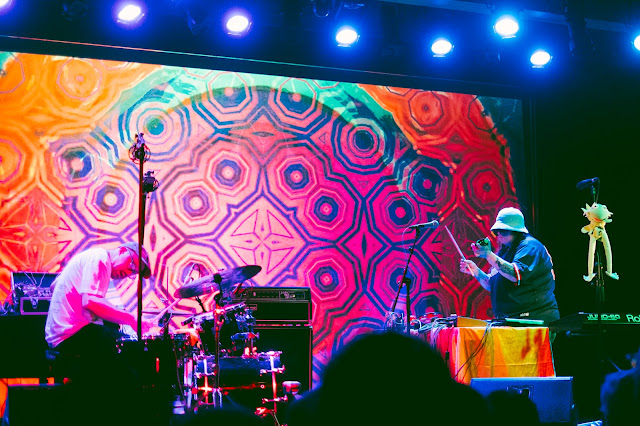
Anteloper. Photo: Gulbenkian Música – Vera Marmelo

At an early point in the pandemic, during the first set of lockdowns, I watched a streaming show by trumpeter Jaimie Branch. It was a low-fi, high-tech affair, in which Branch simply let her creative process drive the show. She played some trumpet, captured and reprocessed the sound, added some layers of electronics, and let it happen. She even sang a slightly sideways version of Moon River.

The duo Anteloper is this, but energized and magnified. Branch, along with drummer Jason Nazary, also allow their combined muse dictate in all of its unbridled creativity what happens on stage. The duo play against a motion image backdrop featuring kaleidoscopic images, sometimes overlaying images of antelopes, birds and tigers. These changing shapes and color schemes are a constant behind each set they play, which I am told is very different each time.

In the smaller auditorium of the Gulbenkian, the act of sitting during the set felt almost out of place. What they were doing -- Nazary playing complex drum patterns over electronic beats and amorphous pulsations, and Branch fiddling with samples, playing organ, and looping her trumpet -- would be entirely appropriate for being in an altered state of mind at big sweaty party in a warehouse that is soon to be torn down to make way for more luxury condos. On the other hand, the act of creation was also quite interesting to witness, and the results of thier sonic explorations was really enjoyable.

At one point Branch sang a lounge tune with the refrain, "we are not the earthlings that you know. It really makes you think, it really makes me drink." It was a fun tune and added a bit of gentle humor to the set. Aside from this Os Mutante moment, the music draws from hip-hop, punk, and 70's Krautrock (especially when Branch laid into the keyboards), but constructed out the controlled chaos, it is very much its own thing.

9:30 p.m., Damon Locks Black Monument Ensemble
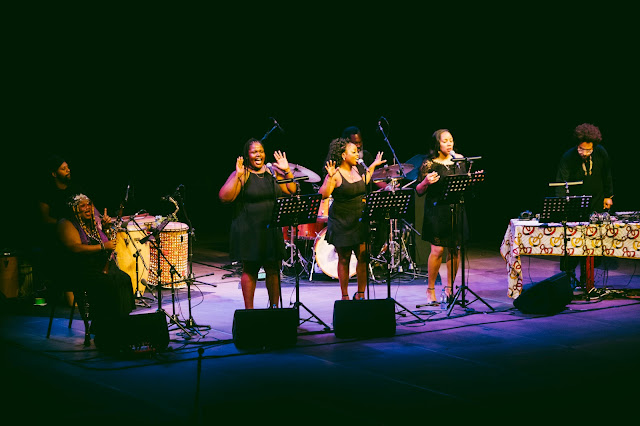
Black Monument Ensemble. Photo: Gulbenkian Música – Vera Marmelo

The show began with an empty stage and the group's manager coming out to press play on a recording. As the song played out, the members of the Black Monument Ensemble took their places: Angel Bat Dawid on clarinet on the left side, Damon Locks on samples and electronics on the right. Then, in the backrow, the incredible rhythmic nexus of drummer Dana Hall and percussionist Arif Smith, and front and center, both of the stage and of the music, the singers Erica Nwachukwu, Monique Golding, and Tramaine Parker.

The group began with a catchy sample that the percussionists locked into immediately. Dawid unveiled a serpentine melody delivered with a distinctive tremolo, and then the singers began. An effervescent melody filled the air, simple and unbelievably catchy, it hooked the audience immediately. Later, Locks' narration added density to the breezy music, tracing themes of freedom and the conditions in the U.S.. "I can't rebuild a nation, no longer working out," rang out the repetitious and sweet-sounding chorus of one song, direct and effective.

Another important ingredient of the music's secret sauce was in the rhythms. This was underscored by a drum and percussion duet that drew a fit of applause from the enthusiastic crowd. After a ceremonial-like leaving of the stage to the sounds of the drums, to a standing ovation, the group came back for a final piece. From behind me I heard in a hushed voice, "wow, they never do an encore!"

Tuesday, August 2nd

6:30 p.m. - A Escuta ('To Listen'), a film about Carlos "Zíngaro" Alves

Portuguese violinist Carlos "Zíngaro" Alves is a seminal figure in the countries avant-garde musical history. He is a self described "well behaved misfit" who chose very deliberately to follow his own path. For a while, if you follow the news clipping that appears briefly on screen during the wonderful 65-minute film, Zingaro, being so outside of the culture, did not have anyone to play with in and around Lisbon. In fact, he spent much of his formative years playing outside the country. This is obviously a situation that has changed and Zingaro can now be found playing in many different configurations in Lisbon, including Jazz em Agosto this year with Turquoise Dream.

Inês Oliveira's film is a fresh blend of styles. A classic documentary approach is used for the aforementioned career retrospective done through showing old headlines, interviews, and concert programs, and an intriguing clip of Zingaro in perhaps the early 1980s performing a piece of new music accompanied by a giant stack of electronic gear. Then, employing a cinéma vérité approach, a lengthy film-within-the-film follows the quartet of Zingaro, Joelle Leandre, Paul Lovens, and Sebi Tramontana between performances on a recent tour in Europe. Finally, choreographed segments show Zingaro deep in thought, holding his violin, and simply waiting.

It is in small interactions, like one where Leandre has to carry her bass up a set of narrow stairs and then assemble it with Zingaro and Tramontana's help, or the conversation about the harsh reality of the creative music life while on a train to Vienna, that provides tacit commentary. Voice overs provided by Zingaro ruminate over the what led him from needing at a young age to be different, and to now, as he thinks about how to use the time he has left well.

It is fantastic film, that in a gentle and loving way gives a glimpse into the inner-life of an important and vital artist.


9:30 p.m., Tashi Dorji / Turquoise Dream
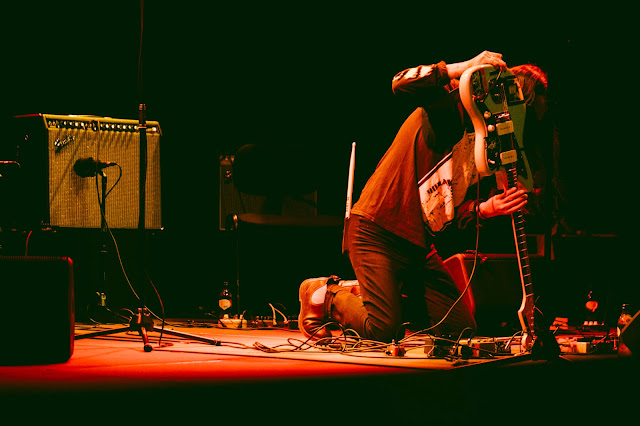
Tashi Dorji. Photo: Gulbenkian Música – Vera Marmelo

Tashi Dorji, who readers of the Free Jazz Blog are likely to be already well informed about, took to the amphitheater stage on Tuesday night just as the sun had set. A lone figure in the middle of the large stage, he began his set with a violent slash at the strings of this electric guitar. Then, he paused. Then again, he struck the strings. A pattern began to emerge: a pause then a doubling down of forcefully strum arhythmic tonal clusters, sometimes a single high note would ring out clearly. Dorji began looping the rhythmic textures and layered on additional sound.

In some sense, Dorji was exploring and reinventing the guitar, live on stage. For a listener who has fixed ideas of how a guitar is typically played, they must see the guitar anew, as an object with many possibilities to make sound, including ones still waiting to be found. For example, at one point Dorji flipped the guitar over and rammed its headstock into the stage, letting the resonant vibration of the strings then ring out. It was a bit painful to see a guitar played this way, but I trusted it would be ok, as he is the professional. 

The experimentation goes beyond the guitar itself as well. During an extended section, Dorji laid the guitar on the floor and harnessed the resonating frequencies of the amplifiers and maybe even dabbled with the flow of electricity itself, to make an expressive array of tones. Using his looper, he developed a stomping rhythmic figure that he then used to accompany himself to a powerful end.
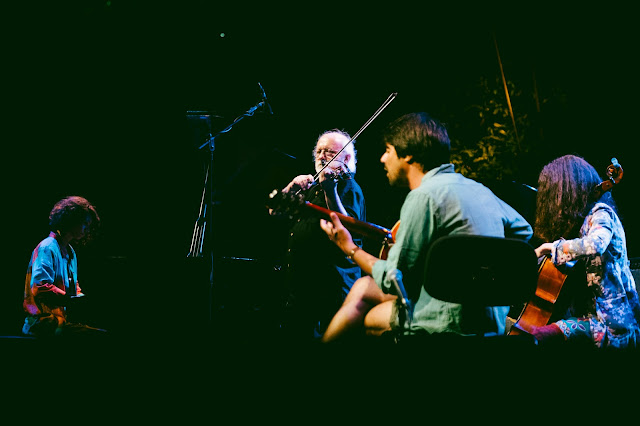
Turquoise Dream. Photo: Gulbenkian Música – Vera Marmelo

When Turquoise Dream took to the stage they, in some sense, picked up with Dorji let off with textural sounds and some unorthodox approaches to their instruments. The acoustic quartet is Marta Warelis on piano, Helena Espvall on cello, Marcelo dos Reis on acoustic guitar, and Carlos “Zíngaro” on violin. The quartet's playing is free, ego-less and and unfraid. They began by creating a whirl of sound. Zingaro played a series of elongated tones as the cello and guitar played single, rapid notes, and the piano added a sprinkle of harmony. 

The group played in long concentrated passages, each musician engaged with their instruments in a seemingly solipsistic way, but were actually quite attuned to each other. The different solo strands would come together to reach intense musical peaks. There were no solos but each player would come to the fore at times, and often it would be Zingaro whose melodic contribution would cut above the others. Sometimes too, small sounds became important ones, like a scrape on the cello or a prepared plinking from the piano.

At one point, placing the guitar in his lap, dos Reis used mallets to strike his instrument, hitting the body of the guitar for its resonance and the strings to create an exotic chime. Another improvisation (each piece was short and had a distinct form) began quite harshly, but even through the most dissonant statement, the music was imbued with sentimentality, buoyancy, and in Zingaro's bowing, hopefulness. It was a lovely set, made so especially through the mix of gentle and somewhat musically violent moments.

Wednesday, August 3rd

9:30 p.m. The Voltaic Trio / Ahmed
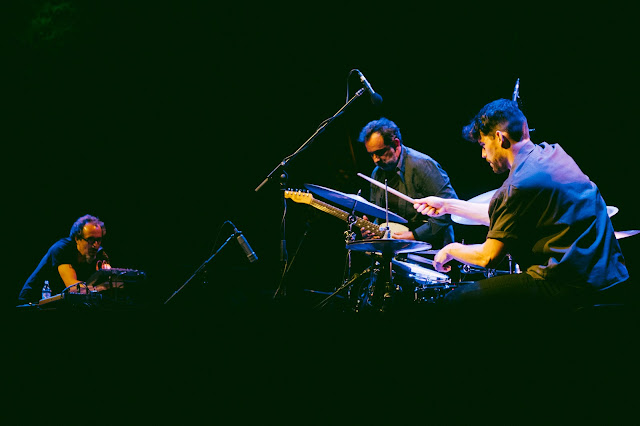
Voltaic Trio. Photo: Gulbenkian Música – Vera Marmelo

The first group of the evenings double header was the Voltaic Trio. I had a reviewed their album 290241 and spoke about their "face melting blast of electric noise and a wealth of harsh, but nonetheless, fascinating rhythms and textures" and was excited to experience it live. The Portuguese trio is Luís Guerreiro on trumpet and electronics (he gravitated to the latter this evening), Jorge Nuno on very electric guitar, and João Valinho on drums.

The set opened with an electric buzz and fizz from Guerreiro's complex seeming set up, which he delivered with flair, seeming to want to physical push a whole bunch of sound at Valinho whose drumming was an artful mix of heavy beats and a lithe pulse. Nuno's guitar buzzed along side the electronics. As the voltage increased on stage, Guerreiro pulled out his trumpet and blasted out a heavily effected series of long notes. The sound was a dense thicket of crackling and buzzing energy with some ringing notes from the guitar.

Nuno then experienced a technical issue, losing sound from his guitar. Guerreiro and Valinho valiantly covered with an intense electronics and drum duel, keeping the energy alive. When Nuno returned, the frustration seemed to pour out of him through his instrument with the energy amped up even higher into a explosive freak-out. The brief return of trumpet slid right in and added another layer of tension.

The next song took a more direct rock angle as Nuno rhythmically discharged a series of power chords, Guerreiro's electronics made a circular buzz, and Valinho worked out a series of slippery thwacks. Excellent and electric set, and many kudos to the band on how they handled the technical issue.
أحمد [ahmed]. Photo: Gulbenkian Música – Vera Marmelo

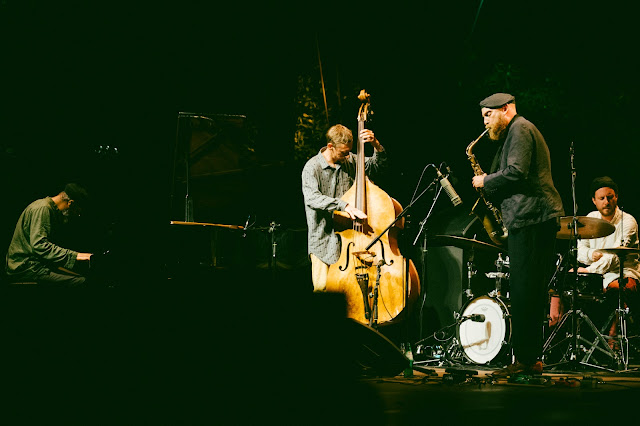
After a quick change over, أحمد [ahmed] took the stage. Comprised of the British pianist Pat Thomas and saxophonist Seymour Wright, Swedish bassist Joel Grip, and French drummer Antonin Gerbal, the quartet creates music from the songs of the American bassist Ahmed Abdul-Malik, who integrated Middle Eastern and North African music styles in his compositions. With such far flung origins and influences, it makes serendipitous sense to have them playing in the middle of the festival whose theme connects US and Europe.

As I had described the group's performance at JazzFest Berlin 2021, أحمد [ahmed] "spent the better part of an hour locked in a hypnotic and demanding groove." This is their thing, and it's a physical wonder how they pull it off.

The set began with Gerbal playing a light "Caravan"-esque drum pattern. One could hear the exotic influences and accents and retro-groove. Wright came in with a purposefully disjointed phrase as Thomas concentrated on tone clusters in the middle range of the keyboard, hitting the high end of the keyboard with his palm for accents. Grip was the rock for the music to cling to, his bass line locked in tight with the drums.

The music is demanding, the group takes a phrase and begin working it in all possible ways and shapes. The riff is like a tape set to loop as the tape player is shaken, the voltage changed, and the play head jostled. The music is dynamic, building up to a formidable tempo and then kept at a high energy level for the next hour. At this pace, I would imagine the group to start seizing up, like an overheating machine. At some point, maybe 30 or 40 minutes into the set, they began to slow down, stretching out the notes and lowering the tempo. One might have thought, 'ahh they're winding down', only to be surprised at the quick reversal and the band reaching for a new high.

Phew.

---

Thursday, May 16, 2024

Clean Feed and the Promotion of Portuguese Jazz

By Stef Gijssels

In the early 00's my interest in music was almost inevitably channeled to the Portuguese Clean Feed label. The step from the known New York crowd to Lisbon was a small one. Checking out new albums with free jazz icons such as Steve Swell, Ken Filiano and Lou Grassi led me to "The Implicate Order at Seixal", and my love for the music of "The Nu Band", also led me to the same label, with their "Live At The Bop Shop".  The label was then also accessible through "emusic.com", at that time one of the easiest sources for downloading digital music, and a very cheap one for improvised music because the cost was measured per track. Some one-track albums were as a result really unusually cheap. Other musicians that were released on Clean Feed were Gery Hemingway, Denis Gonzalez, Kevin Norton, Ken Vandermark, Whit Dickey, Steve Lehman, Ivo Perelman, to name just a few. The list is sheer endless and the quality of the albums remarkable. 

But among those American musicians, either in separate albums or within international bands, we got acquainted with the musical power of Portugal, with top musicians like Rodrigo Amado, Carlos Zingaro, Bernardo Sassetti, Carlos Baretto, Luis Lopes. Even if the initial years of the label were surprisingly characterised by all the free jazz luminaries, gradually these Portuguese names became familiar in the same movement and effort. How else would we have come across this extraordinary RED Trio with Gabriel Ferrandini, Hernani Faustino, Rodrigo Pinheiro, or with the unusual sound of Sei Miguel's trumpet and voice? The brilliant trumpet playing of Susana Santos Silva? The equally stupefying work by Luis Vicente on trumpet and Marcelo Dos Reis on guitar? Or Gonçalo Almeida on bass? Or Pedro Melo Alves on drums? These musicians all have some common factors among their obvious differences, and that is a strong and unique voice, a personal sound that is as free and unconvential as it is lyrical and musical, creative without being off-putting, fascinating also for the less trained listener. Credit to Pedro Costa for giving them this level of exposure next to the long list of established musicians. 

If the Portuguese government is serious about the promotion of its own art and culture, they should ensure that the work of Clean Feed is recognised and rewarded for their efforts. I do not think any other organisation has done as much to give Portugal a place in international modern arts as Clean Feed. 

Pedro Costa and his team threw their net very wide, and managed to become the pinnacle for the top artists from the US, the UK, the Nordics, and many other European countries. The label's portfolio offers the "Who Is Who"of free improvisation, creative modern jazz and the avant-garde, including the more genre-bending explorative work on the Shhpuma sister label. Clean Feed created artists, by giving them an international exposure they would not have received otherwise, and I think the Swedish band "Angles" ranks among the top of those. 

Here is an overview of my favorite Clean Feed records by Portuguese musicians. I can only recommend that you check them out, listening joy is guaranteed. 


Thursday, August 11, 2022

Jazz em Agosto 2022 (Part 4)

By Paul Acquaro

Saturday, August 6th and Sunday August 7th

Heading south east on Av. Alvares Cabral, a mere kilometer over a hill from the Reservatório da Mãe d'Água das Amoreiras (see part 3), is another neighborhood park, the Guerra Junqueiro Garden. It's similar to the other park with plenty of wonderful old trees, like the giant Ficus macrophylla behind the bandstand and that has an old bench sinking into its enormous root system. There is also a small pond, waterfall, cactus garden, and multiple cafes. It also turned out that the first Sunday, which it just happened to be, there is a crafts fair. In fact, crafts-folks were setting up alongside one of the many walking paths and a quick glance at the first couple of stands left a good impression. A seller who builds small boxes featuring vintage comic book characters, explained that the market only accepts vendors who make their own products - everything handmade - ever drawings, photograph, article of clothing, bar of soap, jewelry and the like. It was a nice discovery for an early Sunday morning.

In previous years, I have described the Gulbenkian Foundation's impressive mid-century modern gardens (see here, for example) but not their first class art museums. There are in fact two, one for modern art (which is currently undergoing a multi-year renovation), and the main Gulbenkian building which holds the classics, a collection that spans an impressive range of work from ancient Egypt, the Islamic world, Asia and Europe. A visit to the collection takes time as there is simply so much to take in, beginning with Egyptian pieces, to the impressive Islamic carpets and tiles, to the Rembrandt paintings, up through the Art Nouveau jewelry of René Lalique. Additionally, an excellent temporary exhibition is currently displaying a selection of the work of the haunted Armenian born abstract artist Arshile Gorky alongside the contemporary work of Lisbon painter Jorge Queiroz. The artist curated exhibition (by Queiroz) explores connections and similarities between the works, and it serves as a good introduction to both artists.

These were two very different art experiences, one crafts that you can touch, hold, and buy, and the other, priceless works that you can marvel at, both enjoyable. 

Saturday, August 6th

Bill Orcutt and Chris Corsano, 6:30 p.m.

Bill Orcutt and Chris Corsano. Photo: Gulbenkian Música – Vera Marmelo

In the small auditorium, behind the drum kit, sat New York based drummer Chris Corsano, whose career spans the rock and free improvisation and includes work with saxophonist Paul Flathery, the band Harry Pussy (with his partner tonight, Blll Orcutt) as well as Bjork. To his right sat guitarist Bill Orcutt, of Harry Pussy fame and collaborator to folks such as Peter Brotzmann and Loren Mazzacane Connors.

Orcutt's set up was a Telecaster directly connected to a Fender amp, no pedals, no electronics, and the sound from the guitar was like a fresh breeze. Orcutt began with some jangling notes followed by an array of Americana-flavored riffs, rife with dissonance. Corsano played expertly along with the intense folk-like lines coming from his partner, together building a rich tapestry of pulse and texture. For the second tune, Orcutt dropped the capo and strummed an open and somewhat warbly chord, at first basking in the reverb and then rapidly strumming, from time to time allowing single notes to pop out from the wash of chords. Corsano, a supportive and guiding collaborator, helped bring the churning riffs to a boiling point. By the third song, they went immediately for the jugular with a tough piece made from overdriven shards of sound. Then, they dialed back the energy and Orcutt played some open, twangy chords, sounding a bit like an overheating John Fahey. 

Orcutt's use of the naked guitar and amp brought to mind the idea of a secret guitar festival inside the main festival. We had heard the feedback driven work of Tashi Dorji (See #2), the electric psychedelia of Jorge Nuno (Voltaic Trio), the rich stylistic pallet of Ava Mendoza, the acoustic drive of Marcelo dos Reis (with the Turquoise Trio), the contrasting styles of André Fernandes and Pedro Branco (in Joao Lencastre's Communion), Susan Alcorn's pedal steel and the explosive Julien Desprez (with Seven Storey Mountain), and still to come, the dizzying fretwork of Julian Lage. What a cross section of styles, and for a guitar fan, a real treat. If one were to ask Jazz em Agosto's artistic director Rui Neves if this was on purpose, his reply likely would come wrapped with a sly smile, neither completely confirming nor denying. So, even if not purposeful, it was a delightful accident.

(Corsano and Orcutt released Made Out Of Sound on Palilalia Records last year)


Borderlands Trio, 9:30 p.m.

Borderlands Trio. Photo: Gulbenkian Música – Vera Marmelo

"It's really good to be here," said the trio's bassist Stephan Crump before the trio began their bequiling set, "one reason is that it is one of the most beautiful places on the planet, and another is that I can be here playing with Eric McPherson on drums and Kris Davis on piano."

The generous ensuing set from the Borderlands Trio in the outdoor amphitheater, was, judging by the enthusiastic response of the audience, a fest-goer favorite. To pinpoint a standout from the standout, Crump, with his exquisite bass work and who, aside from taking on the role of the MC, also seemed to be more than one-third of the band on stage this evening.

The music began with a soft, slightly askew introduction from Davis. Crump and McPherson hit on the off-beats, or maybe there were no real beats at all, just a gentle breath. A slow accumulation of sound followed, Davis locking into a questioning pattern of chords, McPherson upping the pulsations and Crump's bowing, building the base of sound. Davis' simple chord progression held the center while Crump stretched the tempos elastically. McPherson's touch was light but driving, as he held the tempo steady with even-handed mix of straight ahead grooves and coloring outside the lines.

Crump's first solo did not go for virtuosity (at first), but rather texture. He played a slowly devolving line until picking up the bow and diving deep into an emotional solo. Davis began by adding light accompaniment. Picking up on something, Crump found the right notes between the piano's, and played light glissandos over the fretboard. McPherson, who had stepped away from the drums, came back and began to ratchet up the energy. 

The set cascaded through sections of prepared piano (which Davis prepared as the other two played) and which caused the acoustic piano to sound almost like a synthesizer, to a long passage that sounded like a classic piano trio, and finally, to a drum solo in which McPherson methodically explored each of the instruments in his kit. The final moments of the performance found the trio escalating the intensity to a more than satisfactory end. Their short encore was like the whole set in miniature, with the trio building from scratch to another tasteful groove.

(Borderlands Trio last released Wandersphere on Intakt)

Sunday, August 7th

Matt Mitchell and Sara Schoenbeck, 6:30 p.m.
  
Matt Mitchell and Sara Schoenbeck. Photo: Gulbenkian Música – Vera Marmelo

Pianist Matt Mitchell and bassoonist Sara Schoenbeck musical careers and interests straddle many worlds. Mitchell's collaboration with Tim Berne's music is bordering on legendary and Schoenbeck has taken her classical instrument into new and unusual territory with Anthony Braxton’s 12+1(tet) and the Tri-Centric Orchestra, the Gravitas Quartet with Wayne Horvitz, and beyond.

Their duo set in the small auditorium was contemporary classical nature, with many delicate moments, fragile and beautiful in their austerity and quirkiness. A highlight of the set was multi-part suite, written by Mitchell, which featured some very compelling piano work. The last song they played was the most accessible, cinematic in sound and scope, with Schoenbeck playing a distinct melody that flowed through Mitchell's undulating chords. Overall, the music seemed to be constructed from tenuous connections and parallel play that came together only to drift apart again.

(A duo collaboration appears on Sara Schoenbeck's self-titled album on Pyroclastic Records)


John Zorn's New Masada Quartet, 9:30 p.m.

John Zorn's New Masada Quartet. Photo: Gulbenkian Música – Vera Marmelo


Back on the outdoor stage, John Zorn's New Masada Quartet played the closing show of the festival. John Zorn on sax, Julian Lage on guitar, Kenny Wollesen on drums, and tonight, Trevor Dunn on bass, sounded looser and more charged than ever. Perhaps it had something to do with the last minute substitution of bass players (Dunn for Jorge Roeder), or perhaps it something to do with Zorn's relationship with Jazz em Agosto (he had special edition of the festival dedicated to his music in 2018) but whatever it was, even the ever cool guitarist seemed stirred up.

They hit with full force, Wollesen kicked things off with a fast tempo and Zorn erupted quickly into a full throated squall. Then, after a sudden and brief pause, the group launched into a tune with a distinct Ornette Coleman like melodic hook. Throughout the set, Zorn directed the band through hand gestures given between his own playing, imbuing the set with something both visually as well as musically exciting. Lage was particularly fierce. Coming in after a quick drum break, his solo was angular and punchy, his typical mind-bending fluid lines becoming darting fists.

Lage kicked off the second tune with a sweeping arpeggio and over the rustle of drum and the thrust of the bass, Zorn played a forlorn, yearning melody. Dunn and Lage then introduced a vamp over a straight forward beat over which Zorn played arching scales and dynamic figures. The band picked up the pulse and moved to on top of the beat and reached a peak of energy that carried them to the next tune. Here, Dunn pulled off a magnificent solo, wrenching brilliance from his fingerboard. Wollesen too gave an urgent performance as Lage and Zorn seem to be colluding to the side of the stage.

The New Masada Quartet offers a new take on the beloved book of Masada and in this closing concert, the quartet took these new interpretations to a higher level. The tune's heads are familiar to fans of the various Masada bands, and even if one wasn't known, the tunes are so infectious that they instantly feel familiar. It would have been pretty difficult to find a disappointed listener in the audience.

(John Zorn released the New Masada Quartet recently on Tzadic)

---