Click here to [close]
Showing posts sorted by relevance for query dunmall coltrane. Sort by date Show all posts

Saturday, December 13, 2014

John Coltrane ‎- Offering & Paul Dunmall, Tony Bianco ‎- Tribute toColtrane

John Coltrane – Offering: Live at Temple University (Impulse, Resonance Records, 2014) ***½

Paul Dunmall, Tony Bianco – Tribute to Coltrane (Slam Productions, 2013) ****

By Colin Green

“There was a turbulence in the music that gave me a negative feeling at times, but I could not quite put my finger on the trouble...Here was a creative person who had become a vegetarian, who was studying yoga and reading the Bhagavad-Gita, yet in whose music I heard much turmoil. I could not understand it.” (Ravi Shankar)

“Everybody wants to hear what I’ve done. Nobody wants to hear what I’m doing...I’ve had a strange career. I haven’t yet quite found out how I want to play music. Most of what’s happened these past few years has been questions. Someday we’ll find the answers.” (John Coltrane)

The legacy of John Coltrane still looms large, close to fifty years after his death. The only other musicians of the 1960s who continue to exert such an influence are Albert Ayler and Jimi Hendrix who like Coltrane, died tragically young. Offering: Live At Temple University is a recording of a concert given on at the University’s Mitten Hall in Philadelphia – his home town – on November 11, 1966 and broadcast and recorded by WRTI, the student radio station. It features his last quintet: Coltrane (tenor and soprano saxophones, flute, voice), Pharoh Sanders (tenor saxophone and piccolo); Alice Coltrane (piano), Rashied Ali (drums); Jimmy Garrison – Coltrane’s usual bass player – was on this occasion replaced by Sonny Johnson. Like Garrison, he plays without amplification so that apart from his solo introduction to My Favourite Things, his contribution goes largely undetected in a sound balance which favours the saxophones.

The recording was made by a single microphone, but mono is often preferable to the somewhat artificially separated channels of many stereo recordings of the era (see: the recent The Beatles in Mono debate). The performance was recorded on two reels. The first, beginning shortly after the opening Naima – here played as a quartet, and a tune of such haunting beauty that it remained a touchstone for Coltrane – and running out before the end of Leo has previously been available as a bootleg, but the original tapes have been cleaned up for this release by Resonance Records in 24/96 sound (though there’s currently no digital download) and are available as a two CD or LP set.

In the Coltrane discography, it comes after two other live recordings by the Quintet (with Garrison): Live at the Village Vanguard Again! (Impulse!, 1966) from May, and two concerts from a tour of Japan in the July – Live in Japan (GRP, Impulse!, 1991) – the zenith of extended solos, with My Favourite Things lasting almost an hour. (“Just take the saxophone out of your mouth” Miles had replied testily some years earlier, when Coltrane told him he found it difficult to bring his solos to an end.)

Due to Coltrane’s virtual deification (there’s even a Church of Saint John Coltrane) which seems to act as a solvent on some listeners’ critical faculties, it has become increasingly difficult to write about his music in terms other than unalloyed praise. As noted by Coltrane’s friend Ravi Shankar, however – and as implicitly recognised by Coltrane himself – his late music can be problematic, although there’s no unanimity as to what exactly makes some of it so tricky. Coltrane always tended towards to the expansive, and the music of his later years can be seen as a search for musical forms and ensembles that would match an increasing range of sounds and the torrent of ideas that flowed from his saxophone. Undoubtedly, it is experimental music – and it can’t have been easy for a musician of Coltrane’s standing to test his musical hypotheses in front of an often unappreciative public – but in order to make a genuine assessment of his musical achievements and those with whom he played, it’s important to recognise that some experiments are only partially successful.

Coltrane coined Ali’s drumming “multi-directional” and the same might be said of the quintet as a whole. Coltrane’s solos are not atonal, but polytonal: small melodic cells, centred on a note or chord, which form a stepping stone to the next progression and a sometimes near obsessional examination of the constituent parts of a motif, held together by his commanding musical presence and encyclopaedic technique. As his saxophone moves further from the source, the playing grows more impassioned, with wider intervallic leaps as a counterpoint, broken notes and smears of a kind first introduced by Ayler employed as expressive devices, before eventually returning to the theme, often played straight. His solos form an arc and although radical, one can detect an obvious lineage back to his original Village Vanguard dates in 1961. In many ways, Coltrane’s playing remained modal right to the end, even though the modes became increasingly sophisticated.

In comparison, Sanders is overblowing and honking from the outset, often with only tangential references to the theme, a series of textural blasts that seek to match Coltrane’s energy (his solos usually followed Coltrane’s) but without the progression or underlying musical logic. He subsequently came to wonder what Coltrane saw in his playing. During all of this, Alice Coltrane comps within a clear tonic/dominant framework – one of the most basic tonal relationships – and the tunes, standards or simple ballads played predominately in the traditional head/solos/head form, have a clear pulse which is purposely avoided or abandoned by Ali. All this makes for music in which there is a high level of dislocation and dissonance in a way that’s absent from genuinely atonal music. Where tonal progression is present, the ear expects some kind of resolution – harmonic tension and release – but with this quintet it can be pulled in different directions simultaneously – towards both the traditional and the radical – giving the music a slightly queasy feel, as if it should either settle somewhere or break free from its moorings. For most of its duration it rarely does either, caught between wanting to give the audience something familiar and the need to work new ground, a transition Coltrane did not find easy.

The quintet lacks the cohesion of the Classic Quartet or earlier quintet with Eric Dolphy, at this performance due in in part to the circumstances of the occasion: two young local saxophonists take solos – a testament to Coltrane’s generosity to other musicians – and percussionists from a church with whom Coltrane had been sitting in join Ali during his solo in Leo; but like most percussion solos, the more drums there are the less interesting it becomes.

There’s a remarkable intensity to the playing, but again no consensus as to what inspired it. Much ink has been spilt on whether it is the result of public issues – the social and political Zeitgeist (both Coltrane and Hendrix put their music first and although sympathetic, resisted overtures from Black militants) – or more private, spiritual concerns. The latter not only troubled Ravi Shankar, but continues to baffle Geoff Dyer in his review of the album for The New York Review of Books (itself the subject of review in The New Yorker). Certainly, for much of the time any spiritual element in the music seems more Evangelical than Hindu, but then again, one man’s turbulence is another man’s spiritual energy.

This highlights one of the issues that faced music at the time – the problem of new registers, both technical and emotional. In music, formal and expressive innovation go hand in hand, but the difficulty for both audiences and the musicians themselves was identifying and understanding ways of thinking and feeling that had not previously been associated with the language of Jazz. One should not underestimate the cultural sense at the time that this was a new dawn of opportunities, provoking a headlong rush to push music forward and press on through the boundaries of the old to new frontiers where what had previously been regarded as mere entertainment – to be danced to, or chatted over in clubs – would have the complexity and emotional depth of serious Art. This applied to both Jazz and Rock and was a collective momentum – largely associated with youth – that can never be fully recaptured.

It was this passionate, risk-taking aspect of Coltrane’s music that was probably most influential in the period following his death, inspiring everything from the incendiary performances of the original Mahavishnu Orchestra on a good night to some of the multi-reed blowouts, full of sound and fury, of those satisfied with the simple equation: angry people = angry sounding music; or to put it a slightly different way: as long as your head’s in the right place, your music will be endowed with similar qualities – one of the more pernicious inheritances from the 1960s. In years to come, musicians would retrace Coltrane’s path – and that of other pioneers – at a more reflective pace freed from the pressure of being on the cutting edge, and in many respects this process continues.   

One notable feature of the performance is that there are two brief passages when Coltrane lays down his reeds and chants, Buddhist style, while beating his chest, producing a wobbly sound that’s not very convincing. It may have felt right at the time, but it would seem he did this only during a few performances and not in the recording studio: again, an indication that what we’re hearing is work in progress rather than anything Coltrane would have regarded as a finished product, or worthy of release (however important it might be as an historical document to later generations).

The most memorable number – after which the album has been named – is Offering, which was subsequently recorded as a trio (without Sanders or Garrison) in what were to be among Coltrane’s final studio sessions the following February, and appears on Expression (Impulse!, 1967), the last recording sanctioned by Coltrane before his death a few months later. This piece, together with others recorded at those sessions, gives us an idea as to some of the answers Coltrane was finding, and which lay in distillation rather than proliferation. The studio environment allowed him to produce terser poetry – but with the same emotional and technical range as his more loquacious playing in public – and the reduction of musicians to the essential resulted in a more satisfactory balance, as heard at this concert where Offering is played almost entirely as a duet for tenor and (somewhat distant) piano. In the studio version, this was followed by a contrasting duet between tenor and drums, a format that gave rise to what is arguably the most significant product of those sessions: the posthumously titled Interstellar Space (Impulse, 1974), featuring just Coltrane and Ali. Freed from the gravitational pull of other tuned instruments, the subtle trajectory of Coltrane’s playing is laid bare against Ali’s pulses and washes. It was an album that more or less defined a genre.

This is the format we hear on Paul Dunmall and Tony Bianco’s Tribute to Coltrane, the second in a trilogy of homages by the duo, though curiously none feature works from Interstellar Space (not a conscious decision, I’m told).  The first was Thank You to John Coltrane, and the third (a double CD) should be released by Slam next year.

Coltrane’s music has been with Dunmall from the beginning. He speaks fondly of listening to Sun Ship (Impulse!, 1971) laid out in his parents’ loft at the age of seventeen – “a religious experience” – and he played and studied with Alice Coltrane during the three years he lived in America in the early 1970s. Along with Evan Parker, David S. Ware, Kidd Jordan and Charles Gayle, Dunmall is among the few tenor saxophonists to have absorbed Coltrane’s style, without imitation. This may be a tribute to Coltrane, but Dunmall and Bianco have their own distinct voices, even when playing Vigil, the only piece prior to Interstellar Space that Coltrane recorded with just saxophone and drums (Elvin Jones). Both pairs start from the same place, but their journeys are quite distinct. Indeed, Dunmall and Bianco’s richness as improvisers means that their different performances of the same tune can highlight an aspect passed over or only alluded to on other occasions, a comparison that can be made on the release of their third CD which will include a live set from Cafe OTO. 

The dialogue in this music is not between Dunmall and Bianco, but within Dunmall’s playing as he shifts between carefully demarcated lines, phrases and tonal areas – exploiting the harmonic ambiguity of many of Coltrane’s tunes – set against Bianco’s backdrop of ever-shifting patterns of energy. The dynamic is altered for The Drum Thing, with Bianco’s more sharply etched figures to the fore against a sitar-like drone and as with the original, bookended by statements of Coltrane’s memorable theme.

Dunmall’s highly focussed playing explores the kind of development that so fascinated Coltrane – a world in a grain of sand – unpacking some of the infinitely variable implications of even the smallest melodic cell, often in contrasting textures that move from a warm buttery tone to something coarser, slightly frayed round the edges. In Ascent, the tiny rising motif is something to which Dunmall keeps returning afresh, each time twisting and turning in a new direction. By way of contrast, in Reverend King he avoids any great elaboration, leaving the gentle nobility of the melody to speak for itself. It seems that rather less is said about Coltrane the writer, but many of his tunes have become iconic in modern music, bearing a dignified authority that still resonates with many. Despite their apparent simplicity, they produce a fecundity of ideas – something Coltrane may have learnt from his time with Thelonious Monk – and which surely accounts for the continued inspiration that musicians draw from both men’s music. 

As one would expect from any homage to Coltrane, Dunmall displays a considerable technique, but always sympathetic to the emotional tone of the material, whether assertive, questioning, yearning or conciliatory. This drama – sometimes struggle – is part of its story, and one which listeners have found it easier to accept in the years since Coltrane’s death.

A steaming (quite literally) performance by the Classic Quartet of Naima in 1965:


And Dunmall and Bianco from Leicester in 2013, including Naima and My Favourite Things:


Saturday, May 11, 2019

Catching-up with Paul Dunmall (Day One)

By Colin Green

Such are the flood of releases from British reeds-man Paul Dunmall that it sometimes feels like you can never quite catch-up. 2018 saw him feature on eight albums, all on Trevor Taylor’s FMR label which has done so much to support free jazz and improv over the years. The Rain Sessions (FMR, 2018) was reviewed by Paul Acquaro in December and over the next two days it falls to me to cover the rest, albeit more briefly than they deserve. Anyone wanting a refresher on this considerable musician can take a look at the blog’s coverage during our Dunmall week a few years ago, starting here (click on “newer post” to move through the reviews).

Paul Dunmall, John O'Gallagher, John Edwards, Mark Sanders ‎– Freedom Music (FMR, 2018) ****


Recorded in January 2018 at the Midlands Arts Centre, Birmingham – a favourite haunt in my teens – the quartet consists of Dunmall (tenor, right), John O'Gallagher (alto, left), John Edwards, double bass, and Mark Sanders, drums. The presence of the latter two is a virtual guarantee of quality.

Dunmall has a particular way of developing material, relying on movement in and around distinct harmonic centres, more modes than keys, travelling from one area to the next like irregular stepping stones. This is likely something he learnt from his intensive studies of Coltrane, though taken into more highly developed areas. It allows him greater fluidity in his modulations, a more discriminating palette of colours, and the resources to construct a narrative that shifts between discernible expressive temperatures. Methodical but unpredictable, it forms a glue that binds his often lengthy discursions into comprehensible progressions, unpacking and reconfiguring musical ideas in seemingly endless chains of association, a continuation of one of Coltrane’s obsessions, and that of other contemporaries on both sides of the Atlantic: the propagation of material from primary particles, the smallest units of significance. Dunmall is also indebted to Coltrane for a sense of heroic determination – music as a spiritual quest striving for transcendence, with the exploration of the interior life of a musical figure operating as a simulacrum of other searches, culminating in peaks of vertiginous grandeur that evoke the Sublime, a place where inner and outer worlds meet.

All this can be heard on ‘Freedom Music One’ and ‘Two’, both of substantial duration. The basic elements are presented at the outset of each of the identifiable dramatic zones through which the music passes in a loose sort of head that functions like a gravitational presence. (I’ve a feeling that some of these phrases, often closely related, are actually derived from Coltrane or so similar they could be.) This produces a sequence of vivid arcs that are also deeply melodic improvisations referable, however obliquely, to those initial seeds and their germination. O'Gallagher is perfectly attuned to Dunmall’s thinking and there’s a visceral excitement as the pair become locked in sinuous counterpoint, ascending and hovering on the currents generated by bustling bass and percussion. They end with epic hollering over thundering drums. The shorter ‘Freedom Music Three’ is a lament of dusky introspection. Here, as elsewhere, Edwards and Sanders are at their inventive best weaving a rich tapestry of sound with verve and sensitivity.

As evidenced by the following two albums, Dunmall is too much of a shape shifter to be regarded simply as a Coltrane acolyte, displaying a multivalence that is part of his strength and originality.

Paul Dunmall, Philip Gibbs, Neil Metcalfe, Ashley John Long ‎– Seascapes (FMR, 2018) ****


These are performances from November 2017 at the Victoria Rooms, Bristol, a frequent recording venue for Dunmall, with tenor and soprano saxophones, Philip Gibbs on electric guitar, Neil Metcalfe, flute, and Ashley John Long, double bass, all familiar collaborators and a combination that gives a chamber music feel to the pieces. Full of incessant activity across a spectrum of registers, always fluctuating, barely still, it’s impossible to avoid marine metaphors or thinking of some of those breath-taking sequences from the BBC’s Blue Planet series depicting the sheer variety of life-forms and complexity of dependence in the aqueous space that lies beneath the ocean’s surface. This is exactly what’s going on musically, a diversity of organisms undergoing startling transformations in a wealth of colour -- an airy flute spinning out notes, bubbling guitar, sprightly, fumbling bass and a saxophone that squeezes into the gaps between. Blink and you might miss something.

Collectively, the ensemble conjures up the multiple movement of glittering shoals – bursts of energy darting hither and thither – undulating ribbons of sound looping and gliding, and odd, interlocked configurations that proceed crabwise. On ‘Colour of the Season’ there’s an unusual buzzing tone to Dunmall’s soprano, sounding like an Indian Shehnai (an affect achieved through his embouchure) playing Eastern scales over the watery strains of Gibbs’ guitar; like surface of the sea, present yet undefined.

Paul Dunmall, Alan Niblock, Mark Sanders ‎– Dark Energy (FMR, 2018) ****


A session from the Blast Furnace studio in Derry, Northern Ireland in April 2013 finds Dunmall (on tenor) and Sanders teamed with Irish double bassist, Alan Niblock. The music is largely defined by their relationship with Niblock whose dexterous, fulsome bass and adroit bowing form the point around which saxophone and drums circulate Faint echoes and rhymes drift through the trio, and we hear yet another side to Dunmall, more restrained and circumspect with accelerations and hard-edged runs tempered by start-stop reflections, honking asides and suggestive pianissimo phrases left hanging in the air. On ‘Light Maters’, his expansive saxophone drops back down, withdrawing into abbreviations, squeals and burrs while Sanders skims and skitters across his kit like an animating breeze. With susurrus brushes and soft trills, ‘Life Matters’ is shadows and whispers, barely there.

Below is the trio’s terrific set from the Playhouse in Derry the following month, a denser and more loquacious affair, and an opportunity to see Sanders give a masterclass in drumming.

Tuesday, January 31, 2017

Paul Dunmall Quartet ‎– Underground Underground (SLAM Productions, 2016) ****

By Colin Green

Between 2011 and 2013, Paul Dunmall (tenor saxophone) and Tony Bianco (drums) recorded three albums as a testament to the inspirational playing, compositions and spirit of John Coltrane, all on the SLAM Productions label -- Thank You to John Coltrane, Tribute to Coltrane and Homage to John Coltrane. In 2015, Dunmall and Bianco were joined by Howard Cottle (tenor saxophone) and Olie Brice (double bass) in two performances which celebrated Coltrane’s Sun Ship (Impulse!, 1971), one of the last recordings of the Classic Quartet, from 1965, and an album which had a seminal impact on Dunmall in his youth. When it came to go into the studio however, rather than record another Coltrane tribute, he decided “to write some heads in the same vein as Sun Ship so we could still capture that intensity, and play with that Coltrane spirit, but make it our own thing”. Underground Underground -- all first takes – is the result.

In this setting, it’s usual to deploy saxophones of different registers for variety and to avoid the saxophonists treading on each other’s toes. Not so here. Rather than adjoining areas, the two tenors occupy the same space, and like Phaeton’s burning chariot, it makes for an exhilarating ride, “With flaming breath that all the heaven might hear them perfectly”.

The heads are often simple figures, such as the title track’s clarion call sounded out on overlapping saxes, and the ardent, jabbing phrases of ‘Sun Up’. As one would expect, the prevailing tone is ecstatic and jubilant, executed at a high-voltage pace, hectic yet never out of control, with Dunmall and Cottle animating phrases until they achieve a molten volatility. Over the whole album, they’re driven by and draw on the kinetic buoyancy of Bianco’s drums and Brice’s taut, gutsy bass. And when the saxophones do play together, it never feels cramped. In “Timberwolf’, the longest track, there’s a passage of jointly sustained virtuosity in which they embrace and blossom, taking the theme to the brink. There’s also intensity of a different kind. ‘Hear no Evil, Play no Evil’ is a ballad, whose yearning melody is beautifully set-off by Brice’s agile bass line. The solos have that Coltrane-esque mix of exaltation with tinges of remorse.

‘Sacred Chant’ is the closing number, with Cottle and Bianco engaged in a fiery duet before, by way of contrast, a stately theme is introduced by Dunmall. The impassioned and the dignified continue in opposition until the whole band is sucked into the whirlpool, but the melody never completely goes away, and eventually is affirmed in noble unison, repeated until the fade.

Coltrane’s music-making was so rich that, even now, just when you think you’ve pinned him down, there’s something more to be found. This album is a fitting tribute to that inexhaustible body of work and the continuing inspiration it provides.

‘Ascent’ from one of the Sun Ship gigs:

Paul Dunmall, John Edwards and Tony Marsh – To Be Real (FMR Records, 2015) ****½


A certain note of sadness accompanies the music on this record, as this was one of the last recordings Tony Marsh made before he succumbed to cancer in 2012.   A frequent musical companion of Paul Dunmall during the last couple decades of his life, Marsh’s sprightly, energetic style was the perfect complement to Dunmall’s own jaunty explorations—which somehow always manage to stay rooted in rhythm and an element of the blues, even while venturing into more abstract and remote territory.  On the first cut of this four-track release, they are joined by bassist John Edwards, another legend of the British free jazz scene, on a live recording from the Vortex in 2010, while the other three tracks consist of duos between Dunmall and Marsh.  The undeniable rapport between Dunmall and Marsh is one of the great strengths of this release, as their familiarity forged over years of collaboration creates a coherent, shared musical vocabulary that is richly engaging.

The trio piece from the Vortex, “To Be Real,” is the centerpiece of the record, extending just over 30 minutes in length, and featuring all three musicians in fiery, spirited interplay.  Dunmall plays tenor here, and his Coltrane-esque cascades of notes are a recurring feature; but one can also hear the ways in which Edwards’ percussive technique helps tease out the more rhythmic aspects of Dunmall’s playing, bringing Sonny Rollins to the surface easily as much as Coltrane whenever Dunmall and Edwards exchange punctuated phrases.  It doesn’t take much effort to hear the implicit language of bebop throughout the recording: an instant of a walking bass line from Edwards, or Dunmall’s working (and reworking) of a phrase with just enough swing that we are reminded of his debt to that tradition.  There is explosive power in abundance—let’s not imagine for a moment that this is a “straightahead” jazz record—but nevertheless, one can always hear the echoes of jazz in Dunmall’s playing, and his partners here certainly help to give voice to that quality of his music.  Especially in those moments when things simmer down a bit, Dunmall’s soulful side really comes through and provides a striking counterbalance to his more demonstrative statements.  Marsh’s presence is also essential: although he never settles into a steady pulse, his dynamic creativity provides the momentum that keeps the music moving, never allowing things to settle and stagnate.  With three masters of free improvisation at work, this track alone makes the record an achievement.

The duo tracks with Dunmall and Marsh were recorded a few years earlier in the studio.  Dunmall’s done a lot with this format over the years—Tony Bianco being an especially frequent duo partner.  “TM” offers perhaps the fullest glimpse of Dunmall’s debt to the bebop tradition, as his engaging licks and phrases spill out in endless succession, with various levels of abstraction, with Marsh’s propulsive flourishes following him every step of the way.  On the last two cuts, “Sea Air Colours” and “Blackbird,” Dunmall switches to soprano sax, and he transitions into a less frenetic mode, exploring longer, more expansive phrases, especially on the former track.  Marsh too pulls back a bit here, making room for Dunmall by relying more heavily on cymbals and punchy toms, as opposed to the rolling waves of percussion more characteristic of “TM.”  But by “Blackbird,” the mood will shift once again, as a piece that begins with an air of mystery and wonder gradually builds into a torrent of tremendous power, Dunmall’s careening phrases taking things into the outer regions, and Marsh eagerly following him there with a thundering tempest.  It’s a cathartic and fitting conclusion to a terrific record, as well as a bittersweet celebration of a wonderful musical partnership.
 

Thursday, July 12, 2012

Paul Dunmall & Tony Bianco - Thank You To John Coltrane (Slam,2012) ****½


Recorded in 1967 with drummer Rashied Ali, John Coltrane's posthumously released Interstellar Space was a template for the sax and drum duo. It is a beautiful and, at times, challenging recording and has been described around the blogosphere as:
"Noisy, abrasive, violent. But it's the tight playing and the remnants of melody that give Coltrane's only duo recording its unique character." (sputnikmusic.com)
"As one of Coltrane's final recordings this duet session with Ali is one of his most essential and unique. Not only is it the grandfather of all extended saxophone/drums duets in jazz, but it also set the standard for all that came after." (All About Jazz)
And it is an obvious comparison for the long term duo of saxophonist Paul Dunmall and percussionist Tony Bianco's Thank You to John Coltrane, which is a stunningly good tribute to the saxophonist, covering a five of his compositions, with just the title song credited to Dunmall.

After repeated listens, I feel I can say that Dunmall and Bianco have created a spare, yet rousing and mesmerizing, set of takes on Coltrane tunes spanning his later career, ending with 1967's Expression, but also incorporating some re-invented themes from the 1960 masterpiece Giant Steps. And here, like the description of Interstellar Space, it's the shreds of Coltrane's melodies, and new takes on the well known themes of 'Giant Steps' and 'Naima', that make this report from the sax-drum duo format a fitting homage and a strong album in its own right. 

Dunmall's playing is utterly fantastic. His precise tone is roughed up and emotive at times and clear and determined at others. His melodies and ideas are well formed and constantly in motion. Without repeating himself or playing out any one idea too long, he builds his lines with wily intensity. Bianco rounds out the sound space with vibrant fills and microscopic reactions to the saxophonist's twists, turns and torrential runs. The platform he creates for his partner's improvizations is empathetic, kinetic and driving. A great example of this is the 28 minute take on 'Expressions' that closes the album. Dunmall's playing is enthralling, Bianco's drum solo never once dips in intensity and together they capture a certain exploratory feel, untempered by reverence. 

I find this to be an exciting and captivating recording. While the comparison was impossible to not make, the album is a conversation between two masterful musicians and an electricfying tribute at the same time. 

Available from the label.


© stef

Sunday, May 12, 2019

Catching-up with Paul Dunmall (Day Two)

By Colin Green

Paul Dunmall, Frank Paul Schubert, Sebastiano Dessanay, Jim Bashford ‎– Sign of the Times (FMR, 2018) ****


A set from October 2017, and multiple saxophones again, with Dunmall covering soprano, alto and tenor (left) and Frank Paul Schubert on soprano and alto (right), their third recorded outing together. They’re joined by Sebastiano Dessanay on double bass and Jim Bashford, drums, who both played with Dunmall as a trio earlier in the year at the same venue ( Live at The Lamp Tavern (NOL, 2017)).

The title track, at just over half an hour, progresses organically, underlying continuity being provided by a core cell sounded out in the saxophone duet with which it opens. The music traverses an inventively varied landscape, Dunmall and Schubert alternating and combining as their lines are gradually pretzel-twisted, a hedonistic mix rising in intensity and urged on by tumbling drums. There are arresting interludes for bass, first plucked, then bowed, after the last of which the music rises slowly from within and fades gently with overlapping statements of the core motif.

‘Talbot’ has moments of tremendous heat, escalating from sizzling to pan-flame as the saxophones sound out within a narrow range, almost as one, balanced against nocturnal passages made up of rattling bass, percussive clicks and split notes. ‘Blues is the Colour of my Beloved’ is a broken blues shuffle eventually transformed into repeated phrases and rapid exchanges; insistent and compelling, simple but effective.


Paul Dunmall, Percy Pursglove, Tony Orrell ‎– Nothing in Stone (FMR, 2018) ****


A gig recorded at Jazz at the Bristol Fringe, Clifton (some good pubs) in September 2017, with Dunmall switching between tenor, alto and soprano, Percy Pursglove on trumpet, doubling double bass, and Tony Orwell, drums, whose association with Dunmall goes back to their days in the band Spirit Level. I’d not come across Pursglove on bass before, but as can be heard on the title track, he has a fine, meaty sound, he and Orrell providing a pulsating backdrop for Dunmall’s funky tenor and rousing crescendos.

The other two lengthy pieces are good examples of the subliminal connotations, fortuitous conjunctions, and metamorphic conversions favoured by free jazz and the ability of improvisers to inject and pick up on changes in pace, mood and sonority, however small. ‘Speaking in Tongues’ presents alto intertwined with trumpet sprays, moving into a calypso feel, then reduced to a shrunken bass line, brushes and saxophone plosives. Dunmall introduces a vibrato-laden melody, teased out in swirling runs supported by mallets, which is suddenly left exposed, cadenza-like. Abstract textures evolve into contractions and inversions on trumpet and sax, and the trio ends with a simple statement of the earlier tune. As the title suggests, ‘Blue India’ is a series of tableaus alluding to different realms and points of connection. Dunmall’s virtuosic soprano launches the piece with tinges of Eastern harmonies (shades of Coltrane’s ‘India’?) but the ensuing bass solo is from a distant region and the prelude to a fierce duo for saxophone and drums (intimations of Interstellar Space?) Sustained, pensive notes on trumpet grow into a stirring lament which provides the foundation for a dialogue with Dunmall, now on tenor. There’re arrhythmic patterns followed by rapid shifts in metre on bass and drums that turn intimate musings to animate surges, then just as quickly into a set of punchy blues choruses.


Paul Dunmall, Philip Gibbs, James Owston, Jim Bashford ‎– Inner and Outer (FMR, 2018) ****


This is the first of two albums recorded at Rain Studios in Kings Heath, Birmingham during August 2018: Dunmall on tenor, Philip Gibbs, electric guitar, James Owston, double bass, and Bashford again on drums.

The session can be heard as a collection of ballads, having a floating, dream-like quality as if composed from fragments of standards that can’t quite be placed. Gibbs’ chiming guitar chords and gloopy pedalling combine with a Ben Webster huskiness to Dunmall’s lingering tenor, producing beguiling layers of lushness. On occasions the contemplative mood is disturbed by bursts of hyperactivity, even wandering into the surreal. On the final track, ‘Outta Time’, a collection of feathery oscillations is concluded in a way that appears to bring the piece to an end, but after a brief silence the drums start up and the music is reanimated, taking on a darker, more aggressive tone.

Paul Dunmall, Julian Siegel, Percy Pursglove, Mark Sanders ‎– As One Does (FMR, 2018) ****


We end as we began both days of this survey, with another two-saxophone line-up – Dunmall on tenor (left), Julian Siegel, tenor and bass clarinet (right), Pursglove, doing his double bass and trumpet thing, and Mark Sanders, drums. There’s a special appeal to Dunmall about the formation, a feeling that with a skilled fellow saxophonist they can challenge each other and raise their respective games – as demonstrated across the album, two voices, crafted and expressive, each lending weight to the other. The title track opens with the fruity sound of the pair in unison, and on ‘Woe is Me FO’, Siegel creates dancing figures in serpentine lines whereas Dunmall, soto voce, takes the material in a different direction, splintering, leaving pauses, blurring. After a brief joint chorale, the two tenors merge at full-throttle, completing thoughts begun by the other. During ‘Talk with Me’ they do just that, the duet of sax and silky bass clarinet drawing on one another, creating an impassioned elegy, each new inflection deftly shaded.

Trumpet and clarinet start ‘Fine Lines of Expression’ in a solemn hymn, followed by a ravishing passage for bass clarinet, leaving it to Dunmall to take us back to the still calm of the opening theme. ‘Ever New Down the Avenue’ has a blues swagger, with deliciously reedy clarinet, burnished tenor and tight, piercing trumpet. The album closes with the optimistically titled ‘New Horizons’, muscular exchanges that twist and turn and where Sanders is Sanders: propulsive, textured and alert to all about him.

Speaking of new horizons, what next? Last November it was announced that Dunmall had received a Paul Hamlyn Foundation award, to give him the freedom to develop his creative ideas and contribute to his personal and professional growth; £60,000.00 over three years, no strings attached. At last, a man who has dedicated fifty years of his life to free jazz and improvisation is getting proper recognition. “This award has really opened up so many ideas of recordings and concerts that I can bring into fruition now,” said Dunmall, “and that is so exciting.” It looks like there’ll be plenty more catching-up to do.

Read part one here.

Friday, February 3, 2017

Paul Dunmall Brass Project ‎– Maha Samadhi (SLAM Productions, 2016) ****

By Colin Green

Miles and Gil Evans probably started the ball rolling with Birth of the Cool (Capitol, 1956), since when we’ve had albums such as Coltrane’s Africa/Brass (Impulse!,1961) and John Surman and John Warren’s Tales Of The Algonquin (Deram, 1971) and  Brass Project (ECM, 1993) – large ensembles with only brass instruments and a rhythm section (sometimes supplemented with piano), no woodwind or other melody instruments. It’s a format for which Paul Dunmall has been wanting to write for many years.

The line-up is Dunmall (tenor saxophone), Aaron Diaz, Alex Astbury, Percy Pursglove (trumpets), Dave Sear, Josh Tagg (trombones), Jo Sweet, Josh Palmer (tubas), Olie Brice (double bass) and Tony Bianco (drums). The ensemble’s conducted by Ed Bennet and the compositions were written by Dunmall. The title and names of the pieces are taken from episodes in the life of Sri Ramakrishna (1836 – 1886) as documented in his The Gospel of Sri Ramakrishna.

With a focus on a family of instruments, there’s a homogeneity that can highlight their distinctive timbre, so that the absence of contrast becomes an advantage. With brass, it’s a richness in harmonic overtones, and collectively, a fruity and dynamic sound which packs a punch, as in the opening ‘Ecstatic, Unbearable Love’, a vivacious depiction of a dance with Krishna. There’s a searing trumpet solo from Pursglove, succeeded by Dunmall’s equally heated solo on tenor, each punctuated by glowing bursts from the brass. 

Brass also excels in soft, legato lines. In ‘Temple of the Mother's Presence’ the instruments slowly appear and merge in a solemn procession of overlapping entries. As if signifying the transmutation of a stone figure – the inspiration for the piece – the elliptical theme is energised by solos for tenor, trumpet (Diaz) and trombone (Sear). Long swells over drums seem to mark the transition back to stone, save for one final glimmer of movement. ‘In the Cossipore Garden’ announces a weighty dirge on the tubas, repeated by the whole ensemble over Bianco’s billowing drums. There are solos for trombone (Tagg), followed by trumpet (Asbury), in both cases striking sparks with the rest of the ensemble. The saxophone moves us to a different level with refulgent variations on the theme, wrenching the funereal chorus into acclamation.

There’s a pervasive spiritual and expressive core to much of Dunmall’s music: the rival forces that riddle our lives and the struggle for some kind of resolution, however transient; a quest that also preoccupied Coltrane in his latter years. On the title track, there’s a tender commentary on the brass melody from Dunmall’s tenor. He’s then enlivened by the irregular syncopation of bass and drums and the saxophone quickens in mood and speed, its mercurial flow counterpointed with block-like fragments from the brass. After Brice’s solo, there’s reconciliation in a sonorous restatement of the theme, combining Dunmall’s single voice with the many.

The album ends with ‘Infinite Cry’, a stirring invocation of some higher plane, with all instruments raised in supplication, in which we hear shades of another brass band tradition, that of New Orleans.

It’s unclear why Dunmall’s music doesn’t receive more attention. He doesn’t fit into any neat category, a bar to those who prefer to listen by labels. Perhaps it’s that the more albums you produce the fewer get heard, however odd that might sound. He’s an unpretentious figure who doesn’t claim revolutionary status, only to have built on and continued the work of his predecessors. By so doing he has helped establish that free jazz is an abundant resource for creative music. Hopefully, this week of reviews will encourage more people to listen to one of the outstanding and most flexible musicians of his generation.

There are no clips of Dunmall’s Brass Project, so here’s some footage of him with Mark Sanders (drums) and Alan Niblock (double bass), a trio which so far as I’m aware has never recorded.

Wednesday, February 1, 2017

Paul Dunmall at the Cardiff School of Music

Paul Dunmall, Phillip Gibbs, Ashley John Long - Now Has No Dimension (FMR, 2016) ****
Paul Dunmall Phillip Gibbs Ashley John Long, & Trevor Taylor - Cardiff (FMR, 2016) ****


Saxophonist Paul Dunmall's versatility is simply phenomenal. I first heard him with drummer Tony Bianco in their tribute to John Coltrane, where he is a fiery player, pushing the instrument to its limits. What is so striking about Cardiff and Now Has No Dimension is just how much of an experimental and textural player he is as well.

These two titles were recorded during two different, but close, dates at the Cardiff School of Music in Wales and they both feature the trio of flutist, saxophonist and EWI-ist Dunmall, guitarist Philip Gibbs, and bassist Ashley John Long, while Cardiff also features FMR label head Trevor Taylor on vibraphone, percussion, and electronics.

Cardiff was recorded in February of 2016. The first track is 'I',m' - the first two letters of the words 'Improvise' - which kicks off the recording with a great deal of musical tumult, showcasing the synthesized sounds of  Dunmall's  EWI. While all four musicians are credited with various electronics, their musical landscape isn't overrun with it, rather the technology comes in the form of quirky samples and mesmerizing textures. Track two, 'Imp', begins with the acoustic magic of the combination of flute and vibraphone whose interactions seem to almost float by, as does an eerie human whistle that punctuates the atmosphere. On track three, 'Impro', the electronics play a key role as a string of samples provokes frenetic percussion and burbling guitar. As the track progresses, they are joined by the saxophone and vibraphone, and the electronics become an equal player in the musical space.

The instrumentation on Now Has No Dimension lends it a different overall sound, though the exploratory approach is similar to Cardiff. Recorded at an earlier show in January 2016, the group here is a trio, without the electronic and percussive colors that Taylor provides. Additionally, Dunmall sticks to the acoustic horns during this concert. Both recordings present lithe interconnected passages and fleeting bursts of intensity, and here the trio is very much in tune with each other. Passages, like on the opening title track where Dunmall takes to the upper registers of the soprano sax and Gibbs tight sweeps of the strings, arrive like frothy waves, and the end of the track 'Harmonised' is a mesmerizing swirl of bowed bass and oscillating burbling guitar. The bassist seems to have more a prominent place here, upfront on tracks like 'Pearls from Oysters', where his bowing provides an intriguing underlayment for Gibbs' fretwork. On this penultimate track, the saxophonist plays the most 'jazz' like solo of the concert - an energetic high point, especially when Gibbs returns with some striking chomping and Long with percussive bass accompaniment.

Both Cardiff and Now Has No Dimension are recommended listens - the earlier trio date is slightly more conventional in its instrumentation but no less uninhibited than the later electronic leaning quartet.

Monday, June 5, 2023

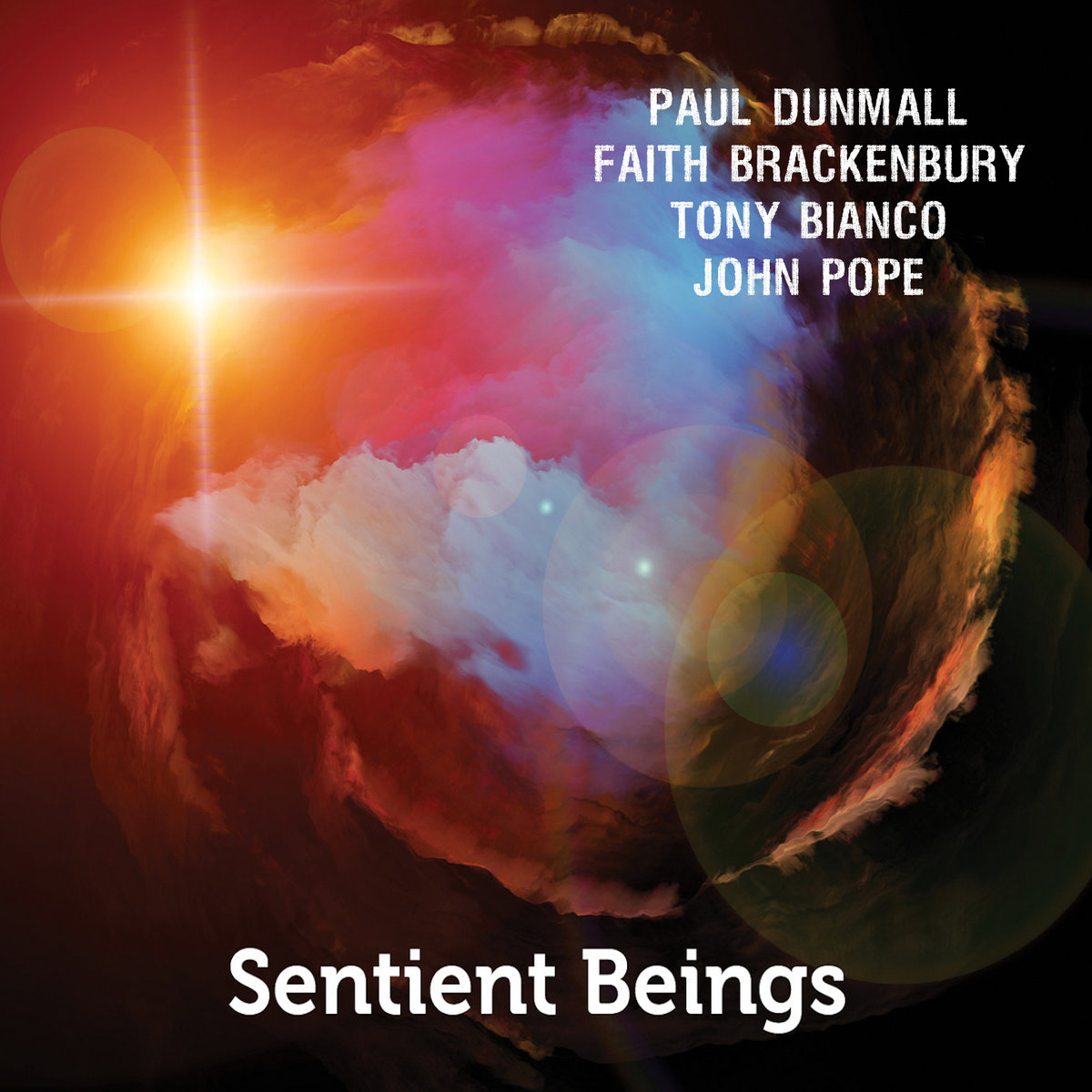
Faith Brackenbury, John Pope, Paul Dunmall, and Tony Bianco - Sentient Beings (Off, 2023)


By Sammy Stein

In September 2022 violin and viola player Faith Brackenbury, tenor saxophonist Paul Dunmall, bassist John Pope and drummer Tony Bianco met in a hilltop studio in Shropshire, England to record. They had not met as a quartet before although Bianco and Dunmall have played and recorded together many times before and Brackenbury has played with Pope and recorded with Bianco.

The date was September 23rd, auspiciously the date of John Coltrane’s birthday. It was clear the quartet shared a love for improvisation and their camaraderie become clear – so much so that Bianco suggested they call the album ‘Sentient Beings’ because of the unreserved outpouring of music that was full of fire, sensitivity, and passion.

Sentient Beings is an exemplar of spontaneous music-making. There are just three tracks named aptly ‘As it Was’, ‘Is Now’, and ‘And Ever Shall Be’ in which the quartet takes turns to lead, sit out, enter, and share diverse conversations. There is noodling at times, with each member laying their own path while at others, there is that wonderful springboarding off each other that only comes when musicians are tuned in to each other’s playing.

Dunmall is flying with his sax as he pushes up, out, and beyond normal parameters, his tongued notes merging into blares and occasional melodic phrasing. Brackenbury’s playing seems to start at every position on the strings, her virtuosity clear as she plucks, bows, and uses the full body of her instruments. Like Dunmall, she occasionally introduces a melodic phrase that counteracts the free spontaneity happening around her and weaves a classical sound into the music. Bianco is standout on drums, his intuition clear and Pope on bass is supportive and creates some deviously inventive solo lines too.

Dunmall leads the quartet many times to challenging and ever-evolving music such as in ‘As It Was’ where he creates rhythm patterns, which the others mimic, albeit not exactly because they put their own subtle spins on the phrases – as expected from these talented improvisers.

Considering the quartet had never played together before, this is a remarkable recording. It starts well with the rapport and intuitive reactions increasing as the recording progresses. The three tracks are broken by very short pauses, just long enough to hit the pause button and go and refresh your chosen beverage if you can pull yourself away from the music long enough. In ‘Is Now’ the music drops away at one point to a pared-back, almost whispered section with the saxophone meandering, the viola sighing gently over the top and the drums adding delicate, intricate sounds, and the bass supporting with its deep, yet gentle voice.

The cover picture shows colourful movement and rolling, boiling clouds with a sun appearing - a perfectly apt choice for this music with its energy, bright spots, and hidden periods of exquisite interaction, shining lit sections revealed before they are gently reclaimed into the beating heart of the music. In ‘And Ever Shall Be’ many times, a kaleidoscope of sound is created, the threads of which come together to create a picture displaying the relationships and imaginative connections of the musicians.

This is some of the best spontaneous playing I have heard in a long time. This music makes your heart and ears sing because the sense of shared understanding is almost tangible. Words can never do justice or relate precisely how the music feels. The best way is to listen to it yourself.

Wednesday, February 25, 2015

Marinated Improvisations

By Tom Burris

The following improvisations were recorded in 2012, but released at the end of 2014. 

Barker/Dunmall/Dahl - Luddite  (New Atlantis, 2014)**** 


Ludd-ite, noun, def: one of a group of early 19th century English workmen destroying laborsaving machinery as a protest; broadly: one who is opposed to especially technological change.

21st century English working reed-man, Paul Dunmall, joined Yank drummer Andrew Barker and bassist Tim Dahl in NYC for a meeting.  The subject of this meeting was recorded – but what was it about the luddites that was on their minds?  Destruction of technology, or even a major opposition to it, seems a bit unlikely – after all, they're putting it down in a recording studio - but these days one can be considered a luddite for simply carrying last year's iPhone.  It is completely true that our tech age moves quicker than is practically needed.  In fact, it has become such a part of modern life that to live without regard to “keeping up” with technological advances is to almost exist outside of (a large segment of) society altogether.  In our new economy, can the term Luddite be synonymous with Outsider?  Aren't “free” players usually referred to as playing outside?   Let's consider that the modern luddite (sic) is as complex as the thing(s) he rejects – maybe more so.   He must practice what is possibly the most advanced system of all.  He must successfully navigate his way to freedom without a preordained map, electronic or otherwise, via the discipline of intuition. 

On “Shame Game,” the album's opener, the trio moves hypnotically through uncharted waters with all hands on a Ouija board deck.  Once sufficient courage has been worked up, Dunmall easily weaves in and out of Barker's crazy waves of floating trash as Dahl plunks and prods from behind, keeping the big ship moving down an obstacle course through a deep fog.  This is the intuitive map they will follow throughout the voyage.

Dunmall and Barker ditch Dahl on half of the album and perform as a duo, as on the title track.  Barker empties a kitchen junk drawer onto the floor and wades loudly through the glass, plastic and wood while Dunmall plays his sax through a wah-wah pedal into an amp that feeds back often.  He also briefly mimics a theremin before diving headlong into Jimi Coltrane mode.  At times they sound like two teenagers who just heard On The Corner and decided they could do that too; and then at other time it's as if the universe is nothing but pure interstellar space. 

Other highlights:  On “No Pity Party,” another duo track, Drunmall's intense-yet-extremely-melodic playing plows through Barker's multi-directional driving like a Boss.  The track peaks with what sounds like an ecstatic avian conversation around a newly-filled bird feeder.  “Champion” is a leisurely drive that accelerates only during the turns.  Barker spins an egg beater through a drawer of paperclips on “Spells” as Dunmall's rambunctious melodicism astounds with equal amounts of forcefulness and sensitivity. 

At the end of the disc (“Flecks”), birds flutter and leaves rustle.  An Englishman and a New Yorker emerge from the leaf pile, shielding their eyes from the sun.  They begin to play their instruments, slowly coming to life.  The sounds they make function as a spiritual caffeine, fueling new ideas and energy almost quicker than is practically needed.  Aaaaand the world turns.

Joe McPhee & Chris Corsano – Dream Defenders  (MNOAD, 2014) ****

The glorious onslaught of early Joe McPhee reissues in 2014 are still getting fairly regular play around here.  It's still jarring to hear the differences between those early assaults and his patient soft harmonics-blowing today; but it's also a fairly standard line of maturity.  A man learns patience as time marches onward.  He listens better.  He knows when to speak and when to hold back.  Events are filtered through experience.  The elder man still contains the intelligence and fire of his former self; but his actions are no longer held captive by his passions.  A man who has truly grown is guided by wisdom.

Chris Corsano is experiencing a similar transition these days, I think – although it's not as obvious.  He still loves to keep on the attack.  He's still the guy who lists Adris Hoyos as a major influence (and that's a great thing).  But his role as a support player is not just being perfected, but re-perfected over & over with every collaboration.  He still dazzles; but he is also aware that dazzling isn't that important in the grand scheme of things.  He's one of the smartest percussionists working today. 
So the passionate men have matured.  So what?  It makes for deeper music, that's what!  At one point on “Tell Me How Long Has Trane Been Gone (for James Baldwin),” McPhee is blowing super-soft harmonics – so quietly that the sound of clacking keys is almost louder than the notes – and Corsano enters with bowed cymbals, endlessly weaving an eerily beautiful web around McPhee.  It's gorgeous and ominous, like a blizzard at dusk.  Corsano bows alone for a short while.  When McPhee reenters, playing a perfect flurry of notes, it's as if your guide has arrived to gently move you through the storm to safety.  His presence puts you at ease.

At one point during his two-minute solo intro on “Ain't No Thing (for Duke Ellington),” Corsano pounds out a pattern that sounds like the Drummers of Burundi – all of them!  When McPhee enters, his tone is simultaneously warm, inviting, shrieking, splattering and lovely.  It's as if they're both reminding us of their full capabilities, how large their arsenal really is, and how badly they don't want to simply throw it all at us.  “Here's just a short peek at what we could do to you if we wanted to...”  A sophisticated show of force is far more effective than a being exposed to a wild bunch of yahoos shooting their weapons off in every direction until they run out of ammunition. 

McPhee plays around with various two-note riffs on “The Icarus Effect” while both musicians allude to some pseudo-rumba tempo for about two-thirds of the track.  It is a flawed flight, but a fascinating one.  The highlight for me is “Other Evidence,” featuring Monk's famous melody leaping and loping out of the saxophone bell, and being chased by Corsano up a ladder into the clouds within one minute.  It suits its precise and concise author well; the whole track times out at 2:16.  It is perfectly stated.  Perfectly contained.  Perfect. 

Note:  I'm giving this one 4 stars instead of 4.5 because Corsano is often buried in the mix.  It sounds like McPhee was playing through a PA and Corsano didn't have a single mic on his kit.  And the recorder's lone stereo mic was placed somewhere at the back of the room.  But overall, the music here is so rich it's a minor complaint.  And at the price of the download it's a total bargain!

Available here:


Thursday, March 26, 2009

Paul Dunmall's Sun Quartet - Ancient And Future Airs (Clean Feed, 2009) ****½

Usually I read the liner notes only after listening to the music, just to avoid influence. The imagery that came to mind when listening to this album was one of quietly floating water, something untangible, elusive and ever changing without actually losing its form. It floats quietly onwards and onwards, taking turns, going through some rapids occasionally, and ending in the most quiet possible context, when it reaches the ocean, all beatiful and peaceful. Now I read (also in the title, you stupid!), that it's about air, and that fits even better. The band consists of Paul Dunmall and Tony Malaby on sax, Mark Helias on bass and Kevin Norton on drums and vibes. And oh, I almost forgot, Dunmall also plays bagpipes in the middle of the long first piece. But don't run away. It doesn't sound like Mull Of Kintyre, not by a long stretch. It sounds like overblown tenor.

Both saxophonists are easily recognizable on the album: Malaby is an emotional lyricist and Dunmall a raw spiritualist, and their tone is totally different, but even when both are playing on tenor, their match is perfect, intense and warm. And their improvisation brilliant. It is extremely difficult to remain coherent for close to 50 minutes, but these guys manage this well, even if there is not much focus in the piece, but that's clearly not the purpose and it would have destroyed the effect too. Now, you're taken along on a trip (air or water) through varying moods, levels of intensity, but always with the greatest of attention to the interaction. Helias and Norton too add greatly to the overall sound. The interaction between Malaby and Norton after about 30 minutes is of the same high level as Dunmall's duet with Helias some five minutes later, and here is an ear-opener for drummers too: listen to Norton's drum solo, light as a feather, subtle as the wind. And he has the same approach when playing his vibes, with the softest touch, adding color and depth, without creating a real presence. Together they create a vision of wide expanse, in the best Coltrane sense, but lighter even, broader. With no sense of melody, no rhythm despite the variations in intensity, yet so lyrical, so fluent, so sensitive, this music is totally free.

The second short track, sounds as an encore for the enthusiastic audience at the Living Theater, and also as a kind of lullaby for the fearless, all sweet and eery.

Highly recommended.

Listen to an excerpt from "Ancient Airs"

Listen and download from eMusic.


© stef

Monday, January 30, 2017

Paul Dunmall, an Introduction

On the occasion of a week of reviews dedicated to British saxophonist Paul Dunmall, Bruce Lee Gallanter, proprietor of the Downtown Music Gallery, provides a personal introduction ...

Photo by Peter Gannushkin

Ever since I heard UK sax colossus Paul Dunmall with Keith Tippett’s Mujician quartet, I knew that there was something special, spiritual about his (tenor) sax playing. Nobody has a sound like him, he is in a class of his own! Keith Tippett has long been my favorite pianist and selecting Paul as a member of Mujician (1990- 2010) was indeed an honor. I had heard of Paul before this since he was a peripheral member of the Canterbury Scene, having worked with Elton Dean, Evan Parker and Robin Williamson, but wasn’t to hear him at length until Mujician appeared. I had the great opportunity to hear Mujician live at the Victoriaville Festival, the performance reminding me of the John Coltrane quartet of the early sixties. The same instrumentation and the same fire-breathing intensity and spirit.

Besides being a master tenor saxist, Paul also plays bagpipes, soprano sax, saxello, flute and wind synthesizer, actually anything he can get his hands on. Thanks to a number of great labels like FMR (50 CD box set), Slam, Emanem and Cuneiform, as well as his own self-produced CD-R label, Duns, Paul can be heard on upwards of 200 CDs. No matter what instrument that Paul plays, he is able to work wonders. The majority of discs that have appeared under his own name are improv sessions featuring a large cast of greats: Evan Parker, Hamid Drake, Alex Von Schlippenbach, William Parker, Tony Malaby and so many others. There are a handful of great musicians that Dunmall has developed an evolving musical relationship with over many years: Paul Rogers (custom made 7-string bass), Mark Sanders (drums) and Trevor Taylor (electronic & acoustic percussion). Ever since starting his own limited edition (of around 50) CD-R labels, Duns, Paul has gone out of his way to discover many new, mostly British players and that list keeps growing every year: Bruce Coates, Percy Pursglove, Matthew Bourne and Olie Brice, to name but a few. Since Paul ended the Duns label a few years back with number 65, the FMR and Slam labels have picked up the slack with occasional releases on ESP, Porter and Clean Feed. As of 2006, when Manny Maris and myself curated a month at The Stone in December of that year, I have helped get Paul get gigs at The Stone, the Vision Festival (twice) and the Living Theatre, as well as a playing great duo with Matt Welch on bagpipes at DMG when we were on the Bowery. The last time I spoke with Paul at Cafe Oto in London a couple of years ago, he said that he might not make back to US anytime soon due the hassles and costs of flying over here. In the meantime, I look forward to each and every disc on which he appears since his playing remains consistently inspired, creative and is often filled with those cosmic spirits.

- Bruce Lee Gallanter, Downtown Music Gallery, January 12th, 2017

Sunday, October 28, 2007

Paul Dunmall - Deep See (FMR, 2007) ****

No, this is not music for scuba-diving, though it may be an interesting experience. The cover art is some of the most unusual I have seen for this kind of music, but then again, what are the rules? Paul Dunmall is a British sax (and bagpipe!) player who has performed and recorded with musicians as diverse as Johnny Guitar Watson, Alice Coltrane and Keith Tippett, and who has been an essential part of the European free improv scene for the past decades. On this record he is accompanied by Tony Orrell on drums and Jim Barr on bass. The music is absolutely fantastic. It is accessible, free, light-footed dancing from beginning to end, with Dunmall playing extremely melodic (without playing themes), very softly, as if he's afraid of creating waves. The interplay among the three musicians is subtle, respectful, creative and focused on shaping this very gentle, fragile kind of free-form improv. Throughout the album, there is some boppish rhythm either explicitly in the foreground or implicitly present in the playing of the musicians. And don't worry, Dunmall sticks to his sax on this record. Coming back to the art work : the music does conjure up feelings of wonder, surprise and sympathy, feelings I could imagine having when admiring the deep sea landscape. Highly recommended.

Friday, May 20, 2016

And many more ...

By Paul Acquaro

We conclude this week of duos with four recordings featuring the saxophone and a stringed instrument - in this case cello, bass, bass guitar and guitar, and then close out with two classic sax and drum duos. The problem is, it's hard to stop here. Just in the time of the creation of this week of reviews, a new recording from OutNow called Esoteric Duos hit the shelves, as did a Clean Feed release of Evan Parker and Alexander Hawkins ... and so many others. What to do. What to do.

Leila Bordreuil and Michael Foster - The Caustic Ballads (Relative Pitch, 2016) ****


Michael Foster (sax) and Leila Bordreuil (cello) are two young musicians from Brooklyn, whose musical partnership extends back to their meeting while studying music at Bard College.

On Caustic Ballads, the duo starts on the outside - way outside - and that old loaded term extended technique is the perfect descriptor to be applied here. This track, 'Born of its own Asphyxiation' sports a creepy title and is an engaging introduction to what has already been presented, by the cover art, as a somewhat sadomasochistic outing. Foster begins with air and fizzy dissonance while Bordreuil exploits the upper harmonics of the cello.as the track proceeds, all sorts of unusual sounds are used. The extra-instrumental materials and techniques are varied, especially on a track like 'Pleasure and Cruelty', which seems to incorporate the sounds of jackhammers and chain links.

There is an unusual intensity that builds during the first two tracks, and by the time 'Intimate Shrinkage of My Body and the Castration of My Life' comes together, the music reaches a climatic skronk. Fast forward a bit and track seven, "Wherever the Orgasm Discharges Its Internal Rottenness," is another peek of energy and sound. 

The energy on Caustic Ballads is focused and intense, and the vision is complete, as these two musicians already display a great amount of control over their instruments in creating otherworldly soundscapes. Like another recent release, Premature Burial's The Conjuring, and I'm sure many other, there seems to be a style emerging from the depths of Gowanus that is challenging, provocative and a bit disturbing!

- - - 

Keir Neuringer & Rafel Mazur - Diachronic Paths (Relative Pitch, 2016) ****


Another recording of a long standing duo, Philadelphia-based saxophonist Keir Neuringer and Kraków-based bassist Rafal Mazur deliver an extraordinary album with Diachronic Paths.

The recording is split into six tracks. Taking the album title literally, each a 'path' would seem to suggest a study, or a variation, of how language changes through time. Over the years that this duo has made music together, they have developed a kinetic approach that is as personal as it is inspiring. With the peeling sounds of circular breathing and the occasional honk of the alto saxophone along with the 16th note runs and choice chord voicing on the bass guitar, the sheer amount of musical ideas that pours forth is vital and fresh from the initial to the final path.

For example, the 'Third Path': the track begins with Neuringer playing an extended tone, it's imperfect in that it wavers and trills come and go, but all the while, Mazur is darting about, playing above and below the line set by Neuringer's single-minded note. This type of energetic matching of energy and ideas is a constant, they respond to each other, egg each other on, and make daring music together.

Diachronic Paths is an album that rewards repeated and attentive listening, and it a valuable documentation of a duo deep into a 17-year-old conversation. 

- - -

Adam Pieronczyk & Miroslav Vitous - Wings (ForTune, 2015) ****


Adam Pieronczyk (tenor & soprano sax, zoucra) is a Kraków-based player with an impressive discography, and Miroslav Vitous (bass) hardly needs an introduction and is of course well known for his work with early Weather Report and more recent titles on ECM. Together, they create gentle, yet insistent improvisations on Wings.

The opening track, 'Enzo and the Blue Mermaid' starts with a bebop line as if written by Raymond Carver - there are hints of the blues, and suggestions of syncopation, but only just what is necessary. Vitous brings an undercurrent of tension to his melodic lines that Pieroncyzk reflects back and soars over. 

'Bach at Night' is a lively piece. Its framework falls away quickly as the duo participates in a trading of phrases. 'I'm Flying! I'm Flying' is introduced with a melodic hook that provides a reference point for the improvisation that follows. The restraint in which they start with gives a fiery track like 'Hanly' - which appears midway through the album - that much more power. Pieroncyzk switches to the zoucra for this one which from what I can tell sounds like a double reed instrument, and its unusual tonality is a nice change.

I know I'm coming to this recording a bit late, as it was released in December, however, Wings is a wonderful album that requires patient and dedicated listening. It doesn't jump out at first, rather it suggests a story that fills in over time.


- - -

Tobias Brügge Matthew Grigg Duo - Vocabularies (Unknown Tongue, 2016) ****


Adopting the practice of dedicating songs - or tracks - to their inspirations, Tobias Brügge (saxophone) and Mathew Grigg (guitar/amplifier) deliver a wide-range of ideas on this release from Unknown Tongues. The improvisations styles range from lowercase passages to explosive forays. The flow of brittle intersections of sax and guitar to powerful scorched earth moments is both organic and born from a certain extrasensory perception.

Vocabularies begins with 'Peace & Fire (for Mats Gustafson)'. There is an interesting contrast between Brügge who uses short phrases to connect with Griggs' textural approach as the track begins. After a moment of quiet, they launch into an exploration of 'small' sounds, like the pops and clicks of the sax's mouthpiece and the pluck of strings on the other side of the guitar's bridge. They then slowly re-build momentum into longer, denser passages. 'Arch Duo (for Derek and Evan)' begins with much drama - Brügge's sax leaping from the speaker and Griggs' guitar particularly snarling, capturing perhaps the well know energies in the partnership of Evan Parker and Derek Bailey.

In distilling the creative spark of their influences, the duo of Brügge and Grigg develop their own challenging and rewarding music.


Matthew Grigg has been a contributor to the blog, check out some of his reviews here.


- - -

John Butcher / Paal Nilssen-Love - Concentric (Clean Feed, 2016) ****


Clean Feed's re-release of Concentric is an unexpected and welcome re-addition to its catalog! First released in 2006, the sax and drum duo of John Butcher and Paal Nilssen-Love is an expansive collaborative exploration of music and sound that needs to be heard.

Butcher is a master of the saxophone - both musically and technically. His unfettered idiosyncratic approach mixes short rhythmic attacks, otherworldly sounds, and unusually constructed melodic passages into cohesive and often evocative statements. Love - an extraordinary percussionist and band leader - compliments the saxophonist with inventive and responsive percussion, matching and contrasting moods, tempos, and textures. Concentric is also a nice companion to Love's well-documented duo work with both Ken Vandermark and Joe McPhee, as it showcases yet another unique and virtuosic approach to the duo.

Definitely worth discovering or rediscovering, Concentric is replete with fascinating sounds and textures - a riveting set of duos!

- - -

Paul Dunmall & Tony Bianco – Autumn (FMR, 2014) ****½


So, to wrap up this series of reviews, I wanted to pick up on an excellent recording that has been eluding my 'pen' for a bit too long.

Paul Dunmall (sax) and Tony Bianco (drums) are another long-standing duo that operates more in the 'fire-music' mode of free jazz. Their partnership has produced several tributes to John Coltrane, modeled after the seminal drum and sax pairing of Rashied Ali and Coltrane.

Dunmall's playing is absolutely captivating, he has an intensity of sound that rises like a high tide, and as its waves break over you, its undertow will sweep you out into the rising ocean. Recorded at Delbury Hall, in Shropshire, England in November 2014, the first two tracks of Autumn are teasers, brimming with life, their condensed arcs set expectations for the half hour "Autumn", which again features Dunmall's effortless flow of ideas and notes, the absolutely air-tight connection between himself and Bianco.

If you haven't heard this one yet, do yourself a favor ...