Click here to [close]

Sunday, February 13, 2022

Hans Reichel and Kazuhisa Uchihashi Daxophone Legacy

By Eyal Hareuveni

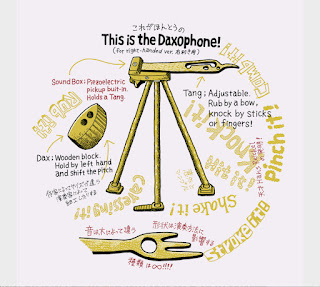
German experimental guitarist and luthier Hans Reichel (1949-2011) invented in the mid-eighties the daxophone, a single wooden blade - the tongue, not longer than 330 mm and no wider than 30 mm and no deeper than 5 mm - attached to a tripod and connected to contact microphone(s) and played with a small wooden block - the dax, a term derived from the German word Dachs, meaning "badger" and referencing the many animals sounds that the daxophone is capable of generating - and stroked or rubbed with a bow, mostly a double bass bow. The stroke of the bow causes the tongue to vibrate and produce an infinite range of voice-like timbre, depending on the shape of the tongue and the type of wood.

Hans Reichel - Yuxo (Innocent, 2021) ****
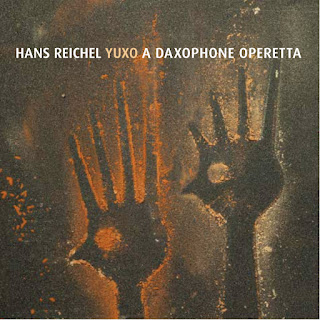
Reichel released his first solo daxophone album in 1992, Shanghaied On Tor Road: The World's 1st Operetta Performed on Nothing but the Daxophone (FMP), but assumed at that time that the “little toy” had to prove something, that it is not a gimmick, and it could properly function in multi-voiced structures, like a band, or a choir. Ten years later, when he released Yuxo: A New Daxophone Operetta (FMP), he already knew that a lot of people have seen and listened to the daxophone since - and learned that the ‘d’ is not at all a misprinted ‘s’. “There was no need to prove something anymore: the daxophone comes by as if it was the most natural thing of the world”.

Yuxo is the last major project of Reichel, composed, played, recorded and produced by Reichel between December 2000 to February 2002 (with one piece dated to March 1994) in Berlin and Reichel’s home in Wuppertal (yes, a neighbor of Peter Kowald and Peter Brötzmann), and re-released by Reichel’s disciple, Japanese pioneering guitarist Kazuhisa Uchihashi, who inherited Reichel’s collection of Daxophones. The inspiration for this project began when Reichel was commissioned in late 2001 to compose and record some daxophone music for a new production of the Comedy of Errors by William Shakespeare, directed by Martin Duncan nd performed at the Maxim Gorki Theatre in Berlin throughout the first half of 2001. Few pieces emerged from the musical material of this project, sometimes just as a theme, a little sketch or an entire song that was refined and put into a new ambiance.

Yuxo is a brilliant dadaist operetta. It still sounds fresh, highly inventive and highly playful. Reichel was clearly inspired by the cartoonish, slapstick kind of humor employed in Shakespeare’s comedy, but spiced it with his own subversive humor and love for doo-wop vocals and joyful, sensual chaos. He created a group of eccentric and talkative characters, each with his own set of very emotional, human-like vocal qualities, all sound as having tons of fun, and insist on relaying this kind of sly fun to the innocent listeners.


Kazuhisa Uchihashi - Singing Daxophone (Innocent, 2021) ***½
Uchihashi is known from the Japanese alternative-free-improvising band Altered States as well as his collaboration with Otomo Yoshihide’s Ground Zero and Tatsuya Yoshida’s Ruins, and his continuous collaborations with innovative musicians from all over the globe. He collaborated with Reichel for the first duo of daxophone in 1990 (Stop Complaining/Sundown, FMP, 1991) and for their second duo in 2006 (King Pawns: Live in Berlin 2006, Innocent, 2012), Uchihashi released his debut daxophone album, Talking Daxophone, five years ago (Innocent, 2017).

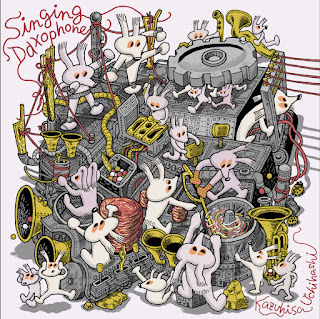
Singing Daxophone is dedicated to “great composers” of jazz standards, partisan anthems, soul, rhythm n’ blues, pop and metal iconic gems, where all the vocal and the instrumental parts are arranged for a choir of daxophones. Uchihashi recorded the 13 songs between 2019 and 2021. Uchihashi adapts the amused pathos and eccentric spirit of Reichel’s operetta characters (just check the beautiful cover illustration by Tetsu Kayama) and plays and twists the vocalists' roles. David Bowie’s dramatic “Space Oddity” is charged into a meeting with curious, alien pixies. Lou Reed’s “Walk on the Wild Side” receives a surprising, breezy, country-ish aroma. Queen’s “Killer Queen” and Bob Marley’s “No Woman No Cry” sound like they were hijacked by harmonica crooner Larry Adler. Robert Plant in Led Zeppelin’s “Black Dog” dances the two steps. The Beatles’ “Eleanor Rigby” gets a dadaist twist and Simon & Garfunkel’s “Scarborough Fair” now suggests that it was all about some horror fair. The Italian partisan anthem “Bella Ciao” already surrendered to countless versions, and Uchihashi keeps its innocent passion. There is no better way to close this hopeful statement about the daxophone with “What a Wonderful World”, with this little toy respecting the iconic, heartfelt vocals of Louis Armstrong.

Saturday, February 12, 2022

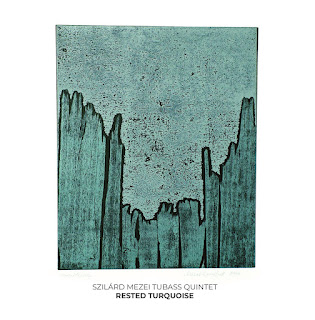
Szilárd Mezei Tubass Ensemble – Rested Turquoise (No Business, 2021) *****

Szilárd Mezei had been on a roll over the last few years, releasing gem after gem after gem ( s ). Then, as much of the world came to a standstill (or at least went virtual), he released, as far as I can tell, just one album in 2019, the double-disc Turizmus, and nothing in 2020. Fortunately, it looks like Mezei had found some time to dig back to a recording session in 2018, whence comes Rested Turquoise, the first release by an unorthodox ensemble of four basses (Ervin Malina, Ernő Hock, Zoltán Csányi, and Szilárd Mezei) surrounding the lone tuba of Kornél Pápista.

Such a formation poses challenges, which may be why it is so infrequently explored. Some of those challenges regard range and - minus the tuba, which is frequently almost indistinguishable from its throaty brethren – timbre. How does such a group avoid entrenching into a battle between muddy rumbling and a garbled tet-e-tet? How do they avoid the mucky drone of albeit admirable projects such as Deep Tones for Peace , which requires such a loud volume and quality speakers to really appreciate? (That was a very different project and included something like 13 basses teleconnected between Israel and the US, but the point still stands.) Others have done it, of course, but often with other strings or saxes to cut through the bass morass. Some others, often bass duos, moreover, resort to extended techniques and seem to consciously avoid the classic bass tunefulness and rely on extended techniques to buzzsaw their way through any heavy, low-end drapery. For the Tubass Ensemble, the approach seems to be melody and space.

This can be a gamble, as well. However, Mezei, the leader on this effort, has a unique gift when it comes to writing infectious tunes for an ensemble that bridges the avant-gardes of classical and jazz with a healthy dose of traditional folk candor as the binding agent. Indeed, this blending of Serbian folk melodicism (or straight-up melodies?) with modern jazz’s curiosity has contributed so much to that recent spate of releases that really brought Mezei and his compatriot musicians to the attention of many who had paid little attention to Serbia as a center of exploratory creative music like this.

The other issue is space both in the sense of spaciousness, or allowing space between phrases and sounds, and arrangement, in each bassist occupies one quadrant of the speakers while the tuba sits right in the center. This is a clever approach that allows each instrument to occupy its own sonic region even during frequent grooving five-man excursions. However, it would not work so well if Mezei, Malina, Hock and Csányi did not share the stage in such a way, allowing each other room to trade melodies and torqued woody plucks. In lesser hands, or lips, in the case of Pápista, this could not have worked so well. Indeed, much of it sounds at least loosely composed, with plenty of space for wandering far beyond the motif (rarely revisited, mind you) into territory wherein one often hears a lone bass or tuba or a dissociated pair. When the musicians layer, moreover, they generally remain distinct voices. Especially for such an ensemble, this combination of catchiness, clarity, and creativity is noteworthy. Then again, one who is familiar with Mezei’s earlier work might not be so surprised, even if they likely would not have anticipated how strangely normal, though hardly conventional, the four-bass-plus-tuba Rested Turquoise feels.

Friday, February 11, 2022

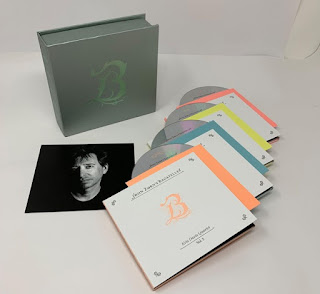
John Zorn—Bagatelles Vols. 5-8 (Tzadik, 2021) *****

By Gary Chapin

It’s been one of my joys this week to have all eight volumes of John Zorn’s Bagatelles on my phone. We’ve had two substantive snow storms and the hours of shoveling have been greatly lightened by all of this music on shuffle. I reviewed volumes 1-4 last October, and many of the fascinations that poked at me then are alive for me still.

This second quartet of recordings is focused on keyboards in a variety of settings. Zorn again is a master of inviting musicians in and creating different idiomatic conditions to take this repertoire through. Here are the lineups of the four discs

VOL 5: KRIS DAVIS QUARTET:

Kris Davis - piano
Mary Halvorson - guitar
Drew Gress - bass
Kenny Wollesen - drums

VOL 6: BRIAN MARSELLA TRIO:

Brian Marsella - piano
Trevor Dunn - bass
Kenny Wollesen - drums

VOL 7: BRIAN MARSELLA:

Brian Marsella - piano

VOL 8: JOHN MEDESKI TRIO:

John Medeski - organ
David Fiuczynski - guitar
G. Calvin Weston - drumd

You’ve got a piano/guitar quartet, a piano trio, piano solo, and organ trio. Each configuration means something different for the tunes. (I wish that there were at least a few tunes repeated in the sets, so that I could triangulate and sort out what is Zorn and what is the performer, but there are none. Each Bagatelle, numbered not titled, appears only once.)

The Kris Davis Quartet starts in a fairly “normal” place. There are a few seconds maybe of homage to Oscar Peterson (the archetypal piano/guitar quartet from my upbringing is Peterson and Joe Pass), before it spirals away and the band make it their own. Can I say a few words about Mary Halvorson? Not enough has been said about Mary Halvorson. Look, I love Davis, Wollesen, and Gress—I really do!—but has anyone noticed how Halvorson has been absolutely killing it this year? Every release, every performance has destroyed me. It’s like an actress about whom they say, “Every time she walks on, the stage just lights up.” Whether playing clean “jazz lines” or spacetime sound effects or outish banging, there is so much joy in her playing that I can hardly stand it. Love it.

I had not heard Brian Marsella before. This week I’ve heard three full discs of him playing Zorn. Aside from these two discs, he also features in a trio on Zorn’s Meditations on the Tarot (recently out on Tzadik). Marsella’s trio and solo discs present the bagatelles in what feels like their natural state (although I know that’s a fiction). Like when Monk played his own tunes, the bagatelles seem so at home under Marsella’s fingers. I specifically mention Monk because on these discs the heads do sound a bit Monkish. But, again, as in the Kris Davis disc, the trio move quickly into freer territory, where they are also very at home.

The bagatelles comprise mainly angular, somewhat atonal, “weirdo” tunes (said with affection), to be interpreted by any improvising player or ensemble who comes along. Every once in a while, though, Zorn will give us a waltz or ballad of shocking simplicity and beauty. These would literally stop me in my tracks (in the snow). Marsella’s interpretations of these were especially fine. Heartbreakingly good.

The final disc blows out your pipes with Medesky, Fiuczynski, and Weston giving us an amazing, driving, improv funkrock organ trio. Weston is a monster on the drums (he always is, really) and the whole trio seems to be having a very good time. It’s loud and pounding and has that rock organ trio sound (more Keith Emerson than Jimmy Smith) which is a genuine benchmark artifact of the mid-20th century.

I know I talk a lot about how fascinating I find Zorn’s lifelong project (very) and how interesting or intriguing it is (very), but I want to close by saying that the concept of Zorn’s music has always been secondary to me. I love music to be fascinating and intriguing. I also need it to be beautiful (in a po-mo free jazz sense). Zorn has been succeeding at this for decades.

Thursday, February 10, 2022

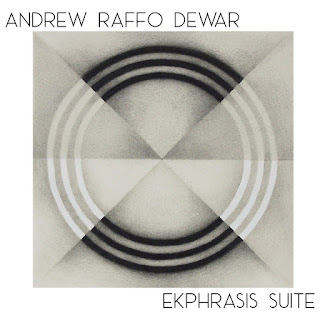
Andrew Raffo Dewar - Ekphrasis Suite (Rastascan Records, 2021) ****

By Keith Prosk

Kyle Bruckmann (English horn, oboe), Andrew Raffo Dewar (soprano saxophone), Gino Robair (percussion), and John Shiurba (acoustic and electric guitars) perform four Dewar compositions of chamber jazz inspired by four Pete Schulte drawings (as on the cover) on the 55’ Ekphrasis Suite.

The group previously recorded Interactions Quartet . Among them, Dewar and Shiurba have recorded together on Anthony Braxton’s Alumni Orchestra (Wesleyan) 2005 and Bruckmann, Robair, and Shiurba have recorded together frequently in various constellations but perhaps notable here is that all three appear on Nine Compositions (DVD) • 2003 and Robair and Shiurba on Six Compositions (GTM) 2001 .

Beyond its chamber leanings’ relative sparsity and gravity, staccato moments in persistent cadences with step-pattern angularity might recall Braxton. All qualities that could translate from Schulte’s work too, its simple staunch structures and minimal color. And like my eye is drawn to shades of grey, tactile in their grain, in Schute’s drawings so my ear is drawn to texture here. In individual stippling timbres, the grit of air through bore, oscillations in sustained wind, frictional percussion, amp hum, but moreso in their harmony, their interactions eccentric but beguiling. Like black and white, discrete and sustained soundings seem two distinct modes, solos and group play too maybe, but the music beams in between.

Free Jazz Blog on Air - Newcomers

freejazzblog on air, featuring free jazz blog writer Martin Schray and public radio host Julia Neupert, will broadcast on SWR2 in southern Germany at 9:05 p.m. Central European Time this Wednesday, February 9th.

For those of you unable to listen when it airs, it will be available online for four weeks following the broadcast.

The theme of the show is "Newcomers" with music by Camille Emaille, Farida Amadou, Signe Emmeluth, Gabby Fluke-Mogul, Baptise Boiron and Susan Alcorn. 

Here is a link to the broadcast: https://www.swr.de/swr2/musik-jazz-und-pop/freejazzblog-on-air-newcomer-on-the-scene-swr2-nowjazz-2022-02-09-100.html

Wednesday, February 9, 2022

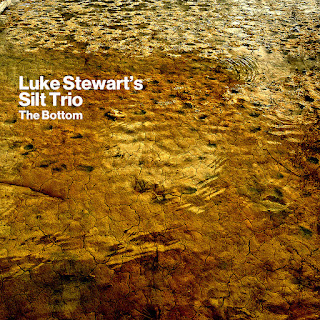
Luke Stewart’s Silt Trio, The Bottom (Cuneiform, 2022) ****½

By Jim Marks

Luke Stewart kicks off the new year with a saxophone trio release featuring Brian Settles on tenor and Chad Taylor on drums and mbira. Stewart has worked with both Settles and Taylor before in trio settings ( No Trespassing and Tin - Tabu - Latin' - Rhyth - Hymn , respectively, both released in 2020), and the three collaborate effortlessly on this set of six tracks that fall somewhere between composition and improvisation (described by Stewart in the liner notes as “like a set of compositions . . . coupled by moments of free improvisation . . . contextualized by what happened before and after”).

The gentle, tropical-sounding opener “Reminiscince” (sic) begins with the mbira setting an odd beat that Stewart then joins on arco followed by Settles with some hesitant blowing. Taylor’s mbira here makes an interesting contrast to its appearance on his duo with Chris Schlarb ( Time No Changes, 2021, reviewed for the FJC by Nick Metzger ).

Things get moving with “Roots,” which Stewart drives with an insistent ostinato that locks into a groove with Taylor. Settles hangs back for a while and then darts in and out, playing off of both before melting into the cymbals toward the end.

“Angles” slows things down again and is the longest and perhaps the most challenging of the six tracks here. A series of clear notes from Settles immediately gives way to Stewart’s arco scrapings and rolls of muted percussion. The three then search tentatively for common ground, each frequently dropping out to let the others try to find a way; the “angles” here are definitely oblique.

“The Bottom” follows a pattern similar to “Roots” but to different effect, with Settles blowing some deep blues in response to Taylor calling up the ghost of Fred Below and Stewart that of Willie Dixon. This track hits especially hard after the ghostly tension of “Angles” and seems far too brief at around five minutes.

“Circles” is the most energetic, even frenetic of the tunes here, showing Settles’ impressive intervals, Taylor’s inventive polyrhythms, and Stewart’s nimble and precise pizzicato. This track also seems short, blazing by in just over three minutes.

“Dream House” rounds out the set at a medium-slow pace, with both Stewart and Settles drawing out their tones on the pleasant descending melody. This dream house is a spacious and warm place for the trio to end its journey.

The Bottom is not a major statement from Stewart like the Works for Bass series (reviewed with other solo bass recordings for the FJC by Eyal Hareuveni) or 2020’s monumental Exposure Quintet , but it provides a nice soundtrack to the start of 2022. And, given his remarkable productivity, undoubtedly have a lot more music to look forward to from Stewart in the coming months.

Tuesday, February 8, 2022

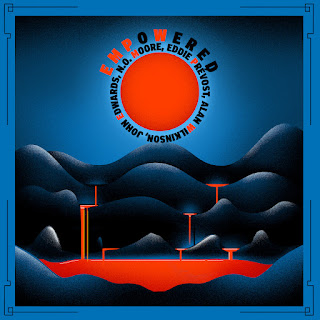
John Edwards, N. O. Moore, Eddie Prévost, Alan Wilkinson - EMPoWered (577 Records, 2021) *****

By Stuart Broomer

Brooklyn’s 577 Records has been issuing some extraordinarily good examples of current English free improvisation, including The Secret Handshake with Danger by the quintet of Olie Brice, Binker Golding, Henry Kaiser, N. O. Moore and Eddie Prévost and Dark Before Dark, an improvised orchestral setting by the London Experimental Ensemble with writer Iain Sinclair’s narrative performance. EMPoWered, a two-segment, 51-minute improvisation, is just as powerful, and its title would be no less apt even if it weren’t emphasizing the initials of bassist John Edwards, guitarist N.O. Moore, drummer Eddie Prévost and alto and baritone saxophonist Alan Wilkinson. This is forceful music, but it’s also music imbued with mysterious powers, suggesting at times trance and shamanic possession. Wilkinson, an active member of the English improvisation scene for about forty years, is a player of tremendous force, particularly on baritone, an instrument that he wields with singular ferocity. Wilkinson toured in 1996 in a quartet with Peter Brötzmann, an early influence; he’s among the very few musicians who can match Brötzmann’s raw force and combines it with an expansive sonic invention.

Part one, thirty minutes long covers much of the terrain of free improvisation and close listening. The music opens subtly, Edwards bowing glissandi with a cello\s lightness, a few bright flurries from Moore and Prévost randomly tapping his drums into a state of alertness. When Wilkinson comes in on alto, it’s with deliberate purpose, an intense repeat of several notes, pause, the same but lower, then a compact, repeated, multiphonic blast. The group both rises to this and presses forward, Moore finding his own squall as Edwards and Prévost build an energized polyrhythmic ground. When Wilkinson re-enters, he brings an intense alto free bop, which eventually breaks up into a field of almost random group noises. It’s highly collective music that lives happily in a state of flux, always moving, always changing. Prévost, strongly associated with AMM’s spacious style of free improvisation, here reveals the other side of his art, drumming in a driving, free jazz tradition with aplomb. N.O. Moore, strongly associated with electronics, even plays a gentle tonal line of classic modern jazz guitar in one of the quieter moments. Amidst these developing gestures, Edwards comes very much to the fore, his articulate, resonant lines providing a singular focus, moving readily from formative lines to forceful insistence. The dialogue assumes a much harder edge as Wilkinson begins to reveal the power of his baritone, at times generating blasts that announce a forcefield to which every member of the group will contribute. The force, though, is no more impressive than the pastoral, the ruminant warmth of the baritone, the melodic precision of the shifting exotic draperies of Moore’s guitar. There are even moments here that might suggest far-fetched instances of West Coast jazz, something Jimmy Giuffre and Jim Hall might have fabricated, before it suddenly rises to yet another dimension of free jazz intensity, ultimately falling off into birdsong, light baritone bleats and cymbal scrapes.

As achieved as the first part is, the 21-minute Part Two is the more powerful, a transformative music filled with foreboding and the possibility of revelation. What’s most memorable here, apart from the force, is the extreme kinship revealed in the music. At some levels, free improvisation is an invitation to spirits, and here it seems especially strong, a séance in a battleground. Without a visual presence, the music becomes even more mysterious. Towards the conclusion, there’s an intense sustained high pitch sound, almost a squeal, that’s evidently passing between Wilkinson’s alto and Moore’s guitar. There are sudden shifts in density and volume, but at times the music becomes a variegated, moving wall into which individual instrumental identities have blurred. This is no mere studied effect, but a significant feature of the heightened mental state of great free improvisation, a suspension of identity in sound, a psychic group formation in which a kind of literal hive mind forms, parts resembling one another in ways that might seem impossible among unalike instruments, but which nonetheless occur.

This is very powerful music, but it’s also imbued with the kind of subtlety that will reveal new life with repeated hearings. Collective improvisation may be small audience music, but its significance can resonate far beyond its performance spaces.

Monday, February 7, 2022

Udo Schindler and Xu Fengxia – WINDundWOLKEN (Arch-Musik, 2021) ****

By Nick Ostrum

As with many musicians, German reedist Udo Schindler had been pushed to his archival material by the pandemic and has released a series of strong performances with a notably diverse cast of musicians ranging from the accordionist Ute Völker to vocalist Rainald Schwarz to Japanese pianist Masako Ohta and many others in between. Count WINDundWolken (Wind and Clouds) among that batch. This release catches the duo of Schindler and Chinese string-master and vocalist Xu Fengxia live in action at the 77.Salon in Krailling, Munich in September 2017.

Xu’s website describes her work with Peter Kowald as a definitive turning point in her musical vision. If one enters this album with that idea too ingrained in their mind, however, they may be quite surprised. Indeed, Xu plays her strings (guzheng, sanxian) in unconventional settings, but, as far as I can tell, with a greater ear toward crisp melody than unorthodox techniques and sounds. WINDundWOLKEN has exceptions, of course, but as much as Xu pushes the limits of her classical training on her strings, her vocal techniques are often at least as striking as her instrumentation. Even here, however, she does not torture her vocal chords to explore the guttural shouts, strained squeaks and decay that many other avant-garde vocalists do. Instead, she dances between East Asian folk melodies, Euro-American acoustic traditions, and experimental music. For what it is worth, Schindler also avoids the extreme ends of unconventionality on his clarinets and this shared focus on melodicism outside of the pop and jazz traditions makes this album work remarkably well.

Especially through Xu’s work, the album hints at interesting connections between American and European folk traditions and those of East Asia. Take, for instance, W&W Solo XF1. This is an absolutely beautiful, pensive folk ballad that, substituting a banjo and English as the instrument and language of choice, could fit as well in Appalachia as I assume it does in the tradition that birthed it. The melody is simple, but moving, and somehow universal. What is more, its plaintive drawl balances the free form excursions surrounding it. These swing from the slow and contemplative, as on W&W #3, which initially evokes a noirish stroll through some nondescript though placid docks (maybe with an eye towards the slowly shifting clouds above) to gustier passages of less inhibited improvisation, including a playful, carnival-esque jaunt through even stranger territories that sets in about halfway through the track. W&W #6 is another example: Xu’s galloping strings and euphonious-to-ululating singing intermingle delightfully with Schindler’s grumbling horns. #6 is also one of the few pieces that showcases Xu’s excursions into the Yamataka Eye/Jaap Blonk tongue-twisting babble. Other pieces, such as the brief W&W Solo and W&W #5 explore tones in a way that the more active and lyrical pieces do not, ranging from drones to high pitched quavering to huffed cadences. W&W #6, the penultimate track, begins with Schindler’s growling contrabass clarinet and Xu joins tentatively on sanxian at first, then on vocals. As the duo finds their footing, they fall into territory that are a more energetic exploration of the folk aesthetics introduced so effectively in W&W Solo XF1. For the final solo, Xu sings “ jetzt geht nichts mehr” (“now it doesn’t work”) and swings into a noisy romp through the guzheng. A fitting ending to a compelling and eccentric release.

Sunday, February 6, 2022

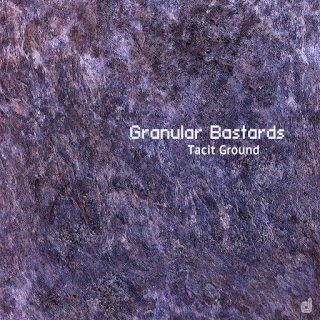
Granular Bastards - Tacit Ground (Discordian Records, 2021) ****


By Ron Coulter

Granular Bastards is Valeria Miracapillo (laptop) and Albert Cirera (saxophones).

Tacit Ground was recorded in Copenhagen, Denmark on June 23, 2020 and released April 5, 2021 on Discordian Records, a Barcelona, Spain based label that offers a large catalog of interesting releases from Barcelona-based artists.

Tacit Ground comes in at 33’27” with its four tracks. The title refers to the fact the album is freely improvised without planning or discussion. The album notes describe the music as follows: “Raw, naked voices from the instrument’s skin. The saxophone activates vibrant objects in its body, while granular machines sample and output grains with the same rough mechanics. Dull transients, resonant metal cans, asynchronous periods and chaotic densities, nothing will smooth out the frictions of thought in its attempt to coherence.” Agreed, this is raw, dirty, gritty, complex sound; it is textural and timbre-driven free improvisation, even in moments of subtlety or rhythmic activity as in track 2 where the rhythmic activity serves more to jaggedly carve out the texture than to establish periodicity. Even in a simple long-tone from the saxophone there is a tension and development of the timbre and pitch generated from it and the laptop (see track one); simple sounds, which are not so simple upon close listening.

This album is one of many that combines a performer on an acoustic instrument and one on electronics, where the acoustic instrument creates the musical content and the electronics use those sounds to be processed/manipulated in order to create their musical content. In many of these contexts the acoustic sounds are often subverted by the electronic sounds, with the resultant sounding like a single instrument or performer. Here, however, the acoustic and electronic are presented side by side as equal voices, clearly distinguishable and still well blended. Granted, the saxophonist’s use of extended techniques, and added objects to the instrument (preparations) generate exotic timbres that at times seem almost electronic in origin. Cirera’s solo performances, on record and youtube, are well worth checking out too; from these you can often see a style of improvising that lends itself well to this duo with Miracapillo and her particular use of electronics.

The duo has an excellent balance in their improvisations, an empathetic performance dynamic that generates very sensitive development of timbre, texture, and pitch. In addition to Cirera’s excellent contributions mentioned earlier, Miracapillo demonstrates adept control with the laptop and the ability to interact with the responsiveness of an acoustic instrument.

Tacit Ground is an excellent album that demands close, attentive listening to appreciate its complexity. The listener will be rewarded for their efforts, especially on repeated listenings that will reveal new depths to the music every time.

Saturday, February 5, 2022

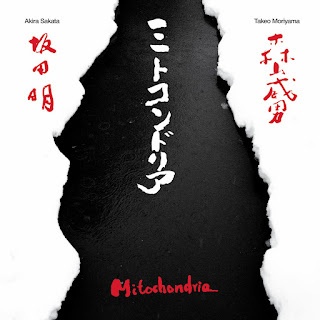
Akira Sakata / Takeo Moriyama - Mitochondria (Trost, 2022) *****

By Eyal Hareuveni

Mitochondria is a spectacular, historic live recording of two forefathers of the Japanese free jazz and free music scene - clarinet and alto sax player Akira Sakata (known from the Arashi Trio with Norwegian drummer Paal Nilssen-Love and Swedish bassist Johan Berthling) and drummer Takeo Moriyama, who like, Sakata, collaborated, among many others, with Peter Brötzmann. This double album was recorded at Kashiwa Church in Chiba Prefecture in May 1986 on Sony stereo cassette recorder, and for its release was mixed by Jim O’Rourke (who collaborated with Sakata as a duo and as a quartet with Chikamorachi), mastered by Martin Siewert (of Radian), designed by Lasse Marhaug, and features the insightful liner notes were written by Kazue Yokoi from Jazz Tokyo, who saw them playing live in many occasions.

Sakata and Moriyama played together in the singular, influential trio of pianist Yosuke Yamashita, one of the pioneers of Japanese free jazz, from 1972 to 1975, when this trio took Europe by storm. The Yamashita Trio stressed its own original sensibility of free music, characterized by eruptive, overwhelming energy spiced with a strong political vibe that reflected the student movement era, quite different from the American or European free jazz or free music of this time (check, for example, the Yamashita Trio’s Clay, Enja, 1974, recorded at Moers Festival in Germany). This period of the Yamashita Trio is considered as its golden age, and an important step in the development of Sakata and Moriyama’s careers and musicianship. Moriyama left the trio in 1975 and Sakata in 1979.

The reunion performance of Sakata and Moriyama, now as a piano-less duo, unconstrained by chords, allowed these two young masters greater degrees of freedom. Moriyama has perfected his distinctive style of drumming, which involved the random strike of the 2 and 3, in quintuplets, and together with the velocity with which these hits were rendered, offered him a freeform impression, still grounded by a sense of powerful groove. Sakata was a devotee of free jazz, known for his energetic drive. Both Sakata and Moriyama knew how to draw the essential elements of each other to benefit this ecstatic performance.

Sakata opens s the A-side of this performance with “Archezoa”, a poetic and lyrical clarinet solo. The following “Mitochondria” and “Hachi” were of the Yamashita Trio’s repertoire (the latter in the Yamashita Trio’s classic Chiasma, MPS, 1976), with Sakata on alto sax, explode instantly and sound like Sakata and Moriyama’s response and homage to John Coltrane and Rashied Ali’s iconic duo Interstellar Space (Impulse!, 1974). Sakata and Moriyama are possessed on these pieces by fiery and liberating, spiritual energy and passion. The B-side tells completely different stories. “Tsui-oku (Reminiscence)” is an emotional, beautiful duet, with Sakata singing with his clarinet and dancing with the Moriyama’s free pulse. Moriyama’s solo “Satsuki (May)” highlights his idiosyncratic sense of time and space, infectious groove and his inimitable sound. This side is concluded with an uplifting, gospel-ish cover of Albert Ayler’s “Ghosts”, covered before by the Yamashita Trio (Montreux After Glow, Frasco, 1976), and Sakata here quotes again a phrase from the Japanese children's song “Akatombo (Red Dragonfly)”, as he did with the Yamashita Trio.

The C-side opens with a playful, super fast and intense yet precise cover of Yamashita Trio’s classic “Chiasma”, where Sakata and Moriyama’s eruptive and boundless energies take this piece from one cathartic climax to another. The same kind of energetic, almost dance-like playfulness is featured also on the free jazz “Dance”, solidifying the telepathic dynamics of Sakata and Moriyama. The D-side concludes this landmark performance with “Wann kann ich sie wiedersehen”, covered later by Sakata’s all-star band (Mooko, NEC Avenue, 1988). Sakata sings the emotional melody on his alto sax with great passion and Moriyama, who takes the role that Ronald Shannon Jackson played later, suggests a sparse groove and imaginative cymbal work.