Music can be compared to radiation - analogous to descriptions by the German writer Ernst Jünger. In his diary entries of the same name, Jünger refers to light, but his observations can also be applied to the auditory world - especially that of improvised music. The musicians capture sound that reflects on the listener. In this sense, they perform preparatory work. The abundance of sounds must first be selected and then evaluated - in other words, given the sound that corresponds to their rank according to a secret key. Sound means life, which is hidden in the tones. A flawless improvisation then has an effect beyond the pleasure it gives the listener. It would be a decision between the played and the discarded, a delicate balance that transcends to the other areas of life and society. Thus musicians would be far more important in their significance than they are generally given credit for. When they transform tones into sound, the future is seen, it is conjured up or banished in the best sense. Perhaps this gives music a little too much weight, but I thought of this analogy when I listened to Sophie Agnel’s and John Butcher’s latest album, RARE.
The very first notes of the opening piece sound like a small homage to György Ligeti’s “Atmospheres”, with their improvisational rigor on the one hand and relaxed, variable and aleatoric moments on the other. However, the two apparent extremes coincide in Agnel and Butcher’s music. The improvisation is then more a state than a contour or shape, the timbre is the decisive element, the actual carrier of the form, which - detached from the musical shapes - becomes an intrinsic value. Agnel’s notes seem to be dabbed on, Butcher’s saxophone casually hisses past them or his lines pop up only to disappear again immediately. Much could be played here, but the two decide not to. The pause is the crucial element. If RARE were an ECM recording, euphony would probably take center stage. But Angel’s and Butcher’s music is roughened, bulky and accessible at the same time, atonal but quite audible, rugged and dark, but also plainly beautiful. Both are masters of their instruments, and there are also wild passages on RARE, as well as stark contrasts such as Butcher’s birdsong in “RARE 2”, which Agnel accompanies with notes from the lower register. Pure life here: The awakening of nature in the early morning, but the dark clouds on the horizon already herald a coming storm.
The music on RARE lives from these fundamental tensions, it even thrives from them. You can lose yourself in the sounds created by two of the great improvisers of our time, let yourself fall into it, reel in it. RARE celebrates this creativity, it’s a high mass of improvisation. Agnel and Butcher manage to uncover the life (the sound) that is hidden in the notes. It’s a vision of a better future. Marvelous!
RARE is available as a download.
You can listen to some excerpts and buy it here:
I've been thinking about extended technique and the saxophone a bit lately, and I am starting to come up with a taxonomy, a classification scheme, if you will, of the various sound possibilities and their application. For example, there are the extended tonal systems that musicians like Evan Parker and John Butcher have developed and extended, rich panoplies of sounds that when you hear it, you can immediately identify the source. This extends, in my nascent system, to titans like Peter Brötzmann whose blasts belong to his own unique vocabulary. Then, there is the over-blowing that add emphasis and takes the listener out to the unknown, like, for example in Tony Malaby's playing.
("Every Woman Is A Tree" (2008), "Elliptical West" (2010), "By Way Of Deception" (2012), "In Our Midst" (2013), "Injuries" (2014), "Disappeared Behind the Sun (2017), "Equality & Death/Pacemaker"2016), "Beyond Us" (2019) "Today Is Better Than Tomorrow" (2019) "A Muted Reality" (2022),
"Hellstorm" (2012), "Lieber Heiland, Lass Uns Sterben" (2017), "Det Försvunnas Namn" (2020), "Utopia" (2022).
Next to these, he also has a few dozen albums with some of the best musicians in free improvisation and jazz: Agusti Fernandez, Rafal Mazur, Vasco Trilla, Zlatko Kaucic, Burkhard Beins, Steve Noble, Ernesto Rodrigues, Keith Rowe ...
Listen and download from Bandcamp.
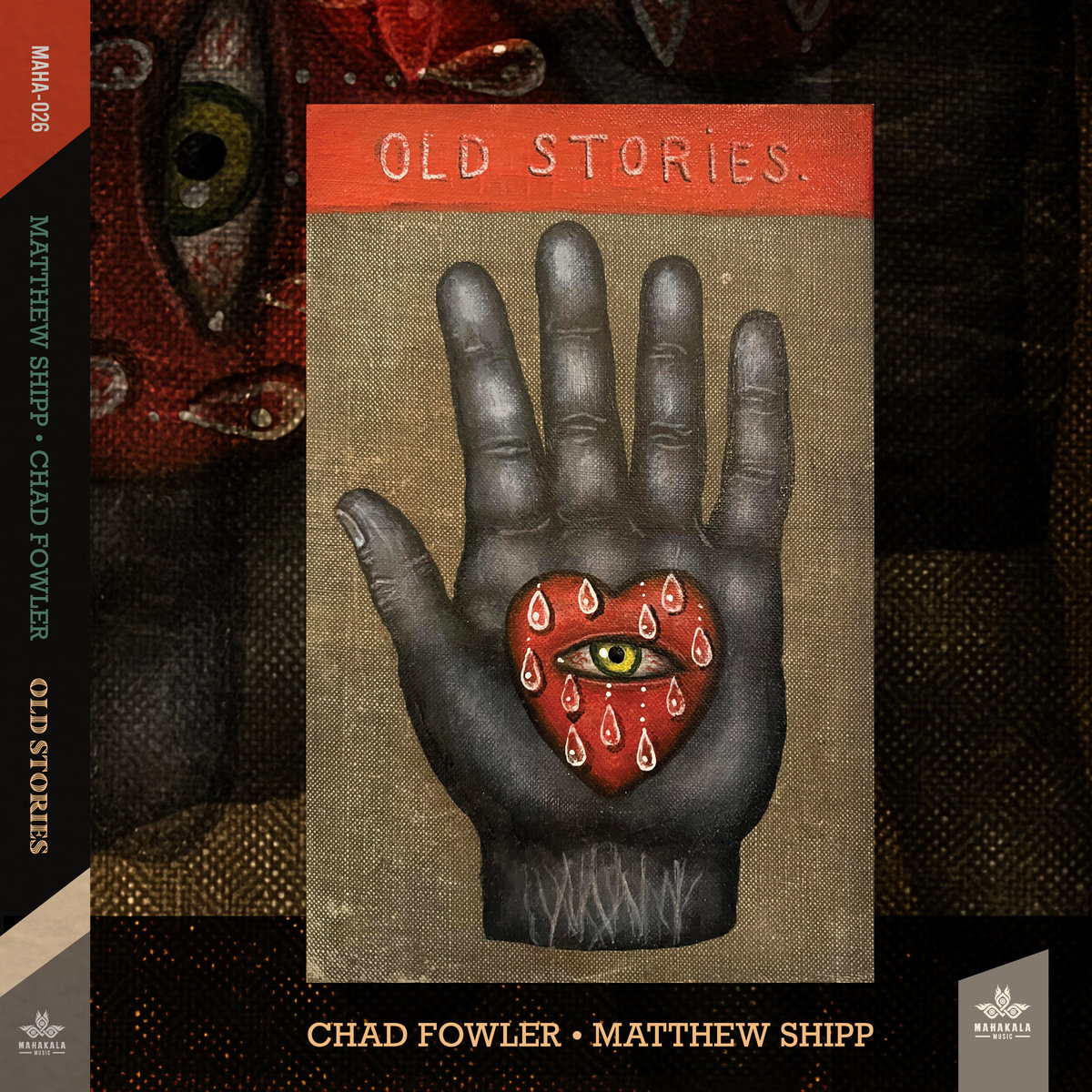
When he walked into the studio, Matthew Shipp was at the piano playing Duke Ellington ballads. “Really swinging, beautiful,” recalls reedist Chad Fowler in the album notes. Other than arranging the logistical details, the two hadn’t discussed the music they were about to record. Their ensuing spontaneous musical dialogue is titled Old Stories (2022) and is published on Fowler’s label Mahakala Music. The 2-CD recording captures their very first time playing together, but the deep simpatico heard between them makes me think they must’ve been playing together for ages. It’s a compelling narrative. And so is their music.
Ellington has been a perennial inspiration and touchstone for Shipp’s art, notably on a wonderful 2015 trio recording titled To Duke (RogueArt) , covering classics and offering originals in a riveting avant-garde spirit. In a sense that’s more oblique though no less alluring, one might hear the spontaneously composed songs on Old Stories as magnifying that homage, this time with Chad Fowler playing stritch and saxello, himself bringing a longstanding admiration for Ellington’s saxophone sideman Johnny Hodges. Shipp’s playing has delightfully lyrical moments on Old Stories, and when Fowler coaxes sweet bluesy tones from his horn, even a fledgling like me catches echoes of Ellington. But it’s volatile, and in the blink of an eye Fowler can be wailing fiercely amidst Shipp’s rapturous storms.
Old Stories is divided into 14 tracks or “chapters,” and Shipp and Fowler have an endearing magnetism throughout. Through both communicative contrasts and mirrored responding, there’s always an emotional valence to their dialogue. Some passages can be emotionally exacting – stories full of pain or rage can be like that. But that doesn’t diminish their value, their importance. There’s vibrancy in expressions of pain. To that point, Fowler’s label Mahakala Music notes “our aim is to create and release aggressively beautiful music.” In Tibetan Buddhism, Mahakala is a deity that represents pure compassion, but expressed through the slaying of egoism. The tension between delicate beauty and ferocious bouts can be heard on nearly every track of this album.
On this topic, Fowler answered some questions I had via email. He wrote about being “motivated by creating catharsis via music. Bringing these abstract concepts into play more concretely in a compositional sense, a piece can use emotion as a musical palette in the same way a melodic fragment, harmonic progression, or textural change is introduced and developed in a composition. Emotion is a higher level of abstraction over the components of traditional music theory. I strive to be able to shift between, say, ‘angry’ and ‘distraught’ in the same way I might alternate between G minor and G major.”
Through most of the album Fowler plays the stritch, a kind of straight alto saxophone often associated with Rashaan Roland Kirk. The only exception is “Chapter VIII” where he plays the saxello. Fowler notes that “playing a strange instrument” is one tool he employs to aid in “shedding the creative baggage I've accumulated both knowingly and unknowingly over the years.”
Here’s live video from the recording of Old Stories (Fowler plays saxello): 'Old Stories - Chapter Eight'
In a career studded with masterworks, pianist Matthew Shipp has numerous duo recordings, including with Roscoe Mitchell, Rob Brown, Ivo Perlemen, Evan Parker, and others. In an interview with Free Jazz Blog, Shipp noted at least two elements to playing duo: an openness to each other’s language and a commitment to “the gestalt'' between the players. This is evident in the distinctive sound created between Shipp and Fowler. Each spontaneously composed song travels the emotional distance from a theme told in sweet or fragile voicings, to another that’s vociferously hammered and bellowed – back and forth often multiple times in the same song. Motifs arise and transform quickly but coherently – they weave a narrative from razor’s edge rawness to swinging strut to sweet melancholy.
This music and theme of Old Stories reminds me of a line in a Herman Hesse novel, “My story isn’t sweet and harmonious, like invented stories. It tastes of folly and bewilderment, of madness and dream, like the life of all people who no longer want to lie to themselves.”
Old Stories is available as a double CD or digital download.
By Paul Acquaro
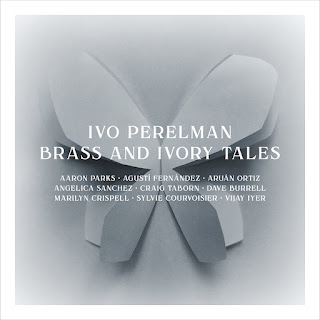
The small white box sits on my desk. Perfectly square, about an inch and a half high, featuring a light grayscale photo overlayed with white lettering. Inside, a slim booklet with saxophonist Ivo Perelman's image. Then, nine cardboard sleeves, each with a black and white image of a different pianist ... first, David Burrell, then Marylyn Crispell, followed by Araun Ortiz, Aaron Parks, Sylvia Courvoisier, Agusti Fernandez, Craig Taborn, Angelica Sanchez, and finally Vijay Iyer. As you can surmise, within each envelope is a CD documenting a fruitful encounter between the saxophonist and musician whose image is on the sleeve. Just a look at the list of musical partners and you can also safely surmise that the contents of the box are likely to combust.
The more proper metaphor, however, is something regarding a book of stories rather than a book of matches. From the "tales" of the title, each one, a new collaboration, is broken into chapters - the track titles are chapter one, two, three, and so on. However, mere minutes into the over 1/2 hour 'Chapter 1' from Tale One, the first of two tracks with Dave Burrell, and the explosive imagery is just as appropriate. Burrell, 81, is ever a thoughtful and melodic player, and the interaction with Perelman is both delicately balanced and devastatingly precise. The energy already streaming from Perelman's instrument is heated, building in intensity as each minute goes by. They settle a bit later in the track, Burrell offering sparse dissonant lines and Perelman playing long yearning tones. The second track continues their adventure, the piano swings occasionally and the sax glides above and below the steady line.
Tale Two, with Marilyn Crispell begins differently. Ruminative and gentle, the duo plays what sounds like a composed song, wistful and pretty, however unexpected tones and intervallic leaps belie the truly improvised nature. Then 'Chapter Two' flips the script. The romanticism turns to pointillism as Crispell's playing is quick, syncopated, and unpredictable. Perelman spars gamely, he is a blaze of notes and twisting musical logic. On this disc, 'Chapter 5' is standout. The two are again in a fierce match of agility, Crispell punctuating her ideas with percussive chords and Perelman jumping into altissimo range on a whim.
Tale Three finds Perelman working out some ideas with Cuban-born, NYC based Auran Ortiz. 'Chapter One' finds Ortiz providing spare, percussive chords for Perelman to climb over and dance around. The saxophonist smears high pitched tones between the spaces in the pianist's accompaniment. On many of the chapters in this collaboration, Ortiz employs a minimalist approach, which is quite interesting to hear in contrast to the denser duos on Tale Two. However, a rumble from the low end coupled with a twinkling cluster of high notes also gives Perelman a much different set of tones and textures to explore.
Brass and Ivory Tales is a generous and rich set of music. The recordings capture the saxophonist's inimitable style, as well as the spirit of pure improvisation. As the booklet with text from writer and de-facto Perelman scholar Neil Tesser indicates, each recording started with a blank slate, no discussion of ideas precede the push of the record button.
This collection took the prolific musician seven years to complete, with the final three recordings made during the summer of 2021. Most collaborations here are first encounters and it is fascinating to hear how Perelman adapts to each different musical partner. The one missing collaborator in this collection is long-time musical partner Matthew Shipp, but there are plenty of other releases available to enjoy their telepathic work.
All nine CDs in this set are worthy of a close listen. They are accessible, but take time and patience. The effort though is not without ample reward. Tale Five, for example, is a set of eleven shorter stories, told with Swiss-born, NYC based pianist Sylvie Courvoisier, that are fulfilling and dramatic. The piano playing is rich and harmonically complex, to which Perelman response is rich and melodically. Tale Six with Craig Taborn begins spiritedly, the pianist providing an expansive array of tones to navigate. Tale Four with Aaron Parks begins on a more subdued note. Known in more modern jazz circles, Parks offers Perelman a calm, expressive palette to work with. Tale Six is with Spanish avant-garde pianist Agusti Fernandez. Their collaboration also begins gently but soon splinters in many directions, sometimes simultaneously. By 'Chapter Three', the two are dancing on hot coals. Tale Eight is with pianist Angelica Sanchez and begins with the cheeriest of interactions so far as Sanchez's lithe playing rounds off some of the sourer timbers in Perelman's tone. 'Chapter Three' is intense, the piano plays tight a tight cluster of tones while Perelman reacts with similarly tightly clustered notes. The tension breaks soon enough, but not without leaving a lasting impression. Finally, Tale Nine is with Vijay Iyer. The two waste no time getting into a sprightly exchange, Iyer seems to envelope the entire keyboard with his ideas and Perelman masterfully matches the exuberance. The five tracks featuring the two of them is a fitting ending to this tremendous set of music.
Brass and Ivory Tales is a book of matches, both literally and figuratively. Combustible sticks on one hand, compatible musical partner on another. The music within is light and lithe, dark and dense, covering the keys, the octaves, and all the rest.
The bandcamp site offers samples from all the CDs, here is a starter for you:
In the May 2018 issue, Downbeat conducted a blindfold test for Tim Berne. When discussing a Zorn composition he stated, paraphrasing from memory, that John goes into the studio with specific ideas on how he wants each participant to sound in a composition unlike Berne’s approach in wanting the musicians to develop the role with their identities. I thought of that often regarding his relationship with Matt Mitchell, whether in Snakeoil and previously released duets, but particularly in this collection of solo piano interpretations of Berne’s compositions, a spellbinding reworking that still contains the stamp of the composer but gently nudges the listener to examine the lyricism in a different way.
The genesis of this recording began when Berne first encountered Mitchell in the summer of 2008 when both taught at the Brooklyn School of Improvised Music’s workshop and performed in the faculty concert. Discovering they were musically sympatico led to increasing concert interactions: a seven piece Adobe Probe concert at the Stone in January 2009, an early version of Snakeoil called Los Totopos in September 2009, and in December 2009 at the Art Alliance in Philadelphia Matt played an opening solo piano set of Tim’s songs before joining Adobe Probe for the second set, the latter of which was released by Screwgun in June 2020, the same release date for 1 which was recorded at Ibeam on June 30, 2010. This wasn't the first time they recorded as a duo but it's the earliest performance to be released. Snakeoil was Berne’s first new band after a prolonged period of one off performances and it gave him an opportunity to revisit older unrecorded compositions and expose them to younger musicians anxious to apply their imprints. One of Berne’s strengths as a composer is in balancing freedom and form and in Mitchell he found a counterpoint to his insistently probing alto lines with ambidextrous melodicism capable of generating complimentary rhythmic propulsion. In the informative liners Matt gives background info for each composition as well as unlisted pieces that they segued into. For example the second piece, “Scanners” which was eventually recorded on the first Snakeoil album in January 2011, they start so strongly and familiarly that you don't miss the clarinet of Oscar Noriega nor Ches Smith’s drums in the swirling alto and piano lines. When things wind down they transition into an earlier composition of Matt’s before ending on a Berne song which never made it to record. I find these early versions of Snakeoil compositions fascinating because they're too fully formed to call them works in progress while still subject to the pushes and pulls of further performances, not to mention differing instrumentation, to morph into something different through time. And as Berne pointed out in an interview shortly after the release of Snakeoil, different studio takes of the same songs sounded wildly different.
Two other pieces here, “Duck” and “All Socket”, ended up on this followup Snakeoil recording as “Cornered (Duck)” and “Socket” recorded in January 2013 and greatly altered with the passage of time but still recognizable in the melody. At the conclusion of “All Socket” Mitchell plays a wigged out stride-ish figure that was a strikingly unique way to close it. One other piece, “Traction” from Berne’s book of work was previously appended to “Jalapeño Democracy” on a live Science Friction recording.
Although Snakeoil was the relatively concurrent destination of these pieces perhaps it's just as useful to consider this performance as an early version of the Berne and Mitchell duo entity realized in three subsequent recordings and ongoing still. Whichever context you place it in, it's a very coherent and adventurous performance providing rewarding listening through repeated exposure.
After the frenzied assertiveness of two musicians still in the learning curve of becoming familiar, this recording represents the opposite musical dynamic: two bandmates from the early 80s making music as an incidental part of a small social gathering over a weekend last September. They carved out two blocks of time in the studio to record these five joint compositions. Initially it sounds like Helias, a wonderfully melodic bassist, sets a rhythmic motif which Berne follows and embellishes in a somewhat uncharacteristically placidly reactive manner, although as the first track, “Throw Me A Bone” progresses the roles reverse and further trade offs occur for the duration. If the track order reflects when they were recorded, the third cut, “Physical Responsibility”, is where Tim’s playing becomes more assertive with subdued fireworks and continues accordingly through the rest of the session. It's a very relaxing musical reunion of two longtime friends.
In the Bandcamp notes, Mark credits Tim for having urged him at the beginning of his career to overcome his reticence in putting his music in front of the public by recording it prior to the usual commitment from a label and then, years later, encouraging him to make a solo bass recording; all successfully executed and received. Maybe the nature of their long musical relationship is borne out by these songs.
By Stef Gijssels
The sheer volume of music released last year forces us to write combined reviews, now on the topic of sax and piano duos. There are many, as you will see, and we leave it up to the reader to further explore them and appreciate them. Some of them require more indepth attention and reviews, for sure, and that may still come. In the meantime, the reader is alerted to their existence.
Peter Brötzmann & Fred Van Hove - Front To Front (Dropa, 2020)
Matthew Shipp & Rob Brown - Then Now (RogueArt, 2020)
Agusti Fernandez & Liudas Mockunas - Improdimensions (No Business, 2020)
Catherine Sikora-Culpo Duo - The Paris Sessions, Volume 1 Mimesis (Self, 2020) & Catherine Sikora & Christopher Culpo Duo - The Paris Sessions Vol. 2, Speaking In Tongues (Self, 2020)
Christian Rønn & Aram Shelton - Multiring (Astral Spirits, 2020)
Listen and download from Bandcamp.
Daniel Carter & Matt Lavelle - The Piano Album (Self, 2020)
Listen and download from Bandcamp.
Cooper-Moore & Stephen Gauci - Conversations Vol. 1 (577 Records, 2020)
Listen and download from Bandcamp.
Marina Džukljev & Mia Dyberg - Circumscription (Self, 2020)
Listen and download from Bandcamp.
Frank Gratkowski & Elisabeth Harnik - Burrum-Bah (Sound Out, 2020)
Listen and download from Bandcamp.
Alexandra Grimal & Giovanni Di Domenico - Down The Hill (Self, 2020)
Listen and download from Bandcamp.
Jan Klare & Wolfgang Heisig (Umland, 2019)
Renê Freire & Thelmo Cristovam - Lobo Temporal (Antena Art, 2020) + Renê Freire & Thelmo Cristovam - C-Agardh (FictÃcio, 2020)
Matana Roberts & Pat Thomas - The Truth (Otoroku, 2020)
Tim Berne & Matt Mitchell Duo - Spiders (Out Of Your Head Records, 2020) & Tim Berne & Matt Mitchell - 1 (Screwgun, 2020)
Listen and download from Bandcamp and from Bandcamp.
Ingrid Laubrock & Kris Davis - Blood Moon (Intakt, 2020) + Ingrid Laubrock & Aki Takase - Kasumi (Intakt, 2020)
Not to forget, Ingrid Laubrock released two duets with pianists this year, one with Kris Davis, the other one with Aki Takase, both on the Intakt label. Matthew Banash already reviewed both albums here. Just to remind you to listen to both albums, as they are a little special. Playful, light-hearted, with lots of ear candy.
Listen and download from Bandcamp and Bandcamp.
Hugo Read & Thomas Rückert - Sirius Variations (Kreuzberg Records, 2020)
Both Hugo Read on soprano and alto, and Thomas Rückert on piano present a very serious, austere and refined album. Their technical skills on the instrument are excellent, but it's all a little bit too polished to my taste.
By Matthew Banash
Free = liberated from social, historical, psychological and musical constraints
Jazz = improvised music for heart, body and mind