Click here to [close]

Thursday, June 9, 2022

Liba Villavecchia Trio, Zaidín (Clean Feed 2022)

That feeling when someone serves you a dish that you’ve forgotten you loved? That’s what I’ve got. There aren’t many alto/bass/drum trios plying the outfunkjazz spaceways. The Thomas Chapin Trio, who charted this territory, was a staple of my New York days (FYI, Chapin and the author are distantly related). One of Chapin’s tunes shows up on Liba Villavecchia’s Zaidín. His spirit would approve of the whole endeavor.

Villavecchia is joined by Alex Reviriego on bass and Vasco Trilla on drums and percussion. Some of the copy on the Clean Feed website informs us that Trilla is a “free improvising drummer that comes from black metal.” Not sure about the black metal connection, but he genuinely swings like a mf’er on this. Reviriego’s bass provides a melodic bass foundation to the enterprise—with the recording quality only amplifying his assertion and solidity—not unlike a Mario Pavone or Michael Formanek.

The star, though, is the alto, of course. Zaidín gives us four compositions by Villavecchia, two trio improvs, and a cover of Chapin’s “Bypass.” The settings provide the opportunity for conversations and disquisitions by every player. There is such a sense of joy to these pieces—a sort of vulgar abandon infused with a Stax-funk sense of humor.

As an example, the piece, “ La Voz Grave Y Los Ojos Negros ,” starts with a free instrospective wander on the alto, then a knotty springtime swingy head, individual statements, a composed middle section, and an alto solo that starts on top of a killer backbeat before the beat disintegrates and we end up at the “deep voices and black eyes.” A wonderful eight minute journey.

Lest you think I’m leaning too much into the Thomas Chapin angle, Villavecchia’s notes explicitly namecheck Chapin (who died in 1998) as a source and inspiration, along with Evan Parker, Ornette Coleman, and Roscoe Mitchell. He sums up the trios mission thusly:

“Jazz is like a giant octopus that dwells in deep waters: everyone knows about its big and robust head, but few people have seen its abundant and magnificent tentacles. We are interested in exploring the most sinuous endings of the slender tentacles that stem from the great Jazz octopus: their role is to contain and develop all the emotion and rage, the howling and crying that constitutes the origin of Jazz.”

First, let me salute that extravagant, extended metaphor. I love that kind of thing. Second, let’s everyone salute the trio’s ability to tap into “all the emotion and rage, the howling and crying,” and coming out with Zaidín.

Check it:

Wednesday, June 8, 2022

Music for Ukraine (We Jazz, 2022)

By Jim Marks

This compilation from We Jazz Records is timely both because all of the proceeds go to embattled Ukraine and because the label is located in Finland, a country threatened with the same fate (and, for that reason, currently seeking membership in NATO). These kinds of compilations provide jazz fans the opportunity to engage in some light activism while sampling some new artists and picking up some rare tracks ( Trost Records recently released a similar effort ).

The result is a grab-bag of outtakes, rarities, live recordings, and overlooked recent releases. The recording quality is consistently high, including on the live tracks, which is not always the case with odds and ends like this. Many but not all of the artists are Finnish. While some are fairly well established, such as Jason Nazary and Mikko Innanen, others will probably be new to many readers of the FJB, so Music for Ukraine serves as a good point of departure for exploring the We Jazz catalog. There are 26 tracks here, over two hours of music, so this review can only provide an overview. Overall, the collection holds together nicely, ranging from fairly free jazz (most of the jazz tracks seem improvised) to more rock- and electronic-leaning material.

Opener “Sea Change” by Black Diamond (Chicagoans Hunter Diamond and Artie Black) gets things off to a fine start with a swirl of woody reed instruments and tinkling bells. The mood continues with Superposition’s meditative “Sight and Science,” led by the saxophonists Adele Sauros and Linda Fredriksson, and a pretty song, “Brother II” by Lucia Cadotsch, that is one of the few tracks with vocals.

Saxophone trios are especially well represented here, ranging from the spacious and stately “Maedels” by Tilo Weber, Sebastian Gille, and Thomas Stieger to the peppy “Accidental Calypso” by the Mikko Innanen Trio, which includes Joe Fonda on bass, and other engaging examples led by Timo Lassy and Lukas Traxel. There are also piano trios (Designers, Dark Horse, Joona Toivanen Trio) and a pair of trumpet trios (Bowman Trio, Oaagaada). Another pleasure is an appearance by Ralph Alessi with Terkel Nørgaard’s trio.

Notable among the tracks showing the influence of rock and hip hop are an untitled piece by Koma Saxo, a quintet led by Swedish bassist Peter Eldh ( reviewed in the FJB ), combining samples of sax and flute with a propulsive bass riff and processed percussion, the Stance Brothers’ “Low,” with dreamy guitar adorning a powerful beat, Lampen’s proggy “Kerzen,” and the eerie, string-driven “Equation” by AINON.

Music for Ukraine , then, is an opportunity both to contribute to a worthy cause and to enjoy and discover some great jazz and interesting other music. Apart from the motivation behind the compilation, there is nothing particularly somber or heavy about it. This music deserves to be heard on its own merits, and hats off to We Jazz for making it available.

Tuesday, June 7, 2022

A Pride Of Lions - No Questions No Answers (RogueArt, 2022)

 By Stef Gijssels

In February we published an overview article on Joe McPhee albums, and this album we received exactly one day too late to include it. The band consists of Joe McPhee on alto & soprano saxophones, pocket trumpet, Daunik Lazro on tenor & baritone saxophones, Joshua Abrams on double bass & guembri, Guillaume Séguron on double bass, and Chad Taylor on drums & mbira. The performance was recorded live at the Saalfelden Jazz Festival in 2018. This is the same band that also performed on the eponymously named A Pride of Lions in 2018. The interaction is excellent. 

McPhee and Lazro have a long-standing collaboration and their musical respect and common voice is obvious, even if both musicians have their distinct sound and approach. The fact that both artists switch horns all the time adds to the fun and the richness of the sound. 

McPhee and Lazro performed together 
  • As a duo on - "Elan, Impulse" (In Situ, 1991)
  • with Evan Parker on "Joe McPhee, Evan Parker, Daunik Lazro" (Vand'Oeuvre, 1996) 
  • Raymond Boni, Joe McPhee, Daunik Lazro, Claude Tchamitchian - "Next To You" (Emouvance - 2013)
  • as a duo on "The Cerkno Concert" (Klopotec, 2016)
  • Evan Parker, Daunik Lazro & Joe McPhee - "Seven Pieces - Live at Willisau 1995" (Clean Feed, 2016)
  • in the Clifford Thornton Memorial Quartet - "Sweet Oranges" (Not Two, 2018)
The album consists of three lengthy improvisations: "An Unanswered Question" clocks at more than 33 minutes, "An Unquestioned Answer" at 12 minutes and "Enough" at 6 minutes. 

The music develops slowly and consistently, with a key role for the two bass players. The sound is warm, eclectic with many references to African sounds, further reinforced by the use of the guembri and the mbira. Taylor's playing is crisp and invigorating, propulsing the band forward in a great rhythmic epic journey on the first track. The atmosphere is great throughout, with McPhee signature singing while playing, now supported by shouts from Lazro (?). 

The liner notes mention that all the music is improvised with the exception of a reference to Albert Ayler's "Spirits" in the second piece. The reference to Don Cherry's "Mopti" (from "Playing", 1981) after 24 minutes on the first track remains uncredited, but both mini tributes give you an idea of the deep roots in "traditional" free jazz this music offers. 

In sum, the quality of the playing is excellent, warm, welcoming and dynamic. Don't miss this one. 

Monday, June 6, 2022

Masayo Koketsu - FUKIYA (Relative Pitch Records, 2022)

By Keith Prosk

Masayo Koketsu breathes and blows one 47’ alto saxophone solo on FUKIYA.

Recent recordings include two live sets alongside other altoists, François Carrier with Daisuke Fuwa and Takashi Itani on contrabass and percussion for Japan Suite and Lao Dan with Deng Boyu and Li Daiguo on percussion and pipa for Burning Bookshop II . As well as a tenor saxophone solo in the contingent environment of Hossawa Falls. On her debut studio solo FUKIYA, these directions might culminate in a sound that seeks the soul of the saxophone with a mindfulness towards sonic interactions outside of the instrument.

Sustained soundings, melodic tunes, writhing skronk, phrases occur in spurts. It draws the ear towards breath. Regular pauses reveal its limits but also delineate its use as material. It fills silences, some too long to be anything other than a call to listen to breath.

Leveraging another interdependent phenomena outside of the instrument in aural perception, the juxtaposition of soft and loud dynamics induces moments like attenuating vision after a flash of light. The recognition that gradual resaturation does not accurately reflect the instant cause of lightning or a flood of sun into a dark room, that experience can be separated from reality. While the effect is less severe quick transitions between textures or speeds, hoarse overblows and piercing whistling or durational sustain and breakneck acrobatics can feel similarly. Together breath - or a pause with presence - and perceptual play seem to place the saxophone as only a mediator for the shared experience of performer and audience, not just generally but profoundly here, where the performer stops to listen and the listeners acknowledge their part in the creation of the experience.

But the instrument is not just an accessory, and FUKIYA regularly glimpses the heart of the alto, its harmonics. Sustained soundings split out overtones. Repeated sequences and fast dyads amplify the spectra between them. Quavering vibrato stokes alto’s overtone glow. And fierce honks surrounded by silence profile harmonic decay.

It is not so ascetic as I have probably made it seem, and there’s a playful energy. A flurry of raspberries, slap tonguing, and key clicks in the final moments feels like a comedic jab at saxophone solo expectations after such a focused set.

Friday, June 3, 2022

Derviche – Murs Absurdes (Ayler, 2022)

By Nick Ostrum

Derviche is the unconventional French duo of Eric Brochard on electric bass and Fabrice Favriou on drums. Their previous release was 2020’s Derviche, which was a trudge through the darker and more rock-oriented fringes of what is covered by this blog. Murs Absurdes (absurd walls) is Derviche’s latest release and it pushes even further into those murky crevices that the likes of Mats Gustafson, Thurston Moore, Mette Rasmussen (especially with MOE), the Dead Neanderthals, and others have been mapping for a while, now. Derviche, however, has found a sound of their own. Murs Absurdes is unmistakably in the line of the previous release but is still grungier.  I am not sure what Brochard and Favriou have been listening to, but I hear some of the slanted melodicism of Pavement and the frayed pop of Nirvana though without vocals and modified with a heavy underlying thread of sludgy metallic soundscaping.  Tracks are divided into five “Sequences”, VI-X, but these are more movements of the greater album-length piece than distinctive tracks.

With that in mind, the third movement, Sequence VIII, is one of the most compelling.  All tracks sound like a morose trip, with heavy looping chords and propulsive drumming, together evoking a hazy industrial dystopia. It has its nervous (Sequence VII) and energetic (Sequence IX) moments.  However, Murs Absurdes really stands out on pieces such as Sequence VIII, a fusion of West Coast-styled droning melodies with uncharacteristically vigorous blast-beat drumming. The slow and plodding just barely restrains the restless energy simmering beneath it. Think Sleep with noise rock proclivities or Earth with less luster. For that matter, think Derviche’s first release with a little less sheen, as well. Sequence X, another prominent section, sounds a like the intro to Soundgarden’s Pretty Noose slowed and expanded into some demented psychedelic romp. And it is absolutely wonderful. If these influences are not conscious, Derviche must have just absorbed these predecessors’ work somewhere in the trans-Atlantic miasma. They come from a different (musical) place, of course. But these echoes are too strong to miss. 

Now for the elephant in the room: the instrumentation.  Suffice it to say that, for this type of music, it works. Although Brochard stews on the low end, he has enough creative range to fill in above that and fill out the sound. Couple that with Favriou’s contributions – a tempestuous fusion of noise rock restiveness and desolate, metallic ritualism – and you have Murs Absurdes, a powerful and surprisingly mature sophomore release, especially considering the stylistic liminality it embraces. 

Thursday, June 2, 2022

Yoni Silver/John Edwards/Steve Noble – HEME (Shrike Records, 2022)


By Fotis Nikolakopoulos

We all tend to rely on small personal facts to guide us through the vast ocean of new music coming out every week. One of them, one which (probably you would agree) has an almost objective value, is that the bass-drum duo of John Edwards and Steve Noble guarantees that something fruitful will be recorded. Be it a trio –like here with Yoni Silver on bass clarinet- or any other line-up.

Before going into this cd, I must mention the small, but eclectic, catalogue of Shrike Records deserves much attention as it balances between presenting some younger generation improvisers alongside some legends of the practice. Keep an eye on the recordings.

Continuing about the aforementioned bass-drums duo (yes, I’m a fan), once more they are proven masters of their instruments. On HEME, which clocks on over an hour of music, the double bass and the drums are flexible partners of Silver’s bass clarinet. Silver himself is in a constant state of flux on each of the seven tracks from HEME. He finds a perfect balance between the droney timbre of his instrument and the small experiments in breathing he executes. He never tries to saturate his fellow players. Considering that he and Noble have worked before (not to mention the numerous recordings Edwards and Noble have made), the listener has the joy of experiencing a musical interaction come partnership of the highest level. Yes, they do play in unison and that’s one of improvisations goals.

The seven improvisations that comprise HEME are fluid and full of energy (but not the typical free jazz blow outs), climaxing inside each track. i felt HEME to be one long improvisation but, at the same, time each track presented a new idea that was formed immediately at the spot. This recording was made in isolation in 2021 at an empty Café Oto. A space where people meet and socialize, always feels empty when present are just the musicians. The lack of other’s people energy is matched on HEME by an edginess and some frustration cause by the situation. Someone could say that HEME is an abstract comment on that fact.

There are quite a few thrills throughout this recording.

@koultouranafigo

Wednesday, June 1, 2022

McPhee Marker - McPhee Marker (Corbett vs. Dempsey , 2022)

By Martin Schray

It’s been ten years since I wrote my first review for the Free Jazz Collective. I wanted to support this website after my love affair with this music had become more and more passionate in the years before. In recent years, however, my affection has cooled a bit, the rapture of the beginning has given way to a certain routine, which doesn’t have to be a bad thing (especially for my bank account). But lately there have been several new releases recently that left me as euphoric as I was in the old days - rediscovered treasures like Charles Mingus’s The Lost Album from Ronnie Scott's, Albert Ayler's Revelations or Ultraman vs. Alien Metron by Peter Brötzmann's Chicago Tentet as well as new recordings like the five albums John Butcher recorded in Berlin or Myra Melford’s For the Love of Fire and Water. And there's McPhee Marker.

Marker is Ken Vandermark’s relatively new project that he started in 2017 with then lesser known musicians, specifically Andrew Clinkman (guitar), Steve Marquette (guitar), Macie Stewart (keyboards) and Phil Sudderberg (drums). The idea for this 12’ inch single (yes, they still exist) came about following a project for a 2019 concert for which Vandermark was asked to arrange a set of music from the 1970s. Among the tracks chosen were Parliament’s "Night of the Thumpasorus Peoples" and DNA’s "Egomaniac's Kiss," the two tracks Marker eventually recorded for this record. Guest starring is Vandermark’s old buddy Joe McPhee, who embodies the proverbial bridge to that era.

Even though the two originals are based on 1970s grooves, they couldn’t be more different. "Egomaniac's Kiss“ is a classic No Wave banger, abstract, weird and broken. On the surface, this seems to be typical for the genre, a fast, disjointed DIY track, devoid of any development and virtually physically assaulting the audience. McPhee Marker’s version is not far from the original, albeit instrumental (Arto Lindsay's vocals would have been hard to replace, though). It comes across a bit more sluggish, but also more organic. On "Night of the Thumpasorus Peoples" the difference between the original and the cover version are bigger, as McPhee Marker swap the P-Funk for a No Wave approach. The fat, dirty groove and Bootsy Collins’s signature bass are replaced by harshness and abstraction, which surprisingly works very well and gives both tracks a new, similar identity. Anyone who says you can't dance to free jazz will be mercilessly proven wrong here.

McPhee Marker is available on vinyl only as a 12’ inch single. There are only 750 copies. Hurry up, it's worth it.

Tuesday, May 31, 2022

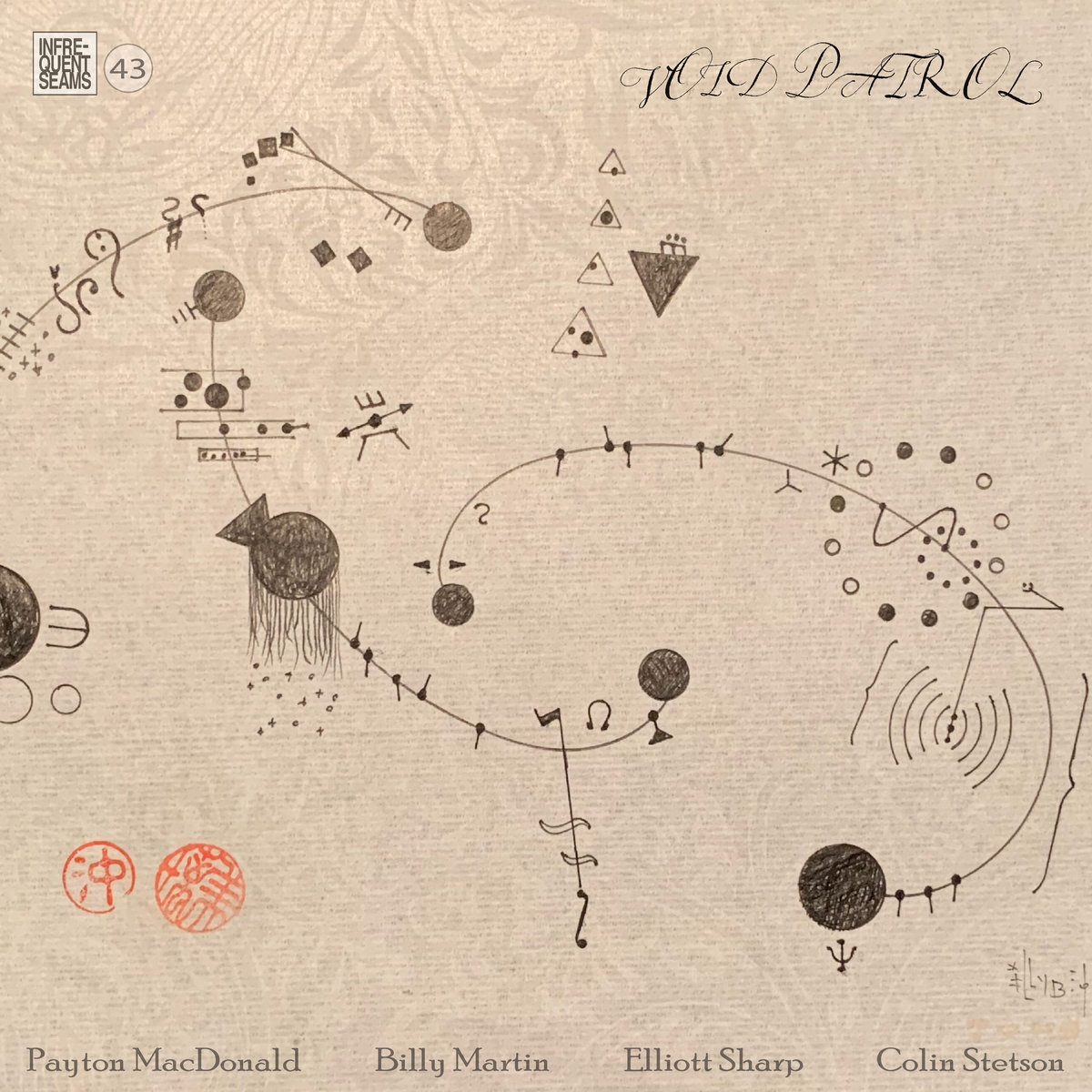
Colin Stetson, Billy Martin, Elliott Sharp & Payton MacDonald - Void Patrol (Infrequent Seams, 2022)


Many years ago I discovered a recording that rewired parts of my musical listening brain, the dark and lugubriously melodic Octave Of The Holy Innocents (Day Eight Music, 1993) from bassist Jonas Hellborg along with guitarist Buckethead and drummer Michael Shrieve. After many listens, my infatuation cooled but the album had buried itself deep in my brain. When I heard percussionist and marimba player (and credited here with keyboard percussion) Payton MacDonald's latest creation Void Patrol with guitarist Elliot Sharp, saxophonist Colin Stetson and percussionist Billy Martin, those old long buried musical memories re-surfaced, reminding me about just how good this dark, layered,  and rhythmically intense music felt.

Void Patrol was born under pandemic circumstances, like much of what is being released at the moment. MacDonald, also a composer and teacher in the music department at William Patterson University in New Jersey, took advantage of some grant funding and extra available time from time not gigging, and constructed this powerful group. Their work was done remotely, constructed from a series of tracks that MacDonald recorded and then shared. As he explained, “through emails, Zooms, and many phone calls we agreed on a basic set of parameters for pitch, form, and groove, and then just got to work making music.”

From the moment the music begins to trickle through the Bluetooth speakers - or ear buds, bookshelf Bose, or maybe even IKEA lamp (I just know I am going to break down and get one one of those someday) - the results of their parameter tweaking is riveting. 'Antares' kicks off with an atmospheric electric slide guitar figure from Sharp that interpolates Morricone-accented lines with an insistent percussive/melodic pattern from MacDonald's marimba. The sound of the instrument is unique, its woodsy timbre lends a certain lightness to the track that grows denser with Martin's groove oriented drumming and added layers of electronics. Towards the end, Stetson's sax add to the unhurried drama. His circular patterns pull the listener in one direction while the electronic oscillations pull in another. Take a few deep breaths after listening to that one because the next, 'Rigel' pick ups with the same intensity.

The settings are tweaked from track to track, resulting in a variety of appraoachs. The second track, 'Sirius,' has much more space, beginning with what sounds like a backwards saxophone underlaid with light percussion. Soon, Sharp tosses fractalized chord tones across the playfield and the keyboard percussion also adds quite a splash towards the end. 'Hadar' employs the resonant tonality of hand drums along with fragmented melodic statements from the marimba. Ghostly moans add a touch of darkness to the vibrating intensity of the track. The closing track, 'Acrux,' opens with an atmospheric melody from MacDonald and gently expanding melody from Stetson. Martin's scattered percussion and Sharp's electronic textures simulate dry-ice smoke and spooky spotlights, situating the bubbling layers of sound perfectly.

Void Patrol album is captivating and effective. I am reasonably sure that it will be settling down next to Octaves in the comings weeks, sharing the creative space where shadowy tones mix with strong rhythmic figures and wispy moments of hope.


Payton MacDonald's Exploration's Project

In October 2020, MacDonald started an ambitious recording project, recording on marimba one full-length recording a week for over a year. As of this writing, it looks like he is on number 61. The recordings all have unique foci and are combination of solo works as well as collaborations. Just a quick sample of a couple reveals the depth and expertise that MacDonald brings to the instrument...

Explorations 21: The Music of Elliot Sharp


Explorations 21 finds MacDonald performing a score from Elliot Sharp, a polymath whose own work goes far beyond his guitar, and in this case, to his classical and new music compositional pieces. The composition, 'Foliage,' is actually a 116 page graphically notated score, and MacDonald approaches it solo via marimba and additional electronics. The tracks unfold in different ways, for example, the first is thick with distortion and ephemeral melodic statements and the second is rhythmically dense, with a push and pull of polyrhythms and tempos that are both soothing and a bit disturbing. Each one has something new to discover, like the spaciousness on the third track or the insistant percussive rain in the next one.


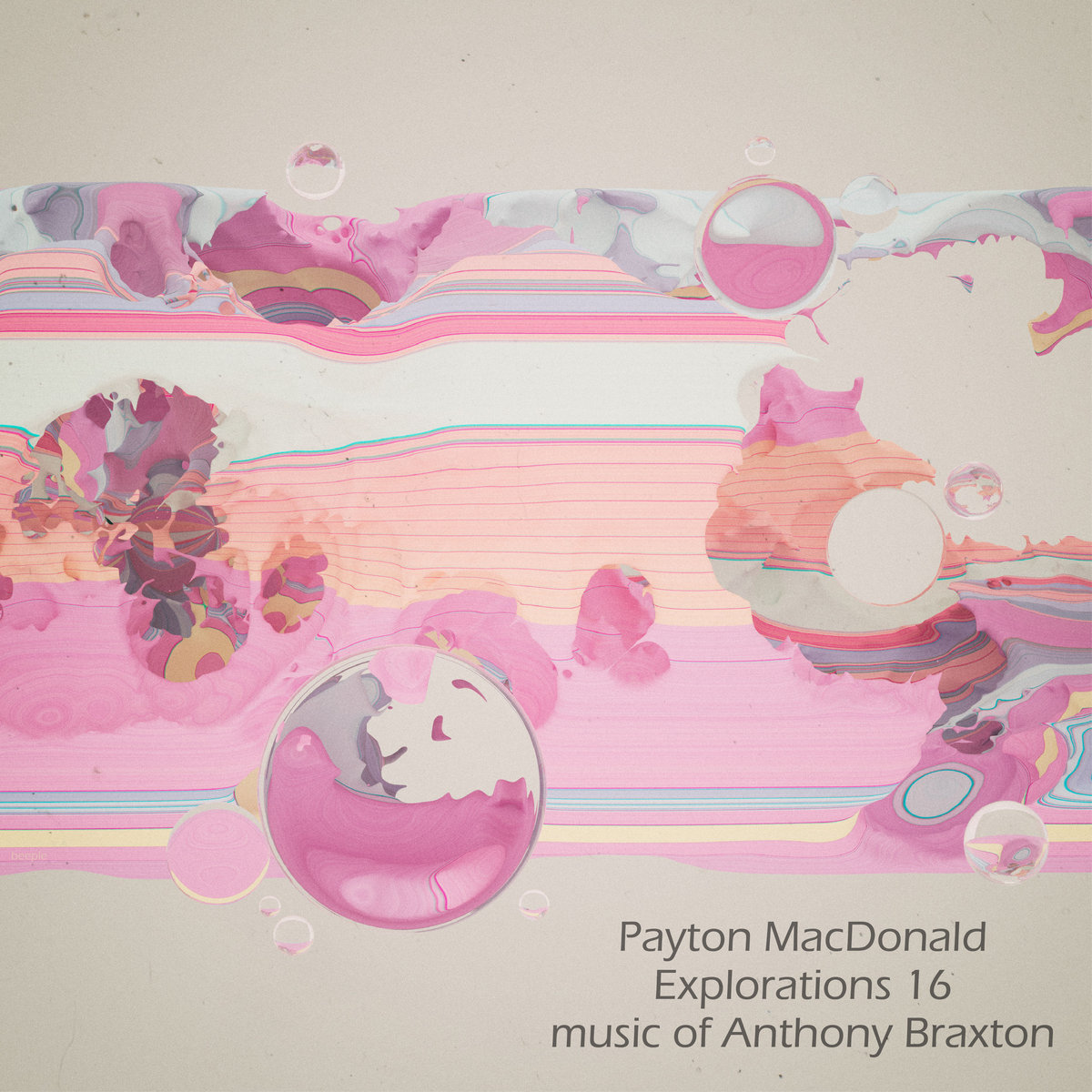
Explorations 16: the Music of Anthony Braxton


Explorations 16 is MacDonald's interpretation of Anthony Braxton’s music for marimba. The work was created in consultation with Braxton's Tricentric foundation and the result is an intimate exploration of the angles and logic of his compositions. Each track is compelling in its own way. For example. 'Number 136' sounds like more than two hands are at work, as melodies and counter melodies contrast and collide, while 'Number 142' is at first carried by a strong a rhythmic figure with the melodic ideas eventually pulling further and further away. 'Number 304' has suspended feeling, lifted by thick asymmetric runs, and 'Number 305' closes the recording with a tightly winding musical ball. MacDonald's ability to embrace all of the complexity of Braxton's music and express it with a single instrument is captivating.


There are many more Explorations to discover on MacDonald's bandcamp site. 

Monday, May 30, 2022

Kyle Bruckmann - Mesmerics/Hindsight A & B (Infrequent Streams, 2021)

By Ron Coulter

San Francisco Bay Area musician, Kyle Bruckmann is an accomplished oboist in contemporary classical and improvised musics. Here in Mesmerics/Hindsight A & B, Bruckmann has applied his creative practice to electronics during the “quarantined conditions of 2020-21.” Often, practicing musicians (i.e. performers of acoustic instruments) bring a vitality and immediacy to the use of electronics, both compositionally and performatively, that escapes those without that experiential knowledge; Mesmerics/Hindsight A is an excellent example of this facility.

In a way this music doesn’t require a review, as the album notes are thoroughly descriptive, lengthy, and colorful. However, those notes lean heavily on association and comparison of Bruckmann’s compositions to already established electronic musics, history, and influences. Even though this music utilizes certain iconic synthesizers and was created in a geographic area with a deep history of electronic music, this music isn’t derivative; it stands firmly on its own.

Mesmerics/Hindsight A is especially strong, abstract electronic music dripping with fat, juicy analog synth sounds. The four tracks comprising Mesmerics/Hindsight A are through-composed, in constant development, and have a lively feeling of pliancy not often heard in electronic music; organic might be the commonly used descriptor. The music has a fluidity like that of an improvising musician using an acoustic instrument—a singular union of the performer and the technology. Mesmerics is an apt title, because this is mesmerizing music of oddly distorted pitch/melody, rhythm, and texture that draws a listener into its idiosyncratic sound world; see track A2, Hindsight II: Occam’s Blunderbuss, in particular.

Mesmerics/Hindsight B is, as the album notes describe, prioritizing periodicity. Its ten tracks appear like studies that each explore a certain aspect of the involved technology. Many of the tracks are built from an ostinato as obvious as track B1, Blindside, or track B6, Mesmeric (metaphoric), and as abstract and elusive as track B3, Mind Blight. Track B8,Fight Flight, may be the strongest piece on Mesmerics/Hindsight B with its writhing, squelching, noisey textures that treat periodicity in the broadest, loosest sense.

Mesmerics/Hindsight A & B is a double release contained on a single 90-minute cassette and available as separate digital downloads. Mesmerics/Hindsight A and Mesmerics/Hindsight B may likely appeal to different audiences of electronic music, but they are both well worth the time to investigate. One looks forward to future developments and releases from Bruckmann in the electronic realm.

Friday, May 27, 2022

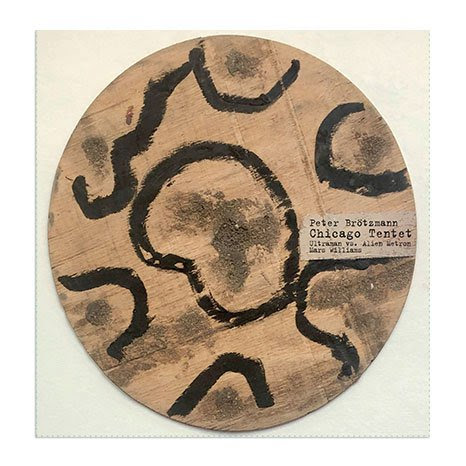
Peter Brötzmann Chicago Tentet: Ultraman vs. Alien Metron (Corbett vs. Dempsey, 2022)

By Martin Schray

Anyone who was able to experience Peter Brötzmann’s Chicago Tentet live won’t forget the brute energy that this band was able to unleash. At the end of their incredible 15-year existence they played with almost no pre-conceived material or scores (partly because they had known each other for so long). However, when they started their project, this was completely different - the members could contribute compositions to the band’s repertoire. On their first release, the triple album 1 / 2 / 3 (Okka Disk, 1998), there are pieces by almost all members. After a US tour in the early 2000s, the band then went into the studio and the result from the sessions were two CDs for Okka Disk, A Short Visit to Nowhere and Broken English. On the first one, you can also find a piece by Mars Williams, the only one who didn’t have a composition on 1 / 2 / 3. In addition to “Hold That Thought“ (the name of the track), another Williams composition was recorded - though never released. Williams has rediscovered it in his archives recently and the Chicago label Corbett vs. Dempsey is now thankfully publishing it.

In case anyone has forgotten what the band was like, here are the hard facts: gathered around Peter Brötzmann (saxophones, tárogató and clarinets - here on tenor only) there were parts of the crème de la crème of the Chicago free jazz scene - Mars Williams and Ken Vandermark (saxophones), Jeb Bishop (trombone), Fred Lonberg-Holm (cello), Kent Kessler (bass), Michael Zerang and Hamid Drake (drums) - plus Mats Gustafsson (saxophones, here on alto only) and Joe McPhee (trumpet and saxophone, here on valve trombone).

Ultraman vs. Alien Metron is a perfect example of the band’s music in its early days. The improvisations are grouped around four themes, in which you are usually confronted with the full monty before everything comes to a halt and then new attempts are made again and again. In the process, the heads vary widely - from the brutal, almost heavy-metal-like riff remotely reminiscent of the theme of the first Godzilla movie, to Lonberg-Holm’s No Wave break everyone jumps on, to the unison melody of the saxophones (a reference to the Sonoré Trio that would later emerge from the band). In between, there is wild improvisation, the saxophones snap, chamber music phases are interspersed, the two percussionists battle, etc. At the end the Tentet blows up to full size and once again tunes in to the theme of the beginning. The whole thing is like a showcase of circus performers, with everyone getting a chance to show off their skills. It’s all completely organic, though, and fits into the overall concept of the composition.

Remixed by original sound engineer John McCortney, Ultraman vs. Alien Metron is a lost classic of improvised music from one of the best large-scale free jazz formats of all time. For fans of Brötzmann and the other musicians the record is certainly a must have, but it’s also great for newcomers to immerse themselves in the music of this band.

This year there have already been great previously unreleased masterpieces to discover ( Ayler and Mingus , for example). This album is another one.

Ultraman vs. Alien Metron is available on vinyl only. It’s limited to 1000 copies. You better be quick.