Markus Eichenberger and Christoph Gallio improvise ten obliquely
intersecting melodies for clarinet and soprano saxophone on the 40’ Unison Polyphony.
Eichenberger and Gallio have performed together on and off for around four
decades and appeared contemporaneously on several compilations but Unison Polyphony is their first meeting on a recording.
Mellifluous melodies irreverent of the other serendipitously converge for
short moments to beat as one in accord. Through discretized monophonies
tethered to breath in playful Lacy-like affects extended to sustain or
breathy subtones in respiratory cadences that best express harmonics, when
each slows their lines converge in dynamic equilibrium to unveil their
shared dimensional harmonic spaces.
There is a strange sensation that the point at which each feels furthest
apart is the same point at which each feels nearest each other. Art Lange’s
liner notes explores this contrapuntal concept conveyed neatly in the title
through the equation one plus one equals one by way of Thomas Carlyle which
reminded me of Ibn ʿArabī’s the oneness of many to which I was only
recently, shallowly, and it seems serendipitously introduced to through
Thomas Merton by way of Brian Harnetty’s
Words and Silences
. Melodies retrace motifs not for lack of inspiration but to celebrate new
articulations necessarily contingent upon new time to illuminate the many
possibilities of one. Beating patterns of intense clarity most often emerge
as each approaches unison with the other but there are moments of
independent multiphonics which are just a recognition of the many parts
constituting one sound. Acknowledging the brief use of C melody saxophone,
adjacent to this simultaneous closeness and farness of a thing could even
be those qualities of the instruments, each reeds of similar shape and
range but diverging materials and overlapping harmonics. Perhaps even the
relationship of the performers, separate but near and at last recording
together here, mimics the music’s relationships. All this to say, there is
a recognition that the oneness of many only becomes possible through the
multitudes of one and Unison Polyphony deeply and resonantly
expresses the true unity of going one’s own way, alone, together.
As a well-documented diehard Keiji Haino fan, this year he'd already
delivered some great music: his transcendental solo hurdy gurdy album, his wonderful collaboration with jazz giant Peter Brötzmann, his album with Marteau Rouge and
even some new projects, collaborations and archival material. To me
however, his best music over the last few years has come out through his
partnership with metal trio Sumac and long time collaborators Jim O'Rourke
and Oren Ambarchi and, luckily for me, both these projects saw the release
of a new album this year.
Keiji Haino + Sumac - Into This Juvenile Apocalypse Our Golden Blood to Pour Let Us Never (Thrill Jockey Records, 2022)
This quartet with metal band Sumac has always been fantastic but it's
undeniable that over their three releases the musicians have gotten to know
each other progressively better; if on their debut they masked possible
uncertainties and misunderstandings under copious amounts of distortion and
on their sophomore they might have had a few stumbles before reaching the
highest highs the band has ever committed to tape, here they act like a
well oiled machine.
Recorded live at the Astoria Hotel in Vancouver during a short North
America tour by Haino, Sumac join him on stage with full confidence in
themselves and each other. Guitarist Aaron Turner greets the listener with
his signature dissonant yet harmonious chords, with Haino's extremely
distorted guitar leads playing counterpoint to the harmony; it's a moment,
and a track, that showcases great chemistry to the point that some parts
don't even sound improvised. The whole song is a slow push and pull between
Haino and Turner with the drums and bass adding atmosphere and color more
than keeping time. At times mysterious, at times feeling resolved, the
music encompasses a wide emotional spectrum they weren't able to achieve
often in their previous collaborations. The second track "A shredded coiled
cable within this cable the sincerity could not be contained" changes pace
with a thunderous bass and drums section setting the mood for Turner's
ferocious vocals and Haino's guitar abuse. A piece for feedback lovers,
with the two guitarists' equally distorted instruments fighting over the
spotlight creating a wall of noise difficult to peer into but that is
textured and rewarding to listen to.
The title track, while still aggressive, gives the listener more room to
breathe and process the music: the guitars are more intelligible and the
track is more of a slow, somber dirge, with all performers never
overplaying and serving the music first and foremost, covering everything
in layers and layers of sound. After about 6 minutes the thick mist from
the guitars dissipates and a lumbering beast rises from the ashes, bassist
Brian Cook painting its rise before settling into a repetitive, obsessive
rhythm in lockstep with the drums, over which the guitars can unload the
tension they've been building up until this point. On "Because the evidence
of a fact is valued over the fact itself truth??? becomes fractured,”
guitar drones create a bedrock for Haino's not-so-softly spoken musings as
the band develops a living and breathing piece of music that manages to
perfectly walk the tightrope of being devoted to creating an atmosphere
while never being not completely engaging. Haino then treats the listener
to a (for his standards) very musical and pretty solo, the music ebbs and
flows, getting to a point of maximum tension and then shirking down again,
leaving nothing but Haino's signature high-pitched siren call. A highlight
for this album and their collaboration as a whole.
After that moment of calm the group goes in for the kill on “That fuzz
pedal you planted in your throat, its screw has started to come loose Your
next effects pedal is up to you do you have it ready?”: feedback, drummer
Nick Yacyshyn's odd time signature start-and-stop playing, tons of
distortion on bass, Turner and Haino taking turns on vocals in what seems
to be a synthesis of every element each member brings to the table and the
high level musicianship we got accustomed to over this album's duration.
Although I felt like the album had reached its apex with the previous song,
there's still a short piece to go: an encore of sorts, slow and heavy, just
to make sure the audience goes home with their ears ringing, maybe
unnecessary but not unenjoyable and welcome nonetheless.
While their second album remains
my personal favourite it's undeniable this is the most accomplished the
band's music has ever been, with constant, very high highs that don't reach
the level of its predecessor's but with nowhere near as many lows (if they
can even be considered lows). Not as uniform as their first, not as
adventurous as their second but a perfect summation of their work so far
and an exciting jumping off point for wherever they may go next.
Released on vinyl, CD and digital by Thrill Jockey Records.
Keiji Haino/Jim O'Rourke/Oren Ambarchi - “caught in the Dilemma of Being Made to Choose” This Makes the Modesty Which Should Never Been Closed Off Itself Continue to Ask Itself: “ready or Not?” (Black Truffle, 2022) *****
The Haino/O'Rourke/Ambarchi trio is at its 11th release and it shows no
signs of slowing down. Over the years it has taken many forms and tried
countless avenues of exploration, sonically, instrumentally and
conceptually, while still remaining mostly rooted in the classic rock
guitar/bass/drums combo and consistently yielding fantastic results.
On this latest release they once again tried something different, deciding
to open the record with a 23 minute piece, commissioned by New York’s Issue
Project Room, that dips its toes in the world of the kind of modern
classical music one would expect from Michael Pisaro or Graham Lambkin with
Ambarchi on gongs and bells and O'Rourke on electronics providing the
perfect backdrop for Haino's frenzied metal percussion and cymbals
performance to shine and to set the emotional tempo of the piece, going
from moments of panicked chaos to sections of somber gentleness. As always
Haino's performance is mesmerizing, his approach to any instrument seeming
to involve him completely becoming one with the sound the instrument emits
and just living in that moment as deeply and for as long as possible. It
reminds me of when I was a child and would sit at my sister's piano and
play the same note over and over for 30 minutes straight just because I
liked how it sounded so much and (to the extent a child's brain is capable
of) somehow feeling that that particular sound in that specific moment
wouldn't have existed had it not been for my interaction with the
instrument. It is a demanding listen but if you try to get lost in the
sound, its nuances and texture, the piece will be very rewarding.
The rest of the album showcases the band in its element: on stage at
Tokyo’s Super Deluxe. The listener is welcomed by Haino behind the drum
kit, O'Rourke on Hammond organ and Ambarchi on processed guitar. The trio
is as commanding as ever: Haino's free flowing drumming against the
primordial soup of organ and guitar is one of the best moments I've ever
heard from them, striking in its directness and yet deeply complex. There
are so many elements one could focus on (Amarchi's guitar's subtle but
invaluable contributions to the sound palette always catch my ear) but they
coalesce into something bigger than the sum of its parts, never unengaging
and never uninspired. After a short interlude with Haino on vocals
accompanied by O'Rourke's organ each member of the trio jumps to their
instruments of choice and the most familiar configuration to fans of this
project: Ambarchi on drums, O'Rourke on bass and Haino on his trusty
guitar. If this is the iteration of the band you signed up for you won't be
disappointed, as the last triptych of the record is completely dedicated to
a long jam in their particular flavour of free improvisation. A long
dialogue among musicians all in a state of grace, it gives me the same
feeling that listening to Coltrane and his band live in Japan does.
Everything flows naturally, from the wailing guitar solos, to the moments
of quiet led by O'Rourke's chordal bass playing all held together and
perfectly matched by Ambarchi's drumming, it's everything a lover of this
trio is well familiar with and could ever ask for.
There's still surprises of course, like the beautiful balancing act between
O'Rourke's Hammond organ and Haino's guitar on the last song or the
pummeling interplay of the rhythm section on part two of the title track,
but such a visceral and physical performance is hard to put into words. It
is what I expected but it's not safe or predictable; it's just their
familiar style I love so much. If Sister Ray meets Coltrane's version of My
Favourite Things sounds good to you this album is something you'll keep
coming back to.
Released on digital and vinyl by Black Truffle, with a gorgeous artwork by Lasse Marhaug.
It’s widely acknowledged that New York saxophonist and composer James
Brandon Lewis is a special musician. Over the last several years he’s given
us plenty of corroboration for advocating that sentiment with a string of
excellent releases. There are the instant classics - albums like his 2014
debut Divine Travels, 2018’s Radiant Imprints, 2020’s Molecular, 2021’s Code of Being and DownBeat’s album of the year Jesup Wagon. Albums where his sound arches the past and the future, tying the black
spiritual jazz tradition of the 1960’s firmly to the black avant garde of
the new millennium. Then there are albums like 2019’s An Unruly Manifesto, 2021’s Resilient Vessel, and the entirety of his work with Heroes Are Gang Leaders that find him
engaged in a fusion of hip-hip, soul, funk, and punk. Piling on, Lewis is
also one of the best free improvisers you’ll ever hear, as evidenced on
albums like 2020’s Emergence with his group Orientation of We, or on his trio release with John Edwards
and Mark Sander’s at
Cafe Oto
, albums where the conceptual rigor that underpins his composed work is
stripped away, revealing his power, energy, and prowess in the most exposed
of settings. Lewis is advanced and his approach is perhaps most eloquently
defined by the man himself in a metaphor that has certainly become a
favorite of mine:
“It is far easier to pick up a drinking glass that is unbroken than one
that has been shattered into a million pieces. I prefer the challenge
of the latter. No longer capable of holding water, it instead offers a
perfect image of freedom and possibility. Examining the individual
pieces allows one to explore the fragments of beauty itself. Along the
way, one discovers the shape and character of every shard: “Pick a rose
to pieces,” wrote Bertolt Brecht, “and every petal is lovely
.”
James Brandon Lewis Quartet - Molecular Systematic Music - MSM Live (Intakt, 2022) *****
When I reviewed Molecular back in 2020 I mentioned that based on how
fantastic Lewis & Chad Taylor’s Live at Willisau was (where they adroitly expound on material from Radiant Imprints)
that I was hopeful that there would be a live release at some point
featuring the “Molecular” material. Well, here it is, and it’s every bit as
superb as I could’ve hoped for. On Molecular Systematic Music - MSM Live the original works serve as jump-offs for intricate and expansive
treatments, long solos, and contemplative group interplay that sees the
length of the original album nearly doubled. The set reshuffles the track
order only slightly, retaining the flow and feel of the original album but
with a sense of unabashed joy and thankfulness, as well as a desire for
exploration. You can tell the players want to hear where the material will
take them as much as the audience does. It’s noteworthy that this is the
premiere live performance of the “Molecular” studio material, over a year
after the album’s 2020 release date. There was some uncertainty as to
whether this set would happen at all in May of 2021 as global cases were
still high, but ultimately the quartet arrived at their destination in
Zürich, Switzerland for the 2021 Unerhört! Jazz Festival and unleashed this
fantastic set of tunes.
The album begins with the thrum and swell of opener “A Lotus Speaks”, the
sophisticated melody ascends into tremendous solos from Lewis and Ortiz,
among the best they’ve recorded. “Helix” then offers an upbeat changeup to
get those toes tapping again. Superb polyrhythms, but never so complex as
to lose the swing, are capped by a stout solo from Jones. This all melts
across the first few bars of “Of First Importance”, a truly sentimental
piece and a favorite of mine from the original album. This version is
expansive and the quartet really gets the feel just right with top notch
playing all around. Likewise on the title track “Molecular” Lewis’ wide
vibrato and precision phrasing sets up another slow roller, but the mirage
masks the dynamism to come on the latter part of the song. Lewis issues
staccato stabs over the plunky chords and steady rhythm of the band, almost
playing his horn as another rhythm instrument.
On “An Anguish Departed” the quartet purposely wanders through an extended
windup, the track unfurling behind the theme and coalescing into two
powerful solos from Ortiz and Lewis. “Cesaire” is both elegant and bouncy,
alternating between the effervescent romp of the rhythm section and soaring
passages from Lewis. The quartet ratchets up the drama on “Neosho”, which
is alternately scrappy and labyrinthine, the passages twisting into strange
forms out of the base material. The quivering intro of “Loverly” precedes a
wonderfully slinky solo from Jones, as Taylor merely accents the soft piano
chords of Ortiz before Lewis takes it home. The band closes the live set
with the heady vamp of “Breaking Code”. With piano, bass, and drums in
absolute lock step, Lewis refrains for almost half the runtime before
joining in the dance. It’s an unrelenting last push of rhythm and melody,
ending with the appreciative applause of the audience. This live set is one
of my favorites of the year and if you liked “Molecular” then picking this
one up is a no brainer.
Floy Krouchi, Benjamin Sanz, James Brandon Lewis - CLIFFS (Off, 2022)
CLIFFS is a collaboration between Lewis and French musicians Floy Krouchi
on fretless bass and Benjamin Sanz on percussion. Recorded over two nights
at the AMJi Jazz Club in Avignon, France back in March 2019 this one comes
as an unexpected - but very much appreciated - gem. This being my first
exposure to the work of Krouchi and Sanz, I came away really impressed with
their playing. The two are fantastic improvisers, both challenging and
complementing the great saxophonist. Krouchi released a solo
electroacoustic album Vibrant Continuum in 2020 that you can get in a bundle with this release (you can also get
a bundle with the aforementioned album from Orientation of We) from the Off
Records Bandcamp site. Finally, Parisian composer & percussionist
Benjamin Sanz has been releasing new jazz for quite some time, and in
writing up this release I discovered his 2020 album The Escape, one that I’m looking forward to spending some time with in the near
future.
The first track “The Door to the Cliffs” opens like a fire alarm, all
urgency and agency. Krouchi’s rounded tone roils beneath Sanz’s searing
percussion, emitting random sparks of glitchy electronic crackle. Lewis is
brilliant, alternately melodic and testy while continually pushing the
tempo. On “The Three Streams” the trio are in no hurry, working up a
billowing and expansive soundscape marked with an uneasy innervation. Lewis
offers soulful lines, growls, split tones, and false notes over the
electroacoustic din as Sanz and Krouchi add dramatic low end rumble and
bright metallic accents. Over the last third of the track the trio comes to
life, reveling in an easy flow of intricate interplay. On “Heavy Interlude”
things get, well, heavy. Krouchi’s bass, now overdriven and sounding much
more ominous, buzzes out a riff over a steady 4/4 rhythm which pulls the
blues from Lewis’ horn. It’s over before you can get your head around it,
but the rest of the album follows suit. On “Transe With Arabesque” the bass
line plots the course with its driving precision. Lewis follows with
probing calls and lyrical lines. Then on “Mallets Ballad” the trio contrast
processed bass lines against barely there percussion and growling sax,
again punctuated with sometimes jarring split tones. The closer
“Freqsnetics” cooks at a low intensity with Krouchi laying down atmosphere
and single reverberating notes against the rustle of percussion and tight
knots of reedy weather. An excellent release.
James Brandon Lewis - Eye of I (Anti, 2023)
On the forthcoming 2023 release Eye of I, Lewis’ first for the Anti
label, he is joined by Chris Hoffman on electric cello and Max Jaffe on
percussion for a scorching trio set. Our readers will know Hoffman as a
member of Henry Threadgill’s Zooid, Double up, and 14 or 15 Kestra: Agg
ensembles as well as being on Lewis’ Jesup Wagon as a member of the Red
Lily Quintet. That’s only scratching the surface really, as he’s played
broadly with everyone from Marc Ribot and Jeremiah Cymerman to Iron &
Wine and Yoko Ono. Similarly Jaffe has been involved in and recorded with a
wide array of players and projects over the past decade-plus, such as the
art-rock band JOBS with Jessica Pavone, Amirtha Kadambi’s Elder Ones,
Chives and Killer Bob with Steven Lurgener, as well as with Peter Evans,
Ava Mendoza, and many others. This wide-ranging experience base plays into
a very unique sound here. Lewis explained that he loves the give-and-take
of this trio, stating “The first time we played, things just lifted up
right away. Everything that group does just feels fresh.”
“Foreground” explodes with a feral burst of glitchy percussion, low-end
cello, and squawking sax that works like ammonia salts for the weary
listener. Next is an instrumental cover of Donny Hathaway’s great 1973
R&B standard “Someday We’ll All Be Free” with Kirk Knuffke guesting on
cornet. The track is as cathartic as it is transcendent, the horns doubling
up on the melody with Hoffman laying down a bed of distortion against
Jaffe’s explosive drums. On “The Blues Still Blossoms” the trio loosens and
the melody can’t be held back. Lewis and Hoffman retrace the line over and
over, adding flourishes yes, but you get the sense that they are driven by
the very essence of the music. My thoughts go to Roy Neary in “Close
Encounters of the Third Kind” and his obsessive drive to sculpt the alien
landing spot out of a mound of mashed potatoes among other materials.
“Middle Ground” is a quick, heated blast of energy that serves as a
transition from the soulful back into the cleansing. The title track “Eye
of I” is all sturm und drang, the distorted grunts of Hoffman’s cello
thundering resounding amidst the heavy percussion as Lewis absolutely goes
off.
On “Within You Are Answers” the trio again shifts back into a more emotive
refrain. The caroming percussion and plucked cello perfectly complement
Lewis’ snaking ear worm. The next track “Womb Water”, following a pattern,
reintroduces discord. Hoffman bows a steady droning counter to Lewis’ husky
lines as Jaffe propels the trio along a jagged course. “Background” wraps
up the fore/middle/back interlude theme with 30 seconds of high octane
burn. On the next piece, “Send Seraphic Beings”, the group stretches out on
a great melody that lopes along between fierce solos from Lewis. As the
album winds down, “Even The Sparrow” sees Knuffke return for what might be
the most solemn track on the album. Soaring but almost mournful, the horns
dance with and around each other, the cello and drums sounding much more
than the sum of their parts. The album closes on “Fear Not” with the trio
joined by the Messthetics - none other than Joe Lally and Brendan Canty
from Fugazi with Anthony Pirog on guitar. The track is a wild mashup of
punk jazz led by Lewis’ horn and marked heavily by Pirog’s pyrotechnic
guitar playing. A fantastic album that gives Lewis fans something to be
psyched about for 2023 - out February 3rd.
For years, the Free Jazz Blog has followed the sonic adventures of
pianist-composer Satoko Fujii and trumpeter Natsuki Tamura, partners in
music and life, who celebrate now Fujii’s 100th album.
Satoko Fujii - Hyaku: One Hundred Dreams (Libra, 2022)
Hyaku (百) means 100 in Japanese and One Hundred Dreams is a suite that
Fujii composed for her 100th album, and for an American, all-star ensemble
- trumpeters Wadada Leo Smith (who collaborated with Fujii before on
Aspiration, Libra, 2017) and Tamura, tenor sax player Ingrid Laubrock,
bassoonist Sara Schoenbeck (both of them recording for the first time with
Fujii), electronics wizard Ikue Mori (a frequent collaborator of Fujii),
bassist Brandon Lopez, and drummers Tom Rainey and Chris Corsano (the
latter three are also recording for the first time with Fujii). The album
was recorded at Cary Hall in New York’s DiMenna Center for Classical Music
in September 2020.
Fujii, in her liner notes, tells about the long and tasking path that she
has passed until she found her personal voice, always refusing to follow
conventional cultural and musical dogmas. One Hundred Dreams celebrates her
idiosyncratic and brilliant musical vision and her unclassifiable,
multifaceted way of music-making. You will find in this five-part suite
echoes of early jazz, chamber jazz and free jazz, contemporary music, sonic
inventions and collective improvisation, but it clearly sounds like a
composition that only Fujii can imagine and harness the best musicians to
realize her vision, and she trusts all of them with generous solos.
Fujii conducts 'One Hundred Dreams' constant shifts between suggestive and
colorful intimate solos and small format segments and full ensemble
abstractions, and its sudden twists and turns between the introspective and
lyrical and the dramatic and sublime, driving it patiently into the
exciting conclusion. The suite begins with a beautiful dreamy solo piano of
Fujii, soon ornamented by the mysterious electronics of Mori. Schoenbeck’s
unaccompanied solo introduces a contemplative, chamber-lyrical melody, and
when the drummers and Smith and Tamura join it blossoms into an intense and
dramatic statement. The second part features Smith expanding the lyrical
vein with subtle sonic manipulation and structural discipline, employing
extended breathing techniques, later matched by Lopez and his own array of
extended bowing techniques, and his solemn, dark and dramatic tone.
Laubrock opens the third part with a playful and energetic free jazz dialog
with Rainey and Corsono, and when Smith, Tamura, Mori, Schoenbeck and Lopez
join it soars into a post-bop celebration, but the tight dynamics transform
into introspective and sometimes even chaotic ones. Now the ensemble is
ready to swing -literally - its imaginative and jubilant dance. But then
introduces Mori otherworldly enigmatic and unsettling tones and Tamura
insists on adding absurdist and comic comments. In the last part, Fujii
returns to the piano and leads the ensemble with an emotional, beautiful
melody that stresses her mastery of sound, silence, space and instrumental
color, and slowly builds the celebratory conclusion. She promises that in
2023 she will start all over again with album no. 101.
5 Trumpets (Libra, 2022)
On 5 Trumpets, Tamura convenes some of the most creative Japanese
trumpeters - Osaka-based Rabito Arimoto, who plays in Satoko Fujii
Orchestra Kobe; a former member of the Orchestra Kobe, Nobuki Yamamoto, who
plays the slide trumpet; Kobe-based Ari Morimoto, who operates a local
recording studio, and the extended technique virtuoso Masafumi Ezaki, known
in the quiet world of reductive improvisation. Tamura composed the
41-minute “Various” for this ensemble, focusing on the exploration of the
possibilities of highly inventive extended breathing techniques. This
composition combines conventional notation, instructions on the extended
techniques that should be used, and distinct and highly personal solo
sections that trigger the ensemble comments.
The composition shifts instantly and constantly from a whisper to a scream,
and from uplifting, humorous segments to dark and abstract sonic searches,
and at times sounds kaleidoscopic and surreal. Each solo section marks a
different course for the ensemble. Arimoto’s solo focuses on breathy
articulations, patiently swirling into a mysterious storm of sounds.
Yamamoto’s solo is melodic and makes full use of the slide trumpet’s bent
and squeezed notes. Ezaki focuses on subtle manipulations of sounds,
disassembles the trumpet and offers a series of birdlike whistles, his own
whistling, and abstract, resonating sounds. Morimoto has a warm and smoky
tone and he constructs a series of lyrical phrases. Tamura's melodic solo
is rooted in the jazz tradition, playing with long racing lines and melodic
phrases, and concludes this wild ride with a bright and uplifting coda.
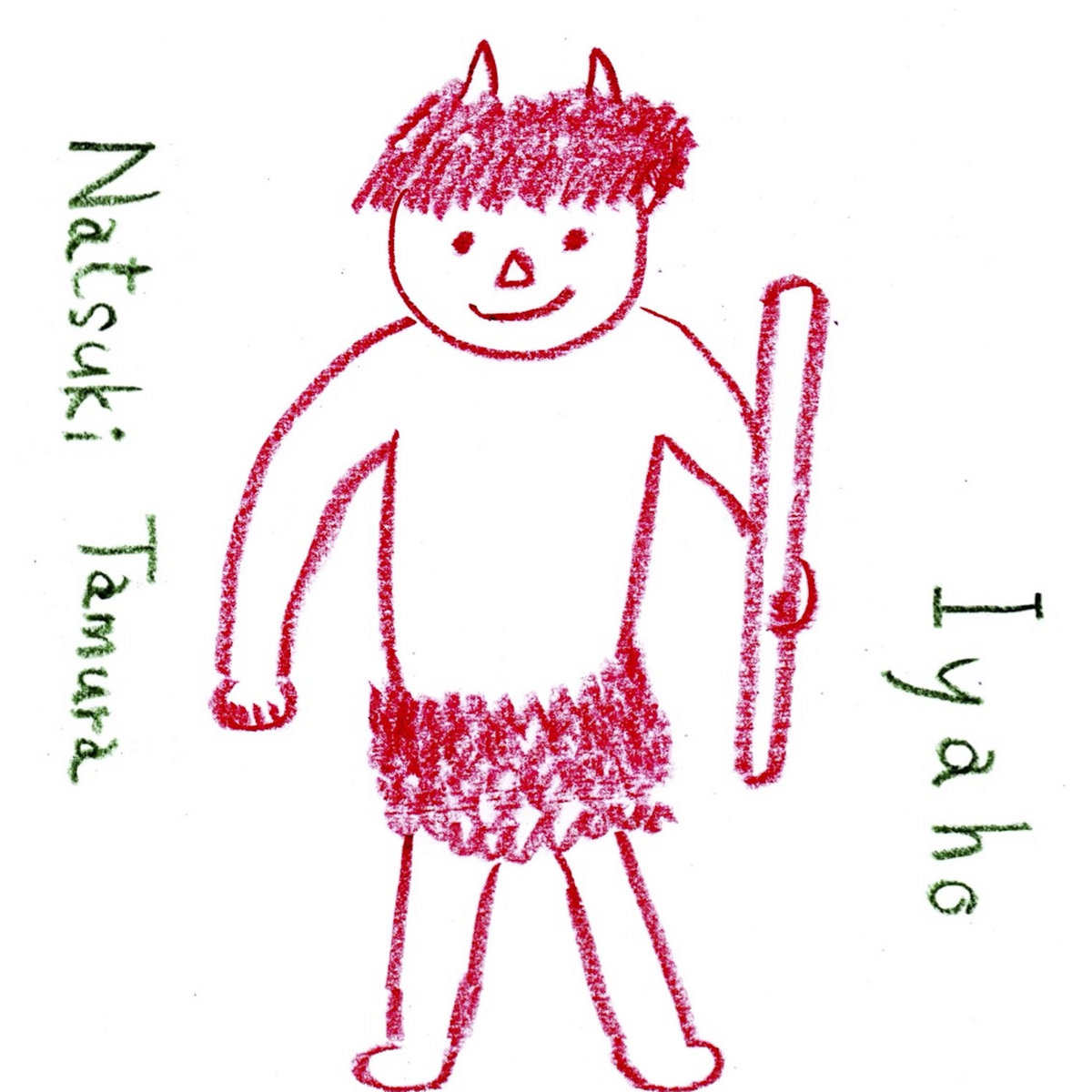
Natsuki Tamura - Iyaho (Libra, 2022)
Iyaho is the sixth solo album of Tamura but here his trumpet playing is
matched by two recent interests of his - playing and banging on kitchenware
- woks, pots and other cooking implements, as explored before on NABE KAMA
(Libra, 2021), and singing and chanting nonsensical syllables, in an amused
and even a comic imitation of a Buddhist priest or one that deciphered the
language of cats. Anyone who followed the discography of Fujii and Tamura
already knows about their love of cats.
The five pieces highlight Tamura’s sly musical imagination and his
eccentric sense of humor. The opening piece “Sagahogenaga” features
Tamura’s ceremonial chants, and sparse percussive sounds with familiar warm
and lyrical trumpet playing, as if he opens this journey with an enigmatic,
purifying ritual. The following “August Wok” is a dadaist, percussion piece
with only kitchenware, that explores their odd sonorities. Tamura invents
an ancient legend on “Mesahoji”, articulated with his trumpet and a voice
of an old storyteller. “August Tp” is the only solo trumpet piece, but
Tamura moans and sings through the muted trumpet, and on the last piece
“Karakara” he vocalizes like a strange bird seducing cats to a twisted
play.
Laura Altman, Monica Brooks, and Magda Mayas play two live environments for
clarinet, accordion, and piano on the 44’ back, before.
This is Great Waitress’ fourth record and a return to the Splitrec label
after their 2011 debut, Lucid.
Altman and Brooks also appear together on As Is
, Jason Kahn’s
Open Space
with Chris Abrahams, Matt Earle, Kahn, Rishin Singh, Adam Sussman, Aemon
Webb, and John Wilton, and the split
Surface Noise Vol. 8
from Shame File Music.
The reverberant performance space makes the air thick and heavy and quiet,
sporadic sounds in clusters and clouds ripple through for tensive
atmospheres. The accordion is a kind of bridge to keyboard and wind and
this spectrum of instrumental material manifests in their breadth of
approaches. Piano can sound more lamellophone than a harp’s rich decay,
accordion rattles and crumples, and clarinet chirps in tropical warbles for
discrete movements but can chime, sigh, and breathe in sustain together for
beating harmonic interactions. Texture becomes tethered to rhythm and
melody and harmony begin to feel the same at different scales. At every
level limen dissolve and their haze creates a sense of dream states.
From the flourishing Polish Jazz Scene, Marek Pospielszalski strikes again
- this time with an admirable quartet that can hardly ever escape the ear
accustomed to feeding itself with jazz.
With a concept inspired by some of the most prominent classical musicians,
as well as a reference to the great Renaissance painter Albrecht Dürer,
Pospielszalski drives us through a wonderful and buoyant journey with this
magical piece of work.
Starting with a 7-minute composition dedicated to the great Schubert, he guides us into a meditative state which serves as an opening into the
following travels. The album progresses with a spiraling sound of the saxophone, followed by
oblique drums (Max Andrzejewski) and bass (Max Mucha). It makes our minds
flow a contemplating stream of enjoyment where, later, the saxophone
is replaced by equally twirling piano sounds (Elias Stemeseder).
As the album progresses, we are taken into deeper and darker voids
made out of more aggressive sounds coming from the piano, but, at the same
time, more sensual ones arising from the saxophone.
Encompassing the true image of what jazz is - an improvisation of sounds, the album continues with a groovier movement so it can take us back to compositions that are heavily influenced by classical pieces, which are used for slamming us back into an otherworldly state of consciousness. It's a pure feeling of musical frequencies, which we succumb to, being driven by the caressing virtuous sounds of Pospielszalski’s tenor saxophone.
He closes it off with a pretty intense composition named "I am all that
remains." The rigidity of the track and the name itself explain the states
and moods that we got in by following through to the end of the album. It
can be described as if we are parting from our physical existence, being
left alone in a form made out of sounds, floating as free as a feather in
the mellifluous wind of melodies. The up-and-down mood of the whole album suggests a perspective of how life
should simply be. Its range varies from chaotic and improvised to
discernible as something composed by the best music laureates that have
ever existed.
In 40 minutes, Pospielszalski manages to take us through different
stairways across the universe, where at moments we think that we hear the
harmonies of the spheres, and in others, we just hear the earthly nature
communicating its magic to our ears through four distinct instruments.
The swinging Slovenian free jazz trio, TiTiTi, is Jure Boršič (alto
saxophone, clarinet), Jošt Drašler (double bass), and Vid Drašler (drums).
They are joined on the fourth track of this May 21, 2022 release, Štafelaj, by Tomislav Vrečar (with some compositionally-integrated
spoken word) and pianist, Marina Džukljev. The vocal recitation on track
four, Tisnikar, is somewhat reminiscent of Kurt Schwitters’ Ursonate in its character. This track is an outlier on the album
and is quite different from the other material.
This trio sounds as if they have a long history of working together. They
manage the integration of the compositional and improvisational elements
very well. There is a natural flow between composed and improvised material
and exacting coordination between the players during composed material. The
trio moves seamlessly between free improvisation, swinging in-time grooves,
and composed material, giving the album a constant sense of forward
development. Short repetitive melodies and unison rhythmic material give a
sense of structure in and around busy trio improvisations.
The six-track album clocks in at 38’18” minutes of music that is nicely
recorded, mixed, and mastered. It is available as a digital download and as
a Compact Disc with visually compelling artwork.
I was surprised to see that we had not reviewed these gems, but not
surprised to see that I was the one who’d promised to review them. Mea maxima culpa. There’s tons of music I’ve not reviewed this
year, but only these three have I been listening to with incessant
fascination. I think I have been reluctant to wrap my thoughts around them.
One of the joys of This Kind of Music is the way it can evoke things
without having to articulate them. Sometimes, in a review, I find myself
trying to articulate things, and thereby diminishing them. Perhaps I’m over
thinking this.
Nate Wooley - Ancient Songs of Burlap Heroes (Pyroclastic Records 2022)
Wooley sets his theme in the accompanying text. His own words:
This album is dedicated to those who recognize living as a heroic act:
the occupiers of sunup barstools; the cubicle-planted; the ghosts of
Greyhounds; the reasonably sketchy. A burlap hero is one who
marches—consciously or not—back to the sea in hopes of making no
splash, who understands and embraces the imperfection of being, and in
that way, stretches the definition of sainthood to fit.
Wooley and crew—himself, trumpet; Susan Alcorn pedal steel; Mary Halvorson,
guitar; Ryan Sawyer, drums; Trevor Dunn, bass on track 4; Mat Maneri, viola
track 2—present us with what I’m interpreting as three movements. These are
punctuated (beginning, middle, and end) with transitions named as extended
ellipses (……………), or they could be many many periods.
Wooley celebrates quotidian heroism as Homeric. Beginning and ending at the
sea, with a “catastrophic legend” at the center. This is earnest music,
without an ounce of irony, evoking the sea in all of its dark, menacing,
comforting, brooding power. The structure of the legend is such that the
voices build slowly, layering chronically, and finally break loose.
Wooley’s trumpet is anthemically clear at points. Halvorson and Alcorn are
uncannily good, woven throughout like indispensable threads.
Julie Tippetts and Martin Archer - Illusion (Discus 2022)
Every track on this long two CD set is immediately discernible as great and
engaging, but the sprawling majesty of the two suites is something that
reveals itself over ime. In those moments when I stop thinking
about what I want to listen to, and start feelingbehaving what I
want to listen to I have been reaching for Illusion.
There’s an abundant creativity to the lyricism, here. So many ideas come
out so effortlessly. It’s like a Jack Kirby drawing, bursting with intrigue
and spectacle. Everything Tippetts is great at is encompassed here, couched
in British free jazz progressive music, art song, aleatoric music,
electronica, and the sort of singer/songwriter eccentricity that led to
Joni Mitchell or Robin Holcomb. Tippett’s, among other things, is an
extraordinarily facile vocalist.
“Circle of Whispers” is a set of contrasting smaller pieces, illuminating
each other in relief. “Illusion” is a genuine suite, seven parts of
continuous music. The ensembles are recombinated into various small groups,
and the overall structure is guided by chance procedures. The mixture of
intent and emergence is striking.
Mike Formanek is the kind of the freebop hard swinging, hip walking, “goin’
down the street and passing out wolf tickets” kind of bass line, and I
don’t even know if it’s close. That’s the vibe this disc starts on, and it
proceeds as it begins. If there’s a story here, it’s kind of dark and also
funny.
Thumbscrew is Formanek, Mary Halvorson (guitar), and Tomas Fujiwara (drums,
vibes). They ran into each other by accident seven albums ago and have been
a genuinely cooperative trio ever since. They share composing duties, and
cover a wide repertoire of “others” work. 2020’s Anthony Braxton Project pretty much destroyed me. The shifting
relationships and pairings mean every player is rhythm and lead, in turns
and simultaneously.
Multicolored Midnight
features eleven originals, varying levels of composition and improvisation.
Mary Halvorson’s guitar again shines. Between this and the Nate Wooley I
just talked about—and every other thing she’s done this year—would make her
my free jazz MVP, if we had such a thing. Fuliwara’s drums are fleet and
unexpected, but his vibes really stick out, for me. I’m actually obsessed
with his vibes.
When musicians go solo, their space expands and they confront (among
other things) the choice to fill it with torrential sounds or to build
architectural sounds that (hopefully) will make that space meaningful. This
is the case of Filippo Abrate's solo percussion work, which is the first
release of a new-born label MUPE (created by Filippo Abrate and the upright
bass player Marco Bellafiore ). Young musicians at work trying to develop
their global idea of music: something worth of our interest.
When declaring his influences in the field of solo recording Filippo Abrate
mentions Keith Jarrett’s Vienna Concert and Paul Bley’s Open to Love for their use of space and narrative tension they
create; and use of space and narrative tension are building blocks in the
making of this work.
Warm to Become
is made of five pieces that use different compositional approaches: two
composed pieces (Bright eyes, pure heart andspirit, spirit, spirit), two pure improvisations ( improvisation n.5 and Night Dance) and an image-guided
improvisation (ancient cerimony-spusyn ) which makes up
the soundtrack for the not-yet-released short film Masquerade by
Raffella Tomellini.
Often, the sounds seem to come from a distance, soft, allusive with a
pictorial quality that is well represented by the cover of the CD. At the
same time, particularly when the drums prevail, the sounds show a proximity
that creates a narrative flow, a word-like consistency.
The author says: “[in the composed pieces] I choose in advance the
materials I want to analyze in an abstract way as if they were colours,
than I try to connect them in an intense and coherent way”
Bright Eyes, Pure Heart
and Spirit, Spirit, Spirit share the same three parts structure
and both exhibit a story-telling attitude in which the different sections
create contrasts and continuities that accompany the listener to the heart
of the matter.
In Ancient Cerimony-Spusyn the evocative side prevails
with gongs, harmonic sounds and a sense of distance. It would be
interesting to see it coupled with the images it refers to.
The two free improvisations, improvisation n.5 and Night Dance, go into an explorations of the different
possibilities that the raw material of percussions offer: wood, metal, skin
spaced in a rhythmic dialogue with silence.
So in conclusion what we have is the debut solo work of a young musician
that exhibits an excellent control of his materials and shows ideas
pointing to interesting directions but, above all, it offers us good music
to listen to.
“The spiky unabashed electric eclecticism of the guitar, and my own
skew-whiff, bomb-dropping bashing, will defuse any neo-bebop comparisons.
But it is there; the spirit of jazz invades, pervades, infects and
delineates. It might not be what the purists want. But purists of all
persuasions (aesthetic or political) inevitably opt for the
‘all-or-nothing’ option. And although content (and complacent) in their
pose, they reject possibility.”
So writes Eddie Prévost in the trenchant liner
essay accompanying Under the Sun, a text that so effectively
describes the current musical circumstance and its historical relations
(and vice versa) that I would rather quote it than struggle to summarize so
acute a vision, so well expressed. It might well be argued that urgency is
the defining quality of much great jazz, holding together though pitched at
the point of flying apart, whether it’s Charlie Parker, Ornette Coleman or
John Coltrane (there’s also a corresponding calm that speaks to the dream
world, a kind of expansive meditation, in Prévost’s case, the music of AMM for which he‘s
best known).
Here, in concert at Iklectik in September 2021, he is solidly on the jazz
side of his musical activity, behind a standard kit, kicking the music
forward with (upright) bass drum bombs , in superb company conventionally
arranged around a bass (Olie Brice’s), a chordal (or, rather, poly-vocal)
instrument (N.O. Moore’s guitar) and a horn (Rachel Musson’s tenor
saxophone). There are two pieces here, each an extended free dialogue, the
opening “Stealing the Final Arrow” (23:37) and the expansive “Scaring the
Sun-eaters Away (alluding to ancient Chinese sun myths)” (45:12).
Musson is a central presence, a forceful tenor player in a grand tradition
who can focus attention with passages that might consist largely of
shifting multiphonic blasts or cascading, hard-edged lines. Brice is
sufficiently adept that he can give the appearance of securing a line in a
field in which security is sometimes illusory. Moore has a quicksilver
musical imagination, enlarging whatever musical space he finds himself in.
Here his presence contributes mightily to these four-way conversations,
further knitting together all the parts in the ensemble, particularly close
in his role to the similarly polyphonic Prévost. Everyone in the quartet is
clearly there, even when only one or two musicians are playing
audibly.
“Stealing the Final Arrow” begins with every voice, Musson’s big-toned
tenor constructing continuity with a series of assertive blasts and micro
phrases, with Brice contributing some of the spikiest pizzicato this
listener has ever heard. Phases arise conversationally, with an underlying
momentum—a lyrical duet of tenor and bass, a free jazz quartet passage of
galvanizing intensity, a storm of drums, a rapid guitar solo that turns
into a duet with bass…shifts and evolutions range from organic to
startling, sually arise naturally, with full quartet passages possessing
enough form – Musson’s melodic and motivic aspects often the source – to
feel (just momentarily) composed before the fully collective distribution
of invention arises.
“Scaring the Sun-Eaters Away” begins with extreme delicacy, Musson playing
alone, sometimes touching on sounds that are sublimely close to silence.
Moore enters on the cusp of inaudibility, his notes pitched somehow between
string harmonics and glassy electronica as Musson exits; then Brice makes
it a string duet before Prevost’s tumultuous entry, then the voices drop
away to leave Moore weaving a complex line of his own, until Musson and
Brice re-enter and Moore suddenly accelerates to a rapid electronic burble.
That’s roughly the first nine minutes and the piece maintains interest for
the next 36’.
There may still be musicians who approach the free jazz idiom from the
right, gingerly loosening a stale-dated idiom. With Prévost and company,
the approach is from the left (also from below, above, before and after).
The questions asked might be formed as, “How do we grow our idiom, how do
we assure the simultaneity of free association, complementarity and forward
movement?” A speculative response? By individually alternating elements as
quickly as possible; by suspending empathy, curious if it grows with
inattention; by posing elements not noticed in the other three players’
lines; or by doing all of these things at once, inattentively arguing
forward to the possibility of presence. The goal, its form unknown, might
be just beyond the next passage.