Click here to [close]
Showing posts sorted by date for query echtzeit@30. Sort by relevance Show all posts

Sunday, December 3, 2023

Ignaz Schick - Sunday Interview

Ignaz Schick - Photo by Nuno Martins

  1. What is your greatest joy in improvised music?

    There are different joy moments, one definitely is when your primal intuition proves to be right. This can be the idea for a line-up, or a musical/material decision you make while playing. In both line-up and material and in improvisation generally speaking we take risks. Like does it really work if I put player A and Player B together in a trio with myself. Then you go on stage, and it comes out exactly as you imagined, or different but even more beautiful than you expected. Similar for musical material, sometimes it is clear what the situation needs, but very often it is a very intuitive decision making process, and when this decisions work, it usually is a big moment of happiness and joy. Another level of course is when you find the new or unexpected. When you don’t expect anything and it just happens. When I found out for myself that objects vibrate and sound just beautifully when being played on and animated directly by holding them onto the rotating platter of a turntable, I found this magic toy by a pure random mistake, and a whole new cosmos of sounds opened up to me. This are the moments you look for! I still remember and I will never forget this exact instant, it was a revelation, this are moments of pure joy and they usually have a long lasting big impact on your work. This moments are rare and thus so valuable. And of course sharing music, with the colleagues while we make it, and with the audience and friends, for whom we make it ...


  2. What quality do you most admire in the musicians you perform with?

    The ability of (deep) listening, the ability to only play if the music asks for it, and the ability to play the right thing in whatever situation. Plus the curiosity for the unknown or unexpected and a general openness to whatever music or situation. For me it is always an amazing and magical moment if I play music with musicians from completely different styles or geographical/cultural background and when we come together and we find a way to communicate and play music together. This happened to me when playing with Mwata Bowden, with African musicians like Amine Mesnaoui, or recently on many occasions with musicians from Vietnam, Indonesia or India where many were from classical Indian background. Still we were able to play together and create something beautiful as we were all open and ready for it. Another feature I really admire is the type of musicians or improvisors, who really invest themselves, like in musical situations which are complicated or may it be just during a bad and difficult day. There is this type of players, who will lean back and say, oh, this won’t work, and they pull out and let the music fall down. But then there are this other players, who really invest and give everything, who will always try and never give up no matter how difficult the situation or constellation is. They really want to play the music, they want it to come out and unfold, they want to have a good time, so they will do everything to make it happen. I love this type of players. Paul Lovens was such a player, Burkhard Beins, Oliver Steidle and Ernst Bier as well. All of them are drummers, interesting, no? And I admire players who will surprise me, either with unexpected sounds, or crazy decisions, where you have to be on your toe all the time, you have to stay wake and alert and be ready for anything any time. Don Cherry was a master of this, also Charlemagne Palestine and Limpe Fuchs. And, there are this musicians, where you never need to worry, you just start to play, and they have this amazing skill of making you forget all technical issues, cause they are so accomplished, and at the same time generous, the music just comes out and you don’t have to think at all, almost like autopilot, you just let it flow...

  3. Which historical musician/composer do you admire the most?
    (see below, these two questions were inadvertently mixed together when the questions were sent out - FJB)

  4. If you could resurrect a musician to perform with, who would it be?

    From Jazz and my personal history and even though I played with him, Don Cherry of course. I was too young and not ready in those days when he asked to sit in with them. Now it would be super interesting and with what I do now to play with Don would be a dream. I think I could really challenge him now. I know his mindset would be wide open, he would be absolutely up for it, even the most crazy noise stuff, he would love it. With his immense openness he would completely understand and embrace what I am doing. He just lived too fast for me, in double triple tempo… From that period, maybe also Lester Bowie with his more abstract phases. I always loved his vocality and super beautiful extended sounds on trumpet. And another trumpeter, Bill Dixon !! But as I live in our time, it is more about catching up with all those amazing players who are all around now, especially the young ones, so many interesting musicians are around, it’s just wonderful! And from the living legends, one player who we wouldn’t need to resurrect: Wadada Leo Smith, that would be another dream!!

  5. What would you still like to achieve musically in your life?

    Oh, wow, big question. I have never been the person who wanted to play with famous people, or win one of those stupid prizes, like a Grammy, or those ridiculous jazz prizes. It seems some people need those to reassure that they have some importance, because it seems that their music is not enough (for them). I could have aimed for such career paths, but it would have also meant to compromise my music and ideas, to adapt to the business, and to those mafia type opinion makers, and this was never my scope. I am always trying to bring into life the music I hear in my inner ear. And it is quite crazy stuff, anti-career sound so to say ! I think I still want to write more music, and this music is dense, energetic, almost orchestral, weird and mystic stuff. A music full of unheard sounds. So right now I am working on building a community of musicians who a interested and ready to go this path with me, and the nice thing is, there are more and more colleagues who support me and my vision in a very loyal way, that is really a big gift for me. Plus I am building my own sound makers/objects/instruments to bring this sound out. I am not sure if I can achieve it with existing instruments. Partially maybe, but I need to go deeper to dig it out, … I am getting closer, but it is still along path.

  6. Are you interested in popular music and - if yes - what music/artist do you particularly like?

    Not really, I went into avantgarde music when I was 11/12 years old, and I always felt quite fulfilled in that zone. I don’t know much about Pop music, I do not really follow what is happening there, and if I get to hear stuff, it is quite random how it comes to my ears. I do like some of it sometimes, I think Prince was a genius, or I highly respect Michael Jackson for his music and performance. I am not interested in his Yellow Press trivia and scandals, but I think he was an amazing artist. I love James Brown, Funk, Soul and good HipHop. I really like it most when it is raw, pure, honest. And I like a lot of the old stuff from the 1960ies, the Beatles, some of the early Stones, Hendrix of course, The Who, … At the same time there is a lot of crap, especially since MTV came on, or this brainwashing Autotune stuff. I just can’t take it, it is like a big stinky rubbish dump, and as we are polluting and destroying our planet by exploiting it and not caring, we also get polluted in our brains by the consumerist mass media and what bullshit music they throw at us nowadays. So it has been really quite rare that I hear some really cool stuff that manages to pull me in. It is always very random, like Björk and Tricky back in the day worked for me, funny enough also Amy Winehouse. There might be a lot of great stuff I miss out on, but I do not follow Pop, I know nothing about it, seriously, it’s not my field, in another life hopefully, but not now, we only live once and I am still busy catching up with all those other histories of music ...

  7. If you could change one thing about yourself, what would it be?

    A lot of things, first thing talk less when I am amongst people, … Focus more on one thing maybe instead of doing so many things in parallel, … Hard to say, we are who we are, and I have learned not to worry so much anymore and to simply accept who I am. Feels not that bad eventually.

  8. Which of your albums are you most proud of?

    Perlonoid from Perlonex, It Aint Necessarily So from Perlonex & Charlemagne Palestine, my solo Rotary Perceptions, ILOG2, Now Is Forever, … It is hard to say, I am generally not so proud of my albums, they are (transition) documents of a long and painful process, but generally speaking recently I am quite ok and in peace with what I am doing. In composition I am slowly getting there. I enjoy to improvise with different folks and types of players. I love playing very physical solo vinyl sets, and I am usually having quite a blast playing saxophone with some well selected rhythms sections. So let’s see, hopefully soon there will be more albums that I can be proud of ...

  9. Once an album of yours is released, do you still listen to it? And how often?

    Not so often, but more for time reasons, so many new things are happening, maybe one day when I get older I hope I can re-listen everything.

    Some years ago a good friend and respected colleague of mine who I didn't know that well at the time played me different albums over a dinner and we talked about it. He wanted to hear my opinion, like in a blindfold test. I think I was highly critical about everything and so at some point he played me my own record, a duo with Andrea Neumann. I did not recognize it in the beginning, and I started analyzing and commenting. "Oh it’s this and that, like a drone, oh, interesting sound, ah, it is prepared piano, oh, it could be inside piano, oh, this sounds like Andrea Neumann. Damn, this is Andrea Neumann. No idea who the electronics person is, Oh, why did he do this, and that, oh, interesting how he decided to place this harsh noise." And then suddenly "Oh shit, that’s me, it is my own record with Andrea, I haven’t heard that in ages. Man, you really got me here." He smiled at me and we burst out in laughter.

  10. Which album (from any musician) have you listened to the most in your life?

    In no specific order:
    • Ornette Coleman – The Shape of Jazz to Come
    • Alber Ayler Quartet – Live in Hilversum
    • Don Cherry/Colin Walcott/Nana Vasconcelos – Codona 2
    • Don Cherry/Ed Blackwell - El Corazon
    • Old And New Dreams, all three albums on Black Saint and ECM
    • Abdullah Ibrahim – The Journey
    • Abdullah Ibrahim/Johnny Dyani – Echoes from Africa
    • Don Cherry – Complete Communion + Brown Rice
    • Art Ensemble of Chicago – Urban Bushmen
    • Archie Shepp & The New York Contemporary Five - this albums and a few others were spinning in nonstop autoreverse mode when I started getting into music in a serious way.

  11. What are you listening to at the moment?

    The music of the composers Pierluigi Billone, Jani Christou, Georg Friedirch Haas, Klaus Lang

    Plus various stacks of vinyls I bought recently including traditional music from Sudan, Africa, Tibet, Turkey, ...

    Stack 1 includes amongst others
    • Graham Moncur III – Evolution
    • Dewey Redman – Look For the Black Star
    • Dieb13 – synkleptie no 1044
    • Dollar Brand – Cape Town Fringe
    • Lester Bowie – Gittin' To Know Y’All
    • Field – Someone Talked
    • Wayne Horvitz-Butch Morris-Robert Previte – nine below zero
    • Zazou/Bikaye – Guilty!
    • Die Vögel Europas – Best Before
    • Senyawa – Alkisah
    • Don Cherry/Jean Schwarz with Michel Portal, J.F. Jenny-Clark & Nana Vasconcelos – Roundtrip (1977) Live at Théatre Récamier Paris
    • Alterations – My Favorite Animals
    • Dewey Redman/Ed Blackwell – Red and Black in Willisau
    • Austin Buckett – Grain Loops 1-30, 30 Works For Sandpaper and 4 Snare Drums
    • Mei Zhiyong – Live in Switzerland
    • The Scorpions & Said Abu Bakr – Jazz Jazz Jazz
    • Night and Day – Live 15.Juni 1984 „FIRST“ Nightclub ehemals FOFIS, Berlin
    • Otomo Yoshihide/Steve Beresford – Museum of Towing and Recovery

      … I hope you don’t wanna know what is in the other stacks ! :-o

  12. What artist outside music inspires you?

    So many, it is an endless list of visual artists, writers, film makers, better don’t get me started. Interests and attention constantly shift here luckily, … In the moment I am reading different books and texts by Roland Barthes about phenomenology, for study and analysis reasons. And I am re-checking the photography of Alfred Stieglitz and some others. Also I saw a beautiful documentary on Arte about Mark Rothko, just to name some ...


Ignaz Schick's music reviewed on the Free Jazz Blog:


Sunday, November 12, 2023

Olaf Rupp - Sunday Interview

Olaf Rupp Photo (c) Bogdan Edi Dimitriu

What is your greatest joy in improvised music?
I like the ephemeral character of improvisation. That means when it is happening it is really living music, really alive with all the marvels and pitfalls of the human mind. It is like talking with the others but without the talking. And when it is over, it is gone. There is silence and the room is not filled with stones that I have chiselled.

What quality do you most admire in the musicians you perform with?

Rudi Fischerlehner has found a wonderful way to bridge the gap between regular looping beats and free flowing pulse. It reminds me of the orbiting grooves that Björk once had on an App she published. Like multiple, circular layers of polymetric patterns. This gives the other players a lot of freedom to choose without breaking up the connection.

Ulrike Brand was the first (and only) classical player who came to me and asked me explicitly to play the electric guitar in duo with her on cello. Many are blinded by the cliché connotations of the Stratocaster (loud, wild, aggressive) and forget how wonderful these electric sounds go together especially with the cello.

Rudi Mahall has incredibly sharp ears and swift reaction. And I especially like his open mind. He is very much rooted in the Jazz-language, but we played for decades now in many different settings that were stylistically sometimes very far away from that and he always finds a natural way to contribute.

Which historical musician/composer do you admire the most? If you could resurrect a musician to perform with, who would it be?

Never ever in my life, not a single moment have I ever been bored. I don’t know what boredom is. When there is a moment with nothing to do, I just direct my mind to the music. It works like switching on a radio in my head. And this music is so wonderful! If only I could play this on my guitar!! Well, I do my best. But there is no time to look back too much. I am not a music-historian. I look forward and follow my vision. And I like very much to play with musicians younger than me. Because they very often also have a strong vision. Older musicians have a plan, a strategy, youngers have visions. My plans never work.

What would you still like to achieve musically in your life?
I would like to keep my music alive as long as possible.

Are you interested in popular music and - if yes - what music/artist do you particularly like

David Bowie, Björk, Double Nelson, This Mortal Coil, Sisters Of Mercy, Legendary Pink Dots, Blind Idiot God, Swans, Neu, Leonard Cohen, Jacques Brel, Lee Perry

You see I stopped buying records somewhere end of the eighties, when life got really, really tough. In recent popular music there are certainly interesting things, but I could not tell you names. I never was good at namedropping.

If you could change one thing about yourself, what would it be?

My “self” is not the part of me that I am worried about. Of course, it belongs to me like my bones and my veins and my fingernails. I have to deal with it every day. I wake up with it. Cannot help.  But it is a complex system. If you change one thing, you just move the balance on a boat and tilt it to the other side. Of course we all want to be stronger, more beautiful, more resilient, more whatever. But it is important to step back and take a wider and calmer look. Then it is not about change myself but rather change how I deal with myself. How I get along. Actually I'm not a big fan of the Stones, but there is some truth in “you get what you need”!


Which of your albums are you most proud of?

I am not proud of any of my albums. They were produced under very poor conditions. Often me doing the recording, mixing, mastering, layout and promotion all as well. And I am a very bad promoter. Once I am gone, nobody will find my albums. Maybe the Youtube-videos will keep crawling the internet on a dystopian planet.

LIFE SCIENCE was a big step ahead, with a real, helping label FMP. But I recorded it in one day in an abandoned building at Oranienburger Straße with a microphone directly into a CDr-recorder. All very rough and free falling.

MYOTIS MYOTIS is a wonderful album, but it is now completely ghosted by the curators. Well, not completely: SERIOUS SERIES have invited us to perform in December!


Once an album of yours is released, do you still listen to it? And how often?

Not often but sometimes it’s good to check again how it changes in time. Well, the album does not change but I do change.

Which album (from any musician) have you listened to the most in your life?

Joe Williamson, HOARD

David Sylvian, SECRETS OF THE BEEHIVE

György Ligeti, ATMOSPHERES

Cecil Taylor, ERZULIE MAKETH SCENT


What are you listening to at the moment?

Arvo Pärt, DA PACEM


Olaf Rupp reviewed on the Free Jazz Blog


Wednesday, December 22, 2021

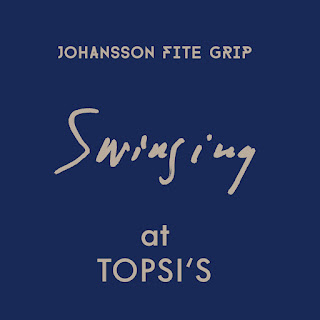
Johansson/Fite/Grip - Swinging at Topsi’s (Astral Spirits, 2021) ****½

This fantastic new release is from the multi-generational trio of Joel Grip (double bass), Niklas Fite (guitar), and our hero Sven-Ã…ke Johansson (percussion and vocals) and it’s one of the best guitar trio performances I’ve heard in the last decade. The album is just filthy with great ideas that spring from their decisive improvisations, and the trio masterfully keep their clean strings/skins tone just to the left of jagged, which gives the listening experience some grit (i.e. it does indeed swing). Johansson and Grip are regular collaborators and one of my favorite combos. A few favorites from the duo are their Neuköllner Modelle and Zyklus releases with Bertrand Denzler (and Alex von Schlippenbach on one volume of the former) as well as a smoking release with Sten Sandell last year, there are others but I’ll leave it to you to hunt them down. Niklas Fite is brand spanking new to this reviewer, and I’ve really enjoyed getting up-to-speed on the young musicians work via his Bandcamp page, where you can find two more terrific 2021 releases to satiate those thirsty ear holes (two duos, one with pianist Margaux Oswald and one with drummer Raymond Strid, both well worth your consideration). On Swinging at Topsi’s the trio braid strands of jazz’s past, present, and future, culminating in a delightful rope trick that warms like a holiday cordial. Prost!

Recorded at Berlin’s Au Topsi Pohl in September of 2020, the album opens with the aural knots and organic gnarl of “Set 2”, which is alternately probing and exhilarating. Grip whinnies and groans arco accompaniments around Johansson’s rich, skittering patterns as Fite slashes away at any remaining dead air. It’s a thick brew and when things get a little thin the trio toss more flour into their already lumpy gravy. Fite’s style of guitar playing nestles in nicely with those of Derek Bailey and John Russell (whose Mopomoso Fite has played in), though his approach is unique and it really does stand out for various reasons, some of which I’m still trying to put my finger on. His tendency to really get after his guitar with a tempered and satisfying physicality gives him a very broad and interesting dynamic range as it’s applied to his picking technique. This is illustrated thoroughly on the next track “Set 1” where his knotty playing is countered with the forward momentum of Johansson and Grip, the rough surfaces tumble together, smoothing and rounding until the interplay is like butter before pulling the tablecloth and changing course for coarse. This set sails on Grip’s supple low end thrum, which both supports and antagonizes Fite, across a landscape of Sven-Ã…ke’s tight rhythms and textures.

The album is finished off with a pair of standards, the Rodgers & Hart song “Isn’t It Romantic” - of which Ella Fitzgerald’s rendering is among my all-time favorites - and the Green & Hayman classic “Out of Nowhere” made famous by Bing Crosby. Johansson croons the pair over the easily assertive backing of Grip and Fite in his genuine and charming manner. A great way to cap off the album, as sometimes sweets like these sound even sweeter after a sustained focus on rougher textures, such as those of the set material. At 78 Sven-Ã…ke continues to produce some of the best stuff out there and is a terrific mentor to a younger generation of improvisers, working in fact with many of the musicians highlighted in the blog’s recent Echtzeit@30 series, so perhaps you could even consider this that, or vice versa. Topsi’s is a terrific record that tempers a heavy dose of wiry guitar trio energy with an earnest charm that makes it effortlessly engaging and will keep you coming back for more.

Wednesday, December 8, 2021

echtzeit@30: An outsider’s perspective of echtzeitmusik

Outside ausland.  ausland © tic / Friedel Kantaut
By Keith Prosk

I don’t remember when I first came across the term echtzeitmusik. I do remember the first recordings that I heard associated with it were Matthias Müller’s solo trombone and George Lewis & Splitter Orchester’s Creative Construction Set™. I found the cover design and solo instrumentation of the former alluring and then upon listening that its quiet, airy explorations opened new avenues to my ears in a similar way as another concurrent interest in Michel Doneda’s Anatomie des clefs from Potlatch, one of the labels that has been an advocate for this kind of music. In the latter, from another advocate in the Mikroton label, I found a network of musicians with analogous approaches across instrumentation to check out. But what is echtzeitmusik?

If anything I hope this week demonstrates the diversity of who and what might be associated with the term and likewise the diversity of the term’s meaning and utility to the practitioners associated with it but here I’ll offer an outsider’s perspective. It tends towards quieter dynamics but rarely contains hyperbolic silence. It often involves traditional western instruments though sometimes in electroacoustic scenarios and more often than not played with extended techniques. That’s where a common footprint in the sound result probably ends. It might find close cousins in other ‘reductionist’ terms like wandelweiser, onkyo, and lowercase though often the mechanisms and sound results associated with these terms are noticeably different. A context that it does seem to share with these other terms comes in its meaning, real-time music, which I interpret as a heightened awareness of music as an unfolding in relation to the contingencies of its time or, whether improvised, composed, or any blend of them, an environment in which performers listen to the sound they’ve sounded and respond to it. Finally, and in what is perhaps the central aspect, it is a Berlin-based network of people, many if not most of whom at any given time happen to be expatriates, that has so far existed in some form since the fall of the Berlin Wall and often works collectively (though trickily enough I would not lump in, say, the folks associated with the Berlin-based Harmonic Space Orchestra despite many similarities and overlap, perhaps because that group has a singular interest in just or rational intonation that is not necessarily shared among those associated with echtzeitmusik).

In its breadth the usefulness of the term is questionable, but there seems to be something distinguishable among its fuzzy lines and in that way it might be like jazz, something recognized rather than defined. And of likely interest to our readers is its common use of western traditional instruments in real-time responsiveness that might be heard as improvisation or something like it in even its more composed contexts. Indeed recordings from many players associated with the term frequently appear on the blog, from Burkhard Beins to Werner Dafeldecker to Axel Dörner to Robin Hayward to Magda Mayas to Olaf Rupp to Michael Thieke to Biliana Voutchkova to too many others to reasonably list. To a degree, we are always celebrating what might be called echtzeitmusik but for a few days we are using the 10th anniversary of the book, echtzeitmusik berlin: self-defining a scene , and the 20th anniversary of the website, echtzeitmusik.de, as an excuse to shine some special attention on it.

echtzeit@30: Q&A with Mia Dyberg

Mia Dyberg. (c) Cristina Marx/Photomusix

Explore Mia Dyberg’s site here . Recent releases include Wide Pointillism with Matthias Müller and Horizons with Kamilla Kovacs and Asger Thomsen.

What is echtzeitmusik to you? Is what might be considered echtzeitmusik connected through any approach, process, or sound result?

I don't think I can answer what echtzeitmusik is, I alone cannot determine this, but it could be looked as more of a collective experience. Besides, my answer would already be in the past. And present time music is something that happens the moment you listen to it?

One thing I can say is that the echtzeit calendar has been a great tool for me to find out if my colleagues were playing concerts I could go and hear and thereby be part of the audience-berlin-community. Or to tell about my gigs where my colleagues, or possible fans could see that I was playing. I am very grateful for this calendar!

It is a challenge to say something general about what echtzeit music is. But if I speak from the echtzeit calendar, you can think of it as an umbrella that collects all concerts in Berlin where some musicians associated with the scene have submitted their concerts.

Now, if I just try to improvise my answer, some different groupings/divisions pop up. But groupings that can be very different but still live under the same roof: the calendar.

Minimalist improv, experimental perfromatic, dadaist improv, fff free-jazz, composed free-jazz with improv elements and much more. Very different from each other. I guess the point is visibility and a way to meet other people. But inside the different groups you could have different approaches, collective improvisation or individual expression for example. But I guess there is a collective interest and curiosity that I cherish.

I like to relate it to the Hannah Arendt plurality-concept: that we become something in the eyes of each other. The Echtzeit audience and musicians exist in the eyes of each other. Being together in the same room and being something for other people has an even greater weight in these times of isolation and increasingly more people feeling alone.

Is there something material - like demographics, affordability, or cultural practices - about Berlin that you think makes such a scene possible?

Yes affordable prices. And the audience seems somehow more open and curious about the improvisation that is going on at the moment. The audience here is used to easy access to improvisation and seems educated in listening curiously.

In what ways do you think the scene has changed since your involvement and what might have caused these changes?

Joining Klub Demboh in 2017 and performing regularly every monday has somehow give me some roots and a stronger audience-connection.

In what ways has the scene changed you and your musical practice?

Now after 5,5 years in berlin I’m aiming even more for pure/precise improvisation.

Are there any recordings, labels, venues, musicians, or other participants you would like to shout out for cultivating the scene, or that you feel are essential to it? And is there a recording of you or your work that you feel is particularly representative of the scene?

Wide Pointilisme Matthias Müller/Mia Dyberg

What did you find in Berlin that you did not find in Denmark?

Space

- Interview conducted by Keith Prosk

echtzeit@30: Q&A with Eric Wong

Eric Wong. (c) Cristina Marx/Photomusix


Explore Eric Wong’s site here . Recent releases include Panomorph with Joseph Kudirka, Margareth Kammerer, Brett Thompson, Beat Keller, Wizard Ashdod, and Hannes Buder and Multiple Portables .

What is echtzeitmusik to you? Is what might be considered echtzeitmusik connected through any approach, process, or sound result?

I think the definition of echtzeitmusik branched out quite a bit over the years. From what I see it is a blend of musicians coming from different musical backgrounds working together within the broader sense of experimental music in Berlin, and usually with a certain degree of improvisation in the music, or sound.

Is there something material - like demographics, affordability, or cultural practices - about Berlin that you think makes such a scene possible?

The reputation of Berlin itself is already attracting a lot of musicians and artists to move or travel here, which is crucial to keep the scene vibrant. There is also a lot of support from institutions for artists who are based here as well as for venues. Also, when it is a norm to have such a large amount of great quality cultural activities, one gets more inspirations simply by getting involved.

In what ways has the scene changed you and your musical practice?

I am a better listener than before, and I play fewer notes.

What did you find in Berlin that was not in Hong Kong or the US?

I left the US more than a decade ago and I was more into indie rock back then, so I cannot compare the experimental music scene between Berlin and the US. To compare Berlin with Hong Kong, one of the most obvious differences is the amount of musicians and events. You wouldn’t see ten concerts of experimental music going on in the same evening for five days straight in Hong Kong, but it is common in Berlin, at least before COVID. For the same reason, you have more exchanges and collaborations in Berlin. Even if one mostly plays solo, there is a greater chance to meet someone who shares similar interests. Also, people are less judgmental here. 


- Interview conducted by Keith Prosk

echtzeit@30: Q&A with Emilio Gordoa

Emilio Gordoa. (c) Cristina Marx/Photomusix

Explore Emilio Gordoa’s site here . Recent releases include Kategorium with Piotr Damasiewicz and MOVE in MOERS with Achim Kaufmann, Adam Pultz Melbye, Dag Magnus Narvesen, and Harri Sjöström.

What is echtzeitmusik to you? Is what might be considered echtzeitmusik connected through any approach, process, or sound result?

Most of your questions could have multiple answers, it depends what we focus on, as there are multiple layers within that label attributed to the music scene in Berlin. For now I better skip the description of the type of music we are talking about, since it would be entering into another universe connected with other attributions and what is part and what is not. When I think of "echtzeitmusik" I think of time. Not necessarily in real time, but in the course of a decade since I arrived in Berlin and my position back then living the legacies of the previous decades (from early 90's). And of course, at that time I would refer to the "echtzeitmusik" scene as a type of music with a certain sound and approach. Nevertheless, this has changed as well as our times and surroundings... Today we look back and we can see generations with different approaches of very interesting musicians, we can find several publications, among others the today almost archaic book "echtzeitmusik berlin" (2011), we have an online calendar with the same name that lists up to date concerts of jazz and free jazz, contemporary music, experimental, noise, performances, minimalism, alternative pop, and more... What is echtzeitmusik?... Today it is a big family, in some cases segregated, with many creative members trying to survive.

Is there something material - like demographics, affordability, or cultural practices - about Berlin that you think makes such a scene possible?

This question would have had a different answer before the pandemic when mobility and the execution of cultural practices seemed to be the usual thing to do. So my answer probably has more connection with your next question.

In what ways do you think the scene has changed since your involvement and what might have caused these changes?

Although the cost of living in the city had already begun to rise exponentially, there was still a heterogenous and vibrant flow. Today I would not put the idealistic vision of accessibility and the possibilities of fostering the scene at all magnificent. I can observe two types of realities for musicians in the scene. Those who have established themselves by gaining a position in the German and European scene and who can enjoy the privilege of getting funding and being regularly invited to festivals and/or projects supported by institutions; and those who are just integrating and/or are not in the formal structures to gain capital from the artistic sector. For some of them booking a gig in one of the venues in Berlin for the door turned to be an achievement. I have the feeling that the underground I experienced 10 years ago is on the verge of extinction due to the rigidity of the rules and conditions of being able to offer live music in a venue. Things that in the past would not be so prevalent. However, not everything is a dark reality as this may sound. I see that rigidity brings new ways of manifesting and breaking and the new generations of people on the scene have that power. I am in between.

In what ways has the scene changed you and your musical practice?

Definitely in the way I listen and transform my skills and emotions into a community dialogue and in the transmission to the audience.

Are there any recordings, labels, venues, musicians, or other participants you would like to shout out for cultivating the scene, or that you feel are essential to it? And is there a recording of you or your work that you feel is particularly representative of the scene?

Oh yeah, right. There are countless examples... Many have probably been mentioned before. For me venues that are a strong part of my community are: Au Topsi Pohl, run by a musicians crew plus Veronica and Laura putting excellent wine and vibe in the bar; Sowieso, currently also run by a musicians collective - in both venues I play often but also voluntarily help doing the bar or the door, if needed; as well we find Petersburg Art Space, Kühlspot Social Club, KM28, LaborSonor, Ausland crew, Exploratorium Berlin among some others. Then there are also relatively new inputs from Field Notes - Initiative Neue Musik, Musikfonds e.V, who are constantly boosting the scene with promotion and opportunities. About a recording of mine that could be representative of the scene?... Well, lets listen to my early recordings with Ignaz Schick and Nicola L. Hein. This would represent the flow, energy and sounds I experience around 2015:

https://www.emiliogordoa.com/tagged/music/page/2

Not so far from each other but more actual would be my recordings from 2021 with sound artist, composer and long time integrant of the echtzeitmusik scene since Annette Krebs. Here a video excerpt:

https://www.youtube.com/watch?v=81rCTsiShnA

The a recorded album will be published soon on my little label WildSonico.

What did you find in Berlin that was not in Mexico?

A living history. The possibility of entering in a community without the need a long proofing process. The possibility of entering into an economic structure attributed to my own practice without compromising my musical anarchy. Bad Mexican food. Axel Dörner. 


- Interview conducted by Keith Prosk

echtzeit@30: Q&A with Carina Khorkhordina

Carina Khorkhordina (w/Hiroki Mano)(c) Cristina Marx/Photomusix

Explore Carina Khorkhordina’s site here . Recent releases include Carina Khorkhordina, Eric Bauer with Eric Bauer.

What is echtzeitmusik to you? Is what might be considered echtzeitmusik connected through any approach, process, or sound result?

To me echtzeitmusik represents a certain period of improvised music in Berlin in the 1990s–2000s, echoes of which we are still enjoying and witnessing. While most of the main protagonists (people I know best are Axel Dörner, Andrea Neumann, Burkhard Beins) are still around and they definitely can play excellent music in this “style,” or according to the logic they originally developed, mainly they're doing a lot of other things which aren't directly associated with the particular “sound” and aesthetic decisions of what ended up being defined as “echtzeitmusik.” I also have an impression that some of them are not particularly fond of the term “reductionism.”

Besides, we still have an echtzeitmusik calendar, which is listing a lot of improvised/new music/free jazz/experimental concerts in Berlin, which is very useful, especially if you don't want to rely on facebook to learn about the concerts.

Is there something material - like demographics, affordability, or cultural practices - about Berlin that you think makes such a scene possible?

When I arrived in Berlin in 2013 for a longer visit, I found it not so affordable at all! Aside from the music itself, the main attraction was definitely the openness of people, you could attend concerts and easily be included in the social environment. I mostly felt quite welcome, and people were curious about me. Yes, I also experienced hostility, but this was rather exceptions.

Initially I was attracted to Berlin as a listener, because there was so much going on. I was not playing music publicly at that time and had no ambitions to do so. Although I did attend some workshops and I played with friends in my hometown. The fact that I started playing concerts in 2017 is due to the community being so incredibly open. I got invited to play a concert with some musicians I admire (in the band I am now a member of: Klub Demboh), and there were more musicians that I really like in the audience. [These were still the golden days of Neu West Berlin on Kurfürstenstrasse right in the prostitution area. The guys running it were clearly doing illegal stuff and they also had an endorsement with Adidas for some reason, the main guy always wore new Adidas sneakers. Later they started stealing our door money because they were drug addicts. The electricity in the entire venue was cut off. Klub Demboh concerts moved eventually to Petersburg Art Space.] I was nervous but I managed not to ruin anything in that performance, and after this I kept being invited to play different small scale door gigs. Less than a year later I got my first official paid concert – exciting! So, still a big surprise to myself, I became a musician.

In what ways do you think the scene has changed since your involvement and what might have caused these changes?

This is difficult for me to judge. I heard an opinion, or a concern, that people might adjust their artistic (or curatorial) work a bit too much to fit the funding guidelines – and that affects the result. Not necessarily in a bad way. I may sometimes slightly sense that it's happening, but would not want to claim anything concrete. I hope people still do exactly what they want to do artistically. But I do not think that we are completely independent here, just playing our idealistic music. Everybody needs money to survive. Living is not getting cheaper. Finding a flat in Berlin is extremely hard nowadays, and if you manage to find it, it won't be cheap like what you hear from people with the old rent contracts.

Probably people still keep coming to Berlin because in the other places it is much worse.

Otherwise I think when I arrived, there was quite a heterogenous mixture of styles and approaches coexisting, and that whole mix is still constantly evolving and changing – people are coming and going, trying new things, venues are closing and the new ones are opening – with no fixed style or sound dominating.

Are there any recordings, labels, venues, musicians, or other participants you would like to shout out for cultivating the scene, or that you feel are essential to it? And is there a recording of you or your work that you feel is particularly representative of the scene?

One incredible organizer is Alexander Markvart. He is doing the programming at Petersburg Art Space and he was in Berlin since 2018, I think. He is also a fantastic musician with a very broad understanding of the music. Unfortunately the German authorities are not giving him an answer on his artist visa since 1,5 years despite many letters, invitations and paid concerts (for which he could not come). So he is at the moment in Russia but I find that he became essential for the Berlin scene.

My personally favorite venue is Au Topsi Pohl. Also this is the place where I was starting to play in the regular workshops run by Joel Grip and Tristan Honsinger. Another person who really supported me in the very beginning is Emilio Gordoa. I am very thankful for their generosity.

What did you find in Berlin that you did not find in Russia?

Musically: people are actually listening when you play together.

In Russia there is not that much exchange and live musical practice with other musicians who are maybe more experienced or coming from different cultures. Not so many Russian musicians are travelling outside of the country (it is difficult because of the visa and the costs). Also, at least in Kaliningrad, even among musicians often there is an attitude towards improvisation that it is not so serious, more like jamming, making noise.

On the political and personal levels, there is a lot I could say, but perhaps this is not directly connected to echtzeitmusik anymore. 


- Interview conducted by Keith Prosk

Tuesday, December 7, 2021

echtzeit@30: echtzeitmusik berlin: self-defining a scene


By Keith Prosk

The 2011 416-page book, echtzeitmusik berlin: self-defining a scene , whose 10th anniversary we are using as an excuse to feature the music associated with the term, is edited by Burkhard Beins, Christian Kesten, Gisela Nauck, and Andrea Neumann and contains chapters on the history of the scene, the diverse theoretical and practical approaches in it, and critical perspectives on it from the editors, Toshimaru Nakamura, Rhodri Davies, Annette Krebs, Robin Hayward, Ignaz Schick, Lucio Capece, Werner Dafeldecker, Axel Dörner, Olaf Rupp and dozens of other practitioners. If it illuminates any throughline beyond geography, it is the breadth of people, perspectives, approaches, sound practices, and sound results and a consequent uneasiness in using a single term, echtzeitmusik, to encapsulate it.

It also exhibits a heightened self-awareness throughout the network of people. Players approach their practices critically, asking questions of ethics, what it means, how it means, and its relation to the collective and other aspects of life with real effects on their methodologies and thus real effects on their sound results. The critical compendium of the book stems from a series of 2007 roundtables called Labor Diskurs which itself stems from a 2007 discussion list called 27 Questions for a Start… from Trio Sowari (Beins, Bertrand Denzler, Phil Durrant). Some of these questions are: to what degree is this kind of music experimental; to what degree is this kind of music improvised; can this music help to stop global warming; is it easier to play than not to play; is failure one of our main sources for progress; do we listen differently to an improvisation than to a composition; does a recording turn an open process into a completed piece of work; is it possible to have a non-hierarchical group interaction. Transcriptions ofLabor Diskurs and the full list of 27 Questions for a Start with context and responses from a few people each have their own chapter.

As much as anything in the sound result or real-time responsiveness or common denominator in methods or even the location of Berlin, this kind of constant critical questioning might characterize what can be called echtzeitmusik. While common across experimental music, maybe in the constellation of other things it helps to define it. It surely makes the music more interesting.

echtzeit@30: Q&A with Annette Krebs

Annette Krebs. (c) Cristina Marx/Photomusix

Explore Annette Krebs’ site here . Recent releases include Konstruktion#1 & 2 | Sah and Konstruktion#4 .

FJB: What is echtzeitmusik to you? Is what might be considered echtzeitmusik connected through any approach, process, or sound result?

Annette Krebs: I think that the term Echtzeitmusik, although it has established in recent years as a style, is still in transformation - at least I hope so.

Originally, we used the term Echtzeitmusik to describe a music genre whose protagonists have diverse backgrounds in music and art, for example, from the classical, jazz, punk or other music genres, or who have studied art and make their art musically audible. Echtzeitmusik is definitely characterized by the combination of various improvised and composed music techniques. It has a lot to do with sound research, adventurousness and musical interest in equal, non-hierarchical (p.e. decoratively arranged) connections of noises, sounds and tones.

I speak here of what I associate with real-time music for 20 years, although today the term may have changed or moved away from some of what I define here.

Is there something material - like demographics, affordability, or cultural practices - about Berlin that you think makes such a scene possible?

For a long time, it was easy to move to Berlin because the prices of apartments and the cost of living were not so high. The city had a lot of free spaces in the vacuum between the two systems of East and West. So, many artists and musicians could meet, work together and also find new spaces for music and art easily. Unfortunately, this has changed in recent years, but there is still a great fluctuation, the city is still inspiring because many interesting musicians and artists from all over the world come to play, live and work here.

In what ways do you think the scene has changed since your involvement and what might have caused these changes?

My preferred time was when the scene was not even called like that, when we started to invent our music and when we were still unknown. I liked the freedom, which was also due to this unknownness and the almost complete absence of money involved. We could develop music without compromise, without thinking about marketing or other capitalistic things. Sometimes five people played on a small stage for six people in the audience, and those six people listened very well and critically, but the music was intense, authentic and very thoughtful.

Today I don't know the scene as a whole so much, because it has become very big and diverse, with over a hundred participants. The term Echtzeitmusik is not clearly defined. This is good, but I'm afraid and observe a little bit that there may already be rules on how to perform Echtzeitmusik, and that you could get graded one day in Echtzeitmusik at music academies. Of course, that would be the opposite of the freedom of art.

Personally, I need the retreat into silence, and the intensive work with a few people, to find and elaborate music in a concentrated way. Therefore, I do not know exactly how the scene as a whole has changed.

Are there any recordings, labels, venues, musicians, or other participants you would like to shout out for cultivating the scene, or that you feel are essential to it? And is there a recording of you or your work that you feel is particularly representative of the scene?

I would not like to do that so happily. I don't believe so much in the artistic necessity of defining a scene, but rather in the creativity of many individual people who are then called this scene. All people are important. Therefore I would not like to shut out someone, or a special production as especially representative: everyone can find out for themselves what they find most inspiring. A lot of information and links are collected on the website “www.echtzeitmusik.de.”

What could ‘real-time’ mean in the context of echtzeitmusik?

It could mean “instant-composing-performing.”

But it does not necessarily have to. 


- Interview conducted by Keith Prosk

echtzeit@30: Q&A with Matthias Müller

Matthias Müller. (c) Cristina Marx/Photomusix

FJB: How did you get in touch with “Echtzeitmusik“?

Matthias Müller: I probably first came into contact with the term “Echtzeitmusik“ in 2004. That was the year I moved to Berlin, but it might have been even earlier, I don't really remember. At that time I was still more rooted in the jazz scene, even though my music already was a lot about free improvisation. I then came across alternative concert venues and series via the website www.echtzeitmusik.de, which already existed at the time. So I was able to make new contacts and immerse in an almost completely new musical world.

What does “Echtzeitmusik“ mean to you?

First of all, “Echtzeitmusik" is not a musical style - at least not anymore. When the term first appeared, which was probably in the mid-90s, it was, as far as I know, still intended as a definition of a certain form of improvisation - and above all to set itself apart from other terms like “free jazz“, “experimental music“, “new music“, and so on. It was a very reduced form of improvisation, therefore often referred to as reductionism. But since I wasn't on the ground then, I don't want to hold forth about it. What I do believe, however, is that reductionism still has a strong influence on the scene in Berlin today. Probably not in the same extreme form as back then, but definitely as a formal phenomenon. Today there is certainly much more diversity: new music, rock, noise, sound art, jazz of course, etc. One of the reasons is that the musicians often have completely diverse musical and cultural backgrounds. Today, that’s what “Echtzeitmusik“ means to me. It’s less a musical definition, it’s rather a collection of different forms of improvised music. Even if the spirit of reductionism still shines through until today.

In what way do you benefit from Echtzeit?

I’d rather say that I benefit from the Berlin scene, from the many different artistic personalities around me, from the people who have moved in from all over the world. I try to let myself be influenced by that and thereby sharpen my own profile. I go to concerts and try to play a lot with musicians of different generations, both with those who were already here in the 90s and with much younger ones who may have landed in Berlin for completely different reasons.

Has Echtzeit influenced your music?

Most definitely - if we talk about “Echtzeitmusik" coming out of reductionism. Maybe it’s not that recognisable in the music I make and publish today. But formal structures or the handling of silence and sound are absolutely present. As I said, I wasn’t in Berlin in the 90s, when this music had its heyday. I didn’t know anything about it at that time. I got to know most of it through recordings and later through direct contact with the “pioneers“. I played with many of them for the first time only when they had already stopped making reduced music.

What do you think could work better with the network?

I honestly never thought about "Echtzeitmusik" being a network before. There is a website where the current dates are listed as well as links to venues, etc. And this website is maintained by some people and always kept up to date, which is a great contribution. But the real, personal network is probably always the scene, friends, colleagues, etc. And not just in the city where you live. So from that point of view, I can't really answer your question about what could work better.

But your question is interesting because it actually points to something else! Namely, that the term “Echtzeitmusik“ seems to be pretty much attractive for many people! Many of us would perhaps say that they play “Echtzeitmusik“ without that term being explicitly defined.

To what extent do you think the scene has changed since you’ve got involved and what could be the reason for these changes?

The scene today is much more colorful, much more international, and probably less dogmatic. Of course, this has a lot to do with the changes in the city. Enormous numbers of musicians from all parts of the world have enriched the scene and given it new impulses, and in the last 20 years the scene has become much bigger. Berlin in the 90s and also at the beginning of the 2000s was a completely different city than today. This has had an impact on all areas and it’s been documented by all different fields of art and so - of course - by us as well.

Is what could be called “Echtzeitmusik“ connected by an approach, a process or a sound result?

Well, I don't know that either. The reduced - that is, “original - “Echtzeitmusik“ is still being made. But as I just said, the improvisation scene in Berlin is much more diverse now than it was 20 years ago. At that time, I think the desire to stand out from other forms of improvisation was much greater than it is today. Today, if you look at what concerts are listed on the website, there’s all kinds of stuff: jazz and impro, composed new music, etc. So there’s a wild mix going on. And from that point of view, I don’t think you can speak of a specific approach today.

Are there any recordings, labels, venues, musicians or other people involved that you would like to highlight because they have contributed a lot to the scene or that you consider essential to it?

One CD that was quite important for me is Barcelona Series by Andrea Neumann, Axel Dörner and Sven Ã…ke Johansson (Hat Hut Records, 2001). For me, it’s a record that exemplifies the musical development of the Berlin scene. Of course, I can also recommend the book Echtzeitmusik - Definition einer Szene (Wolke Verlag, 2011) and the accompanying 3-CD box set, published by Mikroton in 2012. Event series that still play an important role for “Echtzeitmusik“ today are “Labor Sonor“ and the “Biegungen“ at the “Ausland“ club, which have always existed, as it feels. Other important venues for Improvised Music in Berlin today are “Sowieso“, “KM28“ and “Au Topsi Pohl“.

Thank you for the interview, Matthias. 

- Interview conducted by Martin Schray

echtzeit@30: Q&A with Madga Mayas

Magda Mayas. (c) Cristina Marx/Photomusix

Explore Magda Mayas’ site here . Recent releases include Objects of Interest with Tina Douglas, Spoken / Unspoken with Miako Klein and Biliana Voutchkova, and Dinner Music with Chritoph Erb and Gerry Hemingway as well as a print-only volume of non-standard notations, Graphème , in collaboration with Tony Buck, Racha Gharbieh, Mazen Kerbaj, and Ute Wassermann and featuring additional work from Tomomi Adachi, Lotte Anker, Marina Cyrino, Tina Douglas, Phill Niblock, Jon Rose, and Nate Wooley.

What is echtzeitmusik to you? Is what might be considered echtzeitmusik connected through any approach, process, or sound result?

I think in the beginning Echtzeitmusik was very much associated with a reductionist approach, or a starting from scratch and opposing other present movements such as the (Berlin) Free Jazz scene. Many people still associate this with Echtzeit. I think the musicians who started using the label see it more as a phase in the beginning and that Echtzeit can encompass all experimental/improvised music approaches currently happening in Berlin - however, I think that defies the point of using a label in the first place. So personally I guess I would see it as an important and defining movement that happened in the past, which since then branched out into many different directions (along with or parallel to other movements and styles).

Is there something material - like demographics, affordability, or cultural practices - about Berlin that you think makes such a scene possible?

Affordability certainly played a big role for many decades, which drew artists into moving to Berlin. This is of course changing, like everywhere else. As a particular feature of the scene, I also experience the need to discuss and reflect on music/art among musicians and audiences, often right after a performance has happened, as well as warm support among artists, who frequently come and see each others concerts/performances and help each other out. There are still many venues, established and new/temporary ones, where one can try things out, even residency type performances, where artists are asked to curate a couple of days (see Autopsi Pohl) - I find that quite special and necessary. Pre Covid there were also many house concerts happening - meaning a relaxed setting in peoples living rooms and backyards, to experience music. I have organized many of those over many years together with Tony Buck, as have Andrea Neumann, Ute Wassermann, Mazen Kerbaj and many others. Of course, house concerts happen in other cities too though.

Are there any recordings, labels, venues, musicians, or other participants you would like to shout out for cultivating the scene, or that you feel are essential to it? And is there a recording of you or your work that you feel is particularly representative of the scene?

Venues: KM28, Autopsi Pohl and ausland are among my favourites.

There are so many musicians, hard to make suggestions so I will just mention musicians who moved relatively recently, who are shaping and changing the scene: Marina Cyrino, Mathias Koole, Tony Elieh.

My duo Spill, with Tony Buck, started here in 2002. We released 4 recordings.

As smallest functional unit organized Graphème, I imagine you saw a variety of compositions from across the world and I wonder if you recognized any throughlines or even tenuous similarities in compositions or notations from the Berlin scene.

In the first edition we specifically did not include Berlin composers (other than ourselves), as we wanted to introduce the project as an international publication. Of course it being a first edition we also introduced our own work, all living in Berlin and being part of the scene here. I don’t think our 4 scores (Kerbaj, Wassermann, Buck, Mayas) are similar - quite the opposite. And I guess that’s also a problem with using labels such as Echtzeit - if it is supposed to include the totality of experimental/improvised music in Berlin it becomes a redundant label - unless all its meant to be is to represent diversity. One issue with this project was to bridge composed and improvised music scenes, which partly already happens in Berlin, however, one can still feel cultural and financial divisions.


- Interview conducted by Keith Prosk

echtzeit@30: Q&A with Sabine Vogel

Sabine Vogel. (c) Cristina Marx/Photomusix

Explore Sabine Vogel’s site here . Recent releases include BOGONG DAM and the ending of isolated . connected .

FJB: What is echtzeitmusik to you? Is what might be considered echtzeitmusik connected through any approach, process, or sound result?

Sabine Vogel: Difficult question as there is so much going on under the “label” Echtzeitmusik and I am not really a fan of putting music into boxes and label it. I’d say Echtzeitmusik means to experiment with sound in different kind of genre, it can be noise, songs, tunings etc.

Is there something material - like demographics, affordability, or cultural practices - about Berlin that you think makes such a scene possible?

Berlin was for years much cheaper than other cities and it was possible to find places to rent. There were a lot of small clubs to play. This attracted musicians from all over the world, which then made Berlin even more attractive.

You couldn’t make much money, but life was not so expensive. This changed quite a while ago.

In what ways do you think the scene has changed since your involvement and what might have caused these changes?

I came to Berlin in 1999/2000 and the city was so vivid and exciting for me. As I wrote above - all these clubs, the people from all over the world and so on. You could go every night to a concert and get a lot of input. And you could meet every day somebody and play and experiment with ideas.

In what ways has the scene changed you and your musical practice?

When I came to Berlin I was very fascinated by the now so called Berlin Reductionism and how silence and quietness can open a huge space. My playing then was definitive influenced by this. Although I studied Jazz, I never really fell “at home” improvising over changes, I preferred playing more free and experimenting with sounds. When I came to Berlin - I grew up in the Munich area and studied in Linz, Austria - it felt like that there is finally the music I was searching for. I then played for a while in a duo with Tony Buck and worked with Michael Thieke, Alessandro [Bosetti] and Michael Griener in the quartet SCHWIMMER and with this group I had my first CD release (creative sources). I worked a lot with field recordings (which was also a logical step for me after working as a sound designer in a video production company in Munich, where I often recorded my own sounds instead of using their sound library). I then just followed this path with music and nature and now do a lot of work outside or work which is inspired by working outside in the fields. Besides this I became, from the very beginning, a member of the Splitter Orchester, which was founded in 2010 by Clare Cooper, Clayton Thomas and Gregor Hotz. We had intense working periods with exercises and worked with composers such as Matthias Spahlinger and George Lewis. It is hard to answer if “the scene changed me and my musical practice” as I feel like I followed my path and yes, this is always influenced or - better said - inspired through the projects and encounters I have. I wouldn’t say that this is necessarily just the “scene.”

Are there any recordings, labels, venues, musicians, or other participants you would like to shout out for cultivating the scene, or that you feel are essential to it? And is there a recording of you or your work that you feel is particularly representative of the scene?

There are so many: Andrea Neumann, Magda Mayas, Annette Krebs, Tony Buck, Robin Hayward, Burkhard Beins, Axel Dörner, Ute Wassermann…. You know all these names and again hard to pick some, there are so many, it’s everybody who is engaged and playing.

Just mentioning two Berlin labels, which sadly does not exist anymore: Schaum and Absinth records.

An important recording for me back in the early 2000 were - as already mentioned - SCHWIMMER on creative sources, but also my release with kopfüberwelle (a duo with Chris Abrahams on pipe organ) on Absinth records in 2012 and for sure my release ‘luv’ and ‘kopfüberwelle’ live in Sydney on the label Another Timbre of the Berlin Split series. As I do a lot of outside work, also often connected with video, my work lately is often published as online releases.

There were many venues, which popped up and disappeared, but some still exist like AUSLAND and KuLe, that still hosts the concert series Labor Sonor since many many years. 


- Interview conducted by Keith Prosk

Monday, December 6, 2021

Echtzeit@30: Introduction

Berlin, through the trees. (c) Paul Acquaro

echtzeit musik - Day 1


When the question was posed to the folks in the Free Jazz Collective, who would like to join in on a tribute to the echtzeit musik scene in Berlin, the main question was "what is the echtzeit scene"? Funnily, that was a similar answer to some that we received from several of the musicians who comprise the scene itself. It turns out, it is not the worst description of it either, as putting one's finger on it and tracing its contours has not been a straightforward endeavor. Yet it exists ... right? 

Well, we say na klar!, we think it does! "Real-time music", the English translation of "echtzeit musik" seems to have a trail of evidence. For example, we have the invaluable echtzeit musik web site, which is the go-to site to know what is happening with avant and experimental music and where in Berlin it can be found. Then, there are the venues, like the mainstays Ausland, Soweiso, Petersburg Art Space, Au TopsiKM28, Kuehlspot, and several others. Plus, there is the history, going back, as electronics artist and saxophonist Iganz Schick points out in his interview here, to the fall of the Berlin Wall in 1991.

Anyway, as elusive or as present as it is ... in real time ... the next few days on the Free Jazz Blog we pay a tribute, on its 30th anniversary, to the ever changing and evolving experimental music emanating from the ever changing and evolving city that it has sprung from.

Today, we offer a link to some very recent video discussions that were held at the non-profit art-space exploratorium berlin commemorating, discussing, defining the scene, and we have culled an overview of recent reviews that have been posted on the Free Jazz Blog that are from musicians connected to it. We are also presenting Q&A's that we have conducted over the past month with artists from across the scenes lifespan, starting with founding members Burkhard Beins, Robin Hayward, Ignaz Schick, and Olaf Rupp. 

It is important to acknowledge that this is not a comprehensive list or feature. We would not really know where to start - or more importantly - end with getting to everyone involved. We do have many more folks that we would love to reach out to and hear back from, and maybe we can. If you have suggestions, people we should talk to, suggestions and ideas, let us know. Also, a couple of words of thanks: Keith Prosk was instrumental in developing and shaping the feature, as well as making connections and reviewing albums. Martin Schray and Eyal Hareuveni assisted with Q&As and reviews, and Cristina Marx lent us her fantastic photography.


- Paul Acquaro

And so it begins ... 

echtzeitmusik-related recordings previously reviewed by The Free Jazz Collective in 2021

Lucio Capece & Ben Vida - Unwelt (Bocian, 2020)
Read our review here .
https://bocian.bandcamp.com/album/umwelt

Cranes - Formation < Deviation (Relative Pitch Records, 2021)
Read our review here .
https://matthiasmueller.bandcamp.com/album/formation-deviation

Achim Kaufmann & Ignaz Schick - Altered Alchemy (Zarek, 2021)
Read our review here .
https://zarekberlin.bandcamp.com/album/altered-alchemy

Daniel Lercher, Sabine Vogel - Bogong Dam (self-released, 2021)
Read our review here .
https://sabinevogel.bandcamp.com/track/bogong-dam

Magda Mayas - Confluence (Relative Pitch Records, 2021)
Read our review here .
https://magdamayas.bandcamp.com/album/magda-mayas-filamental-confluence

Microtub - Sonic Drift (Sofa, 2021)
Read our review here .
https://robinhayward2.bandcamp.com/album/sonic-drift

Olaf Rupp - NOBEACH (Audiosemantics, 2020)
Read our review here .
https://audiosemantics.bandcamp.com/album/nobeach

Olaf Rupp - Nowhere Near (Audiosemantics, 2021)
Read our review here .
https://audiosemantics.bandcamp.com/album/nowhere-near

Schick/Steidle - ILOG2 (Zarek, 2021)
Read our review here .
https://zarekberlin.bandcamp.com/album/ilog2

Schmoliner/Melbye/Gordoa - GRIFF (Inexhaustible Editions, 2020)
Read our review here .
https://inexhaustibleeditions.bandcamp.com/album/griff

Superimpose - With (Inexhaustible Editions, 2021)
Read our review here .
https://inexhaustibleeditions.bandcamp.com/album/with-john-butcher-sofia-jernberg-nate-wooley

Biliana Voutchkova - Seeds of Songs (Takuroku, 2021)
Read our review here .
https://bilianavoutchkova.bandcamp.com/album/seeds-of-songs

---

Video

In this video, moderated by Mathias Maschat, Alexander Markvart, Rieko Okuda, Ignaz Schick und Alexander von Schlippenbach discuss the generations of experimental musicians in Berlin. It serves as  a nice introduction to the echtzeit musik scene. More can be found on the exploratorium's YouTube channel.


Please check out the Q&A's off the site's main page, or by clicking on the "echtzeit@30" tag.